SUBSCRIBE TO OUR FREE NEWSLETTER
Daily news & progressive opinion—funded by the people, not the corporations—delivered straight to your inbox.
5
#000000
#FFFFFF
To donate by check, phone, or other method, see our More Ways to Give page.
Daily news & progressive opinion—funded by the people, not the corporations—delivered straight to your inbox.
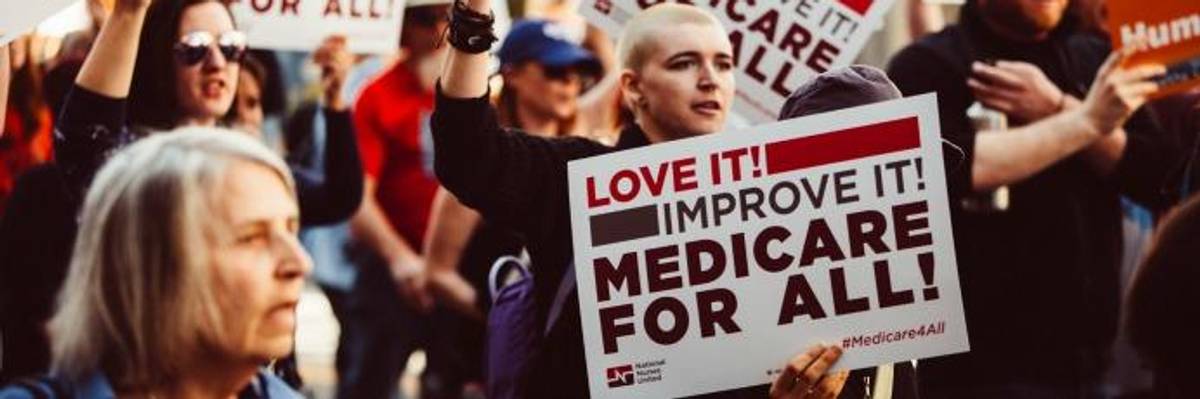
Ultimately, Lighty explains, progressives clamoring for a truly humane and more cost-effective healthcare system are badly served by shallow political advice from the likes of Paul Krugman, who argued this week that single-payer is simply too steep a hill to climb. (Photo: Molly Adams/flickr/cc)
With the explosive growth of the movement for single payer healthcare, it should not be a surprise to see the Empire Strike Back.
In the name of political reality, some liberal pundits, politicians and policy wonks are scolding progressives to give up on Medicare for All. There are many ways to achieve "universal coverage," we're told. "Overhauling" the entire system is too hard, healthcare is too big a part of the economy, and politicians will not take out the health insurance companies.
"Our health is not a commodity--it doesn't belong in the "market"--it is a human right."
Yet, the alternative approaches to reform pose the same political problems: the insurance industry is likely to fight the elimination of their profits (Dutch and German health insurers, for example, are non-profit), and the severe reductions in executive compensation, elimination of shareholder dividends, and rate setting, all of which go away under European-style health insurance. The benefits and rates are government mandated, the companies are essentially payment administrators.
Either this regulated system of private health plans lowers prices through government--by setting rates and negotiations--or it fails to do so and costs shift to individuals. But it is still the government role as rate setter/price negotiator that matters. Wouldn't it be more straightforward and simpler to improve and expand Medicare?
Still, the pundits say it's best to search for incremental reform of the insurance-based system, and live (or not!) with the results. In other words, the best health reform we can do is a version of what we have. Worse, it props up and reinforces a profit-focused system that is antithetical to the very concept of healing. Advocates of Medicare for all, and other non-reformist reforms, are looking to solve problems immediately, not accommodating the status quo.
Progressives are badly served by shallow political advice from the likes of Paul Krugman. It obscures the reality working people actually face and undermines the fight for our values and program.
Our health is not a commodity--it doesn't belong in the "market"--it is a human right. Those who advise us to settle for models of national health systems in other countries are missing the fundamental difference from the broken U.S. scheme. What Australia, the Netherlands and Switzerland all have in common is they do not conflate "coverage" with healthcare. Those countries guarantee healthcare.
Having health insurance in America doesn't prevent medical bankruptcy or denied care. In the U.S., employer based healthcare creates great uncertainty for workers, as premiums and out of pocket costs increase, reflecting costs shifted from the company to workers to fund the profits of the insurance companies.
"Why would we try to buttress a system that is failing workers, hurting business, and shrinking?"
Only 55 percent of employers offer coverage. Why would we try to buttress a system that is failing workers, hurting business, and shrinking? From 60 to 70 percent of healthcare spending comes from taxes. We're just not getting our monies worth. We are wasting 20 cents on the dollar when we pay for private health insurance, wasting huge resources that could go to higher wages, child care, and pensions.
Alternatively, single payer is the reform that establishes health security and enables greater equality and freedom--values worth fighting for.
Ironically, healthcare reform efforts have sought to "improve and expand" every element of the present system, except the program that is popular and works best: Medicare. The Clintons tried to expand HMOs, Obama expanded private health insurance and Medicaid, the GOP tried to expand "individual purchase," so we'd all be on our own when dealing with insurance companies, drug companies and hospital corporations.
It is precisely profit-focused healthcare industry that has caused the problems of escalating costs and restricted access. Rising premiums pay for rising prescription drug costs, which hospital corporations pass on to patients and drive up their own rates as they leverage their market share. As a result, each sector's revenues and profits increase. The industry imperative of revenue and profits has replaced caregiving as the basis of healthcare in the US (see Elizabeth Rosenthal's book, "American Sickness.")
We are not "starting from scratch," as Krugman contends (which he did not in 2005) but instead there exists a model in the U.S. for how single-payer financing could work: Medicare--which if improved and expanded to all--could confront the industry, contain prices and restore the values of caring, compassion and community to our healthcare system.
"The inherently wasteful insurance company bureaucracy doesn't go away when everybody has to buy one of their health plans."
Alternative approaches to universal coverage (though even with the Affordable Care Act, 28 million people remain uninsured) depend on using huge tax subsidies to enable individuals and businesses to buy insurance coverage. Without those subsidies--in California alone they amount to over $100 billion--health insurance is a failed business model. Taxpayers prop up the insurers profits for the honor of paying $2000 in deductibles and potentially under the ACA over 9.5 percent of our income in out of pocket costs. In California, this means 15 million people are uninsured or underinsured.
Truly controlling costs requires eliminating the waste and inefficiency of the private payers - Medicare administrations are cost 4-5 percent compared to up to 12 percent for insurance companies (before profits). The inherently wasteful insurance company bureaucracy doesn't go away when everybody has to buy one of their health plans.
Ultimately, what we must face is an issue of power. Can we collectively organize a healthcare system without the imperatives of revenue and profit? Only if we build a movement for health justice that demands guaranteed healthcare for all as a human right. Only collectively through government do we as a society have the resources and standing to secure that right. Only through an Improved Medicare for All can we achieve health security, not subject to the market power of healthcare corporations.
Dear Common Dreams reader, It’s been nearly 30 years since I co-founded Common Dreams with my late wife, Lina Newhouser. We had the radical notion that journalism should serve the public good, not corporate profits. It was clear to us from the outset what it would take to build such a project. No paid advertisements. No corporate sponsors. No millionaire publisher telling us what to think or do. Many people said we wouldn't last a year, but we proved those doubters wrong. Together with a tremendous team of journalists and dedicated staff, we built an independent media outlet free from the constraints of profits and corporate control. Our mission has always been simple: To inform. To inspire. To ignite change for the common good. Building Common Dreams was not easy. Our survival was never guaranteed. When you take on the most powerful forces—Wall Street greed, fossil fuel industry destruction, Big Tech lobbyists, and uber-rich oligarchs who have spent billions upon billions rigging the economy and democracy in their favor—the only bulwark you have is supporters who believe in your work. But here’s the urgent message from me today. It's never been this bad out there. And it's never been this hard to keep us going. At the very moment Common Dreams is most needed, the threats we face are intensifying. We need your support now more than ever. We don't accept corporate advertising and never will. We don't have a paywall because we don't think people should be blocked from critical news based on their ability to pay. Everything we do is funded by the donations of readers like you. When everyone does the little they can afford, we are strong. But if that support retreats or dries up, so do we. Will you donate now to make sure Common Dreams not only survives but thrives? —Craig Brown, Co-founder |
With the explosive growth of the movement for single payer healthcare, it should not be a surprise to see the Empire Strike Back.
In the name of political reality, some liberal pundits, politicians and policy wonks are scolding progressives to give up on Medicare for All. There are many ways to achieve "universal coverage," we're told. "Overhauling" the entire system is too hard, healthcare is too big a part of the economy, and politicians will not take out the health insurance companies.
"Our health is not a commodity--it doesn't belong in the "market"--it is a human right."
Yet, the alternative approaches to reform pose the same political problems: the insurance industry is likely to fight the elimination of their profits (Dutch and German health insurers, for example, are non-profit), and the severe reductions in executive compensation, elimination of shareholder dividends, and rate setting, all of which go away under European-style health insurance. The benefits and rates are government mandated, the companies are essentially payment administrators.
Either this regulated system of private health plans lowers prices through government--by setting rates and negotiations--or it fails to do so and costs shift to individuals. But it is still the government role as rate setter/price negotiator that matters. Wouldn't it be more straightforward and simpler to improve and expand Medicare?
Still, the pundits say it's best to search for incremental reform of the insurance-based system, and live (or not!) with the results. In other words, the best health reform we can do is a version of what we have. Worse, it props up and reinforces a profit-focused system that is antithetical to the very concept of healing. Advocates of Medicare for all, and other non-reformist reforms, are looking to solve problems immediately, not accommodating the status quo.
Progressives are badly served by shallow political advice from the likes of Paul Krugman. It obscures the reality working people actually face and undermines the fight for our values and program.
Our health is not a commodity--it doesn't belong in the "market"--it is a human right. Those who advise us to settle for models of national health systems in other countries are missing the fundamental difference from the broken U.S. scheme. What Australia, the Netherlands and Switzerland all have in common is they do not conflate "coverage" with healthcare. Those countries guarantee healthcare.
Having health insurance in America doesn't prevent medical bankruptcy or denied care. In the U.S., employer based healthcare creates great uncertainty for workers, as premiums and out of pocket costs increase, reflecting costs shifted from the company to workers to fund the profits of the insurance companies.
"Why would we try to buttress a system that is failing workers, hurting business, and shrinking?"
Only 55 percent of employers offer coverage. Why would we try to buttress a system that is failing workers, hurting business, and shrinking? From 60 to 70 percent of healthcare spending comes from taxes. We're just not getting our monies worth. We are wasting 20 cents on the dollar when we pay for private health insurance, wasting huge resources that could go to higher wages, child care, and pensions.
Alternatively, single payer is the reform that establishes health security and enables greater equality and freedom--values worth fighting for.
Ironically, healthcare reform efforts have sought to "improve and expand" every element of the present system, except the program that is popular and works best: Medicare. The Clintons tried to expand HMOs, Obama expanded private health insurance and Medicaid, the GOP tried to expand "individual purchase," so we'd all be on our own when dealing with insurance companies, drug companies and hospital corporations.
It is precisely profit-focused healthcare industry that has caused the problems of escalating costs and restricted access. Rising premiums pay for rising prescription drug costs, which hospital corporations pass on to patients and drive up their own rates as they leverage their market share. As a result, each sector's revenues and profits increase. The industry imperative of revenue and profits has replaced caregiving as the basis of healthcare in the US (see Elizabeth Rosenthal's book, "American Sickness.")
We are not "starting from scratch," as Krugman contends (which he did not in 2005) but instead there exists a model in the U.S. for how single-payer financing could work: Medicare--which if improved and expanded to all--could confront the industry, contain prices and restore the values of caring, compassion and community to our healthcare system.
"The inherently wasteful insurance company bureaucracy doesn't go away when everybody has to buy one of their health plans."
Alternative approaches to universal coverage (though even with the Affordable Care Act, 28 million people remain uninsured) depend on using huge tax subsidies to enable individuals and businesses to buy insurance coverage. Without those subsidies--in California alone they amount to over $100 billion--health insurance is a failed business model. Taxpayers prop up the insurers profits for the honor of paying $2000 in deductibles and potentially under the ACA over 9.5 percent of our income in out of pocket costs. In California, this means 15 million people are uninsured or underinsured.
Truly controlling costs requires eliminating the waste and inefficiency of the private payers - Medicare administrations are cost 4-5 percent compared to up to 12 percent for insurance companies (before profits). The inherently wasteful insurance company bureaucracy doesn't go away when everybody has to buy one of their health plans.
Ultimately, what we must face is an issue of power. Can we collectively organize a healthcare system without the imperatives of revenue and profit? Only if we build a movement for health justice that demands guaranteed healthcare for all as a human right. Only collectively through government do we as a society have the resources and standing to secure that right. Only through an Improved Medicare for All can we achieve health security, not subject to the market power of healthcare corporations.
With the explosive growth of the movement for single payer healthcare, it should not be a surprise to see the Empire Strike Back.
In the name of political reality, some liberal pundits, politicians and policy wonks are scolding progressives to give up on Medicare for All. There are many ways to achieve "universal coverage," we're told. "Overhauling" the entire system is too hard, healthcare is too big a part of the economy, and politicians will not take out the health insurance companies.
"Our health is not a commodity--it doesn't belong in the "market"--it is a human right."
Yet, the alternative approaches to reform pose the same political problems: the insurance industry is likely to fight the elimination of their profits (Dutch and German health insurers, for example, are non-profit), and the severe reductions in executive compensation, elimination of shareholder dividends, and rate setting, all of which go away under European-style health insurance. The benefits and rates are government mandated, the companies are essentially payment administrators.
Either this regulated system of private health plans lowers prices through government--by setting rates and negotiations--or it fails to do so and costs shift to individuals. But it is still the government role as rate setter/price negotiator that matters. Wouldn't it be more straightforward and simpler to improve and expand Medicare?
Still, the pundits say it's best to search for incremental reform of the insurance-based system, and live (or not!) with the results. In other words, the best health reform we can do is a version of what we have. Worse, it props up and reinforces a profit-focused system that is antithetical to the very concept of healing. Advocates of Medicare for all, and other non-reformist reforms, are looking to solve problems immediately, not accommodating the status quo.
Progressives are badly served by shallow political advice from the likes of Paul Krugman. It obscures the reality working people actually face and undermines the fight for our values and program.
Our health is not a commodity--it doesn't belong in the "market"--it is a human right. Those who advise us to settle for models of national health systems in other countries are missing the fundamental difference from the broken U.S. scheme. What Australia, the Netherlands and Switzerland all have in common is they do not conflate "coverage" with healthcare. Those countries guarantee healthcare.
Having health insurance in America doesn't prevent medical bankruptcy or denied care. In the U.S., employer based healthcare creates great uncertainty for workers, as premiums and out of pocket costs increase, reflecting costs shifted from the company to workers to fund the profits of the insurance companies.
"Why would we try to buttress a system that is failing workers, hurting business, and shrinking?"
Only 55 percent of employers offer coverage. Why would we try to buttress a system that is failing workers, hurting business, and shrinking? From 60 to 70 percent of healthcare spending comes from taxes. We're just not getting our monies worth. We are wasting 20 cents on the dollar when we pay for private health insurance, wasting huge resources that could go to higher wages, child care, and pensions.
Alternatively, single payer is the reform that establishes health security and enables greater equality and freedom--values worth fighting for.
Ironically, healthcare reform efforts have sought to "improve and expand" every element of the present system, except the program that is popular and works best: Medicare. The Clintons tried to expand HMOs, Obama expanded private health insurance and Medicaid, the GOP tried to expand "individual purchase," so we'd all be on our own when dealing with insurance companies, drug companies and hospital corporations.
It is precisely profit-focused healthcare industry that has caused the problems of escalating costs and restricted access. Rising premiums pay for rising prescription drug costs, which hospital corporations pass on to patients and drive up their own rates as they leverage their market share. As a result, each sector's revenues and profits increase. The industry imperative of revenue and profits has replaced caregiving as the basis of healthcare in the US (see Elizabeth Rosenthal's book, "American Sickness.")
We are not "starting from scratch," as Krugman contends (which he did not in 2005) but instead there exists a model in the U.S. for how single-payer financing could work: Medicare--which if improved and expanded to all--could confront the industry, contain prices and restore the values of caring, compassion and community to our healthcare system.
"The inherently wasteful insurance company bureaucracy doesn't go away when everybody has to buy one of their health plans."
Alternative approaches to universal coverage (though even with the Affordable Care Act, 28 million people remain uninsured) depend on using huge tax subsidies to enable individuals and businesses to buy insurance coverage. Without those subsidies--in California alone they amount to over $100 billion--health insurance is a failed business model. Taxpayers prop up the insurers profits for the honor of paying $2000 in deductibles and potentially under the ACA over 9.5 percent of our income in out of pocket costs. In California, this means 15 million people are uninsured or underinsured.
Truly controlling costs requires eliminating the waste and inefficiency of the private payers - Medicare administrations are cost 4-5 percent compared to up to 12 percent for insurance companies (before profits). The inherently wasteful insurance company bureaucracy doesn't go away when everybody has to buy one of their health plans.
Ultimately, what we must face is an issue of power. Can we collectively organize a healthcare system without the imperatives of revenue and profit? Only if we build a movement for health justice that demands guaranteed healthcare for all as a human right. Only collectively through government do we as a society have the resources and standing to secure that right. Only through an Improved Medicare for All can we achieve health security, not subject to the market power of healthcare corporations.