SUBSCRIBE TO OUR FREE NEWSLETTER
Daily news & progressive opinion—funded by the people, not the corporations—delivered straight to your inbox.
5
#000000
#FFFFFF
To donate by check, phone, or other method, see our More Ways to Give page.
Daily news & progressive opinion—funded by the people, not the corporations—delivered straight to your inbox.
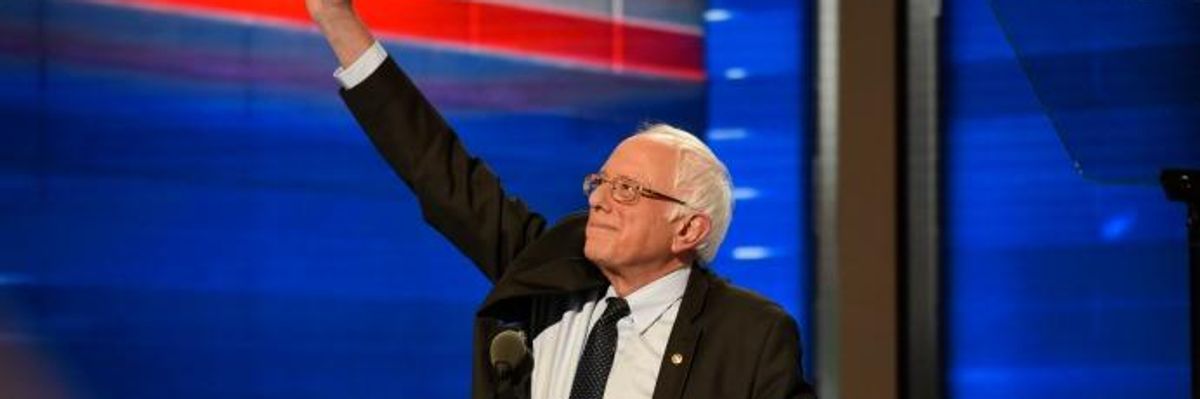
Sen. Bernie Sanders (I-Vt.) waves to the cheering crowd during the 2016 Democratic National Convention. (Photo: Disney/ABC News/flickr/cc)
We all know how thoroughly Bernie Sanders shook up American politics, particularly within the Democratic Party, when he took his challenge to the generally unchallenged, and usually unspoken rule of big money in politics. Even now they're starting to argue about whether he's the party's 2020 frontrunner. And yet political currents at home and abroad suggest a case for him doing something that could shake up the applecart just as thoroughly for a second time - by actually becoming a Democrat for keeps.
We all know how thoroughly Bernie Sanders shook up American politics, particularly within the Democratic Party, when he took his challenge to the generally unchallenged, and usually unspoken rule of big money in politics. Even now they're starting to argue about whether he's the party's 2020 frontrunner. And yet political currents at home and abroad suggest a case for him doing something that could shake up the applecart just as thoroughly for a second time - by actually becoming a Democrat for keeps.
It's not as if his record as the longest-serving independent in the history of the U.S. Congress (a status only interrupted during his run for the presidential nomination) hasn't served him well, or anything like that. Clearly it's been a significant contributor to the fact that even people who disagree with him regard him as a straight-shooter. No, so far as his own career goes, Sanders might just as well stay independent. It could well be the case, however, that the enthusiasm his campaign has injected into mainstream politics would be more effectively channeled if he made his plunge into party politics permanent. The question ultimately comes down to one of unity - and clarity of purpose. What would best unify the broad swath of activists and potential activists trying to develop a political force capable of breaking corporate dominance in American politics?
Sometimes things can be clearer from the outside looking in. Canadian author Naomi Klein, for instance, while recognizing the difficulty "of taking over a party that has been colonized by neoliberalism and by the interests of economic elites who do not want to change"--i.e., the Democratic Party--understands the effort as an unavoidable part of a "battle for the soul of, not just the party, but the country." This perspective seems not always as clear back home, though, where only recently Rose Ann DeMoro, executive director of National Nurses United--an organization as closely linked to the Sanders campaign as any--warned a California Democratic Party convention that "If we dismiss progressive values and reinforce the status quo, don't assume the activists in California and around this country are going to stay with the Democratic Party."
And yet, isn't that precisely what those committed to maintaining the status quo of big money hegemony in politics should assume--that the activists are going to stay and fight to end their control of both major parties? Their worst nightmare is not that we will pick up and leave if we don't get what we want, but that we won't leave!
Meanwhile, for those who fear that abandoning capital "I" political Independent status necessarily means compromising small "i" independence in the eyes of the electorate, you won't find a better example of that ethos than in the recent experience of Jeremy Corbyn and the British Labour Party. For all of the grievances that some people who came into electoral politics with the Sanders campaign may have against the Democratic Party, they surely pale in comparison with Corbyn's treatment at the hands of the Labour Party, whose Members of Parliament last year voted no confidence in him by a 172-57 margin, despite his enthusiastic support among the party rank and file. (And his treatment in the establishment media was even worse.)
But still he--and they--persisted, ultimately producing an electoral platform that proposed re-nationalization of the railways, free public higher education, and a range of other policies that proved to resonate far better with the electorate that those of the pro-business New Labour types who frown upon them--and him.
Why did Corbyn's supporters stay and fight in a party where they were so clearly unwelcome? Because if they were serious about changing their country, there was nowhere else to go. Which is much the situation we face in regard to the Democratic Party here, where any smart big money guy has got to hope that the anti-corporate control types will get fed up with feeling unloved and leave the field to those who've been running the show.
Any decision as to Sanders's political status is obviously ultimately his to make, of course. Yet his oft-stated point, "It's not about me, it's us"--so central to his campaign--does suggest that the consideration is a legitimate matter for all of "us." And one can't help but wonder if Bernie Sanders couldn't add a measure of clarity to the current situation.
Dear Common Dreams reader, It’s been nearly 30 years since I co-founded Common Dreams with my late wife, Lina Newhouser. We had the radical notion that journalism should serve the public good, not corporate profits. It was clear to us from the outset what it would take to build such a project. No paid advertisements. No corporate sponsors. No millionaire publisher telling us what to think or do. Many people said we wouldn't last a year, but we proved those doubters wrong. Together with a tremendous team of journalists and dedicated staff, we built an independent media outlet free from the constraints of profits and corporate control. Our mission has always been simple: To inform. To inspire. To ignite change for the common good. Building Common Dreams was not easy. Our survival was never guaranteed. When you take on the most powerful forces—Wall Street greed, fossil fuel industry destruction, Big Tech lobbyists, and uber-rich oligarchs who have spent billions upon billions rigging the economy and democracy in their favor—the only bulwark you have is supporters who believe in your work. But here’s the urgent message from me today. It's never been this bad out there. And it's never been this hard to keep us going. At the very moment Common Dreams is most needed, the threats we face are intensifying. We need your support now more than ever. We don't accept corporate advertising and never will. We don't have a paywall because we don't think people should be blocked from critical news based on their ability to pay. Everything we do is funded by the donations of readers like you. When everyone does the little they can afford, we are strong. But if that support retreats or dries up, so do we. Will you donate now to make sure Common Dreams not only survives but thrives? —Craig Brown, Co-founder |
We all know how thoroughly Bernie Sanders shook up American politics, particularly within the Democratic Party, when he took his challenge to the generally unchallenged, and usually unspoken rule of big money in politics. Even now they're starting to argue about whether he's the party's 2020 frontrunner. And yet political currents at home and abroad suggest a case for him doing something that could shake up the applecart just as thoroughly for a second time - by actually becoming a Democrat for keeps.
It's not as if his record as the longest-serving independent in the history of the U.S. Congress (a status only interrupted during his run for the presidential nomination) hasn't served him well, or anything like that. Clearly it's been a significant contributor to the fact that even people who disagree with him regard him as a straight-shooter. No, so far as his own career goes, Sanders might just as well stay independent. It could well be the case, however, that the enthusiasm his campaign has injected into mainstream politics would be more effectively channeled if he made his plunge into party politics permanent. The question ultimately comes down to one of unity - and clarity of purpose. What would best unify the broad swath of activists and potential activists trying to develop a political force capable of breaking corporate dominance in American politics?
Sometimes things can be clearer from the outside looking in. Canadian author Naomi Klein, for instance, while recognizing the difficulty "of taking over a party that has been colonized by neoliberalism and by the interests of economic elites who do not want to change"--i.e., the Democratic Party--understands the effort as an unavoidable part of a "battle for the soul of, not just the party, but the country." This perspective seems not always as clear back home, though, where only recently Rose Ann DeMoro, executive director of National Nurses United--an organization as closely linked to the Sanders campaign as any--warned a California Democratic Party convention that "If we dismiss progressive values and reinforce the status quo, don't assume the activists in California and around this country are going to stay with the Democratic Party."
And yet, isn't that precisely what those committed to maintaining the status quo of big money hegemony in politics should assume--that the activists are going to stay and fight to end their control of both major parties? Their worst nightmare is not that we will pick up and leave if we don't get what we want, but that we won't leave!
Meanwhile, for those who fear that abandoning capital "I" political Independent status necessarily means compromising small "i" independence in the eyes of the electorate, you won't find a better example of that ethos than in the recent experience of Jeremy Corbyn and the British Labour Party. For all of the grievances that some people who came into electoral politics with the Sanders campaign may have against the Democratic Party, they surely pale in comparison with Corbyn's treatment at the hands of the Labour Party, whose Members of Parliament last year voted no confidence in him by a 172-57 margin, despite his enthusiastic support among the party rank and file. (And his treatment in the establishment media was even worse.)
But still he--and they--persisted, ultimately producing an electoral platform that proposed re-nationalization of the railways, free public higher education, and a range of other policies that proved to resonate far better with the electorate that those of the pro-business New Labour types who frown upon them--and him.
Why did Corbyn's supporters stay and fight in a party where they were so clearly unwelcome? Because if they were serious about changing their country, there was nowhere else to go. Which is much the situation we face in regard to the Democratic Party here, where any smart big money guy has got to hope that the anti-corporate control types will get fed up with feeling unloved and leave the field to those who've been running the show.
Any decision as to Sanders's political status is obviously ultimately his to make, of course. Yet his oft-stated point, "It's not about me, it's us"--so central to his campaign--does suggest that the consideration is a legitimate matter for all of "us." And one can't help but wonder if Bernie Sanders couldn't add a measure of clarity to the current situation.
We all know how thoroughly Bernie Sanders shook up American politics, particularly within the Democratic Party, when he took his challenge to the generally unchallenged, and usually unspoken rule of big money in politics. Even now they're starting to argue about whether he's the party's 2020 frontrunner. And yet political currents at home and abroad suggest a case for him doing something that could shake up the applecart just as thoroughly for a second time - by actually becoming a Democrat for keeps.
It's not as if his record as the longest-serving independent in the history of the U.S. Congress (a status only interrupted during his run for the presidential nomination) hasn't served him well, or anything like that. Clearly it's been a significant contributor to the fact that even people who disagree with him regard him as a straight-shooter. No, so far as his own career goes, Sanders might just as well stay independent. It could well be the case, however, that the enthusiasm his campaign has injected into mainstream politics would be more effectively channeled if he made his plunge into party politics permanent. The question ultimately comes down to one of unity - and clarity of purpose. What would best unify the broad swath of activists and potential activists trying to develop a political force capable of breaking corporate dominance in American politics?
Sometimes things can be clearer from the outside looking in. Canadian author Naomi Klein, for instance, while recognizing the difficulty "of taking over a party that has been colonized by neoliberalism and by the interests of economic elites who do not want to change"--i.e., the Democratic Party--understands the effort as an unavoidable part of a "battle for the soul of, not just the party, but the country." This perspective seems not always as clear back home, though, where only recently Rose Ann DeMoro, executive director of National Nurses United--an organization as closely linked to the Sanders campaign as any--warned a California Democratic Party convention that "If we dismiss progressive values and reinforce the status quo, don't assume the activists in California and around this country are going to stay with the Democratic Party."
And yet, isn't that precisely what those committed to maintaining the status quo of big money hegemony in politics should assume--that the activists are going to stay and fight to end their control of both major parties? Their worst nightmare is not that we will pick up and leave if we don't get what we want, but that we won't leave!
Meanwhile, for those who fear that abandoning capital "I" political Independent status necessarily means compromising small "i" independence in the eyes of the electorate, you won't find a better example of that ethos than in the recent experience of Jeremy Corbyn and the British Labour Party. For all of the grievances that some people who came into electoral politics with the Sanders campaign may have against the Democratic Party, they surely pale in comparison with Corbyn's treatment at the hands of the Labour Party, whose Members of Parliament last year voted no confidence in him by a 172-57 margin, despite his enthusiastic support among the party rank and file. (And his treatment in the establishment media was even worse.)
But still he--and they--persisted, ultimately producing an electoral platform that proposed re-nationalization of the railways, free public higher education, and a range of other policies that proved to resonate far better with the electorate that those of the pro-business New Labour types who frown upon them--and him.
Why did Corbyn's supporters stay and fight in a party where they were so clearly unwelcome? Because if they were serious about changing their country, there was nowhere else to go. Which is much the situation we face in regard to the Democratic Party here, where any smart big money guy has got to hope that the anti-corporate control types will get fed up with feeling unloved and leave the field to those who've been running the show.
Any decision as to Sanders's political status is obviously ultimately his to make, of course. Yet his oft-stated point, "It's not about me, it's us"--so central to his campaign--does suggest that the consideration is a legitimate matter for all of "us." And one can't help but wonder if Bernie Sanders couldn't add a measure of clarity to the current situation.