SUBSCRIBE TO OUR FREE NEWSLETTER
Daily news & progressive opinion—funded by the people, not the corporations—delivered straight to your inbox.
5
#000000
#FFFFFF
To donate by check, phone, or other method, see our More Ways to Give page.
Daily news & progressive opinion—funded by the people, not the corporations—delivered straight to your inbox.
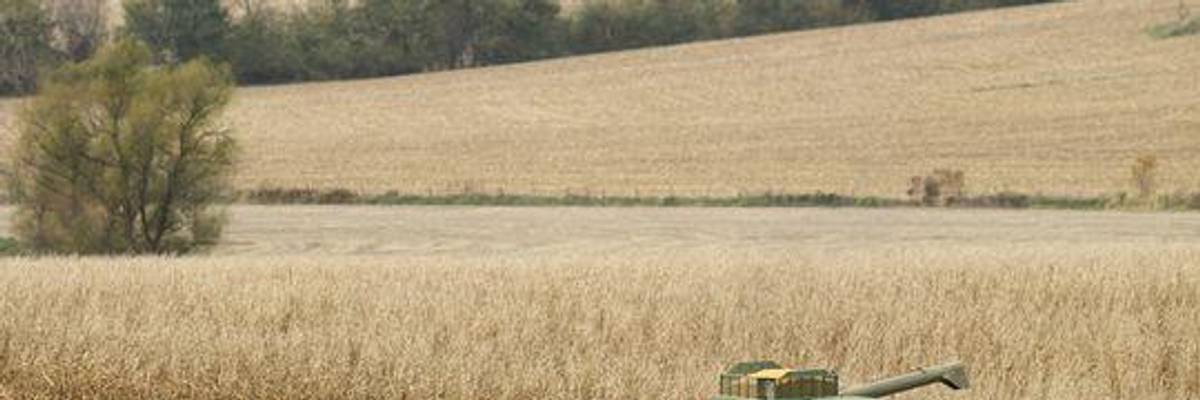
Kevin Kroh harvests corn on a farm in Wheatland, Iowa, on Monday, Oct. 31, 2016. (Photo: David Scrivner / Iowa City Press-Citizen)
owa farmers face a crisis. Crop prices have fallen by more than 50 percent since 2013, with no end in sight. At the same time, farmers hold more debt and possess fewer capital reserves to fall back on. In fact, farmers' debt levels are almost as high as they were prior to the farm crisis of the mid-1980s.
owa farmers face a crisis. Crop prices have fallen by more than 50 percent since 2013, with no end in sight. At the same time, farmers hold more debt and possess fewer capital reserves to fall back on. In fact, farmers' debt levels are almost as high as they were prior to the farm crisis of the mid-1980s.
Meanwhile, a wave of mergers among the world's agricultural giants is upending the markets for seeds, fertilizers and pesticides. If approved, the proposed merger would result in just two companies -- Monsanto-Bayer and Dow-DuPont -- controlling about three-quarters of the U.S. corn seed market. The power that these corporations would hold in the seed market is unprecedented.
Farmers are already being squeezed. The price of corn seed has more than doubled in the past 10 years -- from $51 per acre in 2006 to $102 in 2015 -- as a result of similar consolidation, including Monsanto's purchases of DeKalb and Cargill's international seed business. If the Monsanto-Bayer merger is permitted, this problem will only intensify, further limiting farmers' choices and making the products they need even more expensive.
The merger does not just strengthen Monsanto's control over the corn seed industry. It also helps the company grow its dominance in other areas, like fertilizers, pesticides, and precision farming technology. Monsanto's goal is to bundle all of these products together, sort of like how a cable company bundles internet, phone and television. And just like with most cable companies, the service will be overpriced and shoddy because it will leave farmers with no other option.
Yet this mega-merger is moving forward with barely a murmur of concern from our elected officials in Washington. Not a single senator raised this matter at confirmation hearings for Secretary of Agriculture Sonny Perdue. Even worse, the nominee to lead the Department of Justice's Antitrust Division is a former lobbyist who asserted in a recent interview that "a monopoly is perfectly legal." It is not surprising that Monsanto and Bayer alone spent $120 million in the last decade on lobbying elected officials at the federal level.
And while stopping the Monsanto-Bayer merger would be a good first step, we need to go even further to prevent these giants from bullying Iowa farmers. Monsanto and other agricultural giants like it are just too big. A century ago, President Teddy Roosevelt broke up the trusts and monopolies of his time because he understood that the deck was stacked against consumers, farmers and small businesses.
We need to take a cue from Roosevelt and break up Monsanto and other Big Ag corporations like it. Time and again, studies have shown that monopolies result in less innovation, fewer choices and higher prices for farmers and consumers. We cannot continue to line the pockets of wealthy executives in far-off big cities. By breaking up these giants, we can restore competition and bring vitality back to Iowa's rural communities.
Dear Common Dreams reader, It’s been nearly 30 years since I co-founded Common Dreams with my late wife, Lina Newhouser. We had the radical notion that journalism should serve the public good, not corporate profits. It was clear to us from the outset what it would take to build such a project. No paid advertisements. No corporate sponsors. No millionaire publisher telling us what to think or do. Many people said we wouldn't last a year, but we proved those doubters wrong. Together with a tremendous team of journalists and dedicated staff, we built an independent media outlet free from the constraints of profits and corporate control. Our mission has always been simple: To inform. To inspire. To ignite change for the common good. Building Common Dreams was not easy. Our survival was never guaranteed. When you take on the most powerful forces—Wall Street greed, fossil fuel industry destruction, Big Tech lobbyists, and uber-rich oligarchs who have spent billions upon billions rigging the economy and democracy in their favor—the only bulwark you have is supporters who believe in your work. But here’s the urgent message from me today. It's never been this bad out there. And it's never been this hard to keep us going. At the very moment Common Dreams is most needed, the threats we face are intensifying. We need your support now more than ever. We don't accept corporate advertising and never will. We don't have a paywall because we don't think people should be blocked from critical news based on their ability to pay. Everything we do is funded by the donations of readers like you. When everyone does the little they can afford, we are strong. But if that support retreats or dries up, so do we. Will you donate now to make sure Common Dreams not only survives but thrives? —Craig Brown, Co-founder |
owa farmers face a crisis. Crop prices have fallen by more than 50 percent since 2013, with no end in sight. At the same time, farmers hold more debt and possess fewer capital reserves to fall back on. In fact, farmers' debt levels are almost as high as they were prior to the farm crisis of the mid-1980s.
Meanwhile, a wave of mergers among the world's agricultural giants is upending the markets for seeds, fertilizers and pesticides. If approved, the proposed merger would result in just two companies -- Monsanto-Bayer and Dow-DuPont -- controlling about three-quarters of the U.S. corn seed market. The power that these corporations would hold in the seed market is unprecedented.
Farmers are already being squeezed. The price of corn seed has more than doubled in the past 10 years -- from $51 per acre in 2006 to $102 in 2015 -- as a result of similar consolidation, including Monsanto's purchases of DeKalb and Cargill's international seed business. If the Monsanto-Bayer merger is permitted, this problem will only intensify, further limiting farmers' choices and making the products they need even more expensive.
The merger does not just strengthen Monsanto's control over the corn seed industry. It also helps the company grow its dominance in other areas, like fertilizers, pesticides, and precision farming technology. Monsanto's goal is to bundle all of these products together, sort of like how a cable company bundles internet, phone and television. And just like with most cable companies, the service will be overpriced and shoddy because it will leave farmers with no other option.
Yet this mega-merger is moving forward with barely a murmur of concern from our elected officials in Washington. Not a single senator raised this matter at confirmation hearings for Secretary of Agriculture Sonny Perdue. Even worse, the nominee to lead the Department of Justice's Antitrust Division is a former lobbyist who asserted in a recent interview that "a monopoly is perfectly legal." It is not surprising that Monsanto and Bayer alone spent $120 million in the last decade on lobbying elected officials at the federal level.
And while stopping the Monsanto-Bayer merger would be a good first step, we need to go even further to prevent these giants from bullying Iowa farmers. Monsanto and other agricultural giants like it are just too big. A century ago, President Teddy Roosevelt broke up the trusts and monopolies of his time because he understood that the deck was stacked against consumers, farmers and small businesses.
We need to take a cue from Roosevelt and break up Monsanto and other Big Ag corporations like it. Time and again, studies have shown that monopolies result in less innovation, fewer choices and higher prices for farmers and consumers. We cannot continue to line the pockets of wealthy executives in far-off big cities. By breaking up these giants, we can restore competition and bring vitality back to Iowa's rural communities.
owa farmers face a crisis. Crop prices have fallen by more than 50 percent since 2013, with no end in sight. At the same time, farmers hold more debt and possess fewer capital reserves to fall back on. In fact, farmers' debt levels are almost as high as they were prior to the farm crisis of the mid-1980s.
Meanwhile, a wave of mergers among the world's agricultural giants is upending the markets for seeds, fertilizers and pesticides. If approved, the proposed merger would result in just two companies -- Monsanto-Bayer and Dow-DuPont -- controlling about three-quarters of the U.S. corn seed market. The power that these corporations would hold in the seed market is unprecedented.
Farmers are already being squeezed. The price of corn seed has more than doubled in the past 10 years -- from $51 per acre in 2006 to $102 in 2015 -- as a result of similar consolidation, including Monsanto's purchases of DeKalb and Cargill's international seed business. If the Monsanto-Bayer merger is permitted, this problem will only intensify, further limiting farmers' choices and making the products they need even more expensive.
The merger does not just strengthen Monsanto's control over the corn seed industry. It also helps the company grow its dominance in other areas, like fertilizers, pesticides, and precision farming technology. Monsanto's goal is to bundle all of these products together, sort of like how a cable company bundles internet, phone and television. And just like with most cable companies, the service will be overpriced and shoddy because it will leave farmers with no other option.
Yet this mega-merger is moving forward with barely a murmur of concern from our elected officials in Washington. Not a single senator raised this matter at confirmation hearings for Secretary of Agriculture Sonny Perdue. Even worse, the nominee to lead the Department of Justice's Antitrust Division is a former lobbyist who asserted in a recent interview that "a monopoly is perfectly legal." It is not surprising that Monsanto and Bayer alone spent $120 million in the last decade on lobbying elected officials at the federal level.
And while stopping the Monsanto-Bayer merger would be a good first step, we need to go even further to prevent these giants from bullying Iowa farmers. Monsanto and other agricultural giants like it are just too big. A century ago, President Teddy Roosevelt broke up the trusts and monopolies of his time because he understood that the deck was stacked against consumers, farmers and small businesses.
We need to take a cue from Roosevelt and break up Monsanto and other Big Ag corporations like it. Time and again, studies have shown that monopolies result in less innovation, fewer choices and higher prices for farmers and consumers. We cannot continue to line the pockets of wealthy executives in far-off big cities. By breaking up these giants, we can restore competition and bring vitality back to Iowa's rural communities.