SUBSCRIBE TO OUR FREE NEWSLETTER
Daily news & progressive opinion—funded by the people, not the corporations—delivered straight to your inbox.
5
#000000
#FFFFFF
To donate by check, phone, or other method, see our More Ways to Give page.
Daily news & progressive opinion—funded by the people, not the corporations—delivered straight to your inbox.
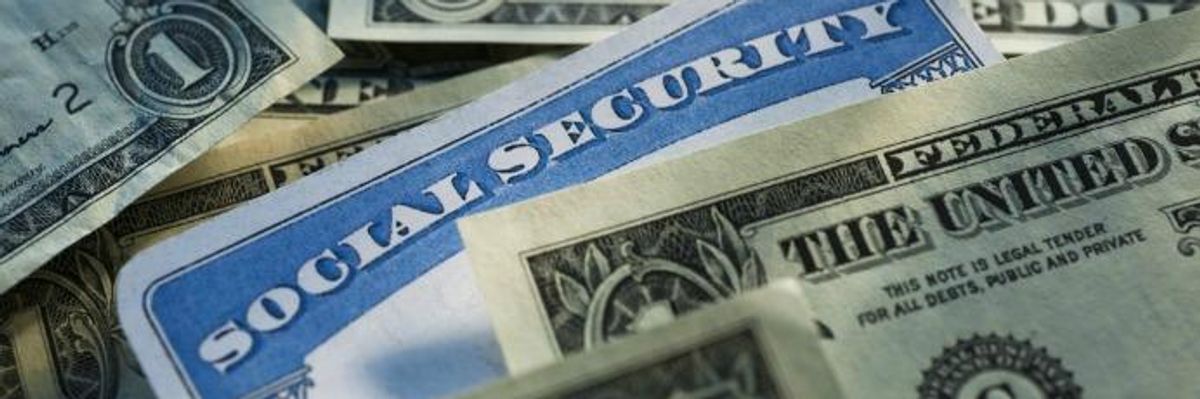
'The super-rich are by far the top beneficiaries of U.S. security, tax laws, and the financial system,' writes Buchheit. (Photo: Tetra Images/Flickr)
The entire 2017 safety net is about $850 billion, compared to over $1.5 trillion for tax expenditures, most of which are for rich Americans.
The Unrelenting Wealth Grab by the 1%
The entire 2017 safety net is about $850 billion, compared to over $1.5 trillion for tax expenditures, most of which are for rich Americans.
The Unrelenting Wealth Grab by the 1%
The average 1% household increased its wealth by $3 million in 2016. Since much of that was in the form of stock gains, they paid tax on only a small part of their incomes, and then took an average of about $200,000 per household in tax subsidies. When ALL forms of taxes and income and capital gains are considered, the richest 1% pay lower tax rates than the poorest 20% of Americans.
The Rich Old White Guy's Safety Net: Retirement and Health Care
Wealthy people are living longer, so they're getting much more of the late-life benefits. A Brookings report estimates that lowest-quintile Americans born in 1960 will receive "only 78 percent of the lifetime Medicare benefits received by the top income quintile." A Congressional Research Service report states: "When Social Security benefits are measured on a lifetime basis, low earners, who show little to no gains in life expectancy over time, are projected to receive increasingly lower benefits than those with high earnings." The American Medical Association agrees. The National Institutes of Health agrees. Middle- and upper-income Americans are even grabbing MEDICAID benefits because of the program's accommodating asset-exclusion limits.
Taking from the Poor American's Shredded Safety Net
Uninformed critics believe that government transfers go to the poorest Americans. They don't. According to the research team of Thomas Piketty, Emmanuel Saez, and Gabriel Zucman, the government transfers go mostly to the middle class and the elderly. In 2014, the middle class--the 40% of American adults with incomes just below the top 10%--received more in safety net government transfers (Medicare, Medicaid, food stamps/SNAP, Veterans' benefits, etc., but excluding Social Security) than the bottom 50% of Americans.
More Outrageous Tax Breaks for the Rich
The Ultimate Safety Net
The super-rich are by far the top beneficiaries of U.S. security, tax laws, and the financial system. But rather than repaying society for these lopsided benefits, households with wealth over $40 million evade 25 to 30 percent of their personal income and wealth taxes.
Senator Lindsey Graham once said, "It's really American to avoid paying taxes, legally...It's a game we play...I see nothing wrong with playing the game because we set it up to be a game."
It's not a game for the 200 million struggling Americans who depend on tax revenue for education and housing and health care.
Dear Common Dreams reader, It’s been nearly 30 years since I co-founded Common Dreams with my late wife, Lina Newhouser. We had the radical notion that journalism should serve the public good, not corporate profits. It was clear to us from the outset what it would take to build such a project. No paid advertisements. No corporate sponsors. No millionaire publisher telling us what to think or do. Many people said we wouldn't last a year, but we proved those doubters wrong. Together with a tremendous team of journalists and dedicated staff, we built an independent media outlet free from the constraints of profits and corporate control. Our mission has always been simple: To inform. To inspire. To ignite change for the common good. Building Common Dreams was not easy. Our survival was never guaranteed. When you take on the most powerful forces—Wall Street greed, fossil fuel industry destruction, Big Tech lobbyists, and uber-rich oligarchs who have spent billions upon billions rigging the economy and democracy in their favor—the only bulwark you have is supporters who believe in your work. But here’s the urgent message from me today. It's never been this bad out there. And it's never been this hard to keep us going. At the very moment Common Dreams is most needed, the threats we face are intensifying. We need your support now more than ever. We don't accept corporate advertising and never will. We don't have a paywall because we don't think people should be blocked from critical news based on their ability to pay. Everything we do is funded by the donations of readers like you. When everyone does the little they can afford, we are strong. But if that support retreats or dries up, so do we. Will you donate now to make sure Common Dreams not only survives but thrives? —Craig Brown, Co-founder |
The entire 2017 safety net is about $850 billion, compared to over $1.5 trillion for tax expenditures, most of which are for rich Americans.
The Unrelenting Wealth Grab by the 1%
The average 1% household increased its wealth by $3 million in 2016. Since much of that was in the form of stock gains, they paid tax on only a small part of their incomes, and then took an average of about $200,000 per household in tax subsidies. When ALL forms of taxes and income and capital gains are considered, the richest 1% pay lower tax rates than the poorest 20% of Americans.
The Rich Old White Guy's Safety Net: Retirement and Health Care
Wealthy people are living longer, so they're getting much more of the late-life benefits. A Brookings report estimates that lowest-quintile Americans born in 1960 will receive "only 78 percent of the lifetime Medicare benefits received by the top income quintile." A Congressional Research Service report states: "When Social Security benefits are measured on a lifetime basis, low earners, who show little to no gains in life expectancy over time, are projected to receive increasingly lower benefits than those with high earnings." The American Medical Association agrees. The National Institutes of Health agrees. Middle- and upper-income Americans are even grabbing MEDICAID benefits because of the program's accommodating asset-exclusion limits.
Taking from the Poor American's Shredded Safety Net
Uninformed critics believe that government transfers go to the poorest Americans. They don't. According to the research team of Thomas Piketty, Emmanuel Saez, and Gabriel Zucman, the government transfers go mostly to the middle class and the elderly. In 2014, the middle class--the 40% of American adults with incomes just below the top 10%--received more in safety net government transfers (Medicare, Medicaid, food stamps/SNAP, Veterans' benefits, etc., but excluding Social Security) than the bottom 50% of Americans.
More Outrageous Tax Breaks for the Rich
The Ultimate Safety Net
The super-rich are by far the top beneficiaries of U.S. security, tax laws, and the financial system. But rather than repaying society for these lopsided benefits, households with wealth over $40 million evade 25 to 30 percent of their personal income and wealth taxes.
Senator Lindsey Graham once said, "It's really American to avoid paying taxes, legally...It's a game we play...I see nothing wrong with playing the game because we set it up to be a game."
It's not a game for the 200 million struggling Americans who depend on tax revenue for education and housing and health care.
The entire 2017 safety net is about $850 billion, compared to over $1.5 trillion for tax expenditures, most of which are for rich Americans.
The Unrelenting Wealth Grab by the 1%
The average 1% household increased its wealth by $3 million in 2016. Since much of that was in the form of stock gains, they paid tax on only a small part of their incomes, and then took an average of about $200,000 per household in tax subsidies. When ALL forms of taxes and income and capital gains are considered, the richest 1% pay lower tax rates than the poorest 20% of Americans.
The Rich Old White Guy's Safety Net: Retirement and Health Care
Wealthy people are living longer, so they're getting much more of the late-life benefits. A Brookings report estimates that lowest-quintile Americans born in 1960 will receive "only 78 percent of the lifetime Medicare benefits received by the top income quintile." A Congressional Research Service report states: "When Social Security benefits are measured on a lifetime basis, low earners, who show little to no gains in life expectancy over time, are projected to receive increasingly lower benefits than those with high earnings." The American Medical Association agrees. The National Institutes of Health agrees. Middle- and upper-income Americans are even grabbing MEDICAID benefits because of the program's accommodating asset-exclusion limits.
Taking from the Poor American's Shredded Safety Net
Uninformed critics believe that government transfers go to the poorest Americans. They don't. According to the research team of Thomas Piketty, Emmanuel Saez, and Gabriel Zucman, the government transfers go mostly to the middle class and the elderly. In 2014, the middle class--the 40% of American adults with incomes just below the top 10%--received more in safety net government transfers (Medicare, Medicaid, food stamps/SNAP, Veterans' benefits, etc., but excluding Social Security) than the bottom 50% of Americans.
More Outrageous Tax Breaks for the Rich
The Ultimate Safety Net
The super-rich are by far the top beneficiaries of U.S. security, tax laws, and the financial system. But rather than repaying society for these lopsided benefits, households with wealth over $40 million evade 25 to 30 percent of their personal income and wealth taxes.
Senator Lindsey Graham once said, "It's really American to avoid paying taxes, legally...It's a game we play...I see nothing wrong with playing the game because we set it up to be a game."
It's not a game for the 200 million struggling Americans who depend on tax revenue for education and housing and health care.