SUBSCRIBE TO OUR FREE NEWSLETTER
Daily news & progressive opinion—funded by the people, not the corporations—delivered straight to your inbox.
5
#000000
#FFFFFF
To donate by check, phone, or other method, see our More Ways to Give page.
Daily news & progressive opinion—funded by the people, not the corporations—delivered straight to your inbox.
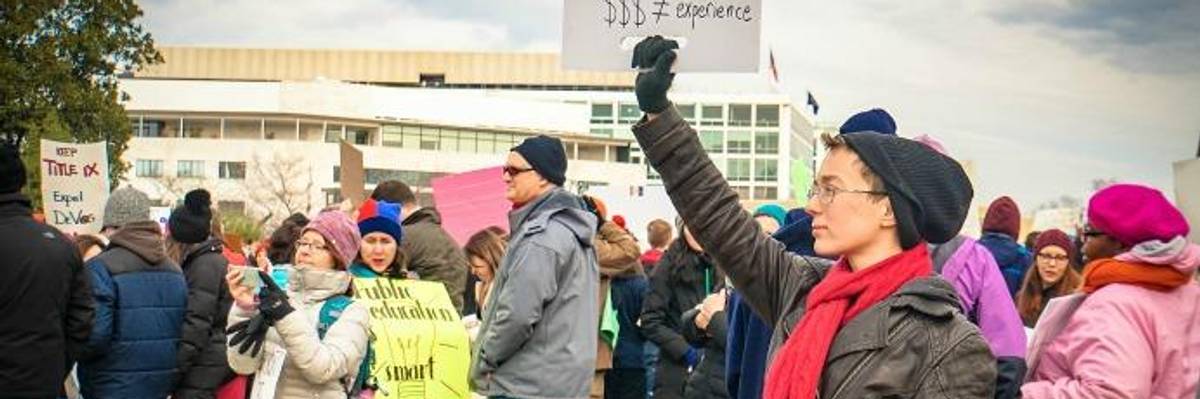
Education Secretary Betsy DeVos has moved quickly to dismantle Obama-era regulations aimed at protecting students from predatory for-profit schools. (Photo: Ted Eytan/Flickr/cc)
D'ye think th' colledges has much to do with th' progress iv th' wurruld?" Asked Mr. Hennessey.
"D' ye think ," said Mr. Dooley, "tis the mill that makes th' wather run?"
-- Finley Peter Dunne [Mr. Dooley], Colleges and Degrees
The good news is that the DJT administration has finally come up with a plan to help businesses that does not benefit one of DJT's enterprises and, therefore, does not represent a conflict of interest for DJT. That comes as a welcome surprise for those who have marveled at how DJT has transformed the White House from a policy center to a profit center. This was most recently demonstrated when the Republican National Committee selected the Trump International Hotel in Washington, to host a $10 million re-election fund raiser in that venue. According to the hotel, the Republican National Committee that put on the event paid "regular prices" for all the services and space provided by the hotel. That blatant conflict of interest made it all the more important to alert the public to the fact that, appearances notwithstanding, the most recent political decision made by the administration does not benefit DJT in any way. That is because, as far as can be determined, DJT no longer has any financial interest in making money by defrauding students. That was not always the case.
A while back, DJT was the poster child for an unethical enterprise that purported to offer training to its victims in get rich schemes. His fraud was called Trump University. It was a complete scam. It had no campus or classrooms. Although it touted the qualifications of its faculty when recruiting students, its faculty lacked academic credentials, the university granted no degrees, and most of its students discovered that promises of lucrative careers in the real estate world following completion of the program were illusory. Because of its palpable fraudulent conduct, it was subject to a class action lawsuit from those who had paid large sums of money in exchange for nothing of value, and the lawsuit was settled, following DJT's election, for $25 million.
Even though DJT had a different fraud model from those for-profit colleges that are run unethically, there was a great sense of relief among all for-profit colleges, the good and the bad , when DJT was elected. The relief was palpable. The day following DJT's election, the stock in Strayer Education, Inc. that owns the for-profit Strayer University, jumped almost 20%. Stock in other for-profit colleges also saw the value of their shares increase. There was a reason for the jump in stock prices. Those institutions had reason to hope that DJT, who had run a complete scam, might have residual sympathy for for-profit colleges that were subject to regulations that were destined to go into effect on July 1, 2017. They hoped that some of the Obama proposals that were directed at fraudulent for-profit colleges might go away or, at least, be delayed. The Trump administration did not disappoint.
Among the regulations imposed by the Obama administration that had been scheduled to be implemented on July 1, 2017, were two that were especially troubling to the for-profit colleges. One was a proposal that would expand and speed up a system that had been created to erase the student federal loan debt incurred by students who were cheated by for-profit colleges that engaged in fraudulent conduct. The other change was to the regulation known as the "gainful employment mandate." That mandate provided that for-profit colleges whose students are unable to find jobs that pay them enough to retire their student debt, may, if the pattern continues for three years, be removed from the student loan program. (The actual rule is more complex but that description is adequate for our purposes.) The regulations that were to take effect on July 1 were imposed after many for-profit schools collapsed before their students graduated, leaving students with no degrees and no means to repay the student loans they'd incurred to attend them. Although the regulations were needed, thanks to the actions of Betsy DeVos, the Secretary of Education, they may never become effective.
On June 14, 2017, Betsy's Education Department announced that the proposed changes would not take place on July 1 as planned. The department said it would form a committee to examine the proposed rule changes, and would not implement them until the review was completed. The delay does not, however, suggest that Betsy DeVos is in favor of fraud. She made that plain when, in commenting on the delay, she said: "Fraud, especially fraud committed by a school, is simply unacceptable." That was very reassuring. The rest of her remarks less so. She said the rules were produced as a "result of a muddled process that's unfair to students and schools, and puts taxpayers on the hook for significant costs." What she overlooked, of course, was that the fraudulent for-profit colleges put the students "on the hook for significant costs."
Not surprisingly, in this administration, if a choice has to be made between taking steps to help the needy, in this case students, or the taxpayer, the taxpayer wins. So sad for the students.
Dear Common Dreams reader, It’s been nearly 30 years since I co-founded Common Dreams with my late wife, Lina Newhouser. We had the radical notion that journalism should serve the public good, not corporate profits. It was clear to us from the outset what it would take to build such a project. No paid advertisements. No corporate sponsors. No millionaire publisher telling us what to think or do. Many people said we wouldn't last a year, but we proved those doubters wrong. Together with a tremendous team of journalists and dedicated staff, we built an independent media outlet free from the constraints of profits and corporate control. Our mission has always been simple: To inform. To inspire. To ignite change for the common good. Building Common Dreams was not easy. Our survival was never guaranteed. When you take on the most powerful forces—Wall Street greed, fossil fuel industry destruction, Big Tech lobbyists, and uber-rich oligarchs who have spent billions upon billions rigging the economy and democracy in their favor—the only bulwark you have is supporters who believe in your work. But here’s the urgent message from me today. It's never been this bad out there. And it's never been this hard to keep us going. At the very moment Common Dreams is most needed, the threats we face are intensifying. We need your support now more than ever. We don't accept corporate advertising and never will. We don't have a paywall because we don't think people should be blocked from critical news based on their ability to pay. Everything we do is funded by the donations of readers like you. When everyone does the little they can afford, we are strong. But if that support retreats or dries up, so do we. Will you donate now to make sure Common Dreams not only survives but thrives? —Craig Brown, Co-founder |
D'ye think th' colledges has much to do with th' progress iv th' wurruld?" Asked Mr. Hennessey.
"D' ye think ," said Mr. Dooley, "tis the mill that makes th' wather run?"
-- Finley Peter Dunne [Mr. Dooley], Colleges and Degrees
The good news is that the DJT administration has finally come up with a plan to help businesses that does not benefit one of DJT's enterprises and, therefore, does not represent a conflict of interest for DJT. That comes as a welcome surprise for those who have marveled at how DJT has transformed the White House from a policy center to a profit center. This was most recently demonstrated when the Republican National Committee selected the Trump International Hotel in Washington, to host a $10 million re-election fund raiser in that venue. According to the hotel, the Republican National Committee that put on the event paid "regular prices" for all the services and space provided by the hotel. That blatant conflict of interest made it all the more important to alert the public to the fact that, appearances notwithstanding, the most recent political decision made by the administration does not benefit DJT in any way. That is because, as far as can be determined, DJT no longer has any financial interest in making money by defrauding students. That was not always the case.
A while back, DJT was the poster child for an unethical enterprise that purported to offer training to its victims in get rich schemes. His fraud was called Trump University. It was a complete scam. It had no campus or classrooms. Although it touted the qualifications of its faculty when recruiting students, its faculty lacked academic credentials, the university granted no degrees, and most of its students discovered that promises of lucrative careers in the real estate world following completion of the program were illusory. Because of its palpable fraudulent conduct, it was subject to a class action lawsuit from those who had paid large sums of money in exchange for nothing of value, and the lawsuit was settled, following DJT's election, for $25 million.
Even though DJT had a different fraud model from those for-profit colleges that are run unethically, there was a great sense of relief among all for-profit colleges, the good and the bad , when DJT was elected. The relief was palpable. The day following DJT's election, the stock in Strayer Education, Inc. that owns the for-profit Strayer University, jumped almost 20%. Stock in other for-profit colleges also saw the value of their shares increase. There was a reason for the jump in stock prices. Those institutions had reason to hope that DJT, who had run a complete scam, might have residual sympathy for for-profit colleges that were subject to regulations that were destined to go into effect on July 1, 2017. They hoped that some of the Obama proposals that were directed at fraudulent for-profit colleges might go away or, at least, be delayed. The Trump administration did not disappoint.
Among the regulations imposed by the Obama administration that had been scheduled to be implemented on July 1, 2017, were two that were especially troubling to the for-profit colleges. One was a proposal that would expand and speed up a system that had been created to erase the student federal loan debt incurred by students who were cheated by for-profit colleges that engaged in fraudulent conduct. The other change was to the regulation known as the "gainful employment mandate." That mandate provided that for-profit colleges whose students are unable to find jobs that pay them enough to retire their student debt, may, if the pattern continues for three years, be removed from the student loan program. (The actual rule is more complex but that description is adequate for our purposes.) The regulations that were to take effect on July 1 were imposed after many for-profit schools collapsed before their students graduated, leaving students with no degrees and no means to repay the student loans they'd incurred to attend them. Although the regulations were needed, thanks to the actions of Betsy DeVos, the Secretary of Education, they may never become effective.
On June 14, 2017, Betsy's Education Department announced that the proposed changes would not take place on July 1 as planned. The department said it would form a committee to examine the proposed rule changes, and would not implement them until the review was completed. The delay does not, however, suggest that Betsy DeVos is in favor of fraud. She made that plain when, in commenting on the delay, she said: "Fraud, especially fraud committed by a school, is simply unacceptable." That was very reassuring. The rest of her remarks less so. She said the rules were produced as a "result of a muddled process that's unfair to students and schools, and puts taxpayers on the hook for significant costs." What she overlooked, of course, was that the fraudulent for-profit colleges put the students "on the hook for significant costs."
Not surprisingly, in this administration, if a choice has to be made between taking steps to help the needy, in this case students, or the taxpayer, the taxpayer wins. So sad for the students.
D'ye think th' colledges has much to do with th' progress iv th' wurruld?" Asked Mr. Hennessey.
"D' ye think ," said Mr. Dooley, "tis the mill that makes th' wather run?"
-- Finley Peter Dunne [Mr. Dooley], Colleges and Degrees
The good news is that the DJT administration has finally come up with a plan to help businesses that does not benefit one of DJT's enterprises and, therefore, does not represent a conflict of interest for DJT. That comes as a welcome surprise for those who have marveled at how DJT has transformed the White House from a policy center to a profit center. This was most recently demonstrated when the Republican National Committee selected the Trump International Hotel in Washington, to host a $10 million re-election fund raiser in that venue. According to the hotel, the Republican National Committee that put on the event paid "regular prices" for all the services and space provided by the hotel. That blatant conflict of interest made it all the more important to alert the public to the fact that, appearances notwithstanding, the most recent political decision made by the administration does not benefit DJT in any way. That is because, as far as can be determined, DJT no longer has any financial interest in making money by defrauding students. That was not always the case.
A while back, DJT was the poster child for an unethical enterprise that purported to offer training to its victims in get rich schemes. His fraud was called Trump University. It was a complete scam. It had no campus or classrooms. Although it touted the qualifications of its faculty when recruiting students, its faculty lacked academic credentials, the university granted no degrees, and most of its students discovered that promises of lucrative careers in the real estate world following completion of the program were illusory. Because of its palpable fraudulent conduct, it was subject to a class action lawsuit from those who had paid large sums of money in exchange for nothing of value, and the lawsuit was settled, following DJT's election, for $25 million.
Even though DJT had a different fraud model from those for-profit colleges that are run unethically, there was a great sense of relief among all for-profit colleges, the good and the bad , when DJT was elected. The relief was palpable. The day following DJT's election, the stock in Strayer Education, Inc. that owns the for-profit Strayer University, jumped almost 20%. Stock in other for-profit colleges also saw the value of their shares increase. There was a reason for the jump in stock prices. Those institutions had reason to hope that DJT, who had run a complete scam, might have residual sympathy for for-profit colleges that were subject to regulations that were destined to go into effect on July 1, 2017. They hoped that some of the Obama proposals that were directed at fraudulent for-profit colleges might go away or, at least, be delayed. The Trump administration did not disappoint.
Among the regulations imposed by the Obama administration that had been scheduled to be implemented on July 1, 2017, were two that were especially troubling to the for-profit colleges. One was a proposal that would expand and speed up a system that had been created to erase the student federal loan debt incurred by students who were cheated by for-profit colleges that engaged in fraudulent conduct. The other change was to the regulation known as the "gainful employment mandate." That mandate provided that for-profit colleges whose students are unable to find jobs that pay them enough to retire their student debt, may, if the pattern continues for three years, be removed from the student loan program. (The actual rule is more complex but that description is adequate for our purposes.) The regulations that were to take effect on July 1 were imposed after many for-profit schools collapsed before their students graduated, leaving students with no degrees and no means to repay the student loans they'd incurred to attend them. Although the regulations were needed, thanks to the actions of Betsy DeVos, the Secretary of Education, they may never become effective.
On June 14, 2017, Betsy's Education Department announced that the proposed changes would not take place on July 1 as planned. The department said it would form a committee to examine the proposed rule changes, and would not implement them until the review was completed. The delay does not, however, suggest that Betsy DeVos is in favor of fraud. She made that plain when, in commenting on the delay, she said: "Fraud, especially fraud committed by a school, is simply unacceptable." That was very reassuring. The rest of her remarks less so. She said the rules were produced as a "result of a muddled process that's unfair to students and schools, and puts taxpayers on the hook for significant costs." What she overlooked, of course, was that the fraudulent for-profit colleges put the students "on the hook for significant costs."
Not surprisingly, in this administration, if a choice has to be made between taking steps to help the needy, in this case students, or the taxpayer, the taxpayer wins. So sad for the students.