SUBSCRIBE TO OUR FREE NEWSLETTER
Daily news & progressive opinion—funded by the people, not the corporations—delivered straight to your inbox.
5
#000000
#FFFFFF
To donate by check, phone, or other method, see our More Ways to Give page.
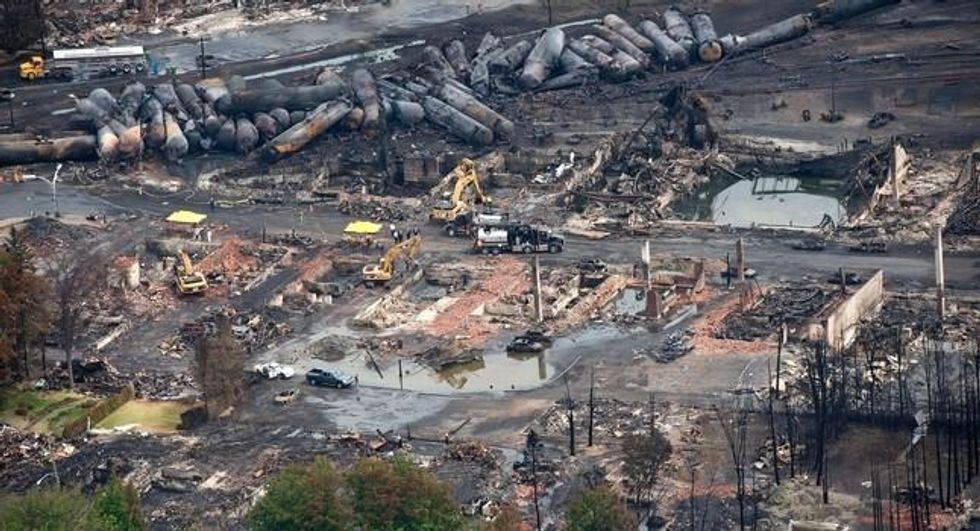
But the recent spate of rail accidents and pipeline leaks and spills doesn't provide arguments for one or the other; instead, it indicates that rapidly increasing oil and gas development and shipping ever greater amounts, by any method, will mean more accidents, spills, environmental damage--even death. The answer is to step back from this reckless plunder and consider ways to reduce our fossil fuel use.
"If we were to slow down oil sands development, encourage conservation and invest in clean energy technology, we could save money, ecosystems, and lives."
If we were to slow down oil sands development, encourage conservation and invest in clean energy technology, we could save money, ecosystems, and lives--and we'd still have valuable fossil fuel resources long into the future, perhaps until we've figured out ways to use them that aren't so wasteful. We wouldn't need to build more pipelines just to sell oil and gas as quickly as possible, mostly to foreign markets. We wouldn't have to send so many unsafe rail tankers through wilderness areas and places people live.
We may forgo some of the short-term jobs and economic opportunities the fossil fuel industry provides, but surely we can find better ways to keep people employed and the economy humming. Gambling, selling guns and drugs and encouraging people to smoke all create jobs and economic benefits, too--but we rightly try to limit those activities when the harms outweigh the benefits.
Both transportation methods come with significant risks. Shipping by rail leads to more accidents and spills, but pipeline leaks usually involve much larger volumes. One of the reasons we're seeing more train accidents involving fossil fuels is the incredible boom in moving these products by rail. According to the American Association of Railroads, train shipment of crude oil in the U.S. grew from 9,500 carloads in 2008 to 234,000 in 2012--almost 25 times as many in only four years! That's expected to rise to 400,000 this year.
As with pipelines, risks are increased because many rail cars are older and not built to standards that would reduce the chances of leaks and explosions when accidents occur. Some in the rail industry argue it would cost too much to replace all the tank cars as quickly as is needed to move the ever-increasing volumes of oil. We must improve rail safety and pipeline infrastructure for the oil and gas that we'll continue to ship for the foreseeable future, but we must also find ways to transport less.
The economic arguments for massive oil sands and liquefied natural gas development and expansion aren't great to begin with--at least with the way our federal and provincial governments are going about it. Despite a boom in oil sands growth and production, "Alberta has run consecutive budget deficits since 2008 and since then has burned through $15 billion of its sustainability fund," according to an article on the Tyee website. The Canadian Taxpayers Federation says Alberta's debt is now $7 billion and growing by $11 million daily.
As for jobs, a 2012 report by the Canadian Centre for Policy Alternatives shows less than one per cent of Canadian workers are employed in extraction and production of oil, coal and natural gas. Pipelines and fossil fuel development are not great long-term job creators, and pale in comparison to employment generated by the renewable energy sector.
Beyond the danger to the environment and human health, the worst risk from rapid expansion of oil sands, coal mines and gas fields and the infrastructure needed to transport the fuels is the carbon emissions from burning their products--regardless of whether that happens here, in China or elsewhere. Many climate scientists and energy experts, including the International Energy Agency, agree that to have any chance of avoiding catastrophic climate change, we must leave at least two-thirds of our remaining fossil fuels in the ground.
The question isn't about whether to use rail or pipelines. It's about how to reduce our need for both.
With contributions from from David Suzuki Foundation Senior Editor Ian Hanington. Learn more at www.davidsuzuki.org.
But the recent spate of rail accidents and pipeline leaks and spills doesn't provide arguments for one or the other; instead, it indicates that rapidly increasing oil and gas development and shipping ever greater amounts, by any method, will mean more accidents, spills, environmental damage--even death. The answer is to step back from this reckless plunder and consider ways to reduce our fossil fuel use.
"If we were to slow down oil sands development, encourage conservation and invest in clean energy technology, we could save money, ecosystems, and lives."
If we were to slow down oil sands development, encourage conservation and invest in clean energy technology, we could save money, ecosystems, and lives--and we'd still have valuable fossil fuel resources long into the future, perhaps until we've figured out ways to use them that aren't so wasteful. We wouldn't need to build more pipelines just to sell oil and gas as quickly as possible, mostly to foreign markets. We wouldn't have to send so many unsafe rail tankers through wilderness areas and places people live.
We may forgo some of the short-term jobs and economic opportunities the fossil fuel industry provides, but surely we can find better ways to keep people employed and the economy humming. Gambling, selling guns and drugs and encouraging people to smoke all create jobs and economic benefits, too--but we rightly try to limit those activities when the harms outweigh the benefits.
Both transportation methods come with significant risks. Shipping by rail leads to more accidents and spills, but pipeline leaks usually involve much larger volumes. One of the reasons we're seeing more train accidents involving fossil fuels is the incredible boom in moving these products by rail. According to the American Association of Railroads, train shipment of crude oil in the U.S. grew from 9,500 carloads in 2008 to 234,000 in 2012--almost 25 times as many in only four years! That's expected to rise to 400,000 this year.
As with pipelines, risks are increased because many rail cars are older and not built to standards that would reduce the chances of leaks and explosions when accidents occur. Some in the rail industry argue it would cost too much to replace all the tank cars as quickly as is needed to move the ever-increasing volumes of oil. We must improve rail safety and pipeline infrastructure for the oil and gas that we'll continue to ship for the foreseeable future, but we must also find ways to transport less.
The economic arguments for massive oil sands and liquefied natural gas development and expansion aren't great to begin with--at least with the way our federal and provincial governments are going about it. Despite a boom in oil sands growth and production, "Alberta has run consecutive budget deficits since 2008 and since then has burned through $15 billion of its sustainability fund," according to an article on the Tyee website. The Canadian Taxpayers Federation says Alberta's debt is now $7 billion and growing by $11 million daily.
As for jobs, a 2012 report by the Canadian Centre for Policy Alternatives shows less than one per cent of Canadian workers are employed in extraction and production of oil, coal and natural gas. Pipelines and fossil fuel development are not great long-term job creators, and pale in comparison to employment generated by the renewable energy sector.
Beyond the danger to the environment and human health, the worst risk from rapid expansion of oil sands, coal mines and gas fields and the infrastructure needed to transport the fuels is the carbon emissions from burning their products--regardless of whether that happens here, in China or elsewhere. Many climate scientists and energy experts, including the International Energy Agency, agree that to have any chance of avoiding catastrophic climate change, we must leave at least two-thirds of our remaining fossil fuels in the ground.
The question isn't about whether to use rail or pipelines. It's about how to reduce our need for both.
With contributions from from David Suzuki Foundation Senior Editor Ian Hanington. Learn more at www.davidsuzuki.org.
But the recent spate of rail accidents and pipeline leaks and spills doesn't provide arguments for one or the other; instead, it indicates that rapidly increasing oil and gas development and shipping ever greater amounts, by any method, will mean more accidents, spills, environmental damage--even death. The answer is to step back from this reckless plunder and consider ways to reduce our fossil fuel use.
"If we were to slow down oil sands development, encourage conservation and invest in clean energy technology, we could save money, ecosystems, and lives."
If we were to slow down oil sands development, encourage conservation and invest in clean energy technology, we could save money, ecosystems, and lives--and we'd still have valuable fossil fuel resources long into the future, perhaps until we've figured out ways to use them that aren't so wasteful. We wouldn't need to build more pipelines just to sell oil and gas as quickly as possible, mostly to foreign markets. We wouldn't have to send so many unsafe rail tankers through wilderness areas and places people live.
We may forgo some of the short-term jobs and economic opportunities the fossil fuel industry provides, but surely we can find better ways to keep people employed and the economy humming. Gambling, selling guns and drugs and encouraging people to smoke all create jobs and economic benefits, too--but we rightly try to limit those activities when the harms outweigh the benefits.
Both transportation methods come with significant risks. Shipping by rail leads to more accidents and spills, but pipeline leaks usually involve much larger volumes. One of the reasons we're seeing more train accidents involving fossil fuels is the incredible boom in moving these products by rail. According to the American Association of Railroads, train shipment of crude oil in the U.S. grew from 9,500 carloads in 2008 to 234,000 in 2012--almost 25 times as many in only four years! That's expected to rise to 400,000 this year.
As with pipelines, risks are increased because many rail cars are older and not built to standards that would reduce the chances of leaks and explosions when accidents occur. Some in the rail industry argue it would cost too much to replace all the tank cars as quickly as is needed to move the ever-increasing volumes of oil. We must improve rail safety and pipeline infrastructure for the oil and gas that we'll continue to ship for the foreseeable future, but we must also find ways to transport less.
The economic arguments for massive oil sands and liquefied natural gas development and expansion aren't great to begin with--at least with the way our federal and provincial governments are going about it. Despite a boom in oil sands growth and production, "Alberta has run consecutive budget deficits since 2008 and since then has burned through $15 billion of its sustainability fund," according to an article on the Tyee website. The Canadian Taxpayers Federation says Alberta's debt is now $7 billion and growing by $11 million daily.
As for jobs, a 2012 report by the Canadian Centre for Policy Alternatives shows less than one per cent of Canadian workers are employed in extraction and production of oil, coal and natural gas. Pipelines and fossil fuel development are not great long-term job creators, and pale in comparison to employment generated by the renewable energy sector.
Beyond the danger to the environment and human health, the worst risk from rapid expansion of oil sands, coal mines and gas fields and the infrastructure needed to transport the fuels is the carbon emissions from burning their products--regardless of whether that happens here, in China or elsewhere. Many climate scientists and energy experts, including the International Energy Agency, agree that to have any chance of avoiding catastrophic climate change, we must leave at least two-thirds of our remaining fossil fuels in the ground.
The question isn't about whether to use rail or pipelines. It's about how to reduce our need for both.
With contributions from from David Suzuki Foundation Senior Editor Ian Hanington. Learn more at www.davidsuzuki.org.