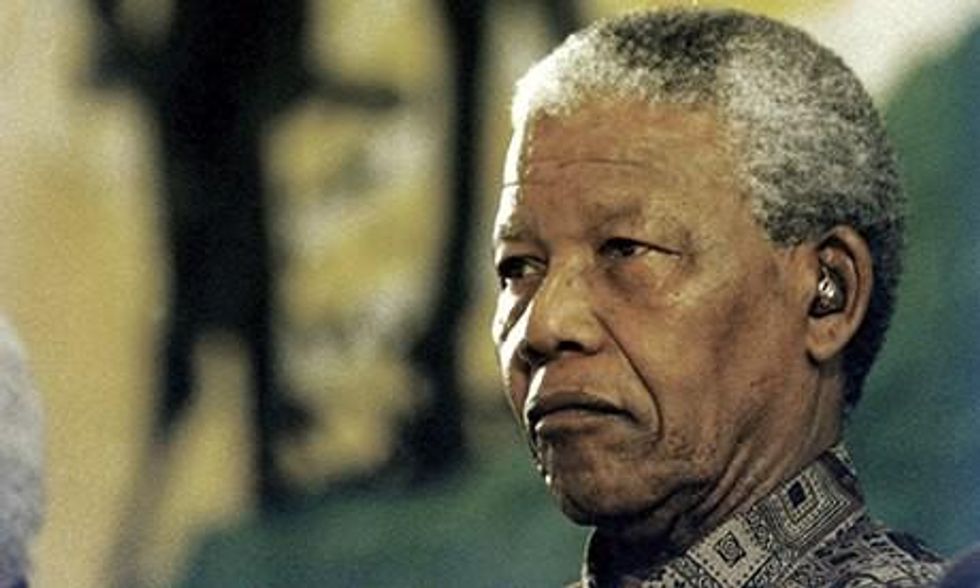
If Nelson Mandela Really Had Won, He Wouldn't Be Seen as a Universal Hero
Mandela must have died a bitter man. To honor his legacy, we should focus on the unfulfilled promises his leadership gave rise to

Is this, however, the whole story? Two key facts remain obliterated by this celebratory vision. In South Africa, the miserable life of the poor majority broadly remains the same as under apartheid, and the rise of political and civil rights is counterbalanced by the growing insecurity, violence and crime. The main change is that the old white ruling class is joined by the new black elite. Second, people remember the old African National Congress that promised not only the end of apartheid, but also more social justice, even a kind of socialism. This much more radical ANC past is gradually obliterated from our memory. No wonder that anger is growing among poor, black South Africans.
South Africa in this respect is just one version of the recurrent story of the contemporary left. A leader or party is elected with universal enthusiasm, promising a "new world" - but, then, sooner or later, they stumble upon the key dilemma: does one dare to touch the capitalist mechanisms, or does one decide to "play the game"? If one disturbs these mechanisms, one is very swiftly "punished" by market perturbations, economic chaos and the rest. This is why it is all too simple to criticize Mandela for abandoning the socialist perspective after the end of apartheid: did he really have a choice? Was the move towards socialism a real option?
It is easy to ridicule Ayn Rand, but there is a grain of truth in the famous "hymn to money" from her novel Atlas Shrugged: "Until and unless you discover that money is the root of all good, you ask for your own destruction. When money ceases to become the means by which men deal with one another, then men become the tools of other men. Blood, whips and guns or dollars. Take your choice - there is no other." Did Marx not say something similar in his well-known formula of how, in the universe of commodities, "relations between people assume the guise of relations among things"?
In the market economy, relations between people can appear as relations of mutually recognized freedom and equality: domination is no longer directly enacted and visible as such. What is problematic is Rand's underlying premise: that the only choice is between direct and indirect relations of domination and exploitation, with any alternative dismissed as utopian. However, one should nonetheless bear in mind the moment of truth in Rand's otherwise ridiculously ideological claim: the great lesson of state socialism was effectively that a direct abolition of private property and market-regulated exchange, lacking concrete forms of social regulation of the process of production, necessarily resuscitates direct relations of servitude and domination. If we merely abolish the market (inclusive of market exploitation) without replacing it with a proper form of the communist organization of production and exchange, domination returns with a vengeance, and with it direct exploitation.
The general rule is that when a revolt begins against an oppressive half-democratic regime, as was the case in the Middle East in 2011, it is easy to mobilize large crowds with slogans that one cannot but characterize as crowd pleasers - for democracy, against corruption, for instance. But then we gradually approach more difficult choices, when our revolt succeeds in its direct goal, we come to realize that what really bothered us (our un-freedom, humiliation, social corruption, lack of prospect of a decent life) goes on in a new guise. The ruling ideology mobilizes here its entire arsenal to prevent us from reaching this radical conclusion. They start to tell us that democratic freedom brings its own responsibility, that it comes at a price, that we are not yet mature if we expect too much from democracy. In this way, they blame us for our failure: in a free society, so we are told, we are all capitalist investing in our lives, deciding to put more into our education than into having fun if we want to succeed.
At a more directly political level, United States foreign policy elaborated a detailed strategy of how to exert damage control by way of rechanneling a popular uprising into acceptable parliamentary-capitalist constraints - as was done successfully in South Africa after the fall of apartheid regime, in Philippines after the fall of Marcos, in Indonesia after the fall of Suharto and elsewhere. At this precise conjuncture, radical emancipatory politics faces its greatest challenge: how to push things further after the first enthusiastic stage is over, how to make the next step without succumbing to the catastrophe of the "totalitarian" temptation - in short, how to move further from Mandela without becoming Mugabe.
If we want to remain faithful to Mandela's legacy, we should thus forget about celebratory crocodile tears and focus on the unfulfilled promises his leadership gave rise to. We can safely surmise that, on account of his doubtless moral and political greatness, he was at the end of his life also a bitter old man, well aware how his very political triumph and his elevation into a universal hero was the mask of a bitter defeat. His universal glory is also a sign that he really didn't disturb the global order of power.
Urgent. It's never been this bad.
Dear Common Dreams reader, It’s been nearly 30 years since I co-founded Common Dreams with my late wife, Lina Newhouser. We had the radical notion that journalism should serve the public good, not corporate profits. It was clear to us from the outset what it would take to build such a project. No paid advertisements. No corporate sponsors. No millionaire publisher telling us what to think or do. Many people said we wouldn't last a year, but we proved those doubters wrong. Together with a tremendous team of journalists and dedicated staff, we built an independent media outlet free from the constraints of profits and corporate control. Our mission from the outset was simple. To inform. To inspire. To ignite change for the common good. Building Common Dreams was not easy. Our survival was never guaranteed. When you take on the most powerful forces—Wall Street greed, fossil fuel industry destruction, Big Tech lobbyists, and uber-rich oligarchs who have spent billions upon billions rigging the economy and democracy in their favor—the only bulwark you have is supporters who believe in your work. But here’s the urgent message from me today. It’s never been this bad out there. And it’s never been this hard to keep us going. At the very moment Common Dreams is most needed and doing some of its best and most important work, the threats we face are intensifying. Right now, with just three days to go in our Spring Campaign, we're falling short of our make-or-break goal. When everyone does the little they can afford, we are strong. But if that support retreats or dries up, so do we. Can you make a gift right now to make sure Common Dreams not only survives but thrives? There is no backup plan or rainy day fund. There is only you. —Craig Brown, Co-founder |

Is this, however, the whole story? Two key facts remain obliterated by this celebratory vision. In South Africa, the miserable life of the poor majority broadly remains the same as under apartheid, and the rise of political and civil rights is counterbalanced by the growing insecurity, violence and crime. The main change is that the old white ruling class is joined by the new black elite. Second, people remember the old African National Congress that promised not only the end of apartheid, but also more social justice, even a kind of socialism. This much more radical ANC past is gradually obliterated from our memory. No wonder that anger is growing among poor, black South Africans.
South Africa in this respect is just one version of the recurrent story of the contemporary left. A leader or party is elected with universal enthusiasm, promising a "new world" - but, then, sooner or later, they stumble upon the key dilemma: does one dare to touch the capitalist mechanisms, or does one decide to "play the game"? If one disturbs these mechanisms, one is very swiftly "punished" by market perturbations, economic chaos and the rest. This is why it is all too simple to criticize Mandela for abandoning the socialist perspective after the end of apartheid: did he really have a choice? Was the move towards socialism a real option?
It is easy to ridicule Ayn Rand, but there is a grain of truth in the famous "hymn to money" from her novel Atlas Shrugged: "Until and unless you discover that money is the root of all good, you ask for your own destruction. When money ceases to become the means by which men deal with one another, then men become the tools of other men. Blood, whips and guns or dollars. Take your choice - there is no other." Did Marx not say something similar in his well-known formula of how, in the universe of commodities, "relations between people assume the guise of relations among things"?
In the market economy, relations between people can appear as relations of mutually recognized freedom and equality: domination is no longer directly enacted and visible as such. What is problematic is Rand's underlying premise: that the only choice is between direct and indirect relations of domination and exploitation, with any alternative dismissed as utopian. However, one should nonetheless bear in mind the moment of truth in Rand's otherwise ridiculously ideological claim: the great lesson of state socialism was effectively that a direct abolition of private property and market-regulated exchange, lacking concrete forms of social regulation of the process of production, necessarily resuscitates direct relations of servitude and domination. If we merely abolish the market (inclusive of market exploitation) without replacing it with a proper form of the communist organization of production and exchange, domination returns with a vengeance, and with it direct exploitation.
The general rule is that when a revolt begins against an oppressive half-democratic regime, as was the case in the Middle East in 2011, it is easy to mobilize large crowds with slogans that one cannot but characterize as crowd pleasers - for democracy, against corruption, for instance. But then we gradually approach more difficult choices, when our revolt succeeds in its direct goal, we come to realize that what really bothered us (our un-freedom, humiliation, social corruption, lack of prospect of a decent life) goes on in a new guise. The ruling ideology mobilizes here its entire arsenal to prevent us from reaching this radical conclusion. They start to tell us that democratic freedom brings its own responsibility, that it comes at a price, that we are not yet mature if we expect too much from democracy. In this way, they blame us for our failure: in a free society, so we are told, we are all capitalist investing in our lives, deciding to put more into our education than into having fun if we want to succeed.
At a more directly political level, United States foreign policy elaborated a detailed strategy of how to exert damage control by way of rechanneling a popular uprising into acceptable parliamentary-capitalist constraints - as was done successfully in South Africa after the fall of apartheid regime, in Philippines after the fall of Marcos, in Indonesia after the fall of Suharto and elsewhere. At this precise conjuncture, radical emancipatory politics faces its greatest challenge: how to push things further after the first enthusiastic stage is over, how to make the next step without succumbing to the catastrophe of the "totalitarian" temptation - in short, how to move further from Mandela without becoming Mugabe.
If we want to remain faithful to Mandela's legacy, we should thus forget about celebratory crocodile tears and focus on the unfulfilled promises his leadership gave rise to. We can safely surmise that, on account of his doubtless moral and political greatness, he was at the end of his life also a bitter old man, well aware how his very political triumph and his elevation into a universal hero was the mask of a bitter defeat. His universal glory is also a sign that he really didn't disturb the global order of power.


Is this, however, the whole story? Two key facts remain obliterated by this celebratory vision. In South Africa, the miserable life of the poor majority broadly remains the same as under apartheid, and the rise of political and civil rights is counterbalanced by the growing insecurity, violence and crime. The main change is that the old white ruling class is joined by the new black elite. Second, people remember the old African National Congress that promised not only the end of apartheid, but also more social justice, even a kind of socialism. This much more radical ANC past is gradually obliterated from our memory. No wonder that anger is growing among poor, black South Africans.
South Africa in this respect is just one version of the recurrent story of the contemporary left. A leader or party is elected with universal enthusiasm, promising a "new world" - but, then, sooner or later, they stumble upon the key dilemma: does one dare to touch the capitalist mechanisms, or does one decide to "play the game"? If one disturbs these mechanisms, one is very swiftly "punished" by market perturbations, economic chaos and the rest. This is why it is all too simple to criticize Mandela for abandoning the socialist perspective after the end of apartheid: did he really have a choice? Was the move towards socialism a real option?
It is easy to ridicule Ayn Rand, but there is a grain of truth in the famous "hymn to money" from her novel Atlas Shrugged: "Until and unless you discover that money is the root of all good, you ask for your own destruction. When money ceases to become the means by which men deal with one another, then men become the tools of other men. Blood, whips and guns or dollars. Take your choice - there is no other." Did Marx not say something similar in his well-known formula of how, in the universe of commodities, "relations between people assume the guise of relations among things"?
In the market economy, relations between people can appear as relations of mutually recognized freedom and equality: domination is no longer directly enacted and visible as such. What is problematic is Rand's underlying premise: that the only choice is between direct and indirect relations of domination and exploitation, with any alternative dismissed as utopian. However, one should nonetheless bear in mind the moment of truth in Rand's otherwise ridiculously ideological claim: the great lesson of state socialism was effectively that a direct abolition of private property and market-regulated exchange, lacking concrete forms of social regulation of the process of production, necessarily resuscitates direct relations of servitude and domination. If we merely abolish the market (inclusive of market exploitation) without replacing it with a proper form of the communist organization of production and exchange, domination returns with a vengeance, and with it direct exploitation.
The general rule is that when a revolt begins against an oppressive half-democratic regime, as was the case in the Middle East in 2011, it is easy to mobilize large crowds with slogans that one cannot but characterize as crowd pleasers - for democracy, against corruption, for instance. But then we gradually approach more difficult choices, when our revolt succeeds in its direct goal, we come to realize that what really bothered us (our un-freedom, humiliation, social corruption, lack of prospect of a decent life) goes on in a new guise. The ruling ideology mobilizes here its entire arsenal to prevent us from reaching this radical conclusion. They start to tell us that democratic freedom brings its own responsibility, that it comes at a price, that we are not yet mature if we expect too much from democracy. In this way, they blame us for our failure: in a free society, so we are told, we are all capitalist investing in our lives, deciding to put more into our education than into having fun if we want to succeed.
At a more directly political level, United States foreign policy elaborated a detailed strategy of how to exert damage control by way of rechanneling a popular uprising into acceptable parliamentary-capitalist constraints - as was done successfully in South Africa after the fall of apartheid regime, in Philippines after the fall of Marcos, in Indonesia after the fall of Suharto and elsewhere. At this precise conjuncture, radical emancipatory politics faces its greatest challenge: how to push things further after the first enthusiastic stage is over, how to make the next step without succumbing to the catastrophe of the "totalitarian" temptation - in short, how to move further from Mandela without becoming Mugabe.
If we want to remain faithful to Mandela's legacy, we should thus forget about celebratory crocodile tears and focus on the unfulfilled promises his leadership gave rise to. We can safely surmise that, on account of his doubtless moral and political greatness, he was at the end of his life also a bitter old man, well aware how his very political triumph and his elevation into a universal hero was the mask of a bitter defeat. His universal glory is also a sign that he really didn't disturb the global order of power.