

SUBSCRIBE TO OUR FREE NEWSLETTER
Daily news & progressive opinion—funded by the people, not the corporations—delivered straight to your inbox.
5
#000000
#FFFFFF
To donate by check, phone, or other method, see our More Ways to Give page.
No matter how many times we've seen it before, the frenzy for launching a military attack on another country is -- to the extent we're not numb -- profoundly upsetting. Tanked up with talking points in Washington, top officials drive policy while intoxicated with what Martin Luther King Jr. called "the madness of militarism," and most media coverage becomes similarly unhinged. That's where we are now.
But new variables have opened up possibilities for disrupting the repetitive plunge to war. Syria is in the crosshairs of U.S. firepower, but cracks in the political machinery of the warfare state are widening here at home. For advocates of militarism and empire by any other name, the specter of democratic constraint looms as an ominous threat.
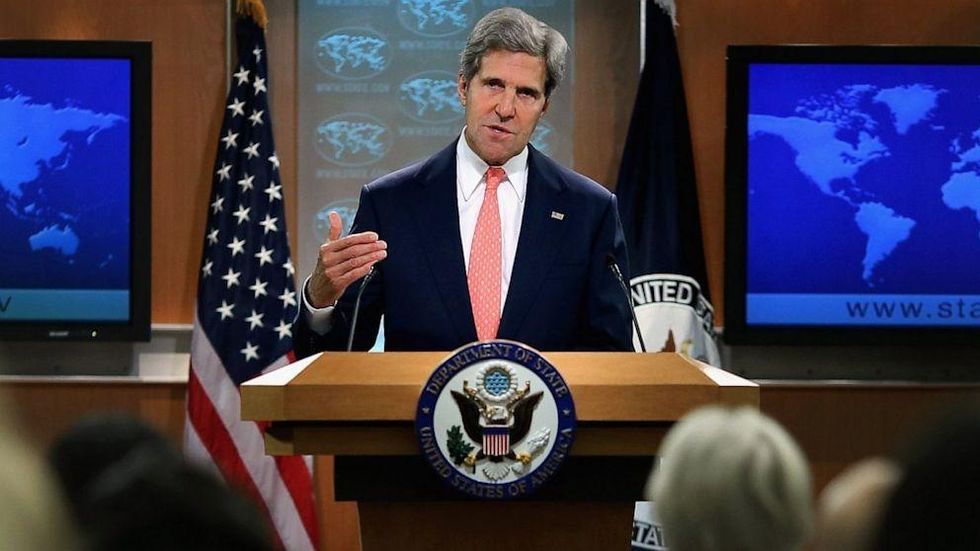
Into the Capitol Hill arena, the Obama White House sent Secretary of State John Kerry to speak in a best-and-brightest dialect of neocon tongues. The congressional hierarchies of both parties -- Nancy Pelosi, Steny Hoyer, John Boehner, Eric Cantor -- are on the same page for an attack on Syria. And meanwhile, the U.S. mass media have been cranking up the usual adrenalin-pumped hype for war.
More than 10 years ago, American media outlets were filled with breathless idolatry of the latest U.S. weapons poised to strike Iraq. Now, the big TV networks are at it again - starting to hype the Pentagon's high-tech arsenal that's ready to demolish Syrian targets. Of course the people at the other end of the weaponry aren't in the picture.
The Media Education Foundation has just posted a two-minute montage of coverage from MSNBC, Fox and CNN idolizing the latest Pentagon weaponry for use in the Iraq invasion a decade ago -- as well as Walter Cronkite doing the same on CBS during the Vietnam War. As a present-day bookend, a CNN clip from a few days ago provides a glimpse of how little has changed (except for slicker on-screen graphics).
But the usual agenda-building for war may not work this time.
The first week of September has stunned the military-industrial-media complex. It began with a familiar bellicose call for action from the president, seconded by leaders of both parties on Capitol Hill and echoed by mass media. And yet by the end of the week, grassroots opposition had interrupted the war momentum.
Senators and members of the House are being overwhelmed with anti-war messages via email, fax and phone. People are rising up to demand that Congress vote against launching a war on yet another country.
Whether Obama would actually abide by failure to gain congressional "authorization" to attack Syria is by no means clear. But our immediate task is to create such a failure.
This is a pivotal juncture of history in real time, an "all hands on deck" moment to exert enough public pressure to prevent a war-on-Syria resolution from getting through Congress. Such an outcome would thoroughly delegitimize any order from Obama to attack Syria. In the process, we would make real progress against the masters of war.
There's an antidote to the repetition compulsion for war. It's called democracy.
No matter how many times we've seen it before, the frenzy for launching a military attack on another country is -- to the extent we're not numb -- profoundly upsetting. Tanked up with talking points in Washington, top officials drive policy while intoxicated with what Martin Luther King Jr. called "the madness of militarism," and most media coverage becomes similarly unhinged. That's where we are now.
But new variables have opened up possibilities for disrupting the repetitive plunge to war. Syria is in the crosshairs of U.S. firepower, but cracks in the political machinery of the warfare state are widening here at home. For advocates of militarism and empire by any other name, the specter of democratic constraint looms as an ominous threat.
Into the Capitol Hill arena, the Obama White House sent Secretary of State John Kerry to speak in a best-and-brightest dialect of neocon tongues. The congressional hierarchies of both parties -- Nancy Pelosi, Steny Hoyer, John Boehner, Eric Cantor -- are on the same page for an attack on Syria. And meanwhile, the U.S. mass media have been cranking up the usual adrenalin-pumped hype for war.
More than 10 years ago, American media outlets were filled with breathless idolatry of the latest U.S. weapons poised to strike Iraq. Now, the big TV networks are at it again - starting to hype the Pentagon's high-tech arsenal that's ready to demolish Syrian targets. Of course the people at the other end of the weaponry aren't in the picture.
The Media Education Foundation has just posted a two-minute montage of coverage from MSNBC, Fox and CNN idolizing the latest Pentagon weaponry for use in the Iraq invasion a decade ago -- as well as Walter Cronkite doing the same on CBS during the Vietnam War. As a present-day bookend, a CNN clip from a few days ago provides a glimpse of how little has changed (except for slicker on-screen graphics).
But the usual agenda-building for war may not work this time.
The first week of September has stunned the military-industrial-media complex. It began with a familiar bellicose call for action from the president, seconded by leaders of both parties on Capitol Hill and echoed by mass media. And yet by the end of the week, grassroots opposition had interrupted the war momentum.
Senators and members of the House are being overwhelmed with anti-war messages via email, fax and phone. People are rising up to demand that Congress vote against launching a war on yet another country.
Whether Obama would actually abide by failure to gain congressional "authorization" to attack Syria is by no means clear. But our immediate task is to create such a failure.
This is a pivotal juncture of history in real time, an "all hands on deck" moment to exert enough public pressure to prevent a war-on-Syria resolution from getting through Congress. Such an outcome would thoroughly delegitimize any order from Obama to attack Syria. In the process, we would make real progress against the masters of war.
There's an antidote to the repetition compulsion for war. It's called democracy.
No matter how many times we've seen it before, the frenzy for launching a military attack on another country is -- to the extent we're not numb -- profoundly upsetting. Tanked up with talking points in Washington, top officials drive policy while intoxicated with what Martin Luther King Jr. called "the madness of militarism," and most media coverage becomes similarly unhinged. That's where we are now.
But new variables have opened up possibilities for disrupting the repetitive plunge to war. Syria is in the crosshairs of U.S. firepower, but cracks in the political machinery of the warfare state are widening here at home. For advocates of militarism and empire by any other name, the specter of democratic constraint looms as an ominous threat.
Into the Capitol Hill arena, the Obama White House sent Secretary of State John Kerry to speak in a best-and-brightest dialect of neocon tongues. The congressional hierarchies of both parties -- Nancy Pelosi, Steny Hoyer, John Boehner, Eric Cantor -- are on the same page for an attack on Syria. And meanwhile, the U.S. mass media have been cranking up the usual adrenalin-pumped hype for war.
More than 10 years ago, American media outlets were filled with breathless idolatry of the latest U.S. weapons poised to strike Iraq. Now, the big TV networks are at it again - starting to hype the Pentagon's high-tech arsenal that's ready to demolish Syrian targets. Of course the people at the other end of the weaponry aren't in the picture.
The Media Education Foundation has just posted a two-minute montage of coverage from MSNBC, Fox and CNN idolizing the latest Pentagon weaponry for use in the Iraq invasion a decade ago -- as well as Walter Cronkite doing the same on CBS during the Vietnam War. As a present-day bookend, a CNN clip from a few days ago provides a glimpse of how little has changed (except for slicker on-screen graphics).
But the usual agenda-building for war may not work this time.
The first week of September has stunned the military-industrial-media complex. It began with a familiar bellicose call for action from the president, seconded by leaders of both parties on Capitol Hill and echoed by mass media. And yet by the end of the week, grassroots opposition had interrupted the war momentum.
Senators and members of the House are being overwhelmed with anti-war messages via email, fax and phone. People are rising up to demand that Congress vote against launching a war on yet another country.
Whether Obama would actually abide by failure to gain congressional "authorization" to attack Syria is by no means clear. But our immediate task is to create such a failure.
This is a pivotal juncture of history in real time, an "all hands on deck" moment to exert enough public pressure to prevent a war-on-Syria resolution from getting through Congress. Such an outcome would thoroughly delegitimize any order from Obama to attack Syria. In the process, we would make real progress against the masters of war.
There's an antidote to the repetition compulsion for war. It's called democracy.

