SUBSCRIBE TO OUR FREE NEWSLETTER
Daily news & progressive opinion—funded by the people, not the corporations—delivered straight to your inbox.
5
#000000
#FFFFFF
To donate by check, phone, or other method, see our More Ways to Give page.
Barry Commoner (1917-2012) had a deep influence on Greenpeace back in the 1980s and 1990s, and was often way ahead of us on particular fronts. Back then, his books were on shelves all over the office, especially Making Peace With the Planet, a powerful, integrated analysis of the environmental crisis. Barry was an adviser to Greenpeace's Toxics Campaign who spoke at Greenpeace-sponsored conferences, authored at least one GP report ("Breaking Down the Degradable Plastics Scam" made a point so simple that I still remember it -- which is that if a polymer doesn't break down to smaller monomers that are less than 50 microns in size, they won't get assimilated into the food web and therefore cannot be called "biodegradable" -- the report itself was a very useful challenge to a specific example of what we commonly refer to now as "greenwashing").
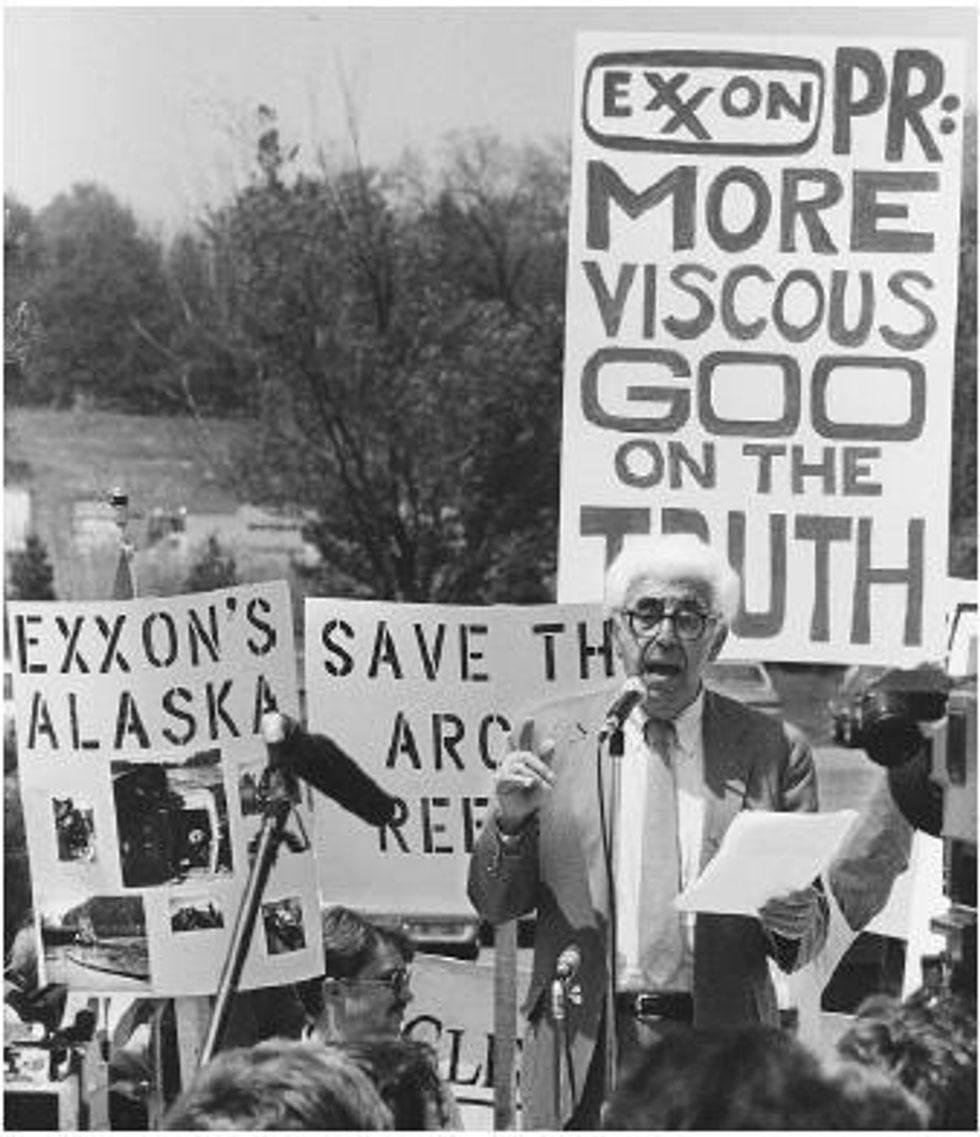
Barry spoke at at a few GP conferences. Greenpeace's legislative director Rick Hind probably still has a cassette somewhere of one such speech, "Breaking the Chlorine Trap," which Dr. Commoner delivered at the Greenpeace Chlorine-free Great Lakes Conference, held in Michigan in 1992.
To get a sense of how great a communicator of scientific principles he was, it's worth watching the video that the NYT posted on their site.
Ralph Nader calls Barry Commoner "the greatest environmentalist of the 20th century." It's hard to argue with that: As the NYTimes obituary attests, Commoner's range of investigative prowess was impressive and groundbreaking on a variety of fronts. He not only conducted cutting-edge research on important issues, but he popularized the results -- thereby changing the entire zeitgeist of scientific culture, making it "the people's" business -- not the diced up array of specialized academic enclaves that so often incentivize political cowardice and the failure of common sense. For example, when Barry was asked for his opinion of "cap and trade" approaches to solving climate change (i.e. pollution credit swaps), he "scorned" the idea for rewarding companies for "fouling the environment in the first place."
Commoner was an organic yet systemic thinker ("the first rule of ecology is that everything is connected to everything else"). His framework for debating industrial policy was guided by practical concerns about public health and economic justice.
So much of his research not only exposed industry lies, but served to galvanize public opinion and action. For example, he mobilized mothers against atmospheric nuclear weapons testing by demonstrating how the radioactive fallout (Strontium90) ended up in children's teeth via milk.
At a time when industry-funded climate deniers have successfully stymied public debate, and Monsanto and other GMO companies use their monopoly patents to obstruct independent research and even attack researchers brave enough to investigate regardless, we could use more scientists like Barry Commoner.
Barry Commoner (1917-2012) had a deep influence on Greenpeace back in the 1980s and 1990s, and was often way ahead of us on particular fronts. Back then, his books were on shelves all over the office, especially Making Peace With the Planet, a powerful, integrated analysis of the environmental crisis. Barry was an adviser to Greenpeace's Toxics Campaign who spoke at Greenpeace-sponsored conferences, authored at least one GP report ("Breaking Down the Degradable Plastics Scam" made a point so simple that I still remember it -- which is that if a polymer doesn't break down to smaller monomers that are less than 50 microns in size, they won't get assimilated into the food web and therefore cannot be called "biodegradable" -- the report itself was a very useful challenge to a specific example of what we commonly refer to now as "greenwashing").
Barry spoke at at a few GP conferences. Greenpeace's legislative director Rick Hind probably still has a cassette somewhere of one such speech, "Breaking the Chlorine Trap," which Dr. Commoner delivered at the Greenpeace Chlorine-free Great Lakes Conference, held in Michigan in 1992.
To get a sense of how great a communicator of scientific principles he was, it's worth watching the video that the NYT posted on their site.
Ralph Nader calls Barry Commoner "the greatest environmentalist of the 20th century." It's hard to argue with that: As the NYTimes obituary attests, Commoner's range of investigative prowess was impressive and groundbreaking on a variety of fronts. He not only conducted cutting-edge research on important issues, but he popularized the results -- thereby changing the entire zeitgeist of scientific culture, making it "the people's" business -- not the diced up array of specialized academic enclaves that so often incentivize political cowardice and the failure of common sense. For example, when Barry was asked for his opinion of "cap and trade" approaches to solving climate change (i.e. pollution credit swaps), he "scorned" the idea for rewarding companies for "fouling the environment in the first place."
Commoner was an organic yet systemic thinker ("the first rule of ecology is that everything is connected to everything else"). His framework for debating industrial policy was guided by practical concerns about public health and economic justice.
So much of his research not only exposed industry lies, but served to galvanize public opinion and action. For example, he mobilized mothers against atmospheric nuclear weapons testing by demonstrating how the radioactive fallout (Strontium90) ended up in children's teeth via milk.
At a time when industry-funded climate deniers have successfully stymied public debate, and Monsanto and other GMO companies use their monopoly patents to obstruct independent research and even attack researchers brave enough to investigate regardless, we could use more scientists like Barry Commoner.
Barry Commoner (1917-2012) had a deep influence on Greenpeace back in the 1980s and 1990s, and was often way ahead of us on particular fronts. Back then, his books were on shelves all over the office, especially Making Peace With the Planet, a powerful, integrated analysis of the environmental crisis. Barry was an adviser to Greenpeace's Toxics Campaign who spoke at Greenpeace-sponsored conferences, authored at least one GP report ("Breaking Down the Degradable Plastics Scam" made a point so simple that I still remember it -- which is that if a polymer doesn't break down to smaller monomers that are less than 50 microns in size, they won't get assimilated into the food web and therefore cannot be called "biodegradable" -- the report itself was a very useful challenge to a specific example of what we commonly refer to now as "greenwashing").
Barry spoke at at a few GP conferences. Greenpeace's legislative director Rick Hind probably still has a cassette somewhere of one such speech, "Breaking the Chlorine Trap," which Dr. Commoner delivered at the Greenpeace Chlorine-free Great Lakes Conference, held in Michigan in 1992.
To get a sense of how great a communicator of scientific principles he was, it's worth watching the video that the NYT posted on their site.
Ralph Nader calls Barry Commoner "the greatest environmentalist of the 20th century." It's hard to argue with that: As the NYTimes obituary attests, Commoner's range of investigative prowess was impressive and groundbreaking on a variety of fronts. He not only conducted cutting-edge research on important issues, but he popularized the results -- thereby changing the entire zeitgeist of scientific culture, making it "the people's" business -- not the diced up array of specialized academic enclaves that so often incentivize political cowardice and the failure of common sense. For example, when Barry was asked for his opinion of "cap and trade" approaches to solving climate change (i.e. pollution credit swaps), he "scorned" the idea for rewarding companies for "fouling the environment in the first place."
Commoner was an organic yet systemic thinker ("the first rule of ecology is that everything is connected to everything else"). His framework for debating industrial policy was guided by practical concerns about public health and economic justice.
So much of his research not only exposed industry lies, but served to galvanize public opinion and action. For example, he mobilized mothers against atmospheric nuclear weapons testing by demonstrating how the radioactive fallout (Strontium90) ended up in children's teeth via milk.
At a time when industry-funded climate deniers have successfully stymied public debate, and Monsanto and other GMO companies use their monopoly patents to obstruct independent research and even attack researchers brave enough to investigate regardless, we could use more scientists like Barry Commoner.