SUBSCRIBE TO OUR FREE NEWSLETTER
Daily news & progressive opinion—funded by the people, not the corporations—delivered straight to your inbox.
5
#000000
#FFFFFF
To donate by check, phone, or other method, see our More Ways to Give page.
No wonder those Quebec student protestors have been spooking the English Canadian establishment. If they get their way, the same ideas could catch on here, leaving the best-laid plans for austerity in tatters.
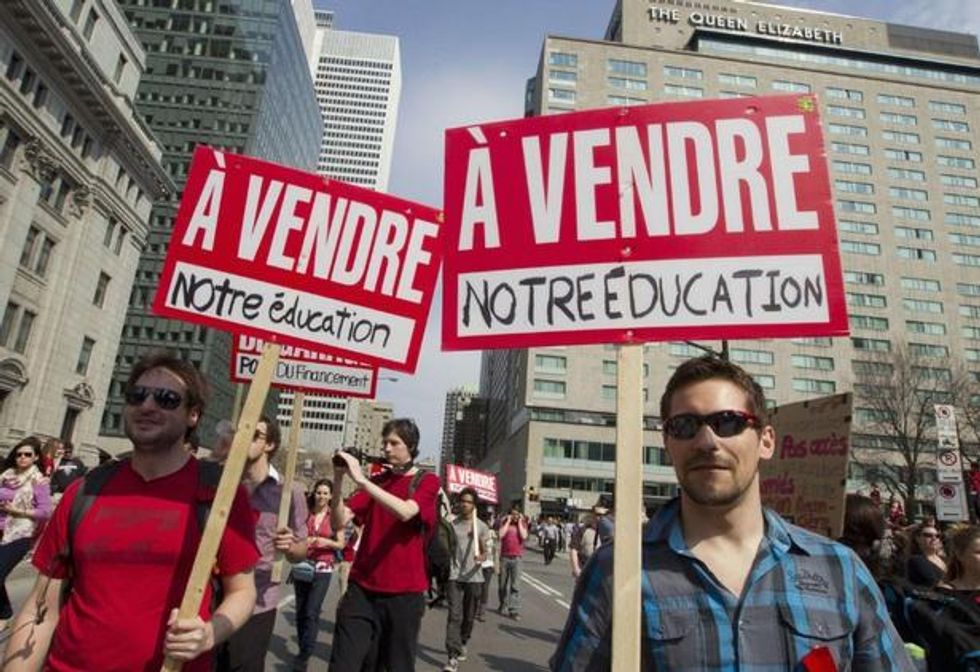
What seems to particularly gall some English Canadian commentators is the fact that the Quebec students -- who reached a tentative deal with the province on the weekend after a three-month strike -- have been protesting tuition hikes that would still leave them with the lowest tuition in the country. Why can't these spoiled brats be grateful, and go back to watching video games and keeping up with the Kardashians like normal, well-adjusted North American youth?
It's that old problem about Quebec. Somehow people there manage to shake a bit loose from the rigid corporate-imposed mindset that has gripped North America in recent decades, convincing us that we as a society must cut back on things -- like university education and old age pensions -- that were somehow affordable in days when our society was a lot less rich.
The Quebec students, more attuned to the outside world, have figured out that this self-denial has more to do with dogma than with some new reality allegedly necessitated by the global economy.
It's an odd form of self-indulgence. Tens of thousands of students have marched hundreds of hours in the cold, potentially jeopardizing their academic (and financial) futures, in order to champion accessible education for all as the cornerstone of a democratic society. If only they could be less self indulgent, and stick to drinking, partying and finding themselves a comfortable niche in the corporate world.
How else to explain the fact that many northern European nations manage to keep university education easily affordable -- even free in Scandinavia -- while managing to compete very effectively in the global economy?
The Norwegian embassy in Ottawa confirmed yesterday that, in addition to free tuition, Norway provides a stipend to cover much of a student's living expenses. (Of course, Norway is blessed with ample oil reserves -- almost as blessed as Canada.)
The Scandinavians -- and the Quebec students -- consider higher education a public good, essential to democracy.
Many Scandinavian countries demonstrate their commitment to this concept -- and to genuine global community -- by even offering free university tuition to foreigners, including North Americans. We reciprocate by treating foreign students like cash cows to be milked relentlessly, charging them tuition fees roughly three times the Canadian rate.
Now there's the spirit of global co-operation!
This lack of generosity toward others isn't surprising since we even throw our own young under the bus. Student debt here, which falls disproportionately on low-income households, now totals $14.4 billion and growing by the second, as demonstrated by the ticking debt clock on the Canadian Federation of Students website.
Of course, high tuition also enables our establishment to keep students on a tight leash, focused on getting into professional and business schools (where they'll have some hope of repaying their debts) and keeping clear of courses that might teach them to question prevailing orthodoxies and mindsets.
Some mistakenly see a generational war going on here. But the austerity fetishists also have their sights set on the older crowd, with plans to take away two years of their retirement.
Under the more sensible Scandinavian approach -- banned under the business dogma that dominates here -- the tax and transfer system helps citizens move through the stages of their lives.
Education is paid for by those in the workforce whose retirement will later be paid for by the students whose education they paid for. Over the life cycle, it all works out. Everybody contributes when they're working, and gets a hand at the beginning and end of their lives.
Everyone also has a chance to develop to the best of their abilities, maximizing their own potential and raising national productivity.
Rex Murphy, writing in the National Post, dismissed the student protests as "the future elite of Quebec having a self-indulgent fit."
It's an odd form of self-indulgence. Tens of thousands of students have marched hundreds of hours in the cold, potentially jeopardizing their academic (and financial) futures, in order to champion accessible education for all as the cornerstone of a democratic society.
If only they could be less self indulgent, and stick to drinking, partying and finding themselves a comfortable niche in the corporate world.
No wonder those Quebec student protestors have been spooking the English Canadian establishment. If they get their way, the same ideas could catch on here, leaving the best-laid plans for austerity in tatters.
What seems to particularly gall some English Canadian commentators is the fact that the Quebec students -- who reached a tentative deal with the province on the weekend after a three-month strike -- have been protesting tuition hikes that would still leave them with the lowest tuition in the country. Why can't these spoiled brats be grateful, and go back to watching video games and keeping up with the Kardashians like normal, well-adjusted North American youth?
It's that old problem about Quebec. Somehow people there manage to shake a bit loose from the rigid corporate-imposed mindset that has gripped North America in recent decades, convincing us that we as a society must cut back on things -- like university education and old age pensions -- that were somehow affordable in days when our society was a lot less rich.
The Quebec students, more attuned to the outside world, have figured out that this self-denial has more to do with dogma than with some new reality allegedly necessitated by the global economy.
It's an odd form of self-indulgence. Tens of thousands of students have marched hundreds of hours in the cold, potentially jeopardizing their academic (and financial) futures, in order to champion accessible education for all as the cornerstone of a democratic society. If only they could be less self indulgent, and stick to drinking, partying and finding themselves a comfortable niche in the corporate world.
How else to explain the fact that many northern European nations manage to keep university education easily affordable -- even free in Scandinavia -- while managing to compete very effectively in the global economy?
The Norwegian embassy in Ottawa confirmed yesterday that, in addition to free tuition, Norway provides a stipend to cover much of a student's living expenses. (Of course, Norway is blessed with ample oil reserves -- almost as blessed as Canada.)
The Scandinavians -- and the Quebec students -- consider higher education a public good, essential to democracy.
Many Scandinavian countries demonstrate their commitment to this concept -- and to genuine global community -- by even offering free university tuition to foreigners, including North Americans. We reciprocate by treating foreign students like cash cows to be milked relentlessly, charging them tuition fees roughly three times the Canadian rate.
Now there's the spirit of global co-operation!
This lack of generosity toward others isn't surprising since we even throw our own young under the bus. Student debt here, which falls disproportionately on low-income households, now totals $14.4 billion and growing by the second, as demonstrated by the ticking debt clock on the Canadian Federation of Students website.
Of course, high tuition also enables our establishment to keep students on a tight leash, focused on getting into professional and business schools (where they'll have some hope of repaying their debts) and keeping clear of courses that might teach them to question prevailing orthodoxies and mindsets.
Some mistakenly see a generational war going on here. But the austerity fetishists also have their sights set on the older crowd, with plans to take away two years of their retirement.
Under the more sensible Scandinavian approach -- banned under the business dogma that dominates here -- the tax and transfer system helps citizens move through the stages of their lives.
Education is paid for by those in the workforce whose retirement will later be paid for by the students whose education they paid for. Over the life cycle, it all works out. Everybody contributes when they're working, and gets a hand at the beginning and end of their lives.
Everyone also has a chance to develop to the best of their abilities, maximizing their own potential and raising national productivity.
Rex Murphy, writing in the National Post, dismissed the student protests as "the future elite of Quebec having a self-indulgent fit."
It's an odd form of self-indulgence. Tens of thousands of students have marched hundreds of hours in the cold, potentially jeopardizing their academic (and financial) futures, in order to champion accessible education for all as the cornerstone of a democratic society.
If only they could be less self indulgent, and stick to drinking, partying and finding themselves a comfortable niche in the corporate world.
No wonder those Quebec student protestors have been spooking the English Canadian establishment. If they get their way, the same ideas could catch on here, leaving the best-laid plans for austerity in tatters.
What seems to particularly gall some English Canadian commentators is the fact that the Quebec students -- who reached a tentative deal with the province on the weekend after a three-month strike -- have been protesting tuition hikes that would still leave them with the lowest tuition in the country. Why can't these spoiled brats be grateful, and go back to watching video games and keeping up with the Kardashians like normal, well-adjusted North American youth?
It's that old problem about Quebec. Somehow people there manage to shake a bit loose from the rigid corporate-imposed mindset that has gripped North America in recent decades, convincing us that we as a society must cut back on things -- like university education and old age pensions -- that were somehow affordable in days when our society was a lot less rich.
The Quebec students, more attuned to the outside world, have figured out that this self-denial has more to do with dogma than with some new reality allegedly necessitated by the global economy.
It's an odd form of self-indulgence. Tens of thousands of students have marched hundreds of hours in the cold, potentially jeopardizing their academic (and financial) futures, in order to champion accessible education for all as the cornerstone of a democratic society. If only they could be less self indulgent, and stick to drinking, partying and finding themselves a comfortable niche in the corporate world.
How else to explain the fact that many northern European nations manage to keep university education easily affordable -- even free in Scandinavia -- while managing to compete very effectively in the global economy?
The Norwegian embassy in Ottawa confirmed yesterday that, in addition to free tuition, Norway provides a stipend to cover much of a student's living expenses. (Of course, Norway is blessed with ample oil reserves -- almost as blessed as Canada.)
The Scandinavians -- and the Quebec students -- consider higher education a public good, essential to democracy.
Many Scandinavian countries demonstrate their commitment to this concept -- and to genuine global community -- by even offering free university tuition to foreigners, including North Americans. We reciprocate by treating foreign students like cash cows to be milked relentlessly, charging them tuition fees roughly three times the Canadian rate.
Now there's the spirit of global co-operation!
This lack of generosity toward others isn't surprising since we even throw our own young under the bus. Student debt here, which falls disproportionately on low-income households, now totals $14.4 billion and growing by the second, as demonstrated by the ticking debt clock on the Canadian Federation of Students website.
Of course, high tuition also enables our establishment to keep students on a tight leash, focused on getting into professional and business schools (where they'll have some hope of repaying their debts) and keeping clear of courses that might teach them to question prevailing orthodoxies and mindsets.
Some mistakenly see a generational war going on here. But the austerity fetishists also have their sights set on the older crowd, with plans to take away two years of their retirement.
Under the more sensible Scandinavian approach -- banned under the business dogma that dominates here -- the tax and transfer system helps citizens move through the stages of their lives.
Education is paid for by those in the workforce whose retirement will later be paid for by the students whose education they paid for. Over the life cycle, it all works out. Everybody contributes when they're working, and gets a hand at the beginning and end of their lives.
Everyone also has a chance to develop to the best of their abilities, maximizing their own potential and raising national productivity.
Rex Murphy, writing in the National Post, dismissed the student protests as "the future elite of Quebec having a self-indulgent fit."
It's an odd form of self-indulgence. Tens of thousands of students have marched hundreds of hours in the cold, potentially jeopardizing their academic (and financial) futures, in order to champion accessible education for all as the cornerstone of a democratic society.
If only they could be less self indulgent, and stick to drinking, partying and finding themselves a comfortable niche in the corporate world.