SUBSCRIBE TO OUR FREE NEWSLETTER
Daily news & progressive opinion—funded by the people, not the corporations—delivered straight to your inbox.
5
#000000
#FFFFFF
To donate by check, phone, or other method, see our More Ways to Give page.


Daily news & progressive opinion—funded by the people, not the corporations—delivered straight to your inbox.
A Republican Arkansas lawmaker has introduced legislation to ban the works of the late historian, activist, and writer Howard Zinn from publicly funded schools.
The bill from Rep. Kim Hendren, just noted by the Arkansas Times, was introduced on Thursday and referred to the House Committee on Education.
It states (pdf) that any "public school district or an open-enrollment public charter school shall not include in its curriculum or course materials for a class or program of study any book or other material" authored by Zinn from 1959 until 2010, the year in which he died.
The Zinn Education Project, which aims to "to introduce students to a more accurate, complex, and engaging understanding of United States history than is found in traditional textbooks and curricula," noted Thursday that educators in the state may have a very different take from Hendren: "To date, there are more than 250 teachers in Arkansas who have signed up to access people's history lessons from the Zinn Education Project website."
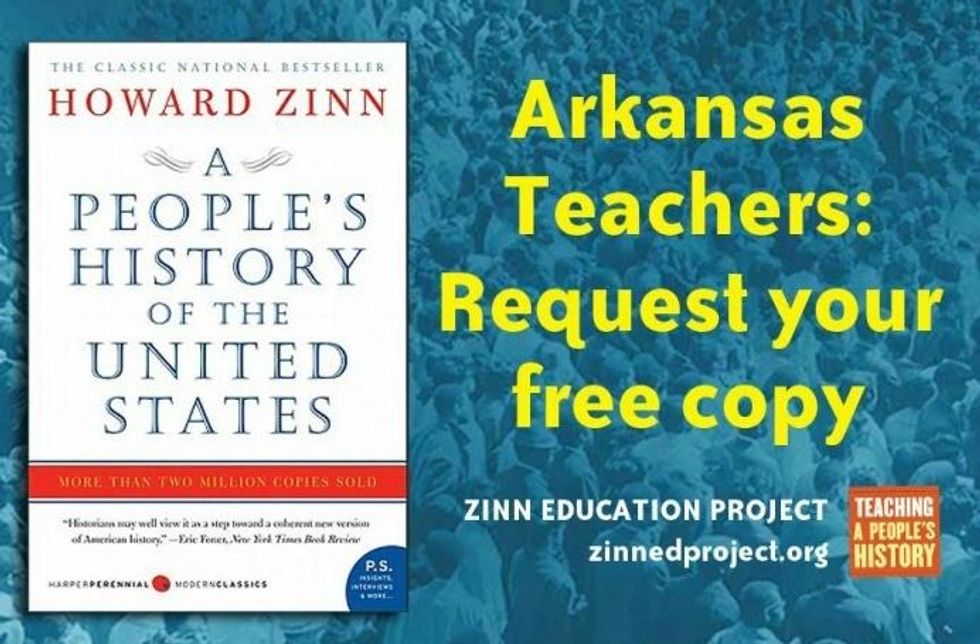
The project is also offering a free copy of Zinn's seminal A People's History of the United States to any Arkansas teacher who requests it:
At least one high school class in northern Arkansas is making its opposition to the legislation clear already:
Publisher Haymarket Books, meanwhile, tweeted in response to the news that people should read more of Zinn's works.
It's not first time in recent history the works of the legendary Zinn have been the target of suppression.
Emails unearthed by the Associated Press in 2013, for example, revealed that former Governor of Indiana Mitch Daniels sought to ban Zinn's works from that state's classrooms, and the Tucson, Arizona school district in 2012 banned A People's History from all classrooms.
Given the response in Indiana to the revelations of Daniel's censorship attempt, however, Hendren may also find his own Zinn-banning efforts backfire.


Controversy flared the summer when the Associated Press revealed that Mitch Daniels, former Indiana Governor and now Purdue University president, attempted to censor Howard Zinn's classic A People's History of the United States from Indiana classrooms. As Zinn Education Project co-director Bill Bigelow told Common Dreams, "When Governor Mitch Daniels attempted to prevent teachers and teacher educators from using Howard Zinn's A People's History of the United States, this was an attack on academic freedom and on students' right to learn a fuller, more honest history than is found in their textbooks."
"[A People's History of the United States] is dangerous because it presents a perspective that ordinary people can change the world, which is the main secret that the richest 1% and their political advocates cannot allow young people to find out." -Jesse Hagopian, high school history teacher
But Daniels' efforts to censor the classic work already backfired, instead sparking a surge in public interest in the late historian's work just a month after Daniels' 'Zinn witch-hunt' was revealed.
The censorship controversy also provided the impetus for the Howard Zinn read-in taking place at Purdue on Tuesday.
As event organizers explain:
'The Zinn Read-in Committee' envisions the event to be a commemoration of academic freedom and a declaration of anti-censorship.
The event will also symbolize the ongoing fightback in the United States against the privatization of public education, attacks on teachers and teachers unions, and the need for real democracy in both schools and curriculum. Zinn's A People's History of the United States is an important text for understanding the history of underrepresented populations; the fight for the right to teach this history is never separate from the fight to improve the material lives of students, teachers, minorities and workers around the world.
"As the event organizers point out," Bigelow continued, "Daniels' attempted censorship is part of larger corporate school reform efforts to undermine public schools along with any teaching that helps students question inequality and injustice. The Zinn Read-In is an imaginative and defiant response to the corporate attack on our students and our schools."
Speakers at the Purdue read-in include historian, labor activist and author Staughton Lynd; peace activist Ann Wright; Anthony Arnove, editor, with Zinn, of Voices of a People's History of the United States; and Jesse Hagopian, a history teacher at Seattle's Garfield High School, where he helped lead the MAP test boycott that gained national attention.
"Former Indiana Governor Mitch Daniels believed that Howard Zinn's book A People's History of the United States was a dangerous text for students to read and should be removed from every classroom in the state," Hagopian told Common Dreams in a statement. "Daniels is right about one thing, A People's History is dangerous."
"It's dangerous because it presents a perspective that ordinary people can change the world, which is the main secret that the richest 1% and their political advocates cannot allow young people to find out in an age where wealth inequality is destroying our society," Hagopian stated.
In addition to the event at Purdue, solidarity read-ins are taking place at 9 other campuses across the nation including the University of Chicago, Stony Brook University, New York, and Indiana University.
Organizers will be live streaming the event, which begins at 6PM ET, at www.wearemany.org, and live discussions on Twitter will be using the hashtag #ReadZinn.
Update: Though the event is over, video of the full two-hour read-in at Purdue is available to watch on YouTube thanks to WeAreManyMedia. Click here to watch it.
____________________
Public demand for Howard Zinn's classic book A People's History of the United States is surging, something likely to make former Indiana Governor Mitch Daniels none too happy.
In July, the Associated Press revealed that Daniels, who is now president of Purdue University, sought to ban the works of Howard Zinn from Indiana classrooms.
But since his "anti-Howard Zinn witch-hunt" has been exposed, Zinn's People's History has become "a hot read at libraries" in the state, the South Bend Tribune reports.
St. Joseph County Public Library, for example, which only had one copy of Zinn's People's History just weeks ago, has now upped the number to 19 due to patrons' interest, but even that wasn't enough. They're all checked out now, and there are 10 people on a waiting list.
At Indiana University South Bend, the book isn't even on any required reading list for the fall 2013 semester, but all the available copies are currently checked out, the Tribune continues.
The surge in interest in the book hasn't been limited to Indiana either.
The Zinn Education Project, which promotes and supports teaching a people's history (upper and lower case) in middle and high school classrooms, has also received a surge of interest in its teaching materials since Daniels' censorship attempts were exposed.
"Thanks to the exposure generated by former Gov. Mitch Daniels' attempt to ban Howard Zinn's A People's History of the United States from Indiana schools and teacher education programs, the Zinn Education Project has been flooded with visitors looking for people's history teaching materials," Bill Bigelow, Zinn Education Project co-director, told Common Dreams via email.
"Teachers and parents have told us that they are redoubling their commitment to teach people's history in the face of the proposed censorship. We invite other governors to attempt to ban Zinn's works--it helps introduce A People's History of the United States to huge new audiences," Bigelow added.
In one 2009 email revealed by AP between Daniels and a top state education official, Daniels wrote:
This terrible anti-American finally passed away. The obits and commentaries mentioned that his book "A People's History of the United States" is "the textbook of choice in high schools and colleges around the country." It is a truly execrable, anti-factual piece of disinformation that misstates American history on every page.
Can someone assure me that it is not in use anywhere in Indiana? If it is, how do we get rid of it before any more young people are force-fed a totally false version of our history?
Howard Zinn, author of A People's History of the United States, one of the country's most widely read history books, died on January 27, 2010. Shortly after, then-Governor of Indiana Mitch Daniels got on his computer and fired off an email to the state's top education officials: "This terrible anti-American academic has finally passed away."
But Gov. Daniels, now president of Purdue University, was not content merely to celebrate Howard Zinn's passing. He demanded that Zinn's work be hunted down in Indiana schools and suppressed: "The obits and commentaries mentioned his book 'A People's History of the United States' is the 'textbook of choice in high schools and colleges around the country.' It is a truly execrable, anti-factual piece of disinformation that misstates American history on every page. Can someone assure me that is not in use anywhere in Indiana? If it is, how do we get rid of it before more young people are force-fed a totally false version of our history?"
We know about Gov. Daniels' email tantrum thanks to the Associated Press, which obtained the emails through a Freedom of Information Act request.
Scott Jenkins, Daniels' education advisor, wrote back quickly to tell the governor that A People's History of the United States was used in a class for prospective teachers on social movements at Indiana University.
Daniels fired back: "This crap should not be accepted for any credit by the state. No student will be better taught because someone sat through this session. Which board has jurisdiction over what counts and what doesn't?"
After more back and forth, Daniels approved a statewide "cleanup" of what earns credit for professional development: "Go for it. Disqualify propaganda and highlight (if there is any) the more useful offerings."
Daniels recently defended his attack on Zinn's work, telling the Associated Press, "We must not falsely teach American history in our schools." In a letter posted on his Purdue University webpage, Daniels claimed that, "the question I asked on one day in 2010 had nothing to do with higher education at all." Daniels should go back and read his own emails.
There are so many disturbing aspects to this story, it's hard to know where to begin.
The first, of course, is Daniels' gleeful, mean-spirited reporting of Zinn's death. Anyone with even a passing familiarity with Howard Zinn's career knows that his great passions were racial equality and peace. Finding cause for joy in the death of someone whose life was animated by confidence in people's fundamental decency is shameful.
As someone who spent almost 30 years as a high school history teacher, I'm amused by the impoverished pedagogical vision embedded in Daniels' emails and subsequent defense. Daniels wants Zinn's A People's History of the United States banned from the curriculum, so that the book is not "force-fed" to students. Governor Daniels evidently assumes that the only way one can teach history is to cram it down students' throats. To see some alternative ways to engage students, Daniels might have a look at our lessons at the Zinn Education Project, which use Zinn's People's History of the United States in role plays, in critical reading activities, to generate imaginative writing, and to search for the "silences" in students' own textbooks.
Take for example the last textbook I was assigned as a teacher at a public high school in Portland, Oregon, American Odyssey, published by Glencoe/McGraw-Hill. In the book's one thousand pages, it includes exactly two paragraphs on the U.S. war with Mexico--the war that led to Mexico "ceding," in the polite language of school curricula, about half its country to the United States. American Odyssey does not quote a single Mexican, a single soldier, a single abolitionist, a single opponent of the war. Well, in fact, the textbook doesn't quote anyone. As one of my students pointed out when we read the book's dull passages in class, "It doesn't even view it as a war. It's a situation."
As the Zinn Education Project reveals regularly in its If We Knew Our History column, the version of U.S. history taught in the textbooks produced by giant corporations is anything but "true." This scant treatment of such an important event in U.S. and Mexican history is one reason why teachers search out alternatives like A People's History of the United States, which includes a full chapter on the conflict, focusing especially on President Polk's hollow justifications for war, the anti-war resistance, and the human impact of the war. Unlike the gray prose of textbooks like American Odyssey, Zinn's chapter on the U.S. war with Mexico--"We Take Nothing by Conquest, Thank God"--is filled with quotes from soldiers and poets, surgeons and abolitionists, generals and journalists, clergymen and presidents. Every passage reminds young people that war is much more than a "situation."
"We must not falsely teach American history in our schools," said Daniels to the Associated Press, implying that the true history is to be found in the officially adopted textbooks. As the Zinn Education Project reveals regularly in its If We Knew Our History column, the version of U.S. history taught in the textbooks produced by giant corporations is anything but "true." The corporate textbooks hide the breadth of U.S. military and economic interventions throughout the world; they ignore the roots of today's environmental crises; they refuse to explore the origins of the vast wealth inequality in the United States; and the textbooks neglect the role of social movements throughout U.S. history, instead focusing on famous individuals; thus, they fail to nurture an activist sensibility--a recognition that if we want the world to be better, then it's up to us to make it better.
This is a point Howard Zinn emphasized when he spoke to teachers at the 2008 National Council for the Social Studies conference in Houston--some of them from Indiana!--not much more than a year before he died. Zinn said: "We've never had our injustices rectified from the top, from the president or Congress, or the Supreme Court, no matter what we learned in junior high school about how we have three branches of government, and we have checks and balances, and what a lovely system. No. The changes, important changes that we've had in history, have not come from those three branches of government. They have reacted to social movements."
Governor Daniels' advisers evidently found no evidence that Zinn's A People's History of the United States was in use in K-12 schools in Indiana. I guess they didn't look hard enough. There are more than 300 Indiana teachers registered at the Zinn Education Project to access people's history curriculum materials to "teach outside the textbook." And these are only the teachers who have formally registered at the site; many more share people's history-inspired lessons.
And at the Zinn Education Project we've heard all week long from Indiana teachers, professors, and parents who have committed themselves to work against censorship in K-12 schools. Their defiance is reminiscent of Indiana's Green Feather Movement that challenged the McCarthy-era attempt to ban Robin Hood from the elementary school curriculum in 1954. What began as the anonymous posting of green feathers on bulletin boards by a few students at Indiana University spread to campuses across the country. As Howard Zinn wrote at the end of his autobiography, You Can't Be Neutral on a Moving Train, "If we remember those times and places--and there are so many--where people have behaved magnificently, this gives us the energy to act, and at least the possibility of sending this spinning top of a world in a different direction."
Former Governor of Indiana Mitch Daniels sought to ban the works of Howard Zinn from Indiana classrooms, the Associated Press revealed this week.

In one email to Tony Bennett, then Superintendent of Public Instruction, Daniels writes:
This terrible anti-American finally passed away. The obits and commentaries mentioned that his book "A People's History of the United States" is "the textbook of choice in high schools and colleges around the country." It is a truly execrable, anti-factual piece of disinformation that misstates American history on every page.
Can someone assure me that it is not in use anywhere in Indiana? If it is, how do we get rid of it before any more young people are force-fed a totally false version of our history?
In another, seeing that a professional development course for teachers included readings from Zinn, Daniels wrote, "This crap should not be accepted for any credit by the state."
In a statement posted Wednesday on the Purdue website, Daniels reacted to the AP story, writing in part:
In truth, my emails infringed on no one's academic freedom and proposed absolutely no censorship of any person or viewpoint. In fact, the question I asked on one day in 2010 had nothing to do with higher education at all. I merely wanted to make certain that Howard Zinn's textbook, which represents a falsified version of history, was not being foisted upon our young people in Indiana's public K-12 classrooms.
"As to the anti-American canard" Daniels used to describe the People's History author, John Tirman, executive director and principal research scientist at the Massachusetts Institute of Technology Center for International Studies, told Inside Higher Ed:
I see this as the last refuge of a politician who is quite ignorant of the discourses in many quarters of American intellectual and activist life. Zinn often appealed to judge American actions by the principles of the founders and those who we all agree brought progress to the social and political freedoms and responsibilities we now take for granted. When U.S. political leaders fell short of adhering to those ideals, Zinn was powerfully and incisively critical, and very often right -- on Vietnam, race relations, women's empowerment, the Iraq War, etc. Daniels does not understand that a vibrant civil society has many voices, many perspectives. To be contrary to the old mainstream construction of history is not equivalent to being anti-American. That should be obvious, but to a politician who still seems to be campaigning for something, it never will be. His unsuitability to be Purdue's president is glaring."
And University of Illinois English professor Cary Nelson, who also served as president of the American Association of University Professors for six years, told AP, "It is astonishing and shocking that such a person is now the head of a major research university, making decisions about the curriculum, that one painfully suspects embodies the same ignorance and racism these comments embody."
____________________