

SUBSCRIBE TO OUR FREE NEWSLETTER
Daily news & progressive opinion—funded by the people, not the corporations—delivered straight to your inbox.
5
#000000
#FFFFFF
To donate by check, phone, or other method, see our More Ways to Give page.
Daily news & progressive opinion—funded by the people, not the corporations—delivered straight to your inbox.
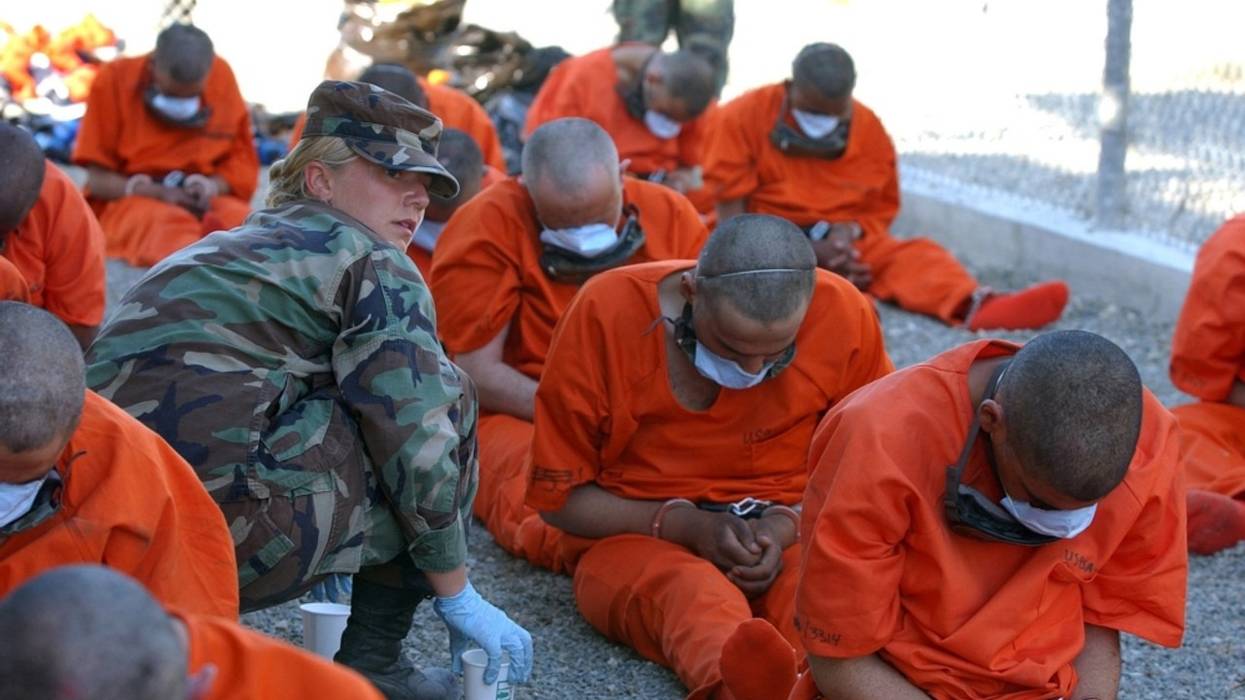
"This decision will ensure nothing but a continued lack of justice and accountability for everyone involved in the 9/11 military trial at Guantánamo," said one critic.
Human rights defenders on Friday condemned a federal appellate panel's decision upholding former U.S. Defense Secretary Lloyd Austin's withdrawal of pretrial plea agreements for three men accused of plotting the September 11, 2001 attacks on the United States.
Austin, who served under former President Joe Biden, "indisputably had legal authority to withdraw from the agreements; the plain and unambiguous text of the pretrial agreements shows that no performance of promises had begun," the D.C. Court of Appeals panel ruled in a 2-1 decision.
Under the proposed deal, accused 9/11 mastermind Khalid Sheikh Mohammed and alleged co-conspirators Mustafa al-Hawsawi and Walid bin Attash would have been spared execution in return for pleading guilty. The agreement came amid years of stalled legal proceedings in a case complicated by the U.S. government's torture of the defendants and efforts to cover it up.
Austin withdrew the plea agreements last August, explaining that he "long believed that the families of the victims, our service members, and the American public deserves the opportunity to see military commission trials carried out in this case."
However, attorneys for the defendants called the legally dubious military commission regime established at the Guantánamo Bay prison—notorious for detainee torture and indefinite detention—during the George W. Bush administration "obviously corrupt and rigged." During the 2000s, several military prosecutors resigned from the commissions in protest over what some of them called a rigged system designed to ensure there were no acquittals.
"The 9/11 case will never be resolved through a contested trial because the defendants were tortured by the CIA."
Last November, Air Force Col. Matthew McCall, a military judge, ruled that Lloyd "did not have the authority to do what he did, asserting that the plea deals "remain valid, and are enforceable," prompting the government's appeal. The following month, a military appeals court also ruled against Austin's bid to ditch the plea deals.
The Center for Constitutional Rights (CCR)—which has long represented Guantánamo detainees—called Friday's decision "a betrayal of justice."
"This decision will ensure nothing but a continued lack of justice and accountability for everyone involved in the 9/11 military trial at Guantánamo," CCR senior staff attorney Wells Dixon said in a statement. "The Biden administration's invalidation of plea agreements that would have resulted in convictions and life sentences for the 9/11 defendants is a painful betrayal of 9/11 victims' families."
"The 9/11 case will never be resolved through a contested trial because the defendants were tortured by the CIA," Dixon added. "The only way to resolve this case is for the Trump administration to succeed where every prior administration has failed and negotiate new deals with the 9/11 defendants that will finally close the 'War on Terror' prison at Guantánamo."
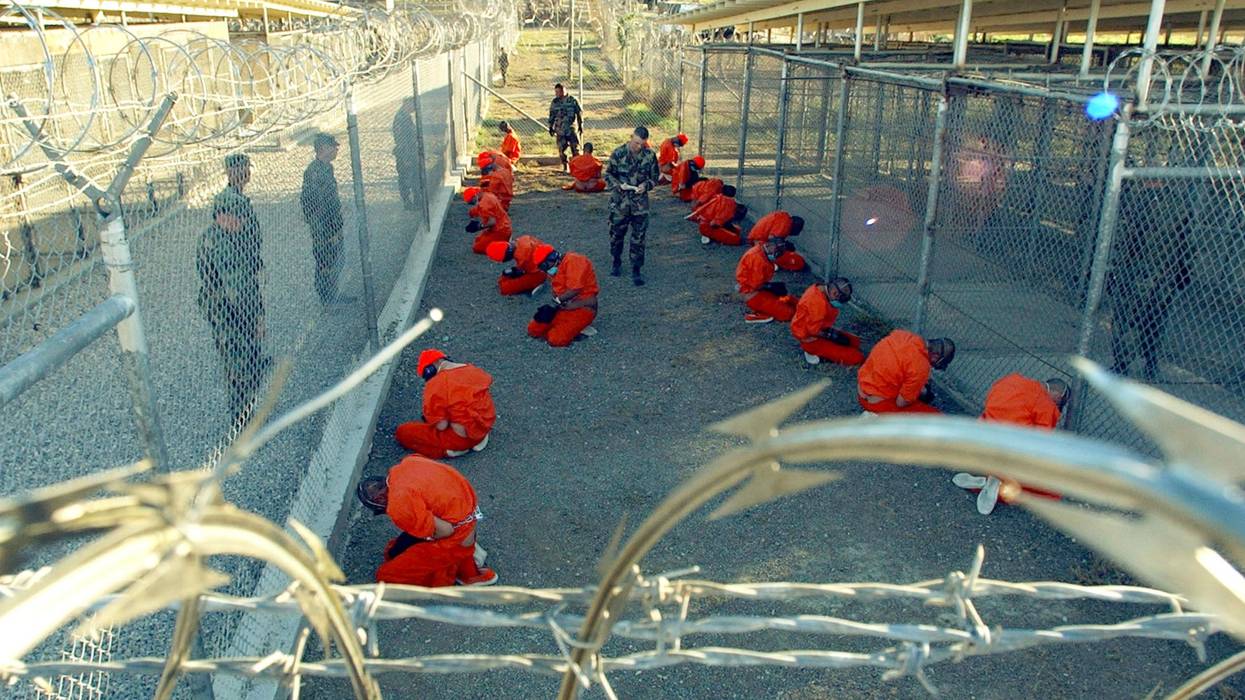
There are still 15 men currently imprisoned in Guantánamo, which is located on Cuban land leased to the U.S. in perpetuity by a dictatorship overthrown in 1959. Multiple detainees have been cleared for release, one of them for 15 years.
Some legal experts doubted whether the U.S. government would ever be able to try, let alone convict, the 9/11 suspects. Military judges and prosecutors have cited defendants' torture in declining to proceed with cases against them. Many men and boys were tortured at CIA "black sites," Guantánamo, and military prisons including Abu Ghraib. At least dozens of detainees died.
The three co-defendants were all captured in Pakistan during late 2002 and early 2003. After being turned over the United States, they were sent to CIA black sites, including the notorious "Salt Pit" outside Kabul, Afghanistan, where suspected militant Gul Rahman was tortured to death in November 2002. In 2006, the men were transferred to Guantánamo.
Mohammed was subjected to interrupted drowning, commonly called "waterboarding," 183 times, as well as other torture and abuse approved under the Bush administration's "enhanced interrogation" program. Hawsawi suffered a shredded rectum resulting from sodomization during so-called "rectal hydration" and has had to manually reinsert parts of his anal cavity to defecate. Bin Attash said he was placed in stress positions for extended periods, beaten, and doused in cold water.
The co-defendants must now decide whether to appeal the ruling to the full D.C. appeals court, the U.S. Supreme Court, or both.
"Putting aside the fantasy that this case is ever going to go to trial—assuming it does go to trial and that there's a conviction—you get to sentencing, and they have a right to put forward evidence... that they were tortured," Dixon told CNN Friday. "That's never going to happen."
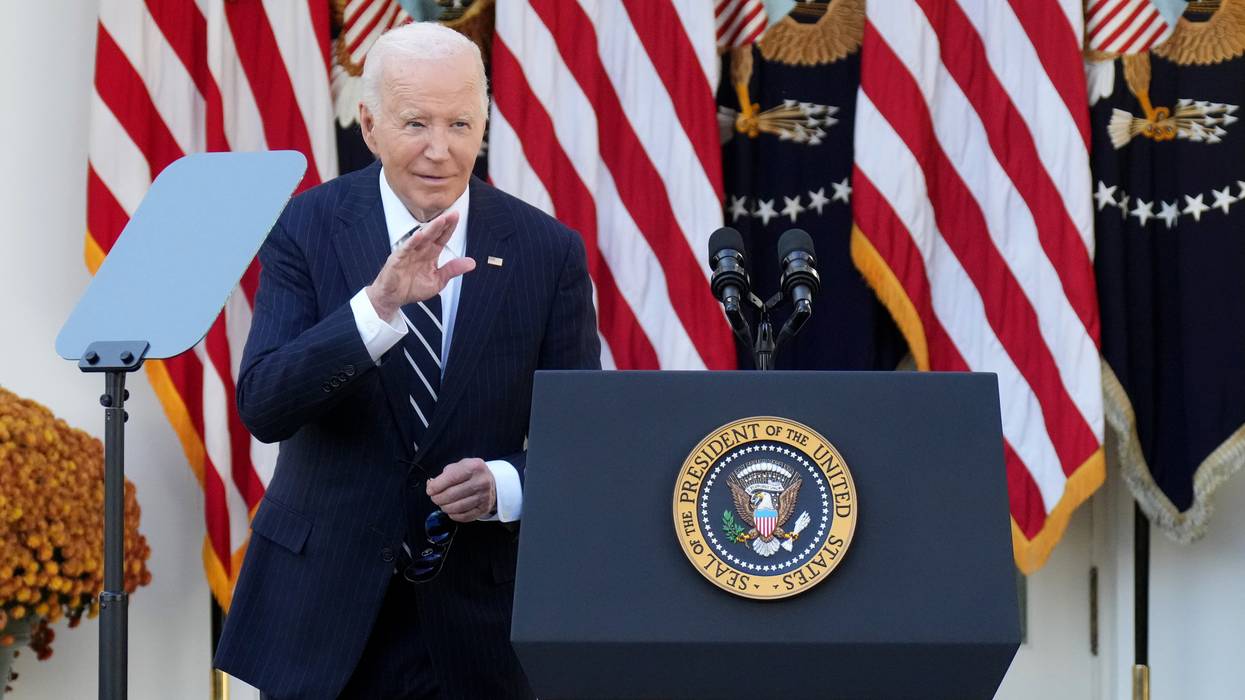
Rights advocates want the president to fulfill his "long-standing commitment to turn the page on the 9/11 era by closing this shameful site of torture and indefinite detention."
U.S. President Joe Biden on Thursday faced pressure from legal groups to accept a military judge's revival of plea deals for three alleged plotters of the September 11, 2001 terrorist attacks and to transfer 19 uncharged men out of the American prison in Guantánamo Bay, Cuba.
Brig. Gen. Susan Escallier, the convening authority for the legally dubious Guantánamo Bay military commissions, this summer reached the controversial deals under which Khalid Sheikh Mohammed, Walid bin Attash, and Mustafa al-Hawsawi agreed to spend the rest of their lives in prison to avoid execution.
U.S. Defense Secretary Lloyd Austin swiftly withdrew the agreements, sparking criticism from some victims' families and legal experts. In a 29-page ruling on Wednesday, the judge, Col. Matthew N. McCall, wrote that the Pentagon chief "did not have the authority to do what he did." Thus, the pretrial agreements "remain valid and are enforceable," he wrote, and plea hearings should be scheduled.
It is not yet clear how the Pentagon will proceed, as its press secretary, Maj. Gen. Patrick Ryder, only told The New York Times that "we are reviewing the decision and don't have anything further at this time." However, legal organizations want the Biden administration to embrace the ruling.
ACLU executive director Anthony D. Romero, whose group represents Mohammed, said in a Thursday statement that "McCall rightly recognizes that Defense Secretary Austin stepped out of bounds" and "we are finally back at the only practical solution after nearly two decades of litigation."
"The government's decision to settle for life imprisonment instead of seeking the death penalty in the case of Khalid Sheikh Mohammed was always the right call," Romero continued. "For too long, the U.S. has repeatedly defended its use of torture and unconstitutional military tribunals at Guantánamo Bay. As a nation, we must move forward with the plea process and sentencing hearing that is intended to give victim family members answers to their questions. They deserve transparency and finality about the events that claimed their loved ones."
"This plea agreement further underscores the fact that the death penalty is out of step with the fundamental values of our democratic system. It is inhumane, inequitable, and unjust," he added. "We also urge the U.S. government to quickly relocate the men cleared for transfer, and finally end all indefinite detentions and unfair trials at Guantánamo."
The Center for Constitutional Rights (CCR)—which represents two of the 19 uncharged men at the facility infamous for torture—also put out a Thursday statement pressuring the administration to accept the judge's decision and focus on transfers.
"The Biden administration should not appeal this ruling because, after more than 20 years of litigation and uncertainty for victims' families, plea deals are the only responsible way to resolve the 9/11 case," CCR argued. "The president must instead use this opportunity to transfer the remaining 19 uncharged men out of Guantánamo, 16 of whom have been approved for transfer by all relevant agencies based on a unanimous determination that they pose no security threat, including our clients Guled Hassan Duran and Sharqawi al Hajj."
"These two steps are essential to fulfilling Biden's long-standing commitment to turn the page on the 9/11 era by closing this shameful site of torture and indefinite detention," the group added.
Biden's time to make any decisions regarding Guantánamo and the men imprisoned there is dwindling. After beating Democratic Vice President Kamala Harris on Tuesday, former President Donald Trump is set to return to the White House in January, shortly after what would be the 23rd anniversary of Guantánamo's opening.
The U.S. prison was launched in January 2002 under then-President George W. Bush, who responded to the 9/11 attacks with a so-called global War on Terror. Biden has so far failed to close Guantánamo, following in the footsteps of former President Barack Obama. Trump, during his first term, took action to keep it open.
As Lawdrawgon reported:
The plea agreements for Mohammad and al-Hawsawi contained provisions that removed the death penalty from the case in the event the government withdrew from the agreements. Sources said that the penalty provision should render the case noncapital, even if Austin was found to have acted lawfully.
The penalty clause was negotiated in the event that a future Trump administration tried to kill the deals, individuals familiar with the negotiations said.
In anticipation of Trump's return to power early next year, Amnesty International is urging Biden to take "six actions before his legacy is sealed for the history books." The final item calls on the outgoing president to "transfer all detainees cleared for release or not charged with crimes to countries where their human rights will be respected, halting the unfair military commissions and fairly resolving the pending cases, and close the Guantánamo prison once and for all."
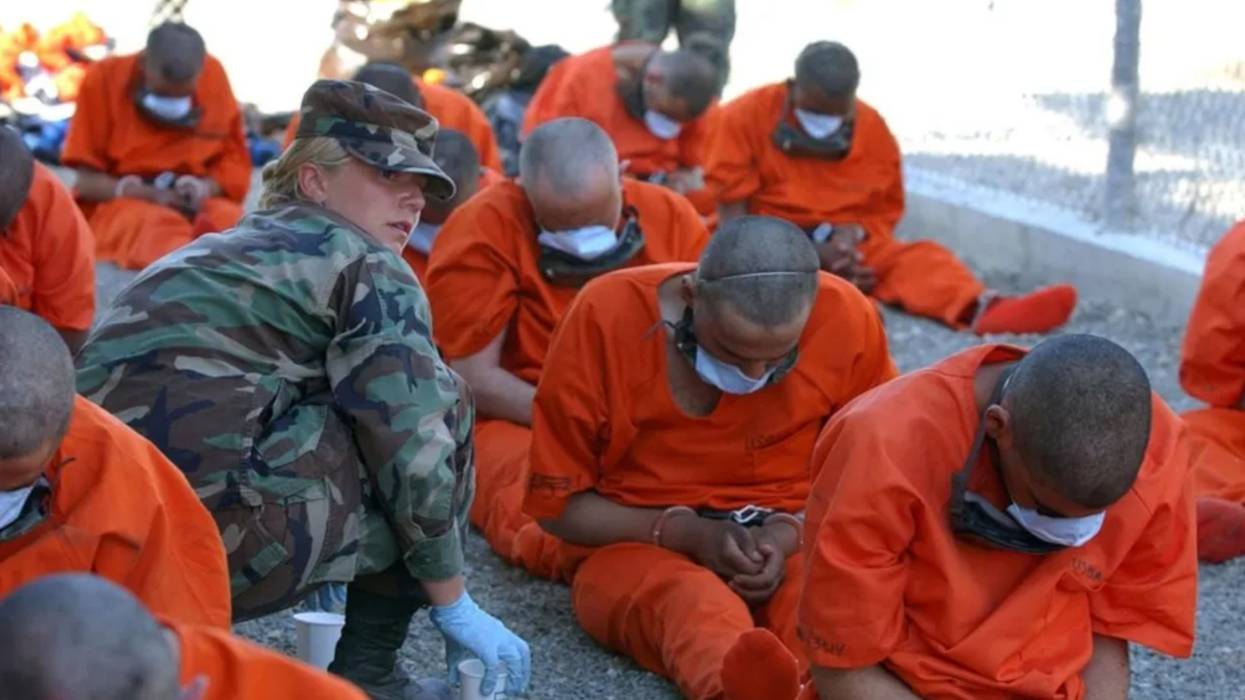
"We have had an unprecedented act by a government official to pull back what was a valid agreement," said an attorney representing tortured 9/11 suspects imprisoned at Guantánamo Bay.
Attorneys representing alleged 9/11 planners imprisoned at Guantánamo Bay argued Wednesday that U.S. Defense Secretary Lloyd Austin's move to block plea deals for three defendants violated Pentagon rules and belied the corruption of the military commission system established during the George W. Bush administration.
"We have had an unprecedented act by a government official to pull back what was a valid agreement," Walter Ruiz, who represents defendant Mustafa al-Hawsawi, said at a hearing at Guantánamo, according to CNN.
"For us, it raises very serious questions about continuing to engage in a system that seems so obviously corrupt and rigged," Ruiz added.
Last week, the Department of Defense announced that Brig. Gen. Susan Escallier, the convening authority for the Guantánamo military commissions, "has entered into pretrial agreements" with al-Hawsawi, alleged 9/11 mastermind Khalid Sheikh Mohammed, and Walid bin Attash.
The long-anticipated agreement—under which the three men would be spared execution by pleading guilty—came amid years of stalled legal proceedings in a case complicated by the U.S.' torture of the defendants and government efforts to cover it up.
While welcomed by advocates of closing the prison and some victims' families, Escallier's move also sparked a firestorm of criticism from numerous U.S. lawmakers, 9/11 first responders, and victims' relatives.
Last Friday, Austin withdrew the plea agreements. Speaking at a press conference on Tuesday, he explained that he has "long believed that the families of the victims, our service members, and the American public deserves the opportunity to see military commission trials carried out in his case."
"I'm deeply mindful of my duty to all those whose lives were lost or changed forever on 9/11, and I fully understand that no measure of justice can ever make up for their loss," Austin added. "So this wasn't a decision that I took lightly."
Eugene Fidell, a military law professor at Yale University and co-founder of the National Institute of Military Justice, told CNN that Austin's move "was illegal."
According to the network:
One of the primary issues pointed to on Wednesday by defense counsel was a regulation laid out in the military's Manual for Military Commissions, which says the convening authority can withdraw a pretrial agreement before the accused begins "performance of promises" or if the accused does not hold up their end of the deal. Gary Sowards, a defense attorney for Mohammad, said in court that Austin did not have authority under that regulation because his client had "begun very important, substantive, specific performance.'"
Sowards acknowledged that motions for discovery on the issue of potential unlawful influence by Austin, which would "seek to explore how he was coerced and influenced," could take a year or two to litigate. But the issue of the Manual for Military Commissions regulation is "a simple reading of about 12 lines of text," he said, and a decision on it should be able to be expedited.
Prosecutor Clayton Trivett Jr. told the commission Wednesday that the government needed to "work through the issues raised in these motions" so that the prosecution's position can be "fully articulated."
Sowards retorted, "'We want to consult with people'—that sounds like, 'We want to get our stories together.'"
Some legal experts doubted whether the government would ever be able to try, let alone convict, the 9/11 suspects. Military judges and prosecutors have cited defendants' torture in declining to proceed with cases against them. Many men and boys were tortured at CIA "black sites," Guantánamo, and military prisons including Abu Ghraib. At least dozens of detainees died.
Wells Dixon, a lawyer with the Center for Constitutional Rights who represented convicted terrorist Majid Khan, told CNN that the prosecution's unwillingness "to allow evidence about the defendants' torture and abuse to be aired in court" will make it extremely difficult to secure death sentences for the men.
"If Secretary Austin says that a 9/11 case is going to proceed to trial, and a verdict, and possibly a sentencing, then he is either hopelessly ill-informed or is lying to victims' family members," he added.
Accusations of military commission corruption go back decades.
In 2004, three military prosecutors—Maj. Robert Preston, Capt. John Carr, and Capt. Carrie Wolf—requested transfers from the commissions after concluding they were rigged.
"They were told by the chief prosecutor at the time that they didn't need evidence to get convictions," Clive Stafford Smith, an attorney who represented more than 70 Guantánamo detainees, told The Nation in 2008.
That year, former Guantánamo chief prosecutor Col. Morris Davis said that then-Pentagon General Counsel William Haynes told him that "we can't have acquittals."
Atlantic staff writer Graeme Wood asserted this week that "there is a way to clean up this mess."
"Now that Austin has assumed the power of the convening authority, he can restore the agreement he tore up on Friday—to reverse the reversal and bring these sordid proceedings to the end they were until recently already destined for," he wrote. "If he instead wants to extend the life of the commissions, slouching toward a trial that will never happen, then the pointless sacrifice of money and time will continue."
"For the families in search of finality, each minute of delay is a minute stolen, and for the defendants, each is a minute gained," Wood added. "The defendants have already cheated the hangman. The best way to end their run is to take that bitter deal, and bring these commissions to a well-deserved end."

One lawyer warned it will not only "push 9/11 victim family members over an emotional cliff," but likely lead "prosecutors to resign and defendants to seek dismissal of all charges for unlawful command influence."
U.S. Defense Secretary Lloyd Austin on Friday withdrew plea agreements the Pentagon had reached with three men accused of planning the September 11, 2001 terrorist attacks and detained in Guantánamo Bay, the American military prison in Cuba infamous for torture.
"I have determined that... responsibility for such a decision should rest with me," Austin wrote to Brig. Gen. Susan Escallier, the convening authority for the legally dubious Guantánamo Bay military commissions. "Effective immediately, in the exercise of my authority, I hereby withdraw from the three pre-trial agreements that you signed on July 31."
The U.S. Department of Defense confirmed Wednesday that Escallier "entered into pretrial agreements" with Khalid Sheikh Mohammed, Walid bin Attash, and Mustafa al-Hawsawi. The Pentagon did not share details of the deal, but it was reported that in exchange for ruling out the death penalty, the suspects agreed to plead guilty and spend the rest of their lives in prison.
The Center for Constitutional Rights (CCR), which has represented detainees at the prison, stressed that the deals were not only "a substantial step toward ending military commissions and the extralegal nightmare of Guantánamo," but also "inevitable because the 9/11 case was never going to be tried" through a process that has "never provided justice or accountability for anyone."
Others had also emphasized that point. U.S. Senate Judiciary Committee Chair Dick Durbin (D-Ill.) said on social media Wednesday that "after all these years, the victims of 9/11 and their families deserve justice and closure. The Bush administration's disastrous decision to torture detainees and set up untested military commissions made a fair trial impossible."
As The New York Times reported Thursday:
Valerie Lucznikowska, whose nephew was killed in the World Trade Center, said she had been to the Guantánamo Bay prison several times to watch pretrial hearings, but had stopped going out of frustration with the legal process.
"The plea agreements should have been done a long time ago," she said. "The system has not worked for a long time."
Ms. Lucznikowska belongs to the group September 11th Families for Peaceful Tomorrows, many of whose members oppose the death penalty. Her own opposition was both moral and practical, she said.
"If the death penalty stayed as the prime object of the trial, there was no way it would come to a conclusion within my lifetime," she said.
She added: "Guantánamo Bay prison is a stain on America. How are we going to get rid of the stain? We're not going to. But let's get it over with."
However, other relatives of victims and U.S. lawmakers, as well as the union representing New York City firefighters, had criticized the agreements. House Committee on Oversight and Accountability Chair James Comer (R-Ky.) even launched an investigation into "what involvement the White House had in negotiating and/or approving the recently announced plea deal."
After the Pentagon's Friday announcement, September 11th Families for Peaceful Tomorrows released a statement calling out Austin for canceling deals that, while "not the justice originally hoped for," had "offered a path to finality, and a modicum of justice and accountability for the crimes of 9/11."
"That the secretary has now overreached and undertaken direct oversight of the 9/11 commission is cause for enormous concern," the group said. "While we understand there are family members who are opposed to plea agreements, the reality stands that the 9/11 accused were tortured and several were sodomized. If any entity is at fault for the inability to prosecute this case with a slam dunk, it's the torturers. Because of the torture, the 9/11 accused will not be put to death. And any administration official or member of Congress who says otherwise is either uninformed, or politically pandering."
"The men who perpetrated the death of thousands on September 11th; men who have never uttered a word of remorse, should be justly punished. But what happened this week to 9/11 families is emotional whiplash," the group continued. "We will recover. We have been working for justice for the death of our loved ones for 23 years. Our larger concerns today are for this country, for the future of our children and grandchildren when legal principles are compromised. We ask that Secretary Austin meet with the 9/11 prosecution team, learn the deep complexities and flaws in the case, and come to his own conclusion that pretrial agreements will provide the finality and accountability we all deserve."
J. Wells Dixon, a senior staff attorney at CCR who specializes in challenging unlawful detentions at Guantánamo, decried the "dirty move" by Austin and accused him of "robbing victim family members of their only chance for justice and accountability for 9/11."
The Pentagon chief's "astounding decision" will not only "push 9/11 victim family members over an emotional cliff," but likely have legal consequences, Dixon warned. "Wait for prosecutors to resign and defendants to seek dismissal of all charges for unlawful command influence."
Daphne Eviatar, director of Amnesty International USA's Security With Human Rights program, similarly said Saturday that "this is a terrible development. The victims of the 9/11 attacks deserve accountability for the horrendous crimes committed after waiting more than 20 years."
"The defendants, who were brutally tortured and mistreated by U.S. agents and then detained without trial for more than 20 years, deserve a fair judicial resolution of their cases," Eviatar argued.
"The death penalty should have been taken off the table long ago," she added. "It is shameful for the defense secretary after all these years to intervene now to prevent the resolution of this case, at a time when the United States should be making every effort to acknowledge, account for, and finally end the abuses of the post-9/11 'war on terror.'"
John Knefel, a senior writer at Media Matters for America, also responded critically to Friday's news, saying that "this development is 100% in alignment with the history of Gitmo in general and the military commission system specifically—ad hoc, arbitrary, capricious. A repulsive apparatus, and one wholly fitting of U.S. empire."
This post has been updated with comment from Amnesty International September 11th Families for Peaceful Tomorrows.

"The Biden administration needs no new authority or ideas" to close the notorious torture prison, one rights group argues. "All it needs is the political will and a willingness to do the work."
Human rights defenders marked 22 years since the opening of the U.S. military prison at Guantánamo Bay, Cuba with renewed calls for President Joe Biden to fulfill his stated intention to close the notorious torture camp, where 30 men—16 of them cleared for release—remain behind bars.
Like most of the roughly 750 prisoners released from Guantánamo, the majority of remaining detainees have never been charged with any crime. Only one—Ali Hamza Ahmad Suliman al-Bahlul, a Yemeni national—has ever been convicted of terrorism-related charges under the highly controversial military commission regime established by the George W. Bush administration in the wake of the September 11, 2001 attacks on the United States.
"It is outrageous that 22 years after the U.S. government opened the Guantánamo detention camp to detain Muslim men beyond the reach of U.S. law, that this abuse of human rights continues today," Daphne Eviatar, director of the Security with Human Rights program at Amnesty International USA, said in a statement.
Four American presidents have failed to close Gitmo, whose detainees ranged in age from 13 to 74 and which is viewed globally as a symbol of the indefinite detention and torture that took place earlier during the ongoing U.S.-led War on Terror. Former President Barack Obama—under whom Biden served as vice president—issued executive orders immediately after taking office in 2009 that were meant to end torture and close Gitmo. However, Obama was blocked by Congress from proceeding with his plan to close the prison, frustrating his campaign promise. Obama was also accused of breaking the law by actively shielding Bush-era officials from facing justice for their roles in torture at Gitmo and other military prisons and CIA so-called "black sites."
Shortly after Biden took office, the White House signaled it wanted to close Guantánamo. However, despite releasing 10 detainees, the administration has taken few steps toward achieving that goal and has spent millions of dollars expanding the facility by building a courtroom where prisoners are meant to be tried in secret.
However, the military commissions—which former lead prosecutor Col. Morris Davis called "rigged from the start"—have been stymied by the torture endured by defendants at the hands of military and CIA operatives. Military judges have barred Guantánamo detainees or evidence in terrorism cases from the courtroom due to torture.
This has been a major impediment to bringing terrorism suspects to justice. For example, Col. Stuart Crouch, a Guantánamo prosecutor whose Marine Corps buddy was a pilot on one of the planes that crashed into the World Trade Center on 9/11, refused to prosecute Mohamedou Ould Slahi—who allegedly helped organize the plane's hijacking—because Ould Slahi was tortured.
In another example, seven out of eight members of a Guantánamo military jury convened to hear the case against alleged terrorist plotter Majid Khan in 2021 recommended total clemency after the defendant testified how he endured torture including rape, being hung from a ceiling beam, and being subjected to the interrupted drowning method known as waterboarding while he was held at a CIA "black site" in Afghanistan.
Davis and at least four other military prosecutors requested and were granted removal from the military commissions because they felt the proceedings were unfair and marred by torture.
Among the Guantánamo detainees cleared for release are "forever prisoner" Abu Zubaydah, who has been imprisoned at Gitmo for 21 years without charge and was the first known victim of waterboarding.
"More than half of those who remain are men the United States itself does not believe need to be detained," the Center for Constitutional Rights—which represents some Guantánamo detainees—said in a statement Thursday. "The fact that they continue to languish after two decades is a cruelty that could end tomorrow."
"The Biden administration needs no new authority or ideas," the group added. "All it needs is the political will and a willingness to do the work."
Biden is seeking reelection this year and the leading Republican candidate is former President Donald Trump, who signed an executive order to keep Guantánamo open while threatening to fill the camp with "some bad dudes," although he did not transfer anyone to the prison.
On Tuesday, scores of rights groups published an open letter urging Biden to permanently close Gitmo.
"Whether Guantánamo and its injustices continue or—as you promised—end, will be a defining part of your legacy and this pivotal year of your presidency may be the last chance at closing it," the letter states. "It is long past time for a meaningful reckoning with the full scope of damage caused by U.S. policies in response to 9/11 and through the so-called 'War on Terror.'"
"Closing Guantánamo, ending indefinite military detention of those held there, and never again using the military base for unlawful mass detention of any group of people are necessary steps towards those ends—and to combating dehumanizing and Islamophobic narratives," the signers added. "We urge you to act without delay, and in a just manner that considers the harm done to the men who have been imprisoned without charge or fair trials for over two decades."
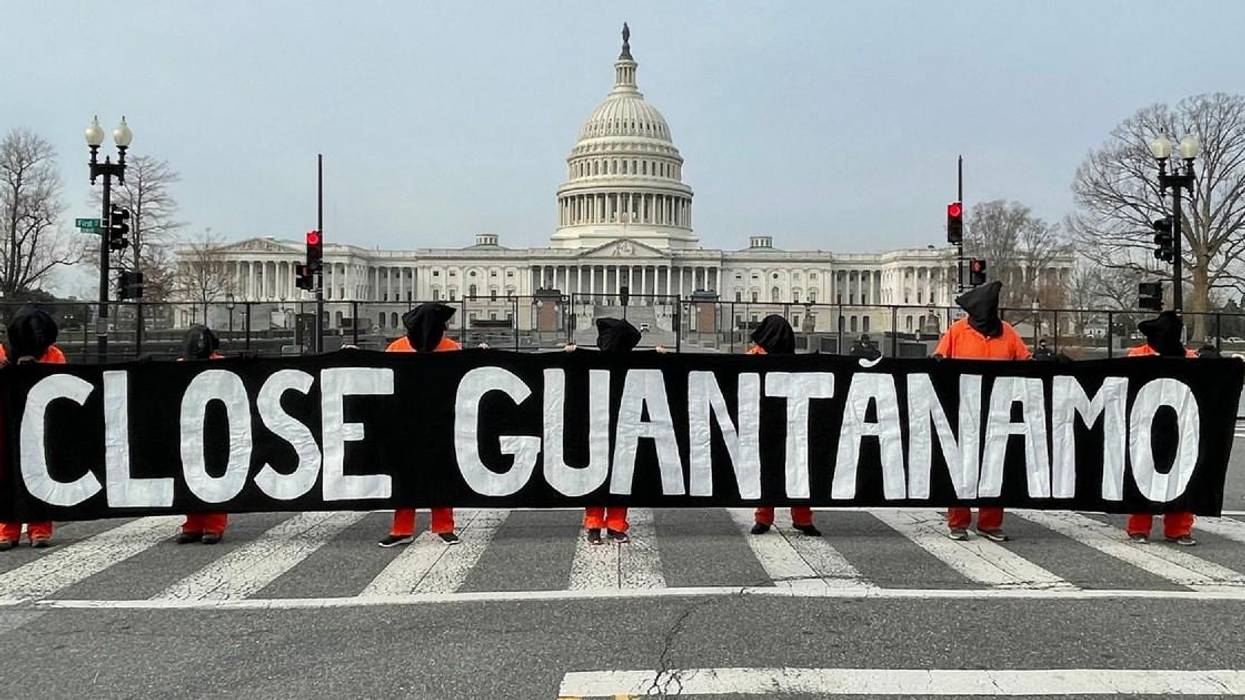
"The military-commission system has failed to bring anyone to justice for anything through contested proceedings," said an attorney for Majid Khan, a tortured former prisoner recently released to Belize.
On February 2, U.S. prisoner and former al-Qaeda courier Majid Khan was released from the Guantánamo Bay Detention Camp in Cuba after more than 16 years of imprisonment. "We are very pleased with Majid's release," says J. Wells Dixon, a senior staff attorney at the New York City-based Center for Constitutional Rights (CCR).
"Majid's transfer to Belize is the culmination of nearly 20 years of work by the CCR and the law firm Jenner & Block," Dixon tells The Progressive. "Our only regret is that he was not released sooner."
On October 7, 2001, in the wake of the 9/11 attacks, the United States, together with Great Britain, launched "Operation Enduring Freedom," the war in Afghanistan and the beginning of the "global war on terror." It was followed, in March 2003, by the U.S. invasion of Iraq ostensibly to end Saddam Hussein's dictatorship and to destroy his alleged weapons of mass destruction (WMD).
On January 11, 2002, the first 20 detainees were delivered from CIA black sites to the Guantánamo military prison, known as Camp X-Ray, on the island of Cuba. Over the following two decades, approximately 780 detainees would be held there. Today, 34 detainees remain imprisoned in the detention facility. Most troubling, this prison held more than 150 innocent men for years. The Guantánamo prison and associated military courts currently cost U.S. taxpayers about $540 million a year (with about $13.5 million being spent on each detainee).
Khan was born in Pakistan, where he lived as a child, and later grew up in a suburb of Baltimore, Maryland. After 9/11, he returned to Pakistan and became a courier for al-Qaeda. He was arrested in Karachi in March 2003 and spent about three years in CIA black sites. He was then taken to Guantánamo in September 2006, which is when CCR began to represent him. He was charged by a military commission in 2012, pleaded guilty, and agreed to cooperate with U.S. authorities.
"I have a story that I have waited almost two decades to tell, so I want to start by thanking you for taking the time to listen to my statement," Khan begins in his October 2021 personal statement before his sentencing by a Guantánamo military commission. Khan said, "I want you to know what I did, what happened to me, and what I hope for the future."
Khan's testimony was also included in a report by the U.S. Senate Select Committee on Intelligence. He was the first former prisoner of a CIA black site to openly describe the violent and cruel torture he suffered under what was infamously dubbed "enhanced interrogation." "The more I cooperated and told them, the more I was tortured," he said.
The committee's report was approved on December 13, 2012, but not declassified until 2014.
Kahn admitted to helping finance the 2003 bombing of a Marriott hotel in Jakarta, Indonesia, that killed eleven people. The Senate report notes that he was "an operative who could enter the United States easily and was tasked to research attacks against U.S. water reservoirs." And, according to Khalid Sheikh Mohammed, who is considered to be the principal architect of the 9/11 attacks, Khan was "to deliver $50,000 to individuals working for a suspected terrorist leader named Hambali, the leader of al-Qaida's Southeast Asian affiliate known as 'J-I.'... Khan confirmed that the money had been delivered to an operative named Zubair..."
According to Khan, the CIA black site had dungeon-like conditions in which he was kept naked with a hood on his head, his arms chained in ways that made sleep impossible. The report chronicles that at the "[b]eginning in March 2004, and continuing until his rendition to U.S. military custody at Guantanamo Bay in September 2006, Majid Khan engaged in a series of hunger strikes and attempts at self-mutilation that required significant attention from CIA detention site personnel."
Most alarming was how the CIA responded to these actions:
Majid Khan was then subjected to involuntary rectal feeding and rectal hydration, which included two bottles of Ensure. Later that same day, Majid Khan's "lunch tray," consisting of hummus, pasta with sauce, nuts, and raisins, was "pureed" and rectally infused. Additional sessions of rectal feeding and hydration followed. In addition to his hunger strikes, Majid Khan engaged in acts of self-harm that included attempting to cut his wrist on two occasions, an attempt to chew into his arm at the inner elbow, an attempt to cut a vein in the top of his foot, and an attempt to cut into his skin at the elbow joint using a filed toothbrush.
Majid also said during his sentencing that he was raped with a garden hose: "While I was hanging for these three days, I recall one instance where I saw a guard or interrogator's face," he said. "This man sexually assaulted me while I was hanging naked. He touched my private parts while we were alone. I told this man to stop and that I wanted to see a lawyer. He responded, ‘Are you kidding, a lawyer? You are in no man's land. No one even knows where you are.'"
"Belize's offer of humanitarian resettlement [for Khan] is a model for other countries to offer [resettlement to] the remaining men."
"Let me be very clear, enhanced interrogation techniques are torture. And torture is—and always has been in modern times—illegal," insists Majid's attorney, Dixon. "There is no exception under U.S. and international law for torture. And the torture that was inflicted on Majid was a war crime that should have been—and should in the future be—prosecuted as a criminal act."
Colonel Douglas K. Watkins, a judge at the Guantánamo military court, considered Khan's treatment "shocking." In his June 2020 ruling on Khan's case, he wrote, "there is no serious dispute that Mr. Khan was tortured and suffered other illegal pretrial punishment both in CIA detention and at Guantanamo."
Shortly after the 9/11 attacks, in November 2001, President George W. Bush issued an executive order establishing military commissions in Guantánamo. They had no legal obligation to grant basic U.S. Constitutional protections to prisoners because the prison was outside of the United States. In addition, they did have to adhere to the Geneva Conventions because these treaties did not apply to "unlawful enemy combatants."
In 2006 the U.S. Supreme Court found that the system of military commissions that was to be used to try selected prisoners held at Guantánamo was in violation of the Geneva Conventions and the Uniform Code of Military Justice.
Dixon points out that "when Majid Khan was brought to Guantánamo in September 2006, the assumption by the Bush Administration was that the U.S. military would go along with what the CIA had done, and would help to cover up what the CIA had done." He then adds, "But when push came to shove when Majid got in front of a military judge and a military jury, that military judge said this was torture—and the military jury condemned it."
"There are 34 men who remain, and the overwhelming majority of those men have been approved for transfer," Dixon adds. "Belize's offer of humanitarian resettlement [for Khan] is a model for other countries to offer [resettlement to] the remaining men."
Going further, he notes that "there [are] a small number of men who are still involved in the military commission system including the so-called 9/11 defendants—i.e., the five men who are accused of plotting the 9/11 attacks. So, what do we do about those men?"
"I'm not involved in those cases but having been through the military-commission system with Mr. Khan," Dixon argues. "I can say this, the military-commission system has failed to bring anyone to justice for anything through contested proceedings. The only success the military commission system has seen is through guilty pleas like that of Mr. Khan."
Dixon adds, "My point is that we will never have accountability for 9/11 if those cases continue toward trial because they will never get to trial, and if they get to trial, they will be overturned on appeal because of issue of the torture." He goes further, pointing out, "negotiated resolutions of the remaining military commission cases is the only way to obtain any modicum of justice and accountability. And it's the only way Guantánamo is going to close."
"It's hard to exaggerate the importance of this visit more than two decades since Guantánamo was open to hold detainees beyond the reach of the law," said one ACLU official.
For the first time ever, a United Nations human rights and counterterrorism expert will visit the U.S. military prison at Guantánamo Bay, Cuba, a U.N. office announced Wednesday.
The United Nations Office of the High Commissioner for Human Rights (OHCHR) said Irish attorney and law professor Fionnuala Ní Aoláin—the U.N. special rapporteur on the promotion and protection of human rights and fundamental freedoms while countering terrorism—will visit Guantánamo as part of a "technical visit to the United States" from February 6-14.
In addition to visiting the prison, OHCHR said Ní Aoláin will "carry out a series of interviews with individuals in the United States and abroad, on a voluntary basis," including victims and relatives of those killed in the 9/11 attacks and former Guantánamo detainees in countries where they have been repatriated or resettled.
Human rights advocates welcomed the development.
"We commend the Biden administration for agreeing to let a U.N. human rights expert visit Guantánamo, finally ending a shameful U.S. government moratorium that sought to establish a prison outside the reach of law," Hina Shamsi, director of the ACLU's National Security Project, said in a statement.
"International human rights norms and institutions are integral to preventing the torture, indefinite detention, and unfair trials that now symbolize Guantánamo globally," Shamsi added. "It should never have taken two decades, but we're encouraged to see the basic principle of U.N. rights officials' independent access to all sites of detention and detainees respected at long last by our country."
Since it was first opened in January 2002 by the George W. Bush administration in the early months of the so-called War on Terror, Guantánamo, or Gitmo in U.S. military parlance, has imprisoned 779 men and boys. Many of them were tortured, and only a handful were ever charged with any crime. According to retired U.S. Army Col. Lawrence Wilkerson—who served as chief of staff to Bush-era Secretary of State Colin Powell—Bush, along with Dick Cheney, his vice president, and Donald Rumsfeld, the secretary of defense, knew that most Gitmo prisoners were innocent, but kept them locked up for political reasons.
Although then-Presdident Barack Obama—under whom President Joe Biden served as vice president—signed executive orders meant to close Guantánamo and end torture, he was blocked by Congress from implementing the former policy, while torture continued at Gitmo during his tenure.
"International human rights norms and institutions are integral to preventing the torture, indefinite detention, and unfair trials that now symbolize Guantánamo globally."
Hundreds of Guantánamo detainees were released during the Bush and Obama administrations, with a relative handful freed under Biden. Today, 35 men remain locked up at Gitmo. According to the Pentagon, 20 of them are cleared for release while nine—including alleged 9/11 mastermind Khalid Sheikh Mohammed—have ongoing cases before military commissions from which numerous prosecutors have resigned amid allegations of rigging to secure convictions.
September 11th Families for Peaceful Tomorrows, an activist group, said in a statement that it "deeply appreciates the willingness of the special rapporteur's office and the Biden administration to work together to make her visit to Guantánamo possible."
"As 9/11 family members, we remain gravely concerned about the absence of justice within the military commission system," the group added. "We welcome the commitment of the special rapporteur to the human rights of victims of terrorism and we hope that her work can inform a path forward to judicial finality for family members, the accused, and all those affected by 9/11 and its aftermath."
Biden—whose former press secretary said closing Guantánamo is "our goal and our intention"—has been criticized for failing to do so two years into his administration and 21 years after the prison opened.
A bad idea doesn't somehow become a good idea just because five years have gone by. However, the Obama White House and Sen. John McCain seem ready to recycle a proposal that was overwhelmingly rejected in 2010.
President Obama has renewed his commitment to closing Guantanamo before he leaves office, and McCain (R-Ariz.) said he might be able to support closure. However, there has always been a right way and a wrong way to close Guantanamo. The restrictions the Senate has passed, along with the latest proposal floated by the White House to move some detainees to the United States for indefinite detention without charge or trial, is the wrong way.
Guantanamo has never been just about the prison. Instead, Guantanamo has been about our government violating the rule of law and ducking American values. From torture and abuse during the Bush administration to indefinite detention and defective military commissions extending through the Bush and Obama administrations, Guantanamo has been a place where our government behaves like a human rights pariah instead of a human rights beacon.
The solution can never be to simply pack up both the detainees and bad policies at Guantanamo and ship them to some new prison here in the United States. No. The only meaningful solution is to close Guantanamo by ending indefinite detention without charge or trial, transferring the detainees who have been cleared for transfer, and trying detainees for whom there is evidence of wrongdoing in our federal criminal courts in the U.S., which regularly try terrorism suspects, including high-profile ones.
But instead of doing the hard work of closing Guantanamo the right way, the Obama White House is reportedly dusting off the same plan that Congress overwhelmingly rejected in 2010. The "plan" would involve transferring overseas all cleared detainees (an excellent idea, but one that needs to be completed now, not when this "plan" goes into effect), but then setting up prisons in the U.S. to continue the indefinite detention of men who have been imprisoned for more than a decade without ever being charged with any crime. Other detainees would be put on trial -- but some of them would be tried before the same unfair military commissions used at Guantanamo. The result would be moving Guantanamo, not closing it.
McCain has a hand in it, too. As chairman of the Senate Armed Services Committee, he sponsored the Senate's National Defense Authorization Act, which would allow indefinite detention and military commissions to be brought to the U.S. as part of closing Guantanamo—but only if both houses of Congress approve the president's plan. Of course, requiring both houses of Congress to approve almost anything from the president is a political non-starter. But this provision is still being sold as a step towards closing Guantanamo.
A particularly bizarre bit of news about the White House plan this week came in a Washington Post report that said that the White House was considering setting up a nearly empty prison in Thomson, Illinois, as a site for indefinite detention of Guantanamo detainees. This same plan, with the same prison in Illinois, was rejected by a House vote of 353-69 in 2010. Then-Attorney General Eric Holder later swore that the Thomson prison would never be used for that purpose.
The ACLU said back in 2009 that shipping indefinite detention north was the wrong way to close Guantanamo, and it still is the wrong way to close Guantanamo. Bad ideas don't get better by just sitting on the shelf. It's time to close Guantanamo the right way by charging in federal court any detainee who can be charged and ending indefinite detention for everyone else. Suppose a prosecutor can't put together a case against someone imprisoned for 13 years. In that case, there is no reason that a person should continue to sit in prison, whether in Guantanamo or someplace else.
Let's close it the right way.