SUBSCRIBE TO OUR FREE NEWSLETTER
Daily news & progressive opinion—funded by the people, not the corporations—delivered straight to your inbox.
5
#000000
#FFFFFF
To donate by check, phone, or other method, see our More Ways to Give page.
Daily news & progressive opinion—funded by the people, not the corporations—delivered straight to your inbox.
Suddenly Americans are debating big ideas that used to be off the table.
New ways to raise taxes on the rich and big corporations have been proposed by candidates Elizabeth Warren, Kamala Harris and Bernie Sanders.
A Medicare-style public health system to expand coverage and cut costs has the support of millions and many Presidential candidates - even as we defend Obamacare.
The Green New Deal has been swept onto the national debate by the dynamic grass-roots Sunrise Movement and by Rep. Alexandria Ocasio-Cortez and colleagues in Congress. With new urgency, sponsors call for massive public investment to retool our economy to stop global warming and create the next generation of good jobs.
Perhaps because of the huge public support for these big ideas, Donald Trump has tried to tar them with the old Cold War scare word: Socialism. This is likely to backfire - just as the Southern racists' attacks on civil rights workers as "Communist agitators" just helped spread the movement. SNCC organizers were greeted at Mississippi doorsteps with "We are so glad you Communists have come to help us vote."
Some cautious Democrats have greeted these big ideas with a warning about the dangers of going too far. "Stick to attacking Trump and his policies," they lecture, "that's what helped us win in the Congressional campaigns 2018."
But over 90 well-known veterans of the successful 2018 campaign have signed a bold new Pledge to Fight for Good Jobs, Sustainable Prosperity and Economic Justice. And these initiators (including myself) have now been joined by 20,000 (and growing) grass-roots activists. Our message is "Yes, fight Trump - but Americans also want to hear big solutions to the large economic problem our country faces."
The Pledge document declares:
We will (continue to) resist Trump. But resistance is not enough. We therefore pledge that:
- We will fight for good jobs, sustainable prosperity and economic justice.
- We will work to build a movement that can make that agenda a reality.
Real change begins with a clear and coherent vision of a better America, and with citizens' movements dedicated to bringing that world into being. We offer this agenda for economic change in that spirit.
The group challenges the inside-the-beltway idea that Democrats need to choose between candidates that are "electable" and those who champion a bold agenda for change. Our signers make the case--and cite extensive polling--that the voters want candidates who know how the system has been rigged against working Americans. They argue that the most electable candidates are the ones with a plan to "un-rig" our government and to grow the economy and reverse inequality.
Note: I was one of the authors of the Pledge, and we found a great deal of enthusiasm from leaders we invited to join us, including the following leaders and thinkers:
Former Labor Secretary Robert Reich; economists Thea Lee, Robert Pollin and James K. Galbraith; African-American activists Rashad Robinson, Janet Dewart Bell, and Dedrick Asante-Muhammad; feminist leaders Gloria Steinem, Nita Chaudhary, and Toni Van Pelt; think tank directors Heather McGhee, Dorian Warren, Chuck Collins, and Angela Glover Blackwell; environmental leaders Bill McKibben, Annie Leonard, and Michael Brune; labor leaders Leo Gerard, Larry Cohen, Randi Weingarten, Chris Shelton, and Bonnie Castillo; business leaders like Leo Hindery Jr. and Charles Rodgers; activists and public intellectuals Manuel Pastor, Robert Borosage, Maria Echaveste, Jeff Faux, Heather Gautney, Eddie Glaude Jr., Zephyr Teachout, Richard Eskow, and Naomi Klein. Signers also include leaders of "resistance movement" groups, including MoveOn, People's Action, Democracy for America, Solidaire, Progressive Change Campaign Committee, Center for Popular Democracy Network, Public Citizen, Working Families Party, Ultra-Violet, Progressive Democrats of America, and Our Revolution. See all 90 initial signers.
The group will not endorse candidates. Individual signers will make those decisions on their own. But the group will ask candidates to tell Americans where they stand on the 11 planks of our economic agenda. And we will publish those positions on the website. Here is the Agenda that all signers of the Pledge have endorsed.
The first two planks of the group's agenda call for a strategy for economic growth and job creation that grows out of large-scale public investment to address real and pressing needs of our economy. They represent a dramatic contrast to the perpetual Republican "economic growth" plans which always involves tax cuts for the wealthy (and shredding important regulations). Progressives, often characterized as "redistributionist," clearly have a plan for sustainable economic growth.
1. Jobs for All by Rebuilding America
This plank takes seriously the warnings of the American Society of Civil Engineers, who have been ranking our infrastructure with marks of D or worse for decades. It also allows progressives to show they have a plan to achieve one of the major promises of candidate Trump, who has failed to deliver on infrastructure because he capitulated to the billionaire corporate wing of his party by giving away the revenue he needed in order to give them massive tax cuts.
2. Invest in a Green New Deal
The Green New Deal plank calls for retooling the US economy to dramatically reduce carbon pollution and make our systems, from housing to transportation much more energy efficient. It sets a goal of dramatically reducing carbon pollution in order to meet (and exceed) the goals set by the UN Climate Panel in order to stop the disastrous warming of the planet. And, as the labor-environmentalist Apollo Alliance told Americans a decade ago, this transition can be a boon to the economy, creating a new generation of good jobs and putting us on the path to sustainable (not wasteful growth that will lead us off a cliff. If we act quickly, we can also become a global leader in the new manufacturing industries we need to create the green transition.
3. Empower Workers to Reduce Inequality
Lots of people (and candidates) are now talking about growing inequality and trends finding that the 400 richest Americans control more wealth than the bottom 60 percent. One essential key to raising wages and reversing inequality is strong unions. So signers pledge to fight for the right of workers to form unions and bargain collectively for better wages and benefits. Guaranteed labor rights should be complemented by action to lift the floor under every worker by guaranteeing a living wage, paid sick and vacation days, and affordable health care. We must curb CEO compensation policies that give executives personal incentives to plunder their own companies. And we should use the tax system to reward companies that pay their workers a decent proportion to what they pay their executives.
4. Opportunity and Justice for All - With Focus on Communities Harmed by Racism
In theory full employment and labor rights should provide opportunity for all. But we insist that special attention must be invested in those communities harmed by the legacy of slavery, Jim Crow, segregation, discrimination, deindustrialization, and destruction of the public sector. Neglected urban and rural communities and working people victimized by the worst economic and social effects of neoliberalism must be given targeted attention and investment. We also call for a fair and humane immigration policy, fundamental reform of our criminal justice system, an end to mass incarceration and targeted investment in areas of need are all central to meeting the promise of economic justice.
5. Guarantee Women's Economic Equality
Addressing women's economic problems will improve our economy for all. We should guarantee that women earn the same pay, protections and opportunities as men in the workplace and in society - including strengthened laws for reporting and preventing sexual harassment. Women must also be guaranteed affordable health care and the right to make choices about their own health and reproduction. Families must have access to high-quality child care, and all women must be guaranteed paid leave from the workplace for childbirth, illness and vacation, and a secure retirement - with Social Security credit for work in the household.
6. Medicare for All - And Shared Economic Security
The group declares health care is a right, not a privilege. And that requires moving to a Medicare for All universal public health care system. Our fight to defend Obamacare from Trump and his allies is a crucial first step to a promise of a high-quality and cost-effective health care for everyone. In addition, America needs a more robust social insurance system. Every worker deserves a secure retirement-- and we will work to create new pension systems, while we secure Social Security by "lifting the cap" that now exempts wealthy people from paying their fair share of Social Security taxes. We will strengthen and expand America's shared security programs -- Social Security, Medicare, Medicaid, unemployment, food support and housing assistance. No one in America should go hungry or homeless. Greater shared security makes the economy more robust by making our society more fair - and giving all people the confidence that comes from solidarity.
7. High-Quality Public Education - Pre-K to University
Every young person must have the right to high-quality, free public education from preschool through college. Public education must be controlled by the public, not by charter school hucksters. This requires that every community, in partnership with the state and Federal Governments must have the financing necessary to strengthen public schools, providing the necessary basics - preschool, smaller classes, summer and after-school programs, and skilled, well-paid teachers with rights on the job.
College education or skills training should be available without tuition at all public universities as a right of civic membership -- as was the policy in many states in the 1950s and 1960s. Education should be a public good that benefits all of society, not a commodity that indentures students to debt. We call for a national student debt jubilee that will cancel the debt burden imposed upon several generations seeking an education. Free college and debt cancellation will not only allow students and former students to live their lives without that burden, but it will also stimulate economic growth and unleash new civic activism.
8. Make Corporations and the Wealthy Pay Their Fair Share
Our public investment/growth, green transition, and justice agenda requires tax revenues. Yet the corporations and the rich do not pay their fair share in taxes--even though they pocket the greatest benefits from public investments.
It is time for the rich and corporations to pay their fair share of taxes. It is time to shut down the tax havens and tax dodges that enable companies to avoid taxes altogether. We should lift the cap on Social Security taxes, so rich people pay the same percentage of their income as the rest of us. We should tax the income of investors at the same rates we tax income from work. We need clear, simple, progressive corporate and individual taxes, closing loopholes and exemptions. And a tax on financial transaction can produce significant revenues. A fair tax system will allow us to invest in an economy that will work for all.
9. Close Wall Street's Casino
Financial deregulation has devastated our economy, and it has protected banks that are too big to fail, too big to manage, and too big to jail. The financial casino fosters ever more dangerous speculation, while investment in the real economy lags. The resulting booms and busts devastate families and small businesses.
In a new age of corporate concentration, American must revive the concept of anti-trust action to reduce corporate power. We need to break up the big banks, levy a speculation tax, and provide low-income families with safe and affordable banking services. We should crack down on payday lenders and other schemes that exploit vulnerable working families, offering instead safe and inexpensive banking via the postal system.
10. Rescue Democracy from the Special Interests
Big money has corrupted our democracy. Some might say democracy is not part of an economics agenda. But the same financial elites and corporations that buy and sell politicians use that political power to rig the economy so the top .01 percent gets massively richer while incomes decline for the rest of us. We pledge to reverse the Citizens United decision which gave corporations the right to spend unlimited money in politics. We will stop the attack on voting rights which has escalated just as a new majority of people of color, young people and working women has begun to exercise new power. We will fight for public financing of elections that bans corporate and big money - and for electoral reforms, like public matching of small donations, so people's candidates can compete with the candidates of the plutocrats. Finally, we pledge to change national and local political party structures so that progressive candidates get a fair shake in the nominating process and in general elections. And we will build a new progressive majority that can take back our democracy and our economic system.
11. A Global Economic Strategy for Working Americans
Our global trade and tax policies have been created for and by multinational companies. We must renegotiate trade deals and rethink tax policies that benefit the already-wealthy, while they encourage the export of whole American industries, drive down pay and worker protections, and harm the environment. We need more but balanced trade, and global standards that protect the rights of workers, consumers and the environment. That requires a crackdown on tax havens, currency manipulation, and deals that allow corporations to trample basic labor rights here and abroad. Finally, we need new policies that allow us to help existing US industries, by having our government buy American, policies that are now outlawed by trade deals. And we need active investment policies that grow new cutting-edge industries, like green energy systems. Our current national security policies commit us to policing the world. The result costs lives and drains public resources. We need a real security policy that makes military intervention a last resort, and focuses on global threats like climate change, poverty and inequality. We should reduce military budgets and properly support humanitarian programs.
We will see what impact the Pledge/Agenda will have on the 2020 political debate. The multiple-candidate field will create a dynamic very different from 2016. But polling shows a wide spectrum of voters want politicians to talk about (and fight for) a bold economic agenda. Senator Bernie Sanders got historic support in 2016 because he talked about an agenda that challenged corporate power and put forward a plan for big economic change. And, because Hilary Clinton didn't want to be crosswise with that progressive agenda, she took positions she might not have - and walked away from the TPP trade deal, which was very unpopular with the Democratic base. And, thanks to pressure from Sanders supporters, the Democratic Platform was more progressive than ever. Unfortunately, Clinton didn't talk about it much.
Bernie Sanders just got into the 2020 race this week, rightly reminding interviewers that many of the ideas candidates are now discussing - and that our Agenda is promoting - first gained respectability and widespread support as a result of his pioneering 2016 Presidential campaign. This year many other candidates are embracing some of those ideas. Using and online comparison, we will publicly keep track of the economic agenda positions each of these candidates take. What the voters will have to determine how much each candidate really means his/her promises - and whether they are willing to fight for the jobs, wages, pensions - and their economic futures - of working Americans.
Who knows? Some of the best candidates may cancel each other out. Even if the eventual nominee ends up being the most conventional Democrat in the race, all progressives will work hard to get rid of Trump. And after that we will unite to organize to push the new President--and a larger Congressional majority--to fight for a plan for economic transformation. This Agenda will not go away, no matter who wins the elections. Because the growing number of Americans who are endorsing the Pledge to Fight for Good Jobs, Sustainable Growth and Economic Justice see themselves as enlisting for a long-term movement for change - not just for the next campaign.
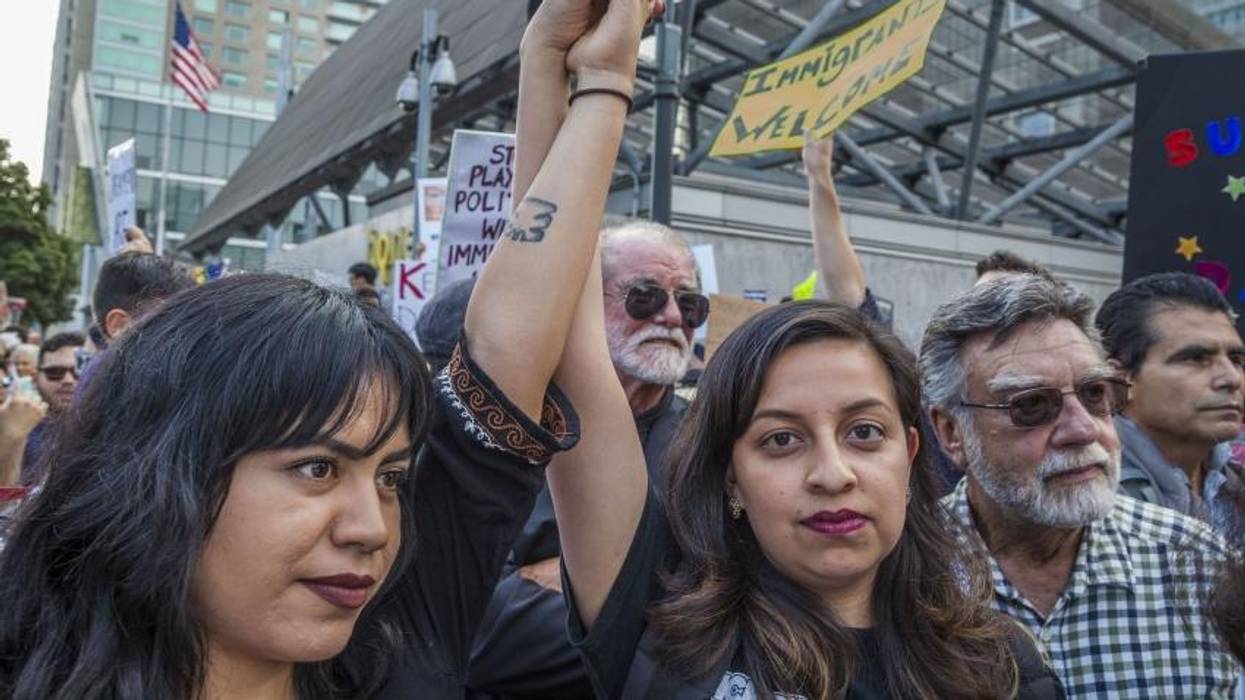
The "dreamers," young recipients of the Deferred Action for Childhood Arrivals (DACA) program--are the true children of the North American Free Trade Agreement (NAFTA). More than anyone, they have paid the price for the agreement. Yet they are the ones punished by the administration of President Donald Trump, as it takes away their legal status, ability to work and right to live in this country without fear of arrest or deportation. At the same time, those responsible for the fact they grew up in the United States walk away unpunished--and even better off.
I'm not talking about their parents. It's common for liberal politicians--and even Trump himself, on occasion--to say these young people shouldn't be punished for the "crimes" of their parents, who brought their children with them when they crossed the border without papers. But parents aren't criminals any more than their children are. They chose survival over hunger, and sought to keep their families together and give them a future.
The perpetrators of the "crime" are those who wrote the trade treaties and the economic reforms that made forced migration the only means for families to survive. The "crime" was NAFTA.
In a just world, U.S. trade negotiators would rewrite the treaty to repair the damage done to communities on both sides of the border, especially in Mexico. They would ensure that those forced to migrate--dreamers and other immigrants--have legal residence where they now live. They would change the rules of the relationship between the United States and Mexico, so that the income and lives of working people and the poor aren't sacrificed to produce profit opportunities for big corporations. And their new agreement would punish those corporations responsible for the vast increase in poverty following NAFTA's passage.
While the Trump administration and a Republican Congress are certainly not going to negotiate any changes like these, the first step in making change possible is telling the truth.Nowhere is this more important than in relation to NAFTA and immigration policy. It's impossible to understand the outrageous injustice of deporting the dreamers without acknowledging the reasons why they live in the United States to begin with.
The treaty had an enormous impact on Mexico, producing a wave of forced migration of millions of people. The World Bank in 2005 found that the extreme rural poverty rate of 35 percent from 1992 to 1994, prior to NAFTA, jumped to 55 percent from 1996 to 1998, after NAFTA took effect. By 2010, 53 million Mexicans were living in poverty, and about 20 percent live in extreme poverty, almost all in rural areas.
People were migrating from Mexico to the United States long before NAFTA, but the treaty put migration on steroids. In 1990, 4.4 million Mexican migrants had come to the United States. A decade later, that population more than doubled to 9.75 million, and in 2008 it peaked at 12.67 million. About 9 percent of all Mexicans now live in the United States. About 5.7 million were able to get some kind of visa, but another 7 million couldn't.
In the first year of NAFTA, one million Mexicans lost their jobs, by the government's count.Jeff Faux, founding director of the Economic Policy Institute, told In These Times that "the peso crash of December, 1994, was directly connected to NAFTA."
The treaty then forced yellow corn grown by Mexican farmers without subsidies to compete in Mexico's own market with corn from huge U.S. producers, subsidized by the U.S. farm bill. Corn imports rose from around 2 million to more than 10 million tons from 1992 to 2008. Mexico imported 30,000 tons of pork in 1995, and by 2010, this number jumped to 811, 000 tons. As a result, pork prices dropped 56 percent, and Mexico lost over 120,000 jobs in pork production.
NAFTA prohibited price supports, without which hundreds of thousands of small farmers found it impossible to sell corn or other farm products for what it cost to produce them. The CONASUPO system--in which the Mexican government bought corn at subsidized prices, turned it into tortillas and sold them in state-franchised grocery stores at subsidized low prices--was abolished. The price of corn to farmers fell by 66 percent, and the price of tortillas jumped by 279 percent in NAFTA's first decade.
In Dreams Deported, published by the UCLA Labor Center, dreamers describe their memories of forced migration, retold in their families. Vicky's family in Mexico "was too poor to pay for her mother's medication and Vicky couldn't find a job to support her parents." Renata Teodoro remembers, "My father had been working in the United States for many years, and we survived on the money he sent us."
Rufino Dominguez, former director of the Oaxacan Institute for Attention to Migrants, said in 2014, "NAFTA forced the price of corn so low that it's not economically possible to plant a crop anymore. We come to the U.S. to work because we can't get a price for our product at home. There's no alternative." About 2.5 million rural Mexican farmers and farmworkers were driven out of work or off their land.
Urban workers felt NAFTA's impact as well. The average Mexican wage was 23 percent of the U.S. manufacturing wage in 1975. By 2002, it was less than an eighth. In the 20 years after NAFTA went into effect, the buying power of Mexican wages dropped, and the minimum wage fell by 24 percent. A U.S. autoworker earns $21.50 an hour, and a Mexican autoworker $3. A gallon of milk costs more in Mexico than it does in the United States. It takes a Mexican autoworker over an hour's work to buy a pound of hamburger, while a worker in Detroit can buy it after 10 minutes. But Mexican workers in the GM plant making the Sonic, Silverado, and Sierra produce the same number of cars per hour that the workers do in U.S. plants. The difference means profit for GM, poverty for Mexican workers and the migration of those who can't survive.
Congress was warned that NAFTA might increase poverty and fuel migration. When the deal passed the Immigration Reform and Control Act (IRCA) in 1986, Congress set up a Commission for the Study of International Migration and Cooperative Economic Development to study immigration's causes. Its 1990 report recommends negotiating a free trade agreement between the United States, Mexico and Canada. But it cautioned, "It takes many years--even generations--for sustained growth to achieve the desired effect." Meanwhile, the study warned of years of "transitional costs in human suffering." Nevertheless, the negotiations that led to NAFTA started within months.
In a statement giving its current position on the trade talks, the AFL-CIO argued that "all workers, regardless of sector, have the right to receive wages sufficient for them to afford ... a decent standard of living," and to prohibit export of products made by companies paying less. Progressive Mexican unions and community organizations support this principle, because it would give workers and farmers a future at home, where they live.
Gaspar Rivera-Salgado, a leader of the Binational Front of Indigenous Organizations, which fights for immigrants' rights in the United States, told In These Times, "We need the ability to stay home with jobs and incomes that can support families--the right to not migrate." But without changing U.S. trade policy and ending pro-corporate economic reforms, millions of displaced people will continue to migrate, no matter how many walls are built on the border. If people bring their children with them, that's no more than any of us would do to avoid the breakup of our families.
Defending the dreamers and the rights of all migrants in the United States is intimately connected with changing the policies that uproot communities and force families into the dangerous journey through the desert and across this country's southern border. Tearing down the wall instead of building a new one, and closing the detention centers instead of filling them with dreamers, is as much a part of renegotiating NAFTA as ensuring that Archer Daniels Midland and Cargill never again drive farmers off their land, or forcing General Motors to pay a wage that won't send workers home to hungry families.
Over the past ten years, Ecuador has achieved major economic and social advances. We are concerned that many of these important gains in poverty reduction, wage growth, reduced inequality, and greater social inclusion could be eroded by a return to of the policies of austerity and neoliberalism that prevailed in Ecuador from the 1980s to the early 2000s. A return to such policies threatens to put Ecuador back on a path that leads not only to a more unequal society, but to more political instability as well. It is important to recall that from 1996 to 2006, Ecuador went through eight presidents.
Unfortunately, there is much confusion and misinformation about Ecuador's achievements in recent years. It has all but become conventional wisdom that the economic and social progress in Ecuador, such as it is recognized, resulted simply from a commodities boom and a spike in oil revenues. This explanation ignores the innovative and important reforms that the Ecuadorian government has enacted that have played an instrumental role and allowed the country to emerge, relatively unscathed, from the 2009 Global Recession and the more recent collapse in oil prices. These reforms included bringing the central bank into the government's economic team, a tax on capital exiting the country, a large increase in public investment, re-regulation of the financial sector, and countercyclical fiscal policy.
Neoliberal economic policies have been tried in Ecuador, and have failed to deliver. Compared to 1.5 percent annual per capita GDP growth from 2006 to 2016, per capita GDP growth averaged just 0.6 percent from 1980 to 2006. From 1980 to 2000, a period during which Ecuador had a number of loan agreements with the International Monetary Fund, Ecuador experienced a considerable economic failure, as GDP per capita fell by 1.5 percent over those two decades. This failure almost certainly resulted at least in part from the neoliberal policies of cutting spending, privatization, inflation-targeting, deregulation, and others that also made the Ecuadorian economy increasingly vulnerable to external shocks. In the 1960-1980 period, by contrast, per capita GDP growth was 110 percent.
Similarly, poverty increased by one-third between 1995 and 2001, when it reached 45 percent. Poverty did decline overall from 1995 to 2006, but by just 2.7 percent; by contrast, poverty fell by over 32 percent from 2006 to 2014. According to Ecuadorian government statistics, the Gini coefficient for net household income (a common measurement of inequality) decreased by over 10 percent between 2006 and 2014, after having increased by more than 7 percent from 1995 to 2006. The indicators from the pre-Correa years, as bad as they are, are bolstered by the fact that emigration of people from Ecuador under prior governments artificially held down Ecuador's inequality, poverty, and unemployment rates.
For most of Ecuador's modern history, its petroleum wealth has largely benefited a relative few. For example, a 2002 law supported by the IMF and World Bank required that Ecuador's Stabilization Fund, an entity created with, and which received, revenues from oil exports, spend 70 percent of its revenues on debt payments, but just 10 percent on social spending.
Important reforms over the past decade have distributed oil revenues more equitably. Oil agreements that previously gave away Ecuador's oil wealth to foreign companies were renegotiated, leading to increased revenues for the people of Ecuador (without these renegotiations, the rise in oil prices would not have generated substantially greater revenues to the government). These government revenues have been channeled into responsible state spending with impressive results: middle and secondary school enrollment shot up dramatically as higher education spending increased from 0.7 to 2.1 percent of GDP. As government spending on health services doubled, as a percentage of GDP, from 2006 to 2016, some 40 percent more patients were treated at public hospitals in 2014 than had been in 2006. The Ecuadorian government enacted a stimulus of about 5 percent of GDP that allowed it to weather the 2009 Global Recession with lost output of only about 1.3 percent.
The "Washington consensus" era in Ecuador did not benefit most Ecuadorians, and a majority of Ecuadorians let their feelings be known, through mass protests that helped to oust several presidents; and finally in the 2006 elections that ushered in an era of real change -- a historic break with the economic policies that had, in part, put the interests of Ecuador's elite, of Washington, and of powerful international capital, ahead of the majority of Ecuadorians.
Our goal is not to tell Ecuadorians whom to vote for, or to interfere in Ecuador's political processes. With the proliferation of misinformation and misunderstanding about Ecuador's economy, however, we felt it necessary to correct the record.
Ecuador deserves leaders who will implement policies that benefit all Ecuadorians -- whoever they may be. It would be tragic for Ecuador's next government to return to a less prosperous, less inclusive past.
Signed,
James K. Galbraith, Lloyd M. Bentsen Jr. Chair in Government/Business Relations and Professor of Government at the LBJ School of Public Affairs, University of Texas at Austin
Ha-Joon Chang, Department of Economics, University of Cambridge, United Kingdom
Stephanie Kelton, Professor of Economics at University of Missouri-Kansas City, Former Chief Economist on the U.S. Senate Budget Committee
William K. Black, Associate Professor of Economics and Law, University of Missouri-Kansas City
Pavlina R. Tcherneva, Associate Professor and Chair of the Department of Economics and the Economics and Finance Program at the Levy Economics Institute, Bard College
Gerald Epstein, Professor of Economics and Co-Director of the Political Economy Research Institute (PERI) at the University of Massachusetts, Amherst.
Mark Weisbrot, Co-Director, Center for Economic and Policy Research
Jeff Faux, Founder, Economic Policy Institute
John Willoughby, Professor of Economics, American University
Dean Baker, Co-Director, Center for Economic and Policy Research
Gabriele Koehler, Development Economist, Munich
William Barclay, Founding Member of Chicago Political Economy Group and retired Sr. Vice President, Chicago Stock Exchange
Amitava Krishna Dutt, Professor of Economics and Political Science, University of Notre Dame and Distinguished Professor, FLACSO, Ecuador
Ben Zipperer, Economist, Economic Policy Institute
Jim Campen, Professor of Economics, Emeritus, University of Massachusetts, Boston
Mustafa Ozer, Professor, FEAS, Department of Economics, Anadolu University, Eskisehir, Turkey
Eileen Appelbaum, Senior Economist, Center for Economic and Policy Research
Alicia Puyana Mutis, Professor of Economics, Facultad Latinoamericana de Ciencias Sociales, Mexico
Jayati Ghosh, Professor of Economics, Jawaharlal Nehru University, New Delhi, India and Executive Secretary, International Development Economics Associates, India
Jorge Buzaglo, Associate Professor of Economics, Sweden
Ann Markusen, Professor Emerita and Director, Project on Regional and Industrial Economics, University of Minnesota
Matias Vernengo, Professor of Economics, Bucknell University and Co-editor of the Review of Keynesian Economics
Stephanie Seguino, Professor of Economics, University of Vermont
Kathleen McAfee, Professor, International Relations, San Francisco State University
Mark A. Price, Labor Economist, Keystone Research Center
Chris Tilly, Professor of Urban Planning, University of California Los Angeles
Gustavo Indart, Associate Professor, Department of Economics, University of Toronto, Canada
Julie Matthaei, Professor of Economics, Wellesley College
Peter Bohmer, Faculty in Economics and Political Economy, The Evergreen State College
Genaro Grasso, Economist at University of Buenos Aires and University of San Martin, Argentina and Researcher at Institute of High Social Studies, IDAES and Cultural Center of Cooperation, CCC
Mark Paul, Postdoctoral Associate, Samuel DuBois Cook Center on Social Equity at Duke University
Renee Prendergast, Reader in Economics, Management School, Queen's University Belfast, Belfast, Northern Ireland
Nicola Melloni, Visiting Fellow, Munk School of Global Affairs, University of Toronto, Canada
Arthur MacEwan, Professor Emeritus of Economics, University of Massachusetts Boston
Demian Panigo, Co-Director, Center of Workers Innovation (CONICET), Argentina and President of the Latin American Economic Thought Association (APEL)
Korkut Boratav, Turkish Social Science Association, Turkey
Peter Dorman, Professor of Political Economy, The Evergreen State College
Carlos Oya, Reader in Political Economy of Development at the School of Oriental and African Studies (SOAS), London
Joseph Ricciardi, Associate Professor of Economics, Babson College, Wellesley, MA
Venkatesh Athreya, Adjunct Professor, Asian College of Journalism, Chennai and Adjunct Professor, Rajiv Gandhi National Institute for Youth Development, Chennai
Eduardo Strachman, Associate Professor, Department of Economics - Sao Paulo State University (UNESP) - Brazil
Saskia Sassen, Professor, Columbia University
Irene van Staveren, Professor of Pluralist Development Economics, International Institute of Social Studies of Erasmus University Rotterdam, Netherlands
Erhan Yildirim, Professor of Economics at Cukurova University, Turkey
Romina Kupelian, Researcher, Centro de Economia y Finanzas para el Desarrollo Argentino (CEFID-AR); Advisor at the Central Bank of Argentina (BCRA)
Guillermo Hang, Independent Researcher and Economist at UNLP, Argentina
Reza Mazhari, Assistant Professor of Economics, The Gonbad Kavoos University, Iran
Ron Baiman, Assistant Professor, Graduate Business Administration, Benedictine University, Lisle, IL
Fadhel Kaboub, Associate Professor of Economics at Denison University, and President of the Binzagr Institute for Sustainable Prosperity
Scott A. Weir, Economics Instructor at Wake Technical Community College, Raleigh, NC (retired)
Farida C. Khan, Professor of Economics, University of Wisconsin-Parkside
Al Campbell, Emeritus Professor of Economics, University of Utah, Steering Committee of the Union for Radial Political Economics (URPE)
Michael Meeropol, Professor Emeritus of Economics Western New England University
Antonio Savoia, Lecturer in Development Economics, Global Development Institute, The University of Manchester, UK
Michael Ash, Professor of Economics and Public Policy, University of Massachusetts Amherst
It seems as though we dread elections in the United States. Over several past races, only 50 percent to 60 percent of eligible voters have cast their ballots. More and more Americans are tuning out of the electoral process. Monday night's debate, the first matchup between the two major-party candidates, was a perfect showcase for explaining voter apathy.
It seems as though we dread elections in the United States. Over several past races, only 50 percent to 60 percent of eligible voters have cast their ballots. More and more Americans are tuning out of the electoral process. Monday night's debate, the first matchup between the two major-party candidates, was a perfect showcase for explaining voter apathy.
The confines of the debate were set by the Commission on Presidential Debates and had the potential to unleash a wide-ranging set of arguments on the issues of income inequality, race and policing, and national security. Instead, over the course of more than 90 minutes, we saw Donald Trump sputter lies and half-truths, interrupt, talk over and "mansplain" issues to Hillary Clinton. And we saw Clinton, the center-right candidate by most reasonable measures, appear by contrast to be the sane and liberal-leaning candidate--at least most of the time. Not only were the issues narrowed down to meaningless levels, they generally skewed politically rightward.
Here are 10 big topics that got no mention during the debate. This is by no means an exhaustive list but simply an indicator of how issue-poor the first presidential debate was.
1. During the discussion on income inequality, no one mentioned how corporations and wealthy elites have created such a lopsided economy in favor of the rich that the entire project of capitalism can be questioned. A recent report by the U.K. organization Global Justice Now found that of the top richest 100 economic institutions worldwide, a majority--69 to be exact--are corporations. That means that Wal-Mart, the world's richest corporation, on whose board Clinton once sat, is wealthier than the country of Spain.
2. No one bought up how poverty is affecting Americans, the residents of the world's wealthiest of all economic entities. So dire are the straits of our most vulnerable citizens that a disturbing new report found that hungry American teenagers are often trading sex for food. This shameful effect can be traced to government policies of the kind that Clinton's husband, former President Bill Clinton, pushed in the name of welfare reform. Whether on a global or domestic scale, such shocking indicators of the failures of capitalism were not considered worthy of discussion during the debate.
3. During one of Trump's very few moderately sane moments in the debate, he raised legitimate concerns about free trade, calling Clinton out for her support of the 1994 North America Free Trade Agreement between the U.S., Canada and Mexico. By most measures, NAFTA has been disastrous for both U.S. and Mexican workers and has driven much of the emigration from Mexico to the U.S. Trump also rightly called Clinton out on her initial support for the proposed Trans-Pacific Partnership (TPP), a much wider-ranging and highly secretive trade deal between the U.S. and a number of Pacific nations that has been denounced by labor and environmental groups. What Clinton failed to point out was Trump's claim that economic growth is hampered by too much regulation--this idea runs counter to his opposition of NAFTA and TPP. The so-called "free trade" agreements are designed to free corporations from the burdens of environmental regulations, labor laws and similar things. Clearly, Trump, the billionaire businessman, has only attached himself to the anti-free-trade sentiment in order to win votes from working- and middle-class Americans. In the end, it became obvious that a billionaire debating a millionaire will hardly result in any substantive discussion of how global trade deals hurt ordinary people.
4. We have just caught one of the most high-profile U.S. banks, Wells Fargo, engaging in widespread criminal behavior, targeting millions of Americans with fraudulent bank accounts and credit cards. Wells Fargo has fired thousands of its low-level workers and taken no real responsibility, short of paying a paltry fine, for its shenanigans. CEO John Stumpf is so obscenely wealthy that as a penalty for overseeing the bank's crimes, he will return $41 million in stocks. He will not, of course, face prison time. Nor will any top Wells Fargo executives. This major news story did not even get a mention during the debate because, after all, corporations are seen by politicians of both major parties as noble job creators, rather than the "blood-sucking vampire squids" that they often are.
5. During the discussion on race and policing, neither candidate mentioned these three little words: Black Lives Matter. Neither mentioned how so few police officers involved in so many killings of unarmed black Americans have been convicted, charged or even indicted. Instead, what we heard from both candidates is that "working with the police" is a major solution to curbing violent and unjustifiable killings by police. But our criminal justice system is already so biased in favor of police that black Americans live in constant fear of being pulled over precisely because, for far too long, we have indeed worked with the police, and only the police.
6. While the candidates had a welcomed debate over New York City's now-illegal "stop-and-frisk" program, with Trump blatantly exposing his ignorance on the matter, what did not get mentioned was the ongoing practice of racial profiling nationwide. Racial profiling, at the heart of stop-and-frisk, is technically unconstitutional, but it persists throughout the country, deeply affecting the quality of life for people of color, especially African-Americans. Clinton's mention of "implicit bias" came close to the issue but ultimately skirted it.
7. During the discussion of cybersecurity, which fixated on Russia's espionage attempts, no mention was made of the National Security Agency's unparalleled invasion of Americans' privacy. As Edward Snowden's revelations have shown, the U.S. has destroyed all semblance of the right to privacy in the name of cybersecurity. Halfhearted attempts at legislating curbs on mass surveillance have failed or stalled.
8. When discussing foreign policy (under the popular guise of "national security"), Trump made one brief mention of Israeli Prime Minister Benjamin Netanyahu that seemed to have little bearing on the conversation. Other than that, there was no mention of Israel or the recent approval of an unprecedented aid package to Israel--a veritable gift of U.S. taxpayer dollars--in an amount larger than any nation has ever been promised. The military aid, in the form of sophisticated weaponry, will be used against Palestinians living in the West Bank and Gaza. It is hardly surprising that the word "Palestinians" and "Palestine" did not feature at all during Monday night's discourse.
9. While there was much focus on Islamic State, mostly in terms of who was responsible for its rise, no substantive discussion emerged on whether bombing Iraq and northern Syria will destroy Islamic State or cause it to proliferate. Discussion of President Obama's expanded drone wars, which fuel much of Islamic State's rage, also was absent. After all, drone strikes are at the forefront of our not-so-secret secret war. Both candidates also failed to mention that U.S. policies in the Middle East are driving the largest global refugee crisis in modern history.
10. Finally, there was no mention of the wars we have fueled in our own hemisphere, in countries whose refugees have arrived on our doorstep. Clinton's role in Central America was easy fodder for Trump, but he stayed away from it because it would mean admitting that Central American children, whom Clinton has said she wanted to deport, are human beings driven by desperation to migrate northward through no fault of their own. Clinton's role in the coup in Honduras that unleashed horrific violence in that country did not come up, even as she touted her credentials as secretary of state.
Too many issues that are far too important remain invisible during our presidential election debates. It is no wonder that elections seem less and less relevant.
On the night of October 3, 2015, an American attack helicopter bombed and strafed a Doctors Without Borders hospital in Kunduz, Afghanistan. At least 22 medical staff and patients, including three children, were killed. Twenty-four are still missing. The U.N. High Commissioner for Human Rights suggested it might be a war crime.
On October 15, almost a year and a half after he announced the war's end, President Obama again extended American military operations in Afghanistan. Now, our soldiers are to remain at least into 2017.
Over 26,000 Afghan citizens have been killed as a result of our invasion, adding to the growing number of the world's people who hate Americans. The killing will continue.
The US Army initially claimed that the assault in Kunduz was an accident. Then, it was done to protect American soldiers. Then to protect Afghan government soldiers. Then, the US forces may not have sufficiently followed the Army's "rules of engagement," although it has declined to tell us exactly what those rules are. The President and the US commander in Afghanistan apologized and promised an investigation that "will hold those responsible accountable."
Don't hold your breath. As Amnesty International has reported, throughout this war the US government has consistently stonewalled investigations of the thousands of Afghan civilians killed in "night raids by US Special Operations forces, air strikes, drone strikes and torture". The episodes are shrugged off as "collateral damage", the unintended consequences of warfare.
Implicit in this notion of collateral damage is that war absolves its participants of murder. The moral logic is that you cannot blame a 20-year-old recruit who is trained to kill, armed with savagely destructive weapons, and sent into the terrifying fog of war for mistaking a wedding guest for an enemy sniper. But the excuse of collateral damage also lets those who sent him or her to war off the hook. It reinforces the illusion that it is possible to wage a crime-free war, i.e., that with more human rights training in the military, better battlefield discipline, and smarter weapons, we can invade a nation without murdering and maiming innocent civilians.
Wars of aggression never were and never will be free of atrocities. The decision to invade another nation is a decision to kill those who resist and get in your way -soldiers or civilians. Smarter bombs can certainly slaughter with more concentrated effect; in Kunduz, the hospital's emergency and intensive care units were obliterated, while a ward ten yards away was untouched. However, such systems are hardly precise regarding whom they kill. As classified Army documents for 2011-13 just made public by Wikileaks reveal, the "vast majority" of US drone strike casualties in Afghanistan were not the intended targets.
The real crime in Afghanistan lies in continuing a war that has long lost any legitimate purpose. An honest search for "those responsible," therefore, would follow the evidence up the chain of command through the Pentagon to the Democratic White House and the Republican Congress that keep our troops in a conflict that cannot be won and cannot be continued without raining more death and destruction on an impoverished faraway land that poses no threat to the American people. The inquiry would go even one step further: to the ultimate authority in a democracy - we citizens.
After 14 years of fighting -at a cost of over 2200 American lives, 20,000 seriously wounded, countless mentally damaged, and a trillion dollars - it is obvious that we cannot accomplish our stated objectives. The Taliban cannot be destroyed, and the Afghan people will not support a US-imposed government. Yet virtually every evening, whether it's on Fox News or PBS, pundits and politicians tell us that with just a little more military training, our corrupt, dysfunctional, and opium-dealing puppet Afghan regime could achieve victory.
You don't have to be a military expert to know this is nonsense. The problem isn't that Afghans don't know how to fight; they are a culture of legendary warriors. The problem is that they don't want to fight for us.
Today, the Taliban controls or is contesting more territory than at any time since the war began. Outside Kabul and a few other areas where mountains of our money buy molehills of temporary allegiance, the government's army and police are hated for their oppression and human rights abuses. Its courts are crooked and criminally unresponsive, while Taliban justice -- although harsh -- is swift, works without bribes and legal fees, and is honestly administered. Warlords, paid for and armed by the CIA and the Pentagon, indulge in brutal behavior toward their people, including a delight in raping children, which the US Army orders its soldiers to ignore. It's just more unavoidable collateral damage.
This wretched experience tells us that unless we are willing to continue fighting forever in Afghanistan, the major force in that country's future is likely to be the Taliban, whose Muslim fundamentalism, by the way, was not a problem for us when the CIA was supplying it with weapons to fight a Russian supported secular regime in Kabul.
Moreover, the longer we stay, the greater the chances that what comes after us will be much worse than the Taliban. ISIS, with its truly savage Wahhabi fanaticism (exported from our allies in Saudi Arabia), is now operating in eastern Afghanistan near the Pakistani border.
Today, the prospects of our governing class pulling out after Obama leaves the White House are nil. Potential Republican presidential candidates are balloons of patriotic bombast, demanding that the war be further escalated. The Democrats speak more moderately, but in the recent debate, no candidates were willing to say, "We've had enough. It's time to go home."
As for the voters in whose name this war is being fought, a majority tells pollsters that the war in Afghanistan was a mistake. Yet they support the decision to keep our troops there.
There are many reasons why we have no serious anti-war movement in this country and why we, Americans who claim to despise and distrust big government, are willing to give it the right to murder in our name. One is the absence of a draft, which allows us to keep our children safe.
Still, we consider ourselves an exceptionally moral people. Our presumed good intentions allow us to rationalize destroyed hospitals, pulverized houses, and children's corpses as preventable accidents, so long as we promise to try hard to avoid such errors during the next blitz. The atrocities are, therefore, conveniently removed from the implicit moral cost/benefit calculation for which citizens in a democracy are responsible when it comes to issues of life and death.
If the war is morally costless, it matters less that it has lost its purpose. Our consciences are thus cleared for maintaining the cynical and soulless post-Viet Nam bargain between we voters and those we vote for: they will not draft our children; we will not oppose their wars.
So, by all means, let us urge the President to find out what happened that night in Kunduz. But let the search continue up the ladder of power. When the investigation reaches those ultimately responsible, we look in the mirror.
They have one argument: he can't win. Why? Well... he's too radical, he lacks charisma, he doesn't connect with minorities, he's a secular Jew, etc. Don't waste your vote, they say; the risks of electing a Republican are too high.
But prematurely presumed losers have won enough elections in our history to make this glib conventional wisdom suspect, especially this year when voter anger at the Washington-Wall Street axis that dominates American politics is so widespread. Even Republicans are, rhetorically at least, trying to distance themselves from being associated with welfare for the rich. In this environment, Sanders' rivals, Hillary Clinton and Joe Biden -- whom the Wall Street Democrats are keeping in reserve in case Hillary implodes -- carry a lot of negative baggage. Hillary's recent drop in the polls, driven by a dramatic decline in the support of women, has already undercut her claim to be the Democrats' strongest champion in next year's election.
More important, those who are Democrats because they believe the Party should be an instrument for building a better country- rather than just a personal career ladder -- need to think through the larger probabilities. Whatever the odds are for Bernie Sanders becoming president, the odds that Hillary Clinton or Joe Biden would, as president, seriously address the issues that the Democratic rank-and-file care about are much longer.
Both Clinton and Biden have been leaders of the crony network of Democratic Party enablers who have colluded with the GOP on the domestic policies that have relentlessly eroded economic security and opportunity for the vast majority of our people. They both are also major promoters of the reckless foreign interventions that have cost thousands of American lives, trillions of dollars and generated fierce hatred of us throughout the world.
"Not our fault," shrug the Democratic elite. "The country has moved to the right." True. Yet these same people have controlled the White House for 15 of the last 23 years. The problem is not that the Republican Party has moved to the right; that has always been its natural tendency. It's that the Democratic Party has willingly moved with them. The signature self-proclaimed "successes" of both the Clinton and Obama administrations - criminal justice and welfare "reforms," deregulation of trade and privatization of government, Wall Street bailouts and a health care program whose major beneficiaries are insurance and drug companies - are all Republican ideas.
Democrats, of course, have been much better at expressing compassion for the people left behind. Thus, Hillary and Bill Clinton are said to be so beloved by African-Americans that Sanders has no chance with this critical Democratic constituency. But thus far about 80 percent of black voters have not even heard of Sanders. They will, and when they compare his actual record on civil rights and combating racism with the Clintons', Bernie will not come up short.
Bill Clinton's 1992 campaign was marked by two transparent appeals to white racism -- the gratuitous public denunciation of an obscure black pop singer whom he made a symbol of black hatred of whites, and, as governor of Arkansas, the execution of a mentally impaired black man.
As president, Clinton signed the 1994 Crime Bill that massively increased the incarceration of African Americans. His welfare reform - administered by the states -- was much harsher on poor blacks than on poor whites. And his trade policies and promotion of privatization undercut the two most important ladders of upward mobility for African-Americans - jobs in manufacturing and government service.
As senators, both Hillary and Sanders received high ratings for their voting record from the NAACP. But Sanders has not just talked-the-talk. He was an activist in the Civil Rights movement - a member of the Congress for Racial Equality and the Student Non-Violent Coordinating Committee, he fought discrimination as a college student, and was even arrested in a civil rights demonstration in Chicago.
Nowhere does the record show that either of the Clintons ever took a personal risk for their proclaimed liberal beliefs about race relations. Or seriously inconvenienced themselves; for example, while Governor of Arkansas in the 1980s, Bill Clinton regularly played golf at a segregated all-white golf club.
Democrats concerned about the future can apply a similar reality test to foreign policy. Hillary voted for the Iraq War. As Secretary of State, she facilitated its expansion to the rest of the Middle East, pursued a hawkish foreign policy to the right of Obama, and oversaw the inexcusable betrayal of the elected President of Honduras in the interests of the thuggish oligopoly that engineered a military coup. Sanders opposed the war, has long argued against military adventurism and has consistently worked to stop US support of corrupt and brutal Latin American governments.
Unlike Sanders, Clinton and Biden are comfortably nestled with most of the other Democratic Party leadership in the left hand pocket of the country's military-financial complex. Would either be better for the country than one of the crowd of reactionary clowns running for the Republican nomination? Most probably. But given our experience with them, can we seriously think that Hillary or Biden would stand up to Wall Street? Clean the neo-con networks out of the Pentagon and State Department? Reverse the relentless march to inequality? Most probably, no.
Thus, Bernie Sanders' candidacy has created a moment of truth for Democratic voters, testing how serious they are about changing the country's direction. We cannot be certain, of course, that even a President Bernie Sanders could loosen Big Money's stranglehold on our democracy. But we can be certain that neither of his rivals would even try.
After forty years of rising income and wealth inequality, some of America's rich seem worried that maybe things have gone too far. In a recent New York Times Op Ed (August 9), for example, Peter Georgescu, CEO emeritus of the multinational public relations firm, Young and Rubicon, wrote that he is "scared" of a backlash that might lead to social unrest or "oppressive taxes."
The Times was so impressed with such enlightened views from this prominent capitalist that a few days later they devoted another long article with his answers to questions submitted by readers.
We should, I suppose, be grateful that Georgescu seems to understand that the gap between the rising value of what American workers produce and the stagnation of their wages has channeled the benefits of economic growth to shareholders (and, he might have added, but didn't, corporate CEOs). But if you are waiting for him and other members of his class to get serious about the problem, don't hold your breath.
Georgescu writes that he would like to see corporations pay their workers a fair wage. But with few exceptions, they don't. He doesn't tell us why, but the reason is obvious -- paying workers less has made their owners and top executives rich.
So, what to do?
We could, suggests one of his readers, stop the offshoring of jobs, which has undercut the wages of American workers. No, Georgescu responds, that would be "protectionist." End of discussion.
Another reader suggests we raise taxes on the rich. Certainly not, says Georgescu; government is too big and inefficient to give it any more money. And besides, "many wealthy people use their wealth wisely"; their contributions (tax subsidized, he omits to note) "help make this nation a more civilized place."
So what is our compassionate plutocrat's "free-market" solution? Businesses he says should get tax subsidies to increase the wages of people making less than $80,000. In other words government should pay a corporation every time it gives a raise to a low to middle income worker. With a straight face, Georgescu assures us that this would not be "an increase in government support."
And where, in the absence of taxes on the rich and in lieu of government borrowing, which he also denounces, would we get the money for this new program of corporate welfare? A deafening silence.
Despite all the hard thought and study Georgescu claims he has put into this problem (he's writing a book on it), he is also silent on the central role that his own corporate class has played in undercutting the bargaining power of the majority of Americans who work for a living. For these past four decades, CEOs have waged a relentless political war against trade unions, minimum wages, labor market regulation and public sector programs that in the past helped offset the natural advantages of capital over labor in a market economy.
Georgescu is thus a prime example of the liberal rich, who would prefer to see a somewhat fairer society, but not if it requires any reduction in their own wealth and privileges. And, if in the name of fairness, their corporations could tap into another vein of cash at the U.S. Treasury, so much the better.
It's easy to see why Georgescu was in the public relations business. Getting the Times to give him all that free space was a piece of high-class P.R. But do not be fooled; it's mostly B.S.
By any sensible measure, our country's highest foreign policy priority is halting the spread of nuclear weapons.
Given our size and military might, we Americans are safe from outside invasion for as far into the future as anyone can possible see. But we are clearly vulnerable to terrorist attacks. And the more nuclear weapons there are in the world, the greater the chance that a future suicide bomber strolling through one of our cities will be carrying a nuclear device in his or her backpack.
Unfortunately, non-proliferation has long taken a back seat to less important drivers of our geopolitics. Thus, for example, in order to keep good relations with Israel and Pakistan, successive US governments provided both countries with billions in military aid while they built nuclear weapons and refused to sign the international non-proliferation agreement. Today, Pakistan's government - corrupt and potentially unstable - is the major source of nuclear weapon technology dribbling out into the world.
Yet, now, when we finally have an opportunity to stop a hostile nation from acquiring true weapons of mass destruction, Republican Party leaders have vowed to kill it. A few hours after Barack Obama's nuclear agreement with Iran was announced and before they had time to read the text, House speaker John Boehner and a chorus of GOP luminaries declared their opposition.
Aside from their hysterical references to Obama as Neville Chamberlain and the Iranian president as Adolf Hitler, Republicans say they oppose the agreement for two reasons. First, it will not succeed. Second, it will succeed.
It won't succeed, they say, because the Iranians will try to cheat. Possibly. But this is the tightest, most enforceable nuclear agreement ever. Iran has agreed to intrusive inspections and, if they are in violation, to "snapback" provisions that will automatically restore the economic sanctions that drove it to make the deal in the first place. Obama's agreement is based on the same principle Ronald Reagan followed when he signed the 1987 treaty with the Soviet Union for mutual reduction of nuclear missile arsenals: "Trust, but verify."
On the question of trust, the Iranians have had to take their own leap of faith. We are, after all, the nation that in 1953 engineered the overthrow of their democratically elected leader and imposed a despotic king - and in the 1970s provided that king with nuclear technology. In 1980, we supported Saddam Hussein's attack on Iran, igniting an eight-year war that killed over a million Iranians. In 1988, we shot down an Iranian passenger plane over Iranian territory murdering 290 civilians, including 66 children, for which we have never even apologized. We then turned on Hussein, plunging the Middle East into its current nightmare of killing, destruction and terror. Not exactly a record to inspire confidence.
Well, if you are not convinced by their first argument, the Republicans have another: the agreement is bad because it will succeed, i.e., lifting economic sanctions, says Boehner, "will embolden Iran - the world's largest sponsor of terror - by helping stabilize and legitimatize its regime as it spreads even more violence and instability to the region."
Iran certainly supports some bad actors in the Middle East drama. But by far the greatest support for terrorism against the United States has come not from our "enemy" Shiite Iran, but from our Sunni allies -- Saudi Arabia and the Gulf oil sheikdoms, whose royal families have bankrolled the Taliban, Al Qaeda, and provided at least start-up funds for ISIS, in their holy war against the Shiites.
No doubt, ending the embargo will make it easier for Iran to pursue its interests in the region. That's why the Saudis and Israelis say they oppose it. But from the point of view of Americans' security, that risk pales beside the risk of nuclear proliferation. So whose priorities are the Republicans serving?
Moreover, they have no alternative. The notion that a new Republican president - Trump? Bush? Walker? Rubio? Huckabee? (The current leaders in the polls) - could by virtue of their superior knowledge of the Persian mind strike a better deal does not pass the laugh test.
But this is no laughing matter. Time is not on our side. Failure to conclude this agreement now will destroy the political influence of Iran's moderates, guaranteeing an all-out acceleration of Tehran's nuclear bomb program. And the only way to stop that, would be war, which, among other disastrous consequences, would vastly expand the pool of volunteers for suicide missions within the US.
Clearly, the Republican opposition is not driven by thought-through national security considerations. What then is motivating them?
The common answer is "partisanship". The Republicans, so the story goes, hate Barack Obama and are determined to deny him any success. But if that was the case, how do we explain the overwhelming Republican support for the President's trade bill, the Trans-Pacific Partnership, upon which he bet so much of his personal political capital? Not only did they back Obama's proposal, the Republicans even denied themselves, as the majority party, the right to amend any deal he brings back from his secret negotiations with eleven foreign countries?
To understand why the Republicans support Obama on the trade treaty but not the nuclear treaty, follow the money. On trade, the GOP was serving the interests of its big business contributors who want to produce for US markets in places where labor is cheap and regulation is weak.
On the Iranian treaty, the Republicans are carrying the water for another group of financiers. One is the so-called Israeli lobby, which in the last few years has dramatically shifted away from the Democrats to the Republicans. Major contributors, such as casino magnate Sheldon Adelson, are in strategic alliance with the rightwing Koch Brothers and Christian fundamentalist constituencies that until recently were openly anti-Semitic. Adelson alone contributed almost $100 million dollars to conservatives in the last presidential election, and will be putting up even more this time
Actually, the Iran accord is likely to be in the interest of the Israeli people. Its net effect will be to intensify the Shiite-Sunni conflict, diverting the energies of Middle Eastern Muslim countries away from their quarrel with Israel. But with some exceptions, the major American Jewish political funders take their cue from Israeli leader Benjamin Netanyahu, who has made a career of demonizing the Iranians, and is now, in effect, the de facto leader for foreign affairs of the Republican Party.
Other, less well-known sources of money to defeat the Iranian accord are the Gulf oil sheikdoms. In addition to funding terrorists, their monies flow generously to Washington's lobbying firms, think-tanks, journalists and, of course politicians running for office. An ex-Republican senator who heads one of the largest super PACs in America is a registered lobbyist for Saudi Arabia.
The Gulf states get further leverage on American politics through their close ties to the US oil and defense industries, who, even after seven years of Democratic Party control of the Energy and Defense Departments, still contribute more to Republican candidates.
The influence of money on domestic policymaking is generally acknowledged, although inadequately scrutinized, by the media. Foreign policy disputes, however, are treated as more honest, high-toned differences over strategic ideas, e.g., hawks versus doves, realists versus idealists, interventionists versus isolationists.
But in our globalized political economy, influence peddling - for export or import -- no longer stops at the water's edge. There is no reason to think that our foreign policy is immune from the same corrupting financial considerations that shape our domestic policy. In 2013 the top ten foreign countries, led by the United Arab Emirates, spent $70 million (not including diplomatic contacts) to influence Washington policymakers.
So, once you consider the money, the shallow dim-wittedness of the Republican opposition to the Iranian nuclear agreement becomes less of a mystery.
As Upton Sinclair once observed, "It's hard to get a man to understand something when his salary depends upon his not understanding."
To placate their pique at his effort to get a non-proliferation agreement with Iran, Barack Obama met last Thursday at Camp David with Saudi royals and leaders of the other five feudal dictatorships of the Persian Gulf. He reaffirmed the United States "ironclad" commitment to their security and promised even more military aid and cooperation. After the personal dust-up between Obama and Israeli Prime Minister Benjamin Netanyahu settles, we can expect the Administration and Congress to add even more steel to our commitment to protect and subsidize Israel by adding more to its already vast store of sophisticated weapons.
Thus, we take another step deeper into the tragedy of U.S. intervention in the Middle East that has become a noxious farce.
Consider just one of the head-spinning subplots: We are allied with our declared enemy, Iran, against the bloody Islamic State, which was spawned from the chaos created by our own earlier decisions to invade Iraq and to overthrow the Assad regime in Syria, which has us fighting side-by-side with jihadist crazies financed by Saudi Arabia, whom we are supporting against the Houthis in Yemen, the bitter rivals of Al Qaeda -- the perpetrators of 9/11!
Since 1980, we have invaded, occupied and/or bombed at least 14 different Muslim countries. After the sacrifice of thousands of American lives and trillions of dollars, the region is now a cauldron of death and destruction. Yet, we persist, with no end in sight. As a former Air Force General Charles F. Wald remarked told the Washington Post, "We're not going to see an end to this in our lifetime."
Democrats and Republicans snipe over tactics, but neither wants to discuss the question of whether we should be there in the first place. Even liberals counseling caution, like the New York Times editorial board, hasten to agrees that the U.S. must play a "leading role" in solving the Middle East's many problems. In other worlds, stay the course.
The ordinary citizen trying to make sense of all this might reasonably ask: why? The president's answer is that the war is in our "national interest." Congress says, Amen. The phrase causes politicians and pundits on talk shows to synchronize the nodding of their heads, signaling that the national interest should not have to be explained -- and certainly not debated.
When pressed for more specifics, our governing class offers four rationales for this endless war:
1. Fighting terrorism
2. Containing Iran
3. Securing oil
4. Defending Israel.
But when the citizen in whose vital interest the war is supposedly being fought takes a close look, he/she will find that none of these arguments -- or all of them together -- justifies the terrible cost, or even makes much sense.
Terrorism
The claim is that we will prevent another 9/11 by killing terrorists and keeping them offshore. But by now it is obvious that our interventions are counter-productive, i.e., they have vastly enlarged the pool of American-hating fanatics, willing to kill themselves in order to hurt us.
Americans are appalled when shown ISIS's public beheadings on TV. What they are not shown is the beheadings routinely performed by the Saudi Arabian government and our "moderate" allies. Nor are they told that militias allied to the U.S.-backed government in Iraq have killed prisoners by boring holes in their skulls with electric drills. This is the way bad people behave in that part of the world. ISIS is a symptom, not a cause, of Middle East fanaticism -- a problem rooted in corruption, tyranny and ignorance, which the United States cannot solve. Meanwhile, Arab governments themselves have enough firepower to defeat ISIS if they can put aside their own differences to do it. If they can't, it is not our job to save them from their own folly.
The rationale here is embarrassingly circular -- we must remain in the Middle East to protect against terrorists who hate America because we are in the Middle East. George W Bush's often echoed claim that "They hate us for our freedoms" is nonsense. They hate us because we are foreign invaders. The longer we stay, the most likely it is that we will see another 9/11. And as the Boston Marathon bombing demonstrates, the people who carry out the next attack are more likely to live here, than there.
Iran
Iran is not a threat to U.S. security and will not be as far as one can see into the future. Its hostility to the U.S. is a product of over 50 years of our active interference in its politics, beginning in 1953 when the CIA overthrew the democratically elected prime minister and replaced him with a king.
Barack Obama is right that stopping the spread of nuclear weapons should be one of our highest international priorities. But taking sides in the Middle East's political and religious civil wars has undercut our credibility, making it look like we are more interested in checking Iran's influence than nuclear proliferation. Why, the inquiring American citizen might ask, is it OK for Israel and Pakistan to refuse to sign international treaties and allow inspection of their nuclear facilities, but not Iran?
In any event, the leverage that brought Iran to the negotiating table was not the U.S. military's presence or saber rattling in Washington. It was the economic sanctions.
Oil
Oil is an international commodity. When it comes out of the ground it is sold on world markets. Producing countries need consumers. U.S. consumers buy oil at world prices, and it is available to them as it is to everyone else who can pay for it. They get no special discount for having military bases in the area.
The economic motivation for the invasion of Iraq was not to assure that we Americans would have gas for our cars and oil for our furnaces, but to assure that American-based oil companies would be the ones to bring it here.
Today, we get less than 10 percent of our oil from the Persian Gulf. The U.S. is now projected to pass both Saudi Arabia and Russia as the world's largest oil producer in the next two years. By 2020 North America, and likely the U.S. alone, will be self-sufficient in oil and gas.
The claim that Americans need to be in the Middle East for the oil has gone from dubious to implausible.
Israel
The United States does not need Israel to protect its security. Nor does Israel need the U.S.
Israel has by far the most powerful sophisticated military in the entire region. Its arsenal includes nuclear and chemical weapons that, because Israel has refused to ratify international nonproliferation treaties banning, it can continue to develop with no outside interference. The surrounding Arab states are dysfunctional, disorganized and caught in the brutal quasi-religious war between Sunnis led by Saudi Arabia and Shiites led by Iran that is likely to drag on for decades. Hezbollah, which arose in Lebanon as a result of Israel's 1982 invasion, can harass, but is certainly no threat to Israel's existence.
Even if Iran eventually builds a bomb, Israel would still have the capacity to blow that country back to the Stone Age, and there is no evidence that Iran's political establishment is suicidal.
The security problem for Israel comes from within the territory it controls: the status of the conquered, embittered Palestinians, who in 1948 and 1967 were driven out of their homes and herded into the ghettos of the West Bank and Gaza in order make room for the Jewish state.
The Palestinians are militarily powerless. They can throw stones and occasionally talk some lost soul into becoming a suicide bomber. From Gaza they can lob wobbly mortars over the Israel border. But always at the cost of harsh retaliation. Two thousand Gazans were killed in the Israeli punitive attacks of August 2014. It will take them ten years to rebuild their homes and infrastructure.
Yet the Palestinians will not give up their own dream of an independent homeland -- at least on the territory occupied by the Israel army since 1967. So for almost a half century, our governments have pushed both sides to negotiate a permanent solution, pouring billions in aid to Israel, and lesser, but substantial amounts to placate the Palestinians and to bribe Egypt and Jordan into recognizing Israel. We have paid a huge political price; our role as collaborator in the Palestinian oppression is a major source of anti-Americanism in the Muslim world.
The U.S. effort has failed. Neither the Palestinians nor the Israelis -- both driven by anger, mutual distrust and historical grievances -- have behaved well. But, Israel is the one in control of the West Bank. So any credible solution requires that it end the apartheid system they have imposed, either by giving Israeli citizenship to the Palestinians (One-State) or by permitting the establishment of an independent Palestine (Two-States).
The Israelis will never accept a one state solution with the Palestinians. Among other reasons is a widely shared fear of the faster Palestinian birthrate. The re-election of Benjamin Netanyahu in March after he promised Israeli voters he would never accept two states, has buried that idea as well. The real Israel solution is already in motion on the ground -- pushing Jewish settlements further and further into the Palestinians' territory until there is no space left for a Palestinian state.
There are now about 600,000 people in the Jewish settlements in the West Bank, and their number is growing. No Israeli government in the foreseeable future will be capable of evicting a substantial share of them in order to give the Palestinians room to form an independent country. The only pressure on Israel is the fear that it might become an international pariah state -- as South Africa did before it ended its apartheid. But so long as Israel is under the political protection of the U.S., it can, and will, ignore world opinion.
Our choice therefore is either to remain as enabler of Israel's "settler" solution, or, as part of a general withdrawal from the region, to let the Israelis and Palestinians deal with the consequences of their own behavior. Indeed, U.S. disengagement might be the political jolt needed to force a change.
Thus, the real answer to the question of why our country is stuck in the Middle East will not be found in the phrase, "national interest." Rather it will be found among a much narrower group of special interests -- military contractors, oil sheikdoms, the Israel lobby, and a media that hypnotizes the electorate into equating patriotism and war.
These interests are formidable. Their fallback argument is that we are in too far even to contemplate pulling out. Much too complicated. And America's "credibility" is at stake.
Maybe. But our credibility as a democracy is also at stake. To maintain it, responsible citizens should at least demand clarity about why we are slogging deeper and deeper into this quagmire, putting lives at risk, wasting enormous resources and diverting the attention of the U.S. government from the deterioration of our national economy -- the fundamental source of national security.
America's bi-partisan governing class has no intention of opening up their Middle East misadventure to such scrutiny. So it's up to the citizenry. The 2016 president election campaign will force candidates into forums, town meetings and question-and-answer sessions. It may be the last chance for citizens to pierce the veils of glib rhetoric that hide the reasons our rulers have pushed us into a part of the world where we have no real business and where our presence has only made things worse.
Barack Obama is cool and personable -- no-drama Obama. Then suddenly, he scolds critics of the Trans-Pacific Partnership, his NAFTA-style trade deal. He accuses them of being "wrong," unable to look at the facts, fighting the last war, confusing this new improved trade deal with NAFTA, if they don't want TPP they must want nothing at all ... and they definitely are not invited to his next birthday party.
Of course, the critics are right, they are looking straight at the facts, the critics know exactly what a good trade policy would look like, and it's nothing like NAFTA or TPP. ..... and deep down, everyone wants to be invited to his next birthday party.
So what's wrong with TPP?
Will TPP create jobs?
No. Economic models predict a tiny increase in GDP from TPP. Globally, tariffs are already low. That deal is done. In the past, these same models have been wildly optimistic, so when they predict "no gain," that says a lot.
In the NAFTA debates in 1993, we heard "millions of new jobs." We lost 700,000. When we let China into the WTO in 2000, we heard "millions of new jobs." We did create 2 or 3 million new jobs -- in China. Three years ago, we heard the same promise for the Korean trade agreement -- 70,000 jobs. We lost 75,000.
The other day, Nike said they would create "up to" 10,000 jobs in America, if we bring Vietnam into TPP. Right. Nike recently reduced their U.S. production workforce by a third. If they can really create 10,000 jobs, they should guarantee it.
We can't walk away from trade
We are told that 95 percent of the consumers in the world are outside the US. That's a big scary number. On the other hand, that number for Belgium is 99.8 percent, and Belgium is still OK.
Those billions of consumers around the world are also producers. They can produce well beyond their capacity to consume, especially when our global corporations eagerly invest capital in low-wage countries and ship our technology to them. These deals are more about producing in low-wage countries, not selling there.
Is TPP a secret?
President Obama says TPP is not a secret. Any member of Congress can look at it. .... as long as they don't take notes -- no pictures, no copies and they can't discuss what they see. However, if Senator Elizabeth Warren tells her constituents about TPP's language protecting corporations, she would be violating national security secrecy laws, and could technically be accused of treason. Maybe at her trial, she can say, "Well President Obama told me it wasn't a secret!"
Exports go up.
Exports go up. Of course, imports go up faster. This is really a simple issue. You give me $5. I'll give you $3. Look! You just got $3. You should be very happy. We can congratulate each other for negotiating that great deal. Let's do it again. You give me $5 and I'll give you $3. Look. You have 3 more dollars!
Of course, trade is much more complicated than that. Not only did you lose $2, you lost your job, your industrial capacity, your ability to innovate and create new products, and your standard of living. But your President is boasting about how his new deal, which you can't see, is different and better.
What have we learned from NAFTA?
The labor and environmental standards are so ineffective that a country as violent as Colombia can get a trade deal with favorable access to our country, while hundreds of labor activists are killed for speaking up for workers. Our US Trade Representative is struggling to decide if murders are a violation of the labor protections in previous agreements. As Thea Lee, from the AFL-CIO put it, "If there is a climate of terror against trade unionists who effectively are prevented from exercising their rights under the law, then our government ought to take this at least as seriously as a failure to send a labor inspector to a factory."
A nutty argument about China
"We should set the rules before China does." This argument takes various forms. Perhaps TPP will contain China by binding Vietnam and New Zealand to our economy. Or maybe TPP will prevent US producers from moving work to Peru and Malaysia to gain access to China's markets. Somehow, TPP will deal with tariffs and taxes in China.
The problem with this argument is that China is not in TPP. China will pursue its national interests with New Zealand, Vietnam and any other country, with or without TPP.
As a case in point, we are already about as integrated with Europe as you can be economically, politically, culturally, and historically. Nevertheless, several European countries recently joined a major Chinese economic investment project.
Will TPP set higher new standards?
Not the way we might hope. Hundreds of corporate lobbyists are actively involved in the negotiating process. TPP will produce very favorable terms for global investors and global companies.
The handful of advisors for the public interest say their access is restricted and their recommendations are mostly ignored. Yes, TPP will set new global standards reflecting corporate values and principles, not our values as a democracy.
Trust me
Some of our elected officials ask, "Why don't you trust the President?"
We have accumulated over $10 trillion in goods trade deficits since NAFTA. Our lived experience tells us the 99 percent are getting burned by our trade policy, while global companies are doing great.
Twenty years after NAFTA, our leaders and negotiators have lost the presumption of trust. They now have the burden of proof. Presidents back to Gerald Ford have made and broken the same promises. President Obama is the last in a long line of leaders playing a weak hand in the trade policy card game.
We need a new trade policy before we can rebuild trust. We can do better. We normally rely on democracy to solve difficult problems. Nothing about TPP looks like democracy.