SUBSCRIBE TO OUR FREE NEWSLETTER
Daily news & progressive opinion—funded by the people, not the corporations—delivered straight to your inbox.
5
#000000
#FFFFFF
To donate by check, phone, or other method, see our More Ways to Give page.
Daily news & progressive opinion—funded by the people, not the corporations—delivered straight to your inbox.
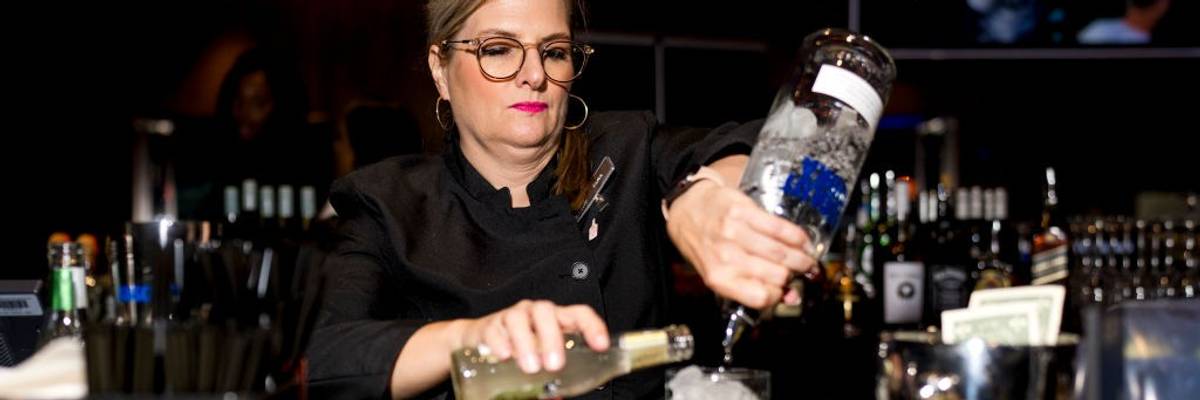
A bartender pours a cocktail at the MGM Grand in Detroit on July 28, 2024.
"Once again, Democrats have thrown working people under the bus, this time in Michigan," said one critic.
Economic justice advocates excoriated Michigan Gov. Gretchen Whitmer on Friday after the Democrat signed legislation that, while speeding up the state's increase to a $15 hour minimum wage, could leave tipped workers earning less than they would under a system imposed last year by the state Supreme Court, according to critics.
Whitmer signed a pair of bills changing the state's minimum wage, tip credit, and paid sick leave law following an eleventh-hour legislative compromise, explaining in a statement that "Michigan workers deserve fair wages and benefits so they can pay the bills and take care of their family, and small businesses need our support to keep creating good jobs."
Abigail Disney, a member of the group Patriotic Millionaires, said in a statement, "Once again, Democrats have thrown working people under the bus, this time in Michigan under the stewardship of Gov. Gretchen Whitmer."
"In its quest to rebrand itself and win back the working-class vote, Democrats needed to present a unified front in this pivotal moment in Michigan—and anything less than that, which this is, should be taken as an abysmal failure," Disney continued.
"This is the unfortunate but predictable outcome of a party that has proven itself over the years to be for sale to the highest bidder. Voters will definitely notice, and Democrats shouldn't expect them to forgive and forget at the polls in 2026 and beyond," she added.
In 2018, advocates drafted ballot initiatives aimed at expanding paid sick leave and raising the state minimum wage, which was then $9.25 an hour. But Republican state lawmakers moved to block the measures by maliciously adopting and then favorably amending them. Last July, Michigan's Supreme Court ruled this "adopt and amend" tactic unconstitutional and ordered the initial sick leave and minimum wage proposals to take affect at midnight on Friday.
By signing one of the bills, S.B. 8, Whitmer leaves in place a system in which tipped workers' minimum wage will be $4.74 instead of $6 under the court-ordered plan. Customer tips are counted upon to close the gap between the tipped and regular minimum wage of $12.48 per hour. Employers must pay the difference if workers don't reach that amount with tips.
While the Michigan Restaurant and Lodging Association welcomed Whitmer's move, John Driscoll, author of Pay the People! Why Fair Pay Is Good for Business and Great for America, said in a statement that "restaurant lobbyists in Michigan may say that they 'won' this battle in preserving the subminimum wage for tipped workers, but in the end, their efforts will only hurt themselves and their state's economy."
"I know from my own experience as the CEO and chair of businesses that pay people stable and fair wages that doing so is best for workers, businesses, and the broader economy," he continued. "When workers have economic security, they are more loyal and productive, which will help businesses and stimulate growth."
"Contrary to what restaurant associations may claim, everybody lost today when Gov. Whitmer signed S.B. 8 into law," Driscoll added. "Tipped workers lost. Businesses lost. And the Democrats lost too when they sacrificed the most vulnerable workers in Michigan to lobbyists."
The advocacy group One Fair Wage accused the governor of "stripping millions of dollars" from Michigan workers' paychecks.
"Michigan's highest court ruled that these wage increases should take effect," One Fair Wage president Saru Jayaraman said in a statement. "Michigan workers have already earned this raise, and taking it away is not a compromise—it is wage theft. We are mobilizing to ensure voters—not politicians—have the final say on whether these protections remain in place."
One Fair Wage said: "If enough valid signatures are collected, S.B. 8 will be blocked from implementation, and the 2024 Michigan Supreme Court decision requiring that all workers receive a raise to $15 an hour with tips on top will go into effect. The referendum will thus ensure that Michigan voters—not politicians—decide whether these wage increases stand."
One Fair Wage must gather 223,099 valid signatures to suspend S.B. 8 and leave the matter up to Michigan voters.
Meanwhile, the federal tipped minimum wage remains stuck at $2.13 an hour, where it's been since 1991. The federal minimum wage has been $7.25 since 2009.
Dear Common Dreams reader, It’s been nearly 30 years since I co-founded Common Dreams with my late wife, Lina Newhouser. We had the radical notion that journalism should serve the public good, not corporate profits. It was clear to us from the outset what it would take to build such a project. No paid advertisements. No corporate sponsors. No millionaire publisher telling us what to think or do. Many people said we wouldn't last a year, but we proved those doubters wrong. Together with a tremendous team of journalists and dedicated staff, we built an independent media outlet free from the constraints of profits and corporate control. Our mission has always been simple: To inform. To inspire. To ignite change for the common good. Building Common Dreams was not easy. Our survival was never guaranteed. When you take on the most powerful forces—Wall Street greed, fossil fuel industry destruction, Big Tech lobbyists, and uber-rich oligarchs who have spent billions upon billions rigging the economy and democracy in their favor—the only bulwark you have is supporters who believe in your work. But here’s the urgent message from me today. It's never been this bad out there. And it's never been this hard to keep us going. At the very moment Common Dreams is most needed, the threats we face are intensifying. We need your support now more than ever. We don't accept corporate advertising and never will. We don't have a paywall because we don't think people should be blocked from critical news based on their ability to pay. Everything we do is funded by the donations of readers like you. When everyone does the little they can afford, we are strong. But if that support retreats or dries up, so do we. Will you donate now to make sure Common Dreams not only survives but thrives? —Craig Brown, Co-founder |
Economic justice advocates excoriated Michigan Gov. Gretchen Whitmer on Friday after the Democrat signed legislation that, while speeding up the state's increase to a $15 hour minimum wage, could leave tipped workers earning less than they would under a system imposed last year by the state Supreme Court, according to critics.
Whitmer signed a pair of bills changing the state's minimum wage, tip credit, and paid sick leave law following an eleventh-hour legislative compromise, explaining in a statement that "Michigan workers deserve fair wages and benefits so they can pay the bills and take care of their family, and small businesses need our support to keep creating good jobs."
Abigail Disney, a member of the group Patriotic Millionaires, said in a statement, "Once again, Democrats have thrown working people under the bus, this time in Michigan under the stewardship of Gov. Gretchen Whitmer."
"In its quest to rebrand itself and win back the working-class vote, Democrats needed to present a unified front in this pivotal moment in Michigan—and anything less than that, which this is, should be taken as an abysmal failure," Disney continued.
"This is the unfortunate but predictable outcome of a party that has proven itself over the years to be for sale to the highest bidder. Voters will definitely notice, and Democrats shouldn't expect them to forgive and forget at the polls in 2026 and beyond," she added.
In 2018, advocates drafted ballot initiatives aimed at expanding paid sick leave and raising the state minimum wage, which was then $9.25 an hour. But Republican state lawmakers moved to block the measures by maliciously adopting and then favorably amending them. Last July, Michigan's Supreme Court ruled this "adopt and amend" tactic unconstitutional and ordered the initial sick leave and minimum wage proposals to take affect at midnight on Friday.
By signing one of the bills, S.B. 8, Whitmer leaves in place a system in which tipped workers' minimum wage will be $4.74 instead of $6 under the court-ordered plan. Customer tips are counted upon to close the gap between the tipped and regular minimum wage of $12.48 per hour. Employers must pay the difference if workers don't reach that amount with tips.
While the Michigan Restaurant and Lodging Association welcomed Whitmer's move, John Driscoll, author of Pay the People! Why Fair Pay Is Good for Business and Great for America, said in a statement that "restaurant lobbyists in Michigan may say that they 'won' this battle in preserving the subminimum wage for tipped workers, but in the end, their efforts will only hurt themselves and their state's economy."
"I know from my own experience as the CEO and chair of businesses that pay people stable and fair wages that doing so is best for workers, businesses, and the broader economy," he continued. "When workers have economic security, they are more loyal and productive, which will help businesses and stimulate growth."
"Contrary to what restaurant associations may claim, everybody lost today when Gov. Whitmer signed S.B. 8 into law," Driscoll added. "Tipped workers lost. Businesses lost. And the Democrats lost too when they sacrificed the most vulnerable workers in Michigan to lobbyists."
The advocacy group One Fair Wage accused the governor of "stripping millions of dollars" from Michigan workers' paychecks.
"Michigan's highest court ruled that these wage increases should take effect," One Fair Wage president Saru Jayaraman said in a statement. "Michigan workers have already earned this raise, and taking it away is not a compromise—it is wage theft. We are mobilizing to ensure voters—not politicians—have the final say on whether these protections remain in place."
One Fair Wage said: "If enough valid signatures are collected, S.B. 8 will be blocked from implementation, and the 2024 Michigan Supreme Court decision requiring that all workers receive a raise to $15 an hour with tips on top will go into effect. The referendum will thus ensure that Michigan voters—not politicians—decide whether these wage increases stand."
One Fair Wage must gather 223,099 valid signatures to suspend S.B. 8 and leave the matter up to Michigan voters.
Meanwhile, the federal tipped minimum wage remains stuck at $2.13 an hour, where it's been since 1991. The federal minimum wage has been $7.25 since 2009.
Economic justice advocates excoriated Michigan Gov. Gretchen Whitmer on Friday after the Democrat signed legislation that, while speeding up the state's increase to a $15 hour minimum wage, could leave tipped workers earning less than they would under a system imposed last year by the state Supreme Court, according to critics.
Whitmer signed a pair of bills changing the state's minimum wage, tip credit, and paid sick leave law following an eleventh-hour legislative compromise, explaining in a statement that "Michigan workers deserve fair wages and benefits so they can pay the bills and take care of their family, and small businesses need our support to keep creating good jobs."
Abigail Disney, a member of the group Patriotic Millionaires, said in a statement, "Once again, Democrats have thrown working people under the bus, this time in Michigan under the stewardship of Gov. Gretchen Whitmer."
"In its quest to rebrand itself and win back the working-class vote, Democrats needed to present a unified front in this pivotal moment in Michigan—and anything less than that, which this is, should be taken as an abysmal failure," Disney continued.
"This is the unfortunate but predictable outcome of a party that has proven itself over the years to be for sale to the highest bidder. Voters will definitely notice, and Democrats shouldn't expect them to forgive and forget at the polls in 2026 and beyond," she added.
In 2018, advocates drafted ballot initiatives aimed at expanding paid sick leave and raising the state minimum wage, which was then $9.25 an hour. But Republican state lawmakers moved to block the measures by maliciously adopting and then favorably amending them. Last July, Michigan's Supreme Court ruled this "adopt and amend" tactic unconstitutional and ordered the initial sick leave and minimum wage proposals to take affect at midnight on Friday.
By signing one of the bills, S.B. 8, Whitmer leaves in place a system in which tipped workers' minimum wage will be $4.74 instead of $6 under the court-ordered plan. Customer tips are counted upon to close the gap between the tipped and regular minimum wage of $12.48 per hour. Employers must pay the difference if workers don't reach that amount with tips.
While the Michigan Restaurant and Lodging Association welcomed Whitmer's move, John Driscoll, author of Pay the People! Why Fair Pay Is Good for Business and Great for America, said in a statement that "restaurant lobbyists in Michigan may say that they 'won' this battle in preserving the subminimum wage for tipped workers, but in the end, their efforts will only hurt themselves and their state's economy."
"I know from my own experience as the CEO and chair of businesses that pay people stable and fair wages that doing so is best for workers, businesses, and the broader economy," he continued. "When workers have economic security, they are more loyal and productive, which will help businesses and stimulate growth."
"Contrary to what restaurant associations may claim, everybody lost today when Gov. Whitmer signed S.B. 8 into law," Driscoll added. "Tipped workers lost. Businesses lost. And the Democrats lost too when they sacrificed the most vulnerable workers in Michigan to lobbyists."
The advocacy group One Fair Wage accused the governor of "stripping millions of dollars" from Michigan workers' paychecks.
"Michigan's highest court ruled that these wage increases should take effect," One Fair Wage president Saru Jayaraman said in a statement. "Michigan workers have already earned this raise, and taking it away is not a compromise—it is wage theft. We are mobilizing to ensure voters—not politicians—have the final say on whether these protections remain in place."
One Fair Wage said: "If enough valid signatures are collected, S.B. 8 will be blocked from implementation, and the 2024 Michigan Supreme Court decision requiring that all workers receive a raise to $15 an hour with tips on top will go into effect. The referendum will thus ensure that Michigan voters—not politicians—decide whether these wage increases stand."
One Fair Wage must gather 223,099 valid signatures to suspend S.B. 8 and leave the matter up to Michigan voters.
Meanwhile, the federal tipped minimum wage remains stuck at $2.13 an hour, where it's been since 1991. The federal minimum wage has been $7.25 since 2009.