

SUBSCRIBE TO OUR FREE NEWSLETTER
Daily news & progressive opinion—funded by the people, not the corporations—delivered straight to your inbox.
5
#000000
#FFFFFF
To donate by check, phone, or other method, see our More Ways to Give page.
Daily news & progressive opinion—funded by the people, not the corporations—delivered straight to your inbox.

"Young Americans have made their voices clear," said the national president of the College Democrats. "A modern Democratic Party must stand against global injustice."
The national president of the College Democrats is co-sponsoring a Democratic National Committee resolution calling for party members to support an arms embargo and the suspension of military aid to Israel, as well as the recognition of a Palestinian state.
The resolution comes after just 8% of voters in the Democratic Party said in a July Gallup poll that they support Israel's military actions in the Gaza Strip, a dramatic sea change from October 2023, when 36% expressed support.
According to an Economist/YouGov poll from mid-August, 69% of Democratic voters said they believed Israel was committing a genocide against Palestinian civilians.
Disapproval of Israel's actions is most staggering among young voters. Among Democrats ages 18 to 49, Pew Research found that unfavorable views of Israel have shot up to 71% from just 62% in 2022. Just 6% of Americans under 35, across all parties, said they had a favorable opinion of Israeli Prime Minister Benjamin Netanyahu.
"Young Americans have made their voices clear," said the national president of the College Democrats, Sunjay A. Muralitharan. "A modern Democratic Party must stand against global injustice."
The College Democrats were joined by a trio of activist groups—Progressive Democrats of America, RootsAction, and Our Revolution—who signed on in support of the proposal Thursday.
"This resolution is a critical step toward aligning our foreign policy with our values," said Joseph Geevarghese, executive director of Our Revolution. "By calling for an arms embargo and suspending military aid to Israel, the DNC would be recognizing what grassroots movements have long demanded: that American taxpayer dollars must not bankroll human rights abuses."
The resolution is one of two dueling proposals that will be considered at the DNC meeting on August 26. Another, backed by DNC chair Ken Martin, expresses support for long-held Democratic Party policies of a "two-state" solution and a ceasefire between Israel and Hamas.
RootsAction political director Sam Rosenthal describes it as a "watered-down resolution that stops far short of calling for an end to arms shipments to Israel."
That proposal closely mirrors the one put forward during the 2024 Democratic National Convention, which stopped short of calling for the suspension of weapons sales to Israel and emphasized the importance of maintaining Israel's "qualitative military edge."
Allison Minnerly, the 26-year-old DNC member from Florida who introduced the embargo resolution earlier this month, told The Intercept that Martin offered his resolution as a compromise in the face of her more ambitious one.
Though her resolution now has the support of the College Dems and delegations from Maine, California, and Florida, it nevertheless faces an uphill battle to pass. If it fails, Minnerly says, it will further exacerbate the yawning rift between the Democratic Party and its supporters.
"Our voters, our base, they are saying that they do not want US dollars to enable further death and starvation anywhere across the world, particularly in Gaza," Minnerly said. "I don't think it should be a hard decision for us to say that clearly."
Though the vote is largely symbolic, Matt Duss, a former foreign policy adviser to Sen. Bernie Sanders (I-Vt.), said that "the position of the DNC does matter" because "it sets the tone for the entire party."
"There are two Gaza-related DNC resolutions," said Prem Thakker, a reporter and commentator at Zeteo. "A status quo one. And one that recognizes public opinion and events in the past 22 months."
"We have a moral obligation to do what we can to stop the slaughter, but most people feel powerless," said Alan Minsky, the executive director of Progressive Democrats of America. "However, it is well understood that Israel would not be able to maintain the siege of Gaza without the steady flow of US weapons."
Update: This article has been updated to include comments from Our Revolution, RootsAction, and the Progressive Democrats of America and note their endorsement of the resolution.
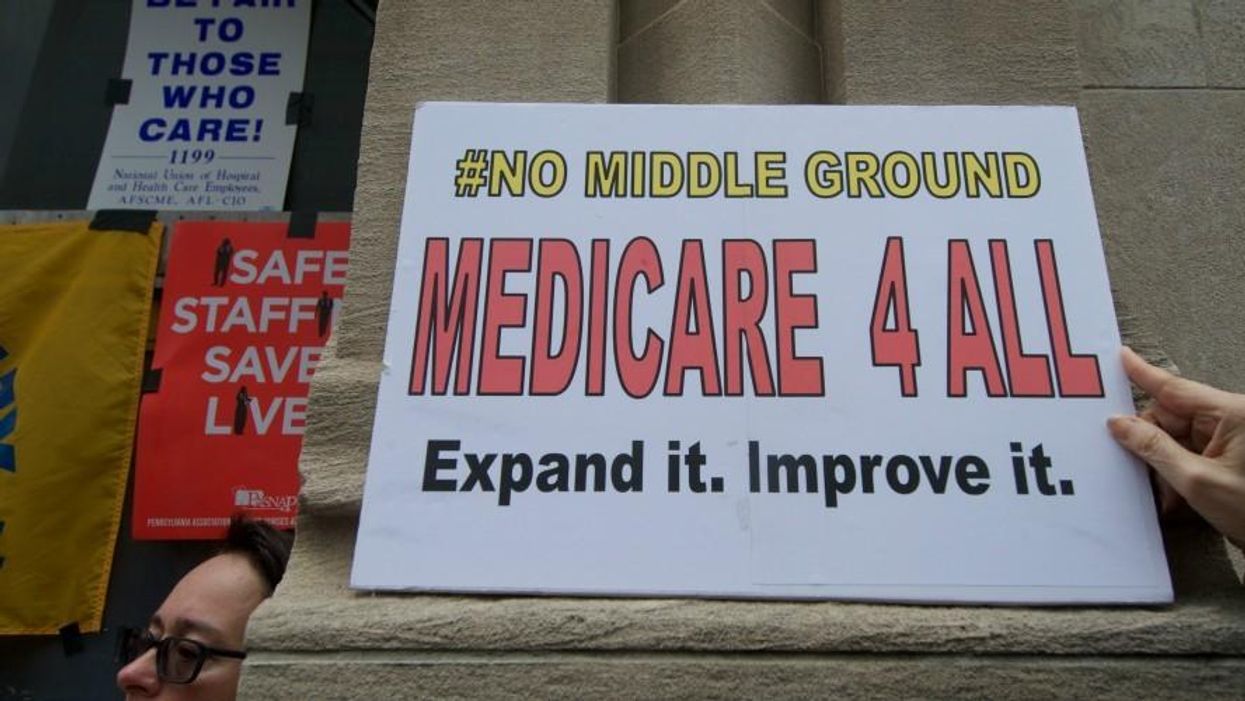
A Democratic National Committee panel on Monday voted down an amendment that would have inserted a plank supporting Medicare for All into the party's 2020 platform, a move progressives decried as out of touch with public opinion and a slap in the face to the millions of people who have lost their health insurance due to the Covid-19 pandemic.
The DNC Platform Committee rejected the Medicare for All amendment introduced by longtime single-payer advocate Michael Lighty by a vote of 36-125 during a virtual meeting Monday. The committee also voted down separate attempts to include support for expanding Medicare to children, dropping the Medicare eligibility age from 65 to 55, and legalizing marijuana.
"Shameful. And during a pandemic," tweeted progressive radio host Kyle Kulinksi in response to the defeat of the Medicare for All amendment. "History will not judge this kindly. It's like opposing the New Deal during the Great Depression. Unforgivable."
Winnie Wong, former senior adviser to Sen. Bernie Sanders' (I-Vt.) presidential campaign, tweeted late Monday that she "can't even imagine what went on in the heads of those 125 DNC Platform Committee members who voted Medicare or All down."
"The fact that our nation is the only advanced industrial country without universal healthcare cannot be blamed on Republican obstruction alone. It was also caused by Democratic leaders who've spent decades catering to corporate interests."
--Jeff Cohen, RootsAction.org
"Today. Now. When the country is in the deathgrip of a global pandemic and people are dying because they can't afford to the upkeep of their sick-care," Wong wrote. "Shameful."
Lighty said ahead of the vote that with more than 100 million people and counting either uninsured or underinsured amid a deadly pandemic, "it is vital that the Democratic Party join the NAACP, the Poor People's Campaign, the Rising Majority, Mijente, community-based organizations all over the country and demand guaranteed healthcare for all through an improved Medicare for All system."
Speaking in support of Lighty's amendment during the platform meeting Monday, Dr. Abdul El-Sayed, former health director for the city of Detroit and 2018 Michigan gubernatorial candidate, said the Covid-19 pandemic has "revealed that our house of healthcare was built of straw."
"We have a for-profit healthcare system that's left 27 million more people without healthcare because we attached healthcare to jobs," said El-Sayed.
As of late Tuesday, more than 600 DNC delegates had signed a petition vowing to vote against the Democratic platform if it doesn't include support for Medicare for All, a policy solution supported by around 80% of Democratic voters and a majority of House Democrats. Most of the petition's signatories are Sanders delegates, according to organizers, but some Biden delegates have also signed on.
Mike Casca, a spokesman for Sanders, said in a statement that the Vermont senator "believes that the Democratic Party platform should advocate strongly for Medicare for All."
"The senator appreciates that, amid a deadly pandemic which is creating a national health emergency, his delegates understand that now more than ever we must guarantee healthcare as a human right," Casca said.
The draft (pdf) version of the Democratic platform includes one mention of Medicare for All but does not endorse the policy that would provide comprehensive healthcare to everyone in the U.S. for free at the point of service.
"Generations of Democrats have been united in the fight for universal healthcare," the draft reads. "We are proud our party welcomes advocates who want to build on and strengthen the Affordable Care Act and those who support a Medicare for All approach; all are critical to ensuring that healthcare is a human right."
Progressives said the brief nod is nowhere near enough. "Democrats who understand the profound need for Medicare for All don't want a pat on the head," Norman Solomon, national director of progressive advocacy group RootsAction.org and a Sanders delegate from California, told Politico on Monday. "We want a genuine political commitment to healthcare as a human right."
In an op-ed for Common Dreams on Tuesday, RootsAction.org co-founder Jeff Cohen wrote that "the fact that our nation is the only advanced industrial country without universal healthcare cannot be blamed on Republican obstruction alone."
"It was also caused by Democratic leaders who've spent decades catering to corporate interests (while collecting their campaign donations)--and refusing to fight for universal coverage," Cohen added. "This history of Democratic obstruction and vacillation is why hundreds of elected delegates to next month's Democratic convention have put their foot down."
Before the Democratic Party's platform is finalized at a meeting late next week, Bernie Sanders and his progressive allies are mobilizing to ensure that opposition to the Trans-Pacific Partnership (TPP)—described by its critics as a global corporate power grab—becomes the party's official stance.
Though President Obama continues to lobby hard on behalf of the controversial deal, and despite a proposal to include such language being voted down during a drafting session last weekend in St. Louis, Sanders and his supporters are making their case into a rallying cry about the future of the Democratic Party.
On Wednesday, the Sanders campaign and Democracy for America, a progressive advocacy group, launched petitions calling on the platform committee to include the anti-TPP language in the final version.
"The Democratic Platform includes a number of very important initiatives that we have been fighting to achieve during this campaign," reads the petition from the Sanders campaign. "But one big item is missing: preventing the disastrous Trans-Pacific Partnership trade deal from ever coming up for a vote in Congress."
In addition to citing Sanders' and Clinton's publicly stated opposition to the TPP, the Sanders petition points out that key Democratic voting blocs—including "virtually every labor union, environmental group, and even major religious groups"—also oppose it. The petition argues that the party should now "go on record in opposition to holding a vote on the TPP during the lame duck session of Congress and beyond."
According to DFA's petition, "opposition to the job-killing TPP should not be controversial within the Democratic Party: Both Bernie Sanders and Hillary Clinton campaigned against the TPP during this year's presidential primary."
Though many have questioned Clinton's resolute opposition to the TPP, others are willing to take her at her word and argue that Obama and other pro-TPP forces within the Democratic Party undermined her campaign by not following through. Either way, outside progressive forces have remained vigilant against the corporate-friendly agreement even as Obama argues for it.
Meanwhile, in an op-ed in the New York Times this week, Sanders warned the Democratic leadership they needed to "wake up" when it comes to recognizing just how frustrated working people and the poor are when it comes to an economic system that is so clearly rigged against them.
While the 15-member committee voted down the measure in St. Louis by a 10-5 vote--with the five Sanders-appointed members voting in favor and all the Clinton- and DNC-appointed members voting against--the split offers a window into how Sanders and the millions of voters inspired by his campaign hope to influence the party in the weeks and months ahead. In turn, the battle over TPP and similar fights related to the minimum wage, climate action, and universal healthcare will reveal much about how the party establishment, currently transitioning its leadership from Obama to Clinton, will respond to the groundswells from below.
As the Washington Post reports Thursday, members of the platform panel who voted to reject the anti-TPP proposal said the White House's influence, not their own feelings on TPP, most impacted their decision.
Citing "people with knowledge of the platform negotiations," the newspaper reports how
Sanders used his post-primary meeting with the president to say he would push for the party to officially oppose the TPP. The president said he would now allow it. And since then, the White House has leaned on key Democrats to make sure that the platform did not include a rebuke.
This is how Rep. Elijah Cummings (D-MD), co-chair of the platform committee, explained his vote: "We have one president, and I have listened to him argue his case many times, and I know that he truly believes this. He really does. I disagree with him, but I don't want to do anything, as he ends his term, to undercut the president. I'm just not going to do it. In his last six months? I'm not gonna do that."
Sanders, however, appears very willing to challenge the president on the issue that he believes will so negatively impact the planet, people, and communities for generations to come.
"Well, I don't want to embarrass the president either. He's a friend," Sanders told USA Today in an interview this week. "But in a Democratic society, people can have disagreements."
In a series of tweets that began Wednesday night and continued into Thursday morning, he made it clear that the fight over TPP is among the foremost issues on his mind:
The question, however, remains: If a majority of the Democrats on the panel oppose the TPP, the presumptive nominee opposes it, and the challenging candidate who won 22 primary contests by stirring the hopes of millions of voters opposes it, why can't the DNC leadership take this opportunity to recalibrate the party's trajectory on this seminal issue?
The full Democratic Platform Committee will meet in Orlando on July 8th and 9th to approve the final draft of the platform.
Laying bare how dangerous it could be for Democrats to ignore populist opposition to corporate-friendly "free trade" deals, Republican presidential nominee Donald Trump on Tuesday attacked Hillary Clinton for her stance on trade in general and the Trans-Pacific Partnership (TPP) in particular.
In Monessen, Pennsylvania, Trump said the "TPP would be the death blow for American manufacturing" and vowed to "withdraw" the U.S. from the agreement.
According to prepared remarks, he said Clinton took "a leading part" in drafting the 12-nation deal, noting that the former secretary of state "praised or pushed the TPP on 45 separate occasions and even called it the 'gold standard'.
"Hillary Clinton was totally for the TPP just a short while ago, but when she saw my stance, which is totally against it, she was shamed into saying she would be against it too," he said. "But have no doubt, she will immediately approve it if it is put before her, guaranteed. She will do this just as she has betrayed American workers for Wall Street throughout her career."
With this claim, MSNBC reporter Alex Seitz-Wald wrote on Twitter, Trump appeared to be "speaking directly to [Bernie] Sanders supporters." Sanders has made opposition to the TPP and other rights-trampling deals a cornerstone of his campaign.
Trump also said he would renegotiate the North American Free Trade Agreement (NAFTA)--and placed partial blame for that deal at Clinton's feet. "It was Bill Clinton who signed NAFTA in 1993 and Hillary Clinton who supported it," he said.
The real estate mogul's speech follows the Democratic National Committee's platform drafting panel's vote not to oppose the TPP, despite the fact that both Clinton and Sanders have opposed the deal. As Common Dreams reported, the Clinton-allied majority on the committee outvoted the Sanders delegates 10-5 to defeat the anti-TPP measure, citing President Barack Obama's support.
In doing so, argues Dave Johnson of the Campaign for America's Future in an op-ed Tuesday, they handed Trump "powerful ammunition" for his claims that Clinton is only "pretending" to oppose the agreement.
Johnson writes:
TPP and past "trade" deals are incredibly unpopular with working-class voters, and Republicans are preparing a full-scale attack on Clinton's credibility over the unpopular TPP. They are making the case that Clinton actually supports TPP but is pretending she does not in order to get votes. They say the president's efforts to pass TPP in the post-election "lame duck" session back up their claims. This pro-TPP vote by Clinton supporters on the platform committee will likely bolster the Republican argument.
[...] It appears that the party elite just don't understand the public's overwhelming opposition to TPP. The pro-TPP members of the platform committee say they must support a Democratic president. But what about the interests of the public, labor and working people, the environment, the economy and their own nominee?
In an interview with MSNBC's Andrea Mitchell on Tuesday, Sanders agreed that the committee's established voices were working against the party and undermining Clinton's stated position.
"I was quite surprised to see that Secretary Clinton's delegates rejected our proposal to kill the TPP even though she has indicated she does not want to see it get onto the floor [of the U.S. Congress]," Sanders told Mitchell.
Meanwhile, as in the primary campaign, Clinton's refusal to come out swinging against corporate-friendly trade deals is costing her support of working-class voters in the general election--a dynamic Public Citizen's Lori Wallach predicted back in March when she declared: "Americans' opposition to job-killing trade policies fueled the stunning Bernie Sanders upset victory in Michigan. However, it could also be a deciding factor in the general election, especially with Donald Trump being the likely GOP nominee. The outcome of the Michigan primary shows the potency of trade issues and foreshadows the trouble Hillary Clinton could face winning key Midwestern states in a race against Trump."
The Democratic party's elites must not think that trade and jobs will be big issues in the coming election. Apparently, they've never listened to a Donald Trump speech and didn't notice that working-class people in the United Kingdom just voted for "Brexit" from the European Union (EU) over these issues.
The Democratic platform writing committee has voted not to oppose the Trans-Pacific Partnership (TPP). Most of the committee is pro-TPP, saying that opposing the agreement would undermine President Obama's efforts to pass it.
The problem is, this hands Trump, as the presumptive Republican presidential nominee, powerful ammunition as he says Democratic challenger Hillary Clinton is only "pretending" to oppose the agreement.
Platform Committee Won't Oppose TPP
The Hill explains, in "Sanders: 'We lost some very important fights' in Democratic platform":
[T]he panel did block several proposals favored by Sanders and his supporters. It refused to adopt a proposed amendment by Rep. Keith Ellison (D-Minn.) that would have opposed President Obama on the Trans-Pacific Partnership (TPP) -- both Sanders and presumptive Democratic presidential nominee Hillary Clinton have spoken against the trade deal. Instead, the panel backed a measure that acknowledged "a diversity of views in the party" on the TPP.
More from AP: "Democrats reject platform proposal opposing trade deal":
Democrats on Friday voted down an amendment to the party's platform that would have opposed the Trans-Pacific Partnership trade deal, avoiding an awkward scenario that would have put its statement of values at odds with President Barack Obama.
Members of a Democratic National Convention drafting committee defeated a proposal led by Rep. Keith Ellison, D-Minn., that would have added language rejecting the Pacific Rim trade pact, which has been opposed by presidential candidates Hillary Clinton and Bernie Sanders.
The panel, which is developing the party's platform ahead of next month's Philadelphia convention, instead backed a measure that said "there are a diversity of views in the party" on the TPP and reaffirmed that Democrats contend any trade deal "must protect workers and the environment."
Trump, Republicans Attacking Clinton Over TPP
TPP and past "trade" deals are incredibly unpopular with working-class voters, and Republicans are preparing a full-scale attack on Clinton's credibility over the unpopular TPP. They are making the case that Clinton actually supports TPP but is pretending she does not in order to get votes. They say the president's efforts to pass TPP in the post-election "lame duck" session back up their claims. This pro-TPP vote by Clinton supporters on the platform committee will likely bolster the Republican argument.
Trump gave a major speech on June 22, attacking Clinton for "corruption." A major portion of the speech was dedicated to his opposition to TPP, and claims that Clinton actually supports the agreement, only claiming to oppose it to get votes. He said:
Hillary Clinton has also been the biggest promoter of the Trans-Pacific Partnership, which will ship millions more of our jobs overseas - and give up Congressional power to an international foreign commission.
Now, because I have pointed out why it would be such a disastrous deal, she is pretending that she is against it.
Backing up Trump's arguments, Republicans and Republican outlets have started to go after Clinton again and again over TPP. The danger is that when conservative outlets begin a drumbeat, "mainstream" outlets often pick it up and amplify it.
This is what right-leaning voters are hearing. This is from Fox News, headlined "Paperback version of Clinton's 'Hard Choices' omits her former TPP trade pact support":
The paperback version of Hillary Clinton's memoir "Hard Choices" fails to include her support of the international trade pact TPP that rivals Bernie Sanders and Donald Trump have opposed, raising criticism about Clinton "reinventing herself" for the general election race.
On Breitbart, one post is headlined, "Donald Trump: Clinton's TPP Would Sacrifice American Jobs and Economic Independence":
A Hillary Clinton Presidency would enact the Trans-Pacific Partnership (TPP) and lead to a massive jobs depression in the same pattern of Clinton's career according to Republican presumptive presidential nominee Donald Trump who laid out a litany of Clinton misconduct in a highly anticipated Wednesday morning address.
"If [Hillary Clinton] is elected President she will adopt the Trans-Pacific Partnership and we will lose millions of jobs and our economic independence for good," said Trump.
Just as she has betrayed the American worker and trade at every single stage of her career and it will be even worse than the Clinton's NAFTA deal. And I never thought it could get worse than that. We will lose jobs. We will lose employment. We will lose taxes. We will lost everything. We will lose our country.
"Mainstream" outlets are already amplifying Trump's theme:
* World Trade Online: "Trump Says Clinton Only 'Pretending' To Oppose TPP"
* Morning Consult: "Trump Says Clinton Would Implement Controversial Trade Deal"
* Time: "Donald Trump Accuses Hillary Clinton of Corruption as Secretary of State":
One of Trump's main lines of attack was on Clinton's position on the Trans Pacific Partnership, the massive trade deal that would link the U.S. and 11 Pacific Rim nations. "If she becomes president she will adopt the Trans Pacific Partnership," Trump argued.
Dem Platform Handing This Issue To Trump
The Brexit vote shows that people are sick and tired of elite schemes to drive down wages. TPP is one such scheme and voters get it.
Trump, Sanders, and Clinton have all expressed opposition to the TPP. President Obama apparently doesn't understand what is happening in the world in reaction to the damage workers have suffered from trade agreements.
John Nichols writes at The Nation, in "What the Democrats Must Learn About Free-Trade Deals From Brexit":
Plenty of Americans are unsettled about Britain's vote to exit the European Union. And a lot of what unsettles them is Donald Trump's claim that the Brexit vote sets the stage for a similar reaction against elite political and economic arrangements in the United States.
[. . .] The Leave campaigners in the UK succeeded because there are millions of working-class voters--many of them in the left-leaning "Labour heartlands" of northern England--who know that globalization has not worked for them. Well, there are millions of Americans in battleground states such as Ohio, Michigan, Missouri, Indiana, Pennsylvania, and North Carolina who know that globalization has not worked for them.
... "It is hard for me to understand why Secretary Clinton's delegates won't stand behind Secretary Clinton's positions in the party's platform," says Sanders, who has said he will vote for Clinton in her race with Trump but argues that the platform must be strengthened in order to better position Clinton to beat the presumptive Republican nominee.
It is difficult to understand why Clinton supporters are blocking efforts to oppose the TPP agreement. Handing the issue to Trump reinforces his position that Clinton is only "pretending" to oppose it.
The party elite doesn't understand the public's overwhelming opposition to the TPP. The platform committee's pro-TPP members say they must support a Democratic president. But what about the interests of the public, labor, and working people, the environment, the economy, and their own nominee?
Send Democratic party elites a message with this petition: "Don't undermine our presidential nominee. No lame-duck vote on the TPP!" The louder the noise is before the full platform committee, the more likely they are to relent and avoid a full convention floor fight.
Also, see this must-watch video, Burning Issues: Explaining The 'Revolt' Against the TPP:
Well, that didn't take long.
Democratic presidential candidate Hillary Clinton, through her surrogates on the Democratic National Committee's platform drafting panel, appears to be already hedging on her most recent stance on the Trans-Pacific Partnership (TPP).
Clinton flipped her position on the corporate-friendly TPP last October, saying she opposed it after backing it as secretary of state. At the time, Slate ran a piece with the headline, "Hillary Clinton Comes Out Against TPP, at Least Until the Democratic Convention."
Rival Bernie Sanders made opposition to the TPP and similar trade deals a cornerstone of his campaign. He and his allies on the committee supported a proposal led by Rep. Keith Ellison (D-Minn.) that would have added language rejecting the 12-nation Pacific Rim pact to the 2016 Democratic Party platform.
However, on Friday night in St. Louis, the Clinton-allied majority on the committee outvoted the Sanders delegates 10-5 to defeat that proposal, citing President Barack Obama's support for the deal.
The Associated Press reports:
The panel, which is developing the party's platform ahead of next month's Philadelphia convention, instead backed a measure that said "there are a diversity of views in the party" on the TPP and reaffirmed that Democrats contend any trade deal "must protect workers and the environment."
But Kevin Gosztola argued that other motivations were involved, writing on Sunday, "The only reason why Clinton appointees would not want to put this in the platform was if Clinton was planning to backtrack on her opposition to the TPP if she is elected president."
Indeed, Gosztola continued, the "diversity of views" amendment that did pass merely gives "corporate Democrats cover to support a trade deal that everyone on the platform committee claims is antithetical to the values of Democrats."
As Bill McKibben--a Sanders appointee to the committee--noted at the time, "Every interest group that we've heard from, human rights groups, labor groups, and environmental groups, have been firm in their denunciation of TPP."
What's more, Sanders advisor Larry Cohen wrote in an op-ed on Monday that "the Clinton campaign's reversal on TPP is not just bad policy--it's terrible politics," especially given the electoral realities of the U.S. and the UK's vote to leave the European Union.
He explained:
Donald Trump has argued that Hillary Clinton would sign the TPP, which would cost millions of American jobs. Working-class Americans have had enough of Democratic presidents like Clinton and Obama saying one thing to get elected, and then adopting trade policies that accelerate the race to the bottom. The Brexit vote in the UK was, in part, about working-class disgust with the rigged global economic system that places investment interests far above their own jobs and living standards.
Also at The Nation, John Nichols added:
The Brexit vote is just the latest signal that voters have not just soured on the rough mix of globalization, deindustrialization and austerity that can be traced back to Margaret Thatcher in Britain and Ronald Reagan in the United States; they are now casting votes based on that opposition. Wealth has been redistributed upward, wages have stagnated, inequality has accelerated. And voters are saying "stop." They are not just doing so in Britain. In the United States, opposition to failed trade policies in general, and to the TPP in particular, played a critical role in helping Sanders secure big victories in Wisconsin, Michigan, Indiana and other states where he was able to focus the debate of economic fundamentals. Clinton has recognized this and spoken with increasingly specificity about her opposition to the TPP--going so far as to declare her disapproval of proposals to organize a post-election vote on the measure by a lame-duck Congress. "I oppose the TPP agreement--and that means before and after the election," [she] declared in May.
To challenge presumptive Republican nominee Donald Trump, Nichols said, "Democrats must offer a clear, coherent alternative that recognizes the failures of the past (NAFTA), commits to avoiding new failures (TPP), and frames out a vision for the future that repudiates both crude nationalism and crude corporatism."
Meanwhile, on social media, observers suggested this platform battle merely signifies things to come.
As Common Dreams reported this weekend, trade policy wasn't the only area where progressive demands went unmet. Former Ohio Congressman and Democratic presidential candidate Dennis Kucinich accused the platform committee of taking "a wrecking ball to the U.S. Constitution, the global climate, and world peace," citing not just the TPP stance but also failed measures denouncing fracking and the Israeli occupation of Palestine.
The party's position on TPP is not yet set in stone, as the document approved Friday was a draft. The committee will meet again in Orlando before the Democratic National Convention in July. In a statement, Ellison said he hopes his anti-TPP amendment will be adopted there.
As Donna Smith wrote in an op-ed Monday, the meeting in Orlando "may be the last chance for the Party to demonstrate in a very concrete way that they want the 12 million votes cast for Bernie to lean strongly 'D' in November."
Or as Sanders himself told a crowd in New York: "If we do not win that fight in St. Louis, we're taking it to Orlando, where the larger committee will meet next month. If we don't make it in Orlando, we're takin' that fight right to the floor of the Democratic convention. Whether they like it or not, we're going to open the doors of the Democratic Party."
Despite its claims to want to unify voters ahead of November's election, the Democratic party appears to be pushing for an agenda that critics say ignores basic progressive policies, "staying true" to their Corporate donors above all else.
During a 9-hour meeting in St. Louis, Missouri on Friday, members of the DNC's platform drafting committee voted down a number of measures proposed by Bernie Sanders surrogates that would have come out against the contentious Trans-Pacific Partnership (TPP), fracking, and the Israeli occupation of Palestine. At the same time, proposals to support a carbon tax, Single Payer healthcare, and a $15 minimum wage tied to inflation were also disregarded.
In a statement, Sanders said he was "disappointed and dismayed" that representatives of Hillary Clinton and DNC chairwoman Debbie Wasserman Schulz rejected the proposal on trade put forth by Sanders appointee Rep. Keith Ellison (D-Minn.), despite the fact that the presumed nominee has herself come out against the 12-nation deal.
"Inexplicable" was how Sanders described the move, adding: "It is hard for me to understand why Secretary Clinton's delegates won't stand behind Secretary Clinton's positions in the party's platform."
The panel also rejected amendments suggested by 350.org co-founder Bill McKibben, another Sanders pick, that would have imposed a carbon tax, declared a national moratorium on fracking as well as new fossil fuel drilling leases on federal lands and waters.
"This is not a political problem of the sort that we are used to dealing with," McKibben stated during the marathon debate. "Most political problems yield well to the formula that we've kept adopting on thing after thing--compromise, we'll go halfway, we'll get part of this done. That's because most political problems are really between different groups of people. They're between industry and environmentalists. That is not the case here."
"Former U.S. Representative Howard Berman, American Federation of State, County, and Muncipal Employees executive assistant to the president, Paul Booth, former White House Energy and Climate Change Policy director Carol Browner, Ohio State Representative Alicia Reece, former State Department official Wendy Sherman, and Center for American Progress President Neera Tanden all raised their hands to prevent a moratorium from becoming a part of the platform," noted Shadowproof's Kevin Gosztola.
According to Gosztola's reporting on the exchange, Dr. Cornel West lambasted the aforementioned panel members, particularly Browner, for "endorsing reform incrementalism" in the face of an urgent planetary crisis.
"When you're on the edge of the abyss or when you're on that stove, to use the language of Malcolm X, you don't use the language of incrementalism. It hurts, and the species is hurting," West said.
Other progressive policies were adopted piecemeal, such as the $15 minimum wage, which the committee accepted but without the amendment put forth by Ellison that would have indexed the wage to inflation.
The panel did vote unanimously to back a proposal to abolish the death penalty and adopted language calling for breaking up too-big-to-fail banks and enacting a modern-day Glass-Steagall Act--measures that Sanders said he was "pleased" about.
According to AP, the final discussion "centered on the Israel-Palestinian conflict."
"The committee defeated an amendment by Sanders supporter James Zogby that would have called for providing Palestinians with 'an end to occupation and illegal settlements' and urged an international effort to rebuild Gaza," AP reports, measures which Zogby said Sanders helped craft.
Instead, AP reports, the adopted draft "advocates working toward a 'two-state solution of the Israel-Palestinian conflict' that guarantees Israel's security with recognized borders 'and provides the Palestinians with independence, sovereignty, and dignity.'"
Citing these "moral failures" of the platform draft, West abstained during the final vote to send the document to review by the full Platform Committee next month in Orlando, Florida.
"If we can't say a word about TPP, if we can't talk about Medicare-for-All explicitly, if the greatest prophetic voice dealing with pending ecologically catastrophe can hardly win a vote, and if we can't even acknowledge occupation... it seems there is no way in good conscience I can say, 'Take it to the next stage,'" West declared before the assembly.
"I wasn't raised like that," he said. "I have to abstain. I have no other moral option, it would be a violation of my own limited sense of moral integrity and spiritual conscience," adding, "That's how I roll."