SUBSCRIBE TO OUR FREE NEWSLETTER
Daily news & progressive opinion—funded by the people, not the corporations—delivered straight to your inbox.
5
#000000
#FFFFFF
To donate by check, phone, or other method, see our More Ways to Give page.
Daily news & progressive opinion—funded by the people, not the corporations—delivered straight to your inbox.
"All railroad accidents are avoidable," said BLET's national president. "This collision underscores the need for significant improvements in rail safety for both workers and the public."
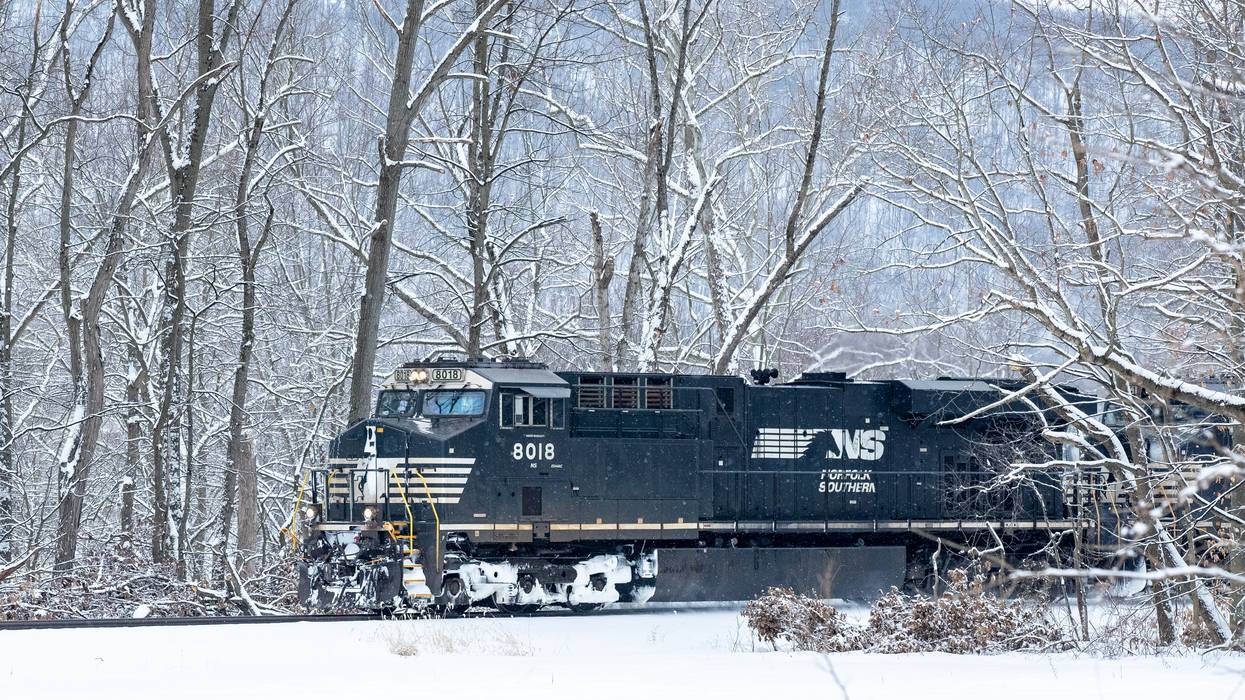
A Norfolk Southern conductor was killed in Ohio early Tuesday, elevating scrutiny of the rail giant and calls for dramatic improvements to industry safety regulations in the wake of a devastating derailment in the state last month.
Louis Shuster, president of the Brotherhood of Locomotive Engineers and Trainmen (BLET) Division 607, was fatally injured when a dump truck collided with a train while he was on the outside of a railcar at the Cleveland-Cliffs Cleveland Works steel plant.
"Lou was a passionate and dedicated union brother," said Pat Redmond, local chairman of the BLET division. "He was always there for his coworkers. He was very active in helping veterans who worked on the railroad and veterans all across our community."
The 46-year-old Army veteran was a father to a 16-year-old son and a caregiver for his elderly parents, according to the union. A GoFundMe fundraiser has been set up to help the family with funeral expenses.
"Norfolk Southern has been in touch with the conductor's family and will do all it can to support them and his colleagues. We are grieving the loss of a colleague today. Our hearts go out to his loved ones during this extremely difficult time," the company said.
The rail company, which added that it is working with city police and Cleveland-Cliffs representatives to learn everything possible about the deadly collision, has faced national criticism since a train carrying hazardous materials derailed and caught fire in East Palestine, Ohio, near the Pennsylvania border, on February 3, creating an environmental and public health disaster.
Following another Norfolk Southern derailment in Ohio Saturday afternoon—over two dozen cars came off the tracks between Dayton and Columbus—the company on Monday announced "a six-point plan to immediately enhance the safety of its operations."
However, the company's plan falls short in terms of recent demands from the Biden administration, Congress, and other critics.
After Shuster was killed on Tuesday, the National Transportation Safety Board (NTSB)—which is already probing the East Palestine disaster—announced a "special investigation" of Norfolk Southern's "organization and safety culture."
"Given the number and significance of recent Norfolk Southern accidents, the NTSB also urges the company to take immediate action today to review and assess its safety practices, with the input of employees and others, and implement necessary changes to improve safety," the board said in a statement.
Earlier Tuesday, U.S. Transportation Secretary Pete Buttigieg had tweeted that the NTSB, Federal Railroad Administration, and Occupational Safety and Health Administration are investigating the collision in Cleveland.
"Our thoughts are with the family facing this preventable tragedy. Now more than ever, it is time for stronger freight railroad accountability and safety," added Buttigieg, who is also under fire for not going far enough to rein in rail safety risks.
BLET national president Eddie Hall pointed to the conductor's death as more proof of the need for stricter rail safety rules.
"This was a tragic situation and it's a devastating loss for the Shuster family as well as the members of this union," he said. "All railroad accidents are avoidable. This collision underscores the need for significant improvements in rail safety for both workers and the public."
As Common Dreams reported last week, Hall welcomed parts of the bipartisan Railway Safety Act of 2023—introduced by Sen. Sherrod Brown (D-Ohio) after the East Palestine derailment—while also warning that "you can run a freight train through the loopholes."
This post has been updated with information about the fundraiser.
"Regardless of tonight's outcome, there's broad agreement that Minneapolis residents want more tools for public safety. There's also consensus that the status quo is not an option."
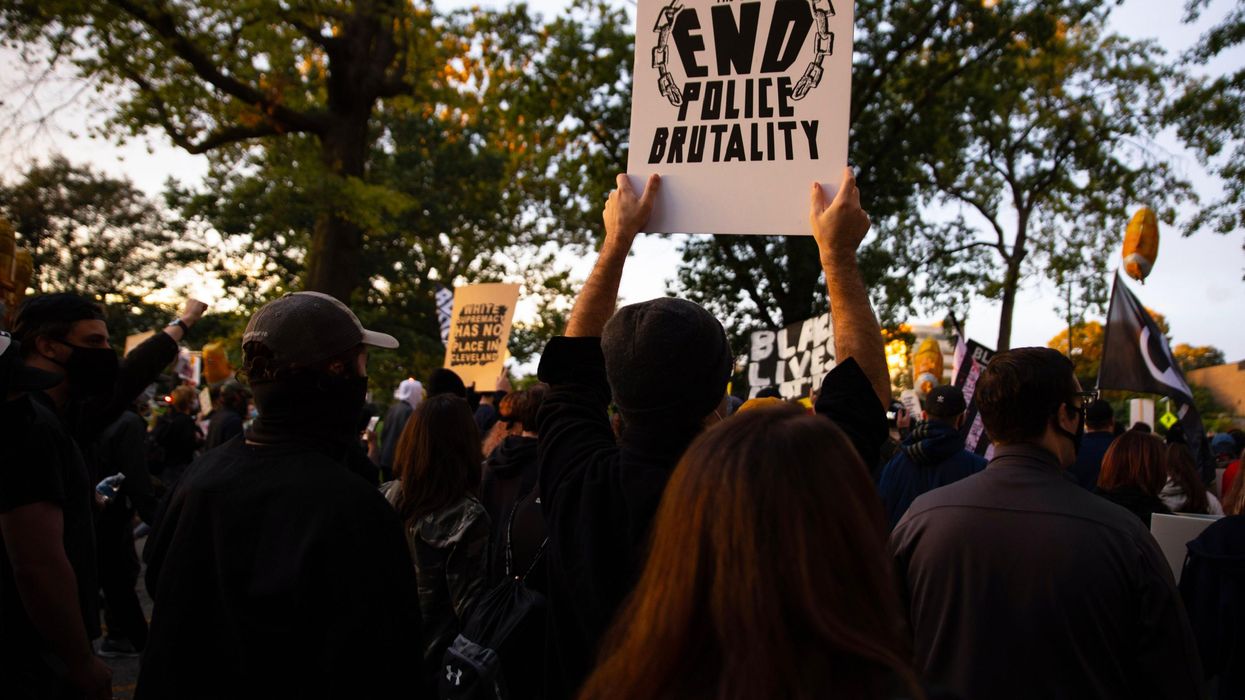
The grassroots group Black Visions Collective applauded the "historic" Yes on 2 campaign, which helped push nearly 44% of Minneapolis voters to support Question 2 after launching a petition to demand the question be included on the ballot.
"You actually can staff the department the way that meets the needs of the people," campaign spokesperson JaNae Bates told NPR in October. "We wanted to really be centered and focused on the safety of human beings."
Proponents of bold reforms to policing applauded the campaign for the traction it managed to gain in the city.
"In the dead of winter, organizers collected 22,000 signatures from across the city to put this amendment on the ballot," said People's Action Movement Politics director Brooke Adams and TakeAction Minnesota executive director Elianne Farhat. "Black organizers and activists have worked toward this for years before 2020, and the work for a better future where everyone can feel safe in their communities will continue."
"Regardless of tonight's outcome, there's broad agreement that Minneapolis residents want more tools for public safety," added Adams and Farhat. "There's also consensus that the status quo is not an option."
Radley Balko, author of "Rise of the Warrior Cop" and a Washington Post columnist, called the level of support campaigners garnered for a "radical reorganization" of policing in Minneapolis "pretty remarkable."
The demand for an end to the status quo regarding policing was evident in a number of other cities including Austin, where voters overwhelmingly rejected a measure to hire hundreds more police officers--which would have required major budget cuts in other areas including firefighting, emergency health services, and libraries, according to opponents.
"It's past time we as a society reimagine the role of police."
Sixty-eight percent of Austin voters rejected Proposition A, which was pushed by Save Austin Now, a group co-founded by the Travis County Republican Party chair. The group raised $1.7 million in its effort to add to the city's 1,600-strong police force.
Austin Mayor Steve Adler, a Democrat, said the election reaffirmed "our community's belief that public safety for all requires a comprehensive system that includes properly staffing our police, but also our fire, EMS, and mental health responses as well."
Voters in Cleveland, Ohio also made clear their demand for more police accountability, approving a plan to establish a Civilian Police Review Board that would investigate reports of police misconduct. The proposal, known as Issue 24, passed by a margin of 59% to 41%.
The measure was endorsed by groups including Black Lives Matter Cleveland and the Cuyahoga County Progressive Caucus, as well as Cleveland Mayor-elect Justin Bibb, a Democrat who won his election Tuesday night.
"We can't keep making this a false choice between good and effective law enforcement and police accountability," Bibb told local news outlet 3News. "We can do both. I believe trust is the biggest thing to do to make sure we have safety and security and residents trust police. Without it, you don't get safety."
Jeff Follmer, president of the local police union, accused Cleveland voters of approving a "vengeful" initiative that would "be the downfall of Cleveland." Issue 24 was proposed months after the U.S. Department of Justice declined to prosecute Cleveland officers in the police shooting of 12-year-old Tamir Rice in 2014.
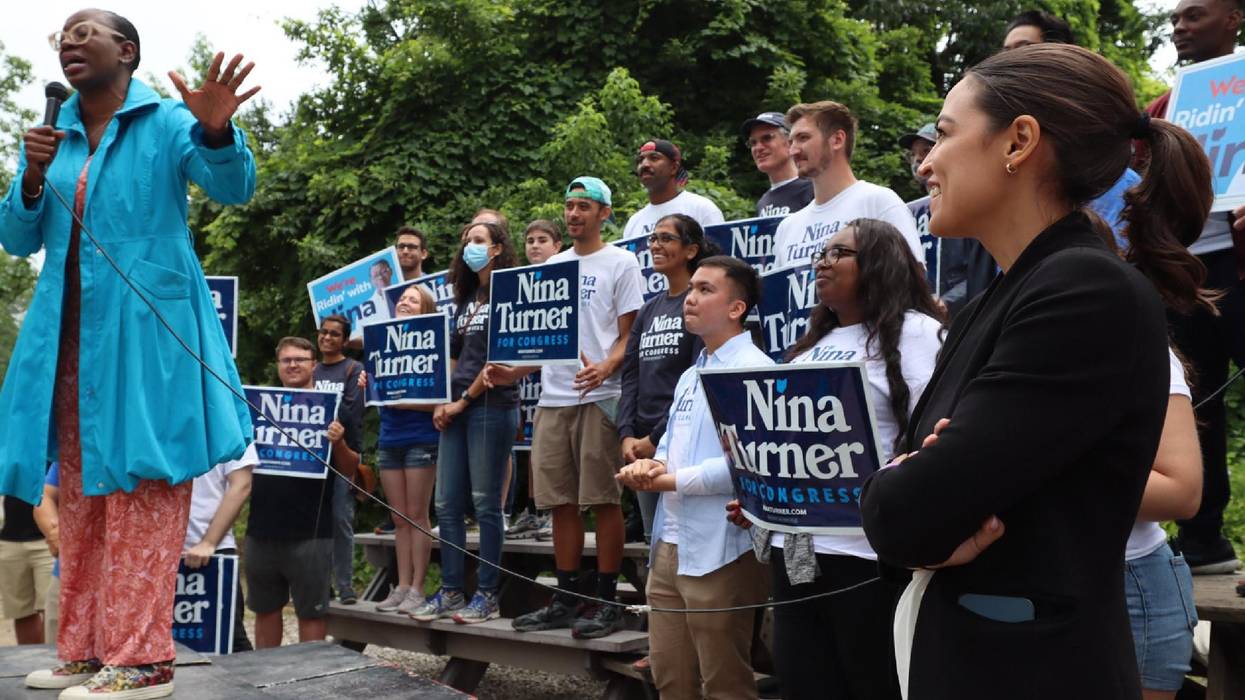
In a congressional primary race that's been framed as part of a broader battle for the future of the Democratic Party, Nina Turner has won not only an endorsement but on-the-ground support from one of the most high-profile progressives in the U.S. House of Representatives: Congresswoman Alexandria Ocasio-Cortez.
Ocasio-Cortez (D-N.Y.) was in Cleveland on Saturday to campaign for Turner, a former member of the city's council as well as the Ohio state Senate. More recently, Turner served as a national co-chair for the 2020 presidential campaign of Sen. Bernie Sanders (I-Vt.), who is also backing her bid to represent Ohio's 11th Congressional District.
"This isn't about Nina versus any opponent; this is about the people versus big money," Ocasio-Cortez said at a Saturday event. "This is a deep blue seat. It's a deep blue seat. Districts like Ohio's 11th should be leading the country on issues. They are opportunities, they are very rare opportunities, very rare districts like this one that can take and be visionary."
Asked why she endorsed Turner, Ocasio-Cortez told the local 3News, "I think it's extremely clear that Nina Turner is the candidate in this race that answers to the people of Ohio first and foremost."
"She has supported, she has worked in this community, she has served in this community, and she understands this community's needs, and she is a candidate that I think can be trusted to bring people's voices to Washington," the congresswoman added.
While early voting started more than two weeks ago for the crowded primary with 13 candidates, Turner's main opponent is Shontel Brown, who chairs the Cuyahoga County Democratic Party and serves on the county's council. Brown has been endorsed by key establishment figures including Rep. Jim Clyburn (D-S.C.), the majority whip.
On Saturday, as Brown canvassed on Cleveland's West Side, Turner and her supporters also knocked on doors in the city and suburban Cleveland Heights.
"Canvasses are where the fight gets won," Ocasio-Cortez said at a launch event. "Right here, this is where the work happens and I love being where the work happens--where we actually get our hands dirty in the work of knocking on our doors and having conversations with our neighbors and building actual community. There's no replacement for that."
"We're knocking on doors that have never been knocked," Turner tweeted Sunday. "Ohioans who've been left behind and excluded from the democratic process."
"Young folks. Black and Brown folks. Working-class folks. They're not hard to reach--they're hardly reached," she continued. "It's time to expand the electorate."
Another nationally known progressive in Congress is planning to visit Ohio to support Turner next week. Sanders is set to travel to Cleveland and deliver a keynote speech at a get-out-the-vote rally for the candidate on July 31.
Sanders, who endorsed Turner the same day she formally announced her candidacy in December, has said that "she deeply cares for working families and she has the heart to be an effective, unwavering fighter for them in Congress."
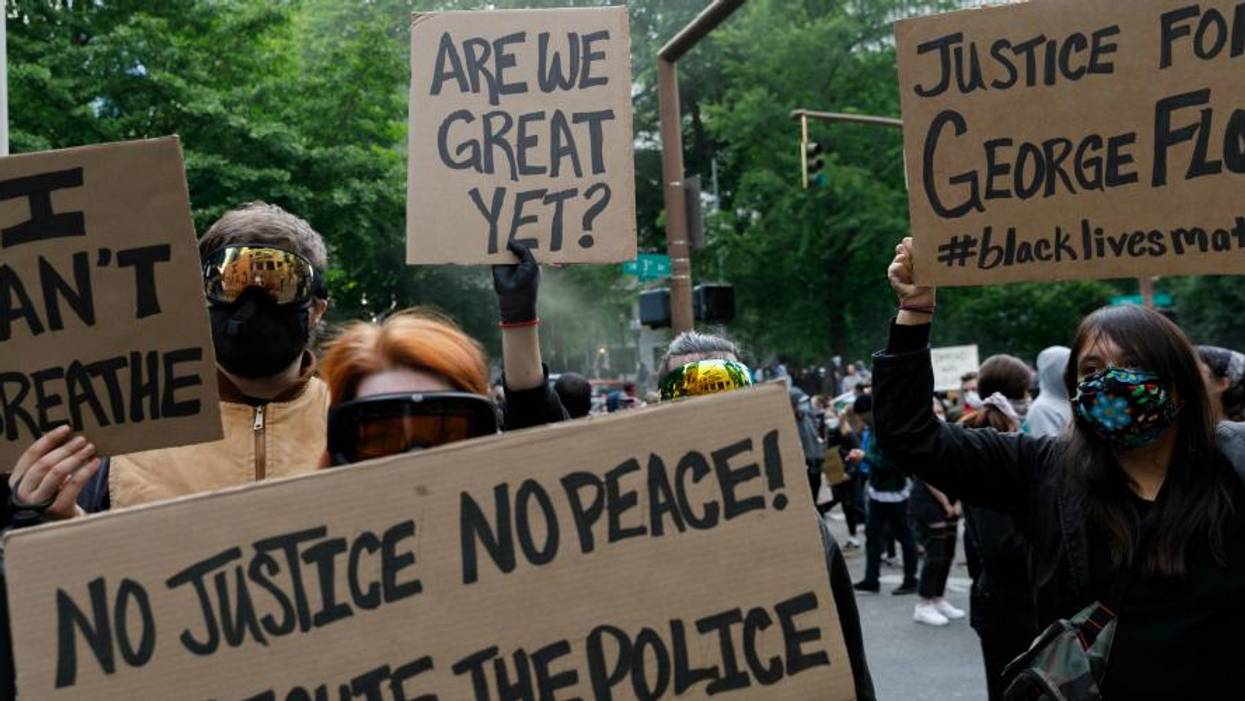
Local police and National Guard troops cracked down on demonstrations in cities across the country throughout the weekend as protests provoked by the killing of George Floyd continued against police brutality, systemic racism, and the militarization of local law enforcement.
There have been peaceful demonstrations as well as instances of violence and destruction. Police nationwide responded to the mass mobilization with force, though some officers in Michigan joined one protest and publicly condemned the conduct of Floyd's killer, Minneapolis police officer Derek Chauvin.
While protesters welcomed the news Friday that Chauvin was arrested and charged in the May 25 killing of Floyd, an unarmed black man, they are calling for legal action against the other three officers involved in Floyd's death--who were merely fired--as well as broader reforms to policing in the United States.
Demonstrations Sunday demanding justice for Floyd and other people of color killed by the police in recent years culminated as the White House went dark and fires burned in D.C., local governments across the country imposed curfews, and the National Guard was deployed in over two dozen states.
Here is a look at some protests and related developments from Sunday and Monday...
A truck driver identified by authorities as Bogdan Vechirko was arrested after driving a tractor-trailer into a crowd of peaceful protesters on a closed Minneapolis bridge. Though no protesters appear to have been struck by the vehicle, Vechirko was reportedly pulled from the truck by protesters before police arrived and was later taken to a hospital with non-life threatening injuries.
During an appearance on CNN, host Don Lemon asked Philonise Floyd if he had a question for Minneapolis Police Chief Medaria Arradondo.
"I want to know if he's going to get me justice for my brother," said Philonise Floyd, by ensuring that all officers involved in George Floyd's killing are arrested and convicted.
A CNN journalist passed on the question to the chief. "Being silent, or not intervening, to me you're complicit," Arradondo said to the Floyd family about the officers he fired, while noting that he does not have the authority to bring charges against them. "Mr. Floyd died in our hands, and so I see that as being complicit."
Minnesota Attorney General Keith Ellison has taken the lead on all charges brought foward in connection with Floyd's death. The Minneapolis Police Department--which Arradondo has run since 2017--has faced national scrutiny the past week for its handling of the recent protests and its broader conduct.
In Linn Park, protesters defaced an obelisk Confederate monument. As Al.com columnist Kyle Whitmire noted, "For the last three years, the city and state have been in a legal battle over the monument in court, with state Attorney General Steve Marshall fighting to preserve it."
Whitmire wrote that after failing to topple the obelisk, demonstrators turned to a statue of the park's namesake. According to the local news station WBRC, "Protesters pulled down the top part of the statue of Charles Linn by tying a rope and using manpower and a truck to pull it down."
"After a large and peaceful protest in Boston, a turning point around 9 pm," tweeted New York Times journalist Ellen Barry. "Then pockets of remaining protesters began breaking windows, and set a police SUV on fire. It is burning near the State House, belching a column of black smoke. That image will last."
Actor John Cusack, who documented the Chicago protests on Twitter, said early Sunday morning that he stopped riding his bike to take a video: "Cops didn't like me filming the burning car so they came at me with batons. Hitting my bike." He tweeted a blurry video with audio of an officer repeatedly yelling at him to leave the area, followed by another video of the burning car and a group of officers.
Chicago Mayor Lori Lightfoot announced Sunday that a National Guard contingent would support the Chicago Police Department after 240 arrests overnight. Illinois Gov. JB Pritzker said that at the city's request, he activated 375 soldiers who "will carry out a limited mission to help manage street closures and will not interfere with peaceful protestors exercising their First Amendment rights."
Late Sunday, Chicago Public Schools announced that "based on the evolving nature of activity across the city, we are suspending grab-and-go meal sites and all other school and administrative office activities tomorrow," leaving thousands of families to figure out how to feed children in the midst of the coronavirus pandemic. The Chicago Teachers Union and others criticized the decision on Twitter.
Cleveland police were sharply criticized by civil liberties advocates and journalists after reportedly saying Sunday that as part of the downtown curfew that is in effect until Tuesday night, "No media is allowed downtown unless they are inside their place of business. Period."
"This is unconstitutional," tweeted the ACLU of Ohio. "The City of Cleveland has no authority to restrict the rights and access of the press. The power of the people is rooted in the ability of the #FreePress to investigate and report news, especially in times of upheaval. We are reviewing this situation."
Although Cleveland Mayor Frank Jackson later said in a press conference Sunday that credentialed members of the media would still be allowed downtown, the ACLU of Ohio on Monday morning highlighted NPR producer Rachel Rood's account of the difficulty she experienced getting to her office.
As Common Dreams previously reported, while protests raged across the nation, "the external floodlights that typically keep the White House illuminated at night were shut off as President Donald Trump remained out of sight and silent--with the exception of occasional incendiary outbursts on Twitter."
Critics regarded the move as a symbol of Trump's lack of leadership during this time of national turmoil. According to The Guardian, when the 11 pm curfew took effect, "the police line in front of the White House advanced with tear gas rounds across Lafayette Park clearing out the protesters, with intermittent sprints."
Jounalists and others circulated images on social media of fires that burned near the darkened White House:
The City of Los Angeles and Mayor Eric Garcetti continued to endure intense criticism for announcing a city-wide closure of Covid-19 testing sites Saturday. Critics regarded the decision as a punitive response to the protests, noting that Garcetti said in a press conference that "we're not going to stand for the burning of police cars" or "people who destroy shop windows."
Garcetti then requested 1,000 National Guard troops from California Gov. Gavin Newsom. The Los Angeles Times reported that "by Sunday morning, scores of Guardsmen toting M-4 rifles could be seen patrolling streets between skid row and Bunker Hill. In combat gear, they stood guard outside shattered storefronts and graffiti-tagged buildings, where windows had been shattered and the street strewn with trash."
"On Sunday afternoon, scores of troops had formed a partial perimeter around City Hall, which faces the Los Angeles Police Department building and was itself guarded by many police officers," according to the newspaper. In response to Garcetti's decision to bring in the Guardsmen, City Councilman Marqueece Harris-Dawson said, "Our fear is real that additional law enforcement will only further violence against people of color."
Louisville Mayor Greg Fischer confirmed in a statement Monday that David McAtee was killed in an incident at Dino's Food Mart involving a crowd, Louisville Metro Police Department, and the National Guard shortly after midnight. A local ABC affiliate reported that LMPD Chief Steve Conrad said someone in the crowd fired as law enforcement began to clear the parking lot and both local police and the National Guard returned fire.
Kentucky Gov. Andy Beshear released a statement Monday that aligned with Conrad's description of the incident. However, the governor added that "given the seriousness of the situation, I have authorized the Kentucky State Police to independently investigate the event." Local residents, meanwhile, gathered near the site of the shooting on Monday:
Floyd's death has reignited outrage in Louisville over the police killing of Breonna Taylor, a 26-year-old black emergency room technician, in her home on March 13. After months of outrage and calls for accountability, the FBI opened an investigation into Taylor's killing on May 21.
Largely peaceful demonstrations in New York City included marches across the Brooklyn and Williamsburg Bridges. However, the New York Times noted that "Mayor Bill de Blasio said on Monday that he was considering implementing a curfew after parts of New York City descended into chaos for a fourth night."
"As the night wore on, violent confrontations between protesters and police officers erupted throughout Manhattan and Brooklyn," the Times reported. "Protesters threw glass bottles and trash at the police, while large groups of officers charged down streets, pushing crowds of demonstrators aside and using batons as they made arrests."
The New York Police Department was widely criticized over the weekend after officers drove their vehicles into demonstrators in Brooklyn. Denouncing de Blasio's response to the incident, Rep. Alexandria Ocasio-Cortez (D-N.Y.) tweeted that "running SUVs in crowds of people should never, ever be normalized. No matter who does it, no matter why."
Members of the National Guard headed to Philly after a weekend that saw at least 429 arrests and police deploying pepper spray from an armored vehicle to disperse crowds. While the city garnered national attention for looting and destruction, peaceful protesters--including former Philadelphia Eagles player Malcolm Jenkins--gathered Sunday for a demonstration at Center City.
"These are all of our children," city Register of Wills Tracey Gordon said of black Americans mistreated by police while speaking to a crowd that peacefully assembled at City Hall on Sunday, according to The Philadelphia Inquirer. "They deserve to have dignity. Everyone deserves to have dignity in this city and in this country."

About a dozen players from the Cleveland Browns team are receiving applause for taking a knee on Monday night, to pray about racial and social injustice, during the national anthem before their pre-season game against the New York Giants Monday night.
"We just felt like it was the right time and the need to do it," linebacker and prayer leader Christian Kirksey told ESPN.
"There's a lot of racial and social injustices in the world that are going on right now," Jabrill Peppers, another player who participated, said after the game. "We just decided to take a knee and pray for the people who have been affected and just pray for the world in general."
"We were not trying to disrespect the flag or be a distraction to the team," Peppers added, "but as men we thought we had the right to stand up for what we believed in, and we demonstrated that."
Although most of the identified players--including Kirksey, Peppers, Jamie Collins, Duke Johnson, Isaiah Crowell, Calvin Pryor, Jamar Taylor, Kenny Britt, Ricardo Louis, Brandon Wilds, and Terrence Magee--are black, they were joined by Seth DeValve, the first known white NFL player to kneel with teammates since a trend of pre-game protests over racial injustice began last season.
DeValve said the action was partly inspired by Charlottesville, but it was also personal for him. His wife is African American, and he said he took a knee because he hopes to raise his children "in a better environment than we have right now," adding: "I wanted to take the opportunity with my teammates during the anthem to pray for our country and also to draw attention to the fact that we have work to do."
"The United States is the greatest country in the world. It is because it provides opportunities to citizens that no other country does. The issue is that it doesn't provide equal opportunity to everybody," DeValve told ESPN.
The players--including athletes who remained standing, but placed supportive hands on their kneeling teammates' shoulders--were celebrated on social media:
Their action Monday--the largest the league has seen so far--follows protests by San Francisco 49ers quarterback Colin Kaepernick, who dominated national headlines last season, garnering both praise and condemnation, when he refused to stand for the national anthem--first sitting, then kneeling. At the time, Kaepernick told NFL Media:
I am not going to stand up to show pride in a flag for a country that oppresses black people and people of color.... To me, this is bigger than football and it would be selfish on my part to look the other way. There are bodies in the street and people getting paid leave and getting away with murder.
Other NFL players expressed solidarity with Kaepernick last season. Some of his teammates and players across the country "locked arms, raised their fists, or knelt during or just after the national anthem during the first big day of the league's 2016 season," ABC News reported last September. Despite the support, those who knelt with Kaepernick were people of color; however, DeValve's participation Monday, as well as actions by others during this year's preseason, indicate a shift.
At least three other white NFL players have protested during the anthem during the 2017 pre-season, but "those three players--the Eagles' Chris Long, the Seahawks' Justin Britt and the Raiders' Derek Carr--stood while showing support for black teammates," the Washington Post reported.
Even so, Kaepernick's protests last season may have impacted his future in the NFL. He currently remains a free agent--meaning the quarterback has no team for this season, and at this point, it's unlikely he'll find one. His preseason on the sidelines has left some of his critics feeling vindicated, but has also provoked calls for an NFL boycott if Kaepernick remains unsigned.
The Republican National Convention (RNC) kicked off Monday night with some controversial moments, many of which were punctuated by a seeming theme of white anger and pride--but none as explicit as a statement by Rep. Steve King (R-Iowa), who said during a panel discussion on MSNBC that whites have contributed more to history than "any other subgroup."
Responding to Esquire's Charlie Pierce that the Quicken Loans Arena in Cleveland, Ohio, where the RNC was taking place, was "wired by loud, unhappy, dissatisfied white people" ready to shut down signs of protest, King said, "This whole 'white people' business does get a little tired, Charlie. I would ask you to go back through history and figure out where are these contributions that have been made by these other categories of people you are talking about. Where did any other subgroup of people contribute more to civilization?"
Anchor Chris Hayes asked, "Than white people?"
King continued, "Than Western civilization itself, that's rooted in Western Europe, Eastern Europe and the United States of America and every place where the footprint of Christianity settled the world."
The panel--comprising King, Hayes, Pierce, and April Ryan, the Washington bureau chief of the American Urban Radio Networks--broke into a brief argument as Hayes said, "We're not going to argue the history of civilization," and Ryan countered, "Let's argue the history of this country, okay?"
Hayes then ended the discussion telling King, "Let me note for the record, that if you're looking at the ledger of Western civilization, for every flourishing democracy, you've got Hitler and Stalin as well." (After coming under fire for his lack of response, Hayes later tweeted that he may have mishandled the moment by not letting Ryan respond to King.)
Watch below:
King's statement set a "white supremacist tone" in Cleveland, wrote Robert Mackey for The Intercept, adding that his assertions "were not well received on social networks by non-racists or those with even the slightest grasp of history."
"King's frank defense of the disproportionately white makeup of the Republican party came just days after Speaker Paul Ryan inadvertently drew attention to the same problem, by posting a selfie on Instagram showing the lack of diversity in the party's current crop of Capitol Hill interns," Mackey wrote. Ryan's photo is here.
And the Des Moines Register reports:
State Rep. Ako Abdul-Samad, D-Des Moines, who is black and a Muslim, said King's remarks were "asinine" and displayed an ignorance of history and a lack of sensitivity for race relations. He suggested King lacked knowledge about the contributions of African-Americans and slaves, Chinese people who helped to build American railroads, and of women. "Let's talk about the contributions of Africa that actually brought Europe out of the Dark Ages," he added.
At Quartz, correspondent Josh Horwitz compiled an article titled "Dear Steve King: Here are some things not invented by white people." The list includes mathematics, music, and the compass, among other things.
"King could use a history lesson," Horwitz wrote.
And as Juan Cole also explained, "There are lots of basic things wrong with King's statement, even just starting with his category of 'whiteness.' Whiteness is not 'natural'--it is an invented category.... If by civilization is meant urban society with high rates of literacy, scientific and technological innovation, role specialization and division of labor, and high levels of collective government, then northern European Christians did not invent it. Iraq, Iran, India, China and Egypt did."
Cleveland, Ohio is preparing for what many expect to be a volatile Republican National Convention (RNC) on Monday, as protesters and supporters converge on the city and controversy around presumptive nominee Donald Trump and his divisive running mate, Indiana Governor Mike Pence, continues to build.
About 50,000 people are expected to take part in protests and rallies for the four days of the convention, from July 18-21. The Guardian reports that thousands of police officers, secret service, and Federal Bureau of Investigation (FBI) agents "swarmed the downtown area throughout the weekend."
As Common Dreams reported last week, officials are readying extra jail space and keeping courts open late "in case protesters are arrested en masse."
Activists are rallying against Trump's caustic rhetoric, now signature to his speeches, as well as the issues of police brutality and racism--particularly significant in Cleveland, where 12-year-old Tamir Rice was shot and killed by officers in November 2014.
In addition, activists plan to rally around the issue of housing. Community organizers say the poverty-stricken city has lost 17 percent of its residents due to predatory practices; in 2008, Trump pushed students of his for-profit education company Trump University to use similar schemes to target low-income communities. "Investors Nationwide are Making Millions in Foreclosures...AND SO CAN YOU!" read one advertisement from the real estate mogul.
Meanwhile, Trump's fan base is also expected to make a showing. Due to Ohio's "open carry" laws, many are expecting his supporters to be armed--which could further increase tensions.
"Should violence break out during protests in Cleveland, open-carry activists bearing long-gun rifles may distract officers, frighten demonstrators, or inadvertently endanger themselves," CityLab said last week.
Cleveland Police Chief Calvin Williams said during a press conference Sunday that no firearms will be allowed inside a "hard perimeter" around the Quicken Loans Arena, where the convention will take place.
Two highly anticipated dueling rallies supporting and opposing Trump are set for Monday, along with a slew of other counter-RNC events. The opposition protest is organizing under the slogans "Dump Trump, Say No to the Republican Agenda. Stand Against Racist, Anti-immigrant and Anti-Muslim Attacks. We Demand Peace, Justice and Equality."
The Facebook event page for the protest reads, "Inside the convention hall, Republicans will promote their agenda of bigotry, racist discrimination, Islamophobia, war, and austerity. On the streets of Cleveland, we will demand Peace, Justice and Equality!"
Smaller marches that took place throughout the weekend reportedly went smoothly. An estimated 100 people gathered downtown on Saturday against racism and xenophobia, rallying for eight hours amid speeches from prominent activists like Cornel West.
"We want the world to know that we can stand together," West said.
Malik Shabazz of Black Lawyers For Justice, a rally organizer, also spoke.
"Mr. Trump is an uncouth racist," Shabazz said. "But it's not just Mr. Trump. It's an indictment on America. That a racist can be a hair away from being in the White House is an embarrassment for America."
Authorities in Cleveland, Ohio, are adding fuel to an already "combustible" atmosphere, some activists say, as the city readies extra jail space and courtrooms and shuts down a local university to house 1,700 riot police and their weapons in preparation for demonstrations at next week's Republican Party convention.
Democracy Now! reported Thursday that city officials "say some courts will be kept open almost 24 hours per day in case protesters are arrested en masse. Authorities have also opened up extra jail space to hold protesters."
The decision to shut down classes at Case Western Reserve University to house riot police drew ire from students and faculty, as one professor described in Belt Magazine:
Imagine my surprise[...] when I learned that not only would CWRU be housing approximately 1,700 riot police in student dormitories during the Republican National Convention, that not only would those police be permitted to store their weapons in student dormitories, and that not only would widespread student opposition to this decision be placated with two milquetoast Q&A sessions--"opportunities to learn," President Barbara Snyder called them--but that my colleagues and I, with only one week's notice, would be expected to cancel a week of summer classes in order to accommodate the quartering of the paramilitary force descending on Cleveland to police the city during the convention.
Adding tension to the situation in Cleveland is the fact that several Black Lives Matter protests last week saw mass arrests and violent behavior from police, leading civil rights groups in Louisiana to sue the Baton Rouge police force for violating demonstrators' First Amendment rights--not to mention the fatal police shootings of two black men in St. Paul and Baton Rouge a week prior.
In Cleveland in particular, there is widespread distrust of the police department that fatally shot 12-year-old Tamir Rice, and then lied about the circumstances of the killing to cover themselves.
Police nationwide have also been on edge since a lone gunman ambushed a peaceful protest in Dallas, killing five officers.
Moreover, it emerged on Thursday that officials from the FBI have been personally contacting civil rights activists associated with the Black Lives Matter movement to warn them that they shouldn't show up at the convention, the Independent reports.
"I think the FBI should be more concerned with investigating and dissuading the known white supremacists and people with ties to known terrorist organizations from attending the convention, versus trying to intimidate people who are speaking out against injustice," said Samuel Sinyangwe, a civil rights activist contacted by the FBI, to the Independent.
The Ohio chapter of the National Lawyers Guild and the Cleveland Branch of the NAACP made similar complaints last month in response to such tactics from local police.
Ratcheting tensions further, presumptive Republican nominee Donald Trump is expected to draw out many passionate supporters of his divisive and racist rhetoric. As Ohio has an "open carry" law allowing the open display of guns, observers expect many convention-goers to be armed.
"Should violence break out during protests in Cleveland, open-carry activists bearing long-gun rifles may distract officers, frighten demonstrators, or inadvertently endanger themselves," CityLab argued.
CityLab also noted that while "Ohio's permissive open-carry laws introduce quite an X-factor into the proceedings[...] so does the Cleveland Police Department's 2015 consent decree with the U.S. Department of Justice, which remains unresolved. Then there is the fact that the RNC is a national and global event on a scale that Cleveland has never seen. (Certainly not in 1936, the last time the city hosted the RNC.)"
Activists are preparing for the worst.
The Boston Globe reported that hundreds of demonstrators "will undergo training to help ensure their safety. Some will don neon green caps and be tasked with documenting--with video--the use of force by police or attacks by other groups."
"Activists are being trained to make sure their hands are always exposed, so it's evident they are not holding weapons, and to clearly articulate if approached by police that they are 'complying, not resisting,'" the newspaper added.
"Some members of Black Lives Matter[...] said they would join [other] marches instead of holding their own event, in part due to safety concerns," the Globe wrote.
Democracy Now! observes that the FBI and local police are also turning their cameras onto protesters: "Authorities, including the FBI, have been monitoring protest groups ahead of the convention and even approaching local activists. Police have also said they will deploy a video unit to document police interactions with demonstrators."
"We want to make it very clear that we are being cooperative," the Rev. Waltrina Middleton, founder of Movement for Black Lives and Cleveland Action, told the Globe.
Middleton "said many local activists are already on edge following home visits by the FBI and other law enforcement inquiring about their plans during the convention. (The FBI has characterized the visits as 'community outreach' aimed at keeping the convention safe)," the Globe noted.
The newspaper added that police "insist they are prepared to keep the peace with ramped-up security plans":
Stephen Loomis, president of the Cleveland Police Patrolmen's Association, said he expects around 3,100 uniformed officers to be on duty, including police coming from out of state, in addition to an undisclosed number of undercover officers.
"We're training for the worst-case scenario. Just over the last few weeks we've really gotten aggressive about it," Loomis said. "We are going to have two very passionate groups of people here on opposite ends of the ideological universe. We are not going to tolerate rocks being thrown, citizens being injured, property being damaged because of a handful of knuckleheads."
Heads of the Department of Homeland Security and the FBI both told reporters that they fear violence from "radical activists" at next week's convention, ABC reported.
"It's a threat we're watching very, very carefully," FBI director James Comey said.
The ACLU of Ohio and the city of Cleveland have reached a settlement after a judge on Thursday struck down the rules set by city officials for protesters at next month's Republican National Convention, saying the restrictions on speeches and parades were unconstitutional.
The decision from U.S. District Judge James Gwin comes in response to a lawsuit filed last week by the ACLU of Ohio, which said the rules were "arbitrary, unnecessary, and unjustifiable."
According to Cleveland.com, Gwin said:
The RNC takes place in Cleveland from July 18-21.
Given the short timeline, ACLU of Ohio attorneys negotiated with the city at Gwin's behest to come up with a compromise. The details of that agreement, announced Friday, have not yet been made public.
The Cleveland.com editorial board wrote on Thursday:
Three changes that Cleveland should make right away would go a long way -- maybe all the way -- to resolving this mess.
The first would be to allow protesters on Ontario Street across from The Q -- the street is expected to be closed anyway and barricades could keep protesters out of any Secret Service exclusion zone.
The second would be to give protesters easier access to Public Square and other high-profile sites farther from the convention.
A third would be to allow protests during late-afternoon and evening hours when delegates are likely to be attending the convention.
Both the ACLU and groups that are planning to demonstrate during the convention were pleased with Gwin's ruling.
"Clearly the legal system worked today, when a federal judge ruled that peaceful protestors deserve the right to have their voices heard," the coalition Stand Together Against Trump declared on Facebook. "That's what we've been fighting for--and we think this is a step in the right direction. We're hopeful the City will work with us moving forward."
Meanwhile, the Ohio chapter of the National Lawyers Guild (Ohio NLG) and the Cleveland Branch of the NAACP are crying foul over reports that local and federal police are knocking on the doors of community activists in advance of the convention. More than a dozen people in Cleveland have reported visits this week from law enforcement officials with the Department of Homeland Security, Secret Service, FBI's Cleveland Field Office, Cuyahoga County Sheriff's Department, and Cleveland Division of Police.
"The purpose of these door knocks is simple: to intimidate the target and others in an effort to discourage people from engaging in lawful First Amendment activities," said Jocelyn Rosnick, co-coordinator for the Ohio NLG, in a statement (pdf). "We are concerned these visits will chill the free speech activities of individuals wishing to lawfully protest and that individuals who are not planning to be involved in the RNC are being harassed due to their associations."
The American Civil Liberties Union of Ohio on Tuesday filed a lawsuit in a federal court against the city of Cleveland charging that the rules for the 2016 Republican National Convention violate free speech and "criminalize everyone."
The rules for the convention, which takes place July 18-21, cover a 3.3-square mile so-called Event Zone. They include restrictions on the duration and location of protests and marches, and require permits for parades. No proverbial soapbox will be allowed within the Event Zone. The rules have already been the target of sharp criticism by advocacy groups and protest organizers.
According to Christine Link, executive director of the ACLU of Ohio, "The restrictions on speech put in place by the city of Cleveland are arbitrary, unnecessary, and unjustifiable."
"City officials have refused to make proper accommodations to protect free speech, so we are asking the courts to step in now," she said.
The rules also include a list of banned items, such as tennis balls and canned food but not guns. The lawsuit decries the "Regulations' draconian reach," and explains how the list of prohibited items would affect the city's homeless population:
Regulations prohibit the possession of items that are essential to and often carried by homeless people every day, items as basic as string, rope, tape, coolers, large backpacks, and tents, among other things. By designating many of their basic, everyday necessities as contraband, and drawing an unreasonably wide zone for enforcement, the City is subjecting its homeless residents to unnecessary encounters with the police, and interfering with their rights to liberty, privacy and movement.
A university, dormitories, homes, and grocery stores are in the zone as well.
The Regulations, however, prohibit shoppers from carrying cans, canned goods, bottles, and aerosol cans out of a store. University tennis courts are located in the Event Zone, but tennis balls are "prohibited" in the zone. The absurd reach of the Regulations over everyday items goes on and on.
The suit also claims that the city is delaying processing applications for permits to engage in free speech activities, such that groups that "are planning marches or rallies involving three to five thousand participants will lack sufficient time to complete critical logistical arrangements. The City's inaction is a constructive denial of the permits, and a prior restraint of this First Amendment activity."
"By effectively denying permits through attrition," Link stated, "Cleveland is removing the people from an event which is supposed to be a celebration of democracy."
The suit is asking the city to amend its "unjustified restrictions on items and activities," for the Event Zone size to be reduced or eliminated, for the city to properly process permit applications, and to provide for improved official and alternate parade routes and places for assembly.
The ACLU of Ohio and other civil liberties organizations had already expressed concern in March in an open letter (pdf) to Cleveland Mayor Frank Jackson and City Council president Kevin Kelley over the extent of militarization that could accompany the convention, including the city's reported purchase riot gear and surveillance equipment.