SUBSCRIBE TO OUR FREE NEWSLETTER
Daily news & progressive opinion—funded by the people, not the corporations—delivered straight to your inbox.
5
#000000
#FFFFFF
To donate by check, phone, or other method, see our More Ways to Give page.
Daily news & progressive opinion—funded by the people, not the corporations—delivered straight to your inbox.
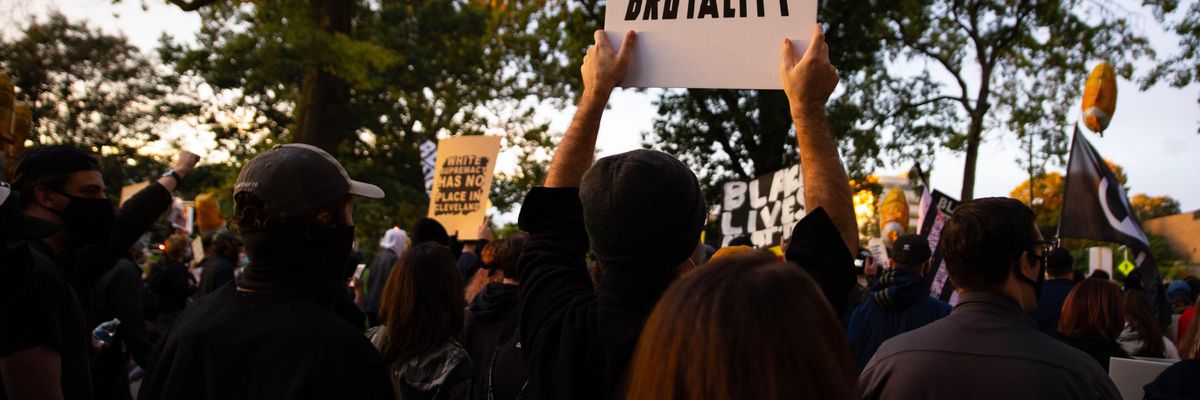
A Black Lives Matter supporter holds an "End Police Brutality" sign as people march at Case Western Reserve University and the Cleveland Clinic in Cleveland, Ohio, on September 29, 2020. (Photo: Megan Jelinger/AFP via Getty Images)
"Regardless of tonight's outcome, there's broad agreement that Minneapolis residents want more tools for public safety. There's also consensus that the status quo is not an option."
The grassroots group Black Visions Collective applauded the "historic" Yes on 2 campaign, which helped push nearly 44% of Minneapolis voters to support Question 2 after launching a petition to demand the question be included on the ballot.
"You actually can staff the department the way that meets the needs of the people," campaign spokesperson JaNae Bates told NPR in October. "We wanted to really be centered and focused on the safety of human beings."
Proponents of bold reforms to policing applauded the campaign for the traction it managed to gain in the city.
"In the dead of winter, organizers collected 22,000 signatures from across the city to put this amendment on the ballot," said People's Action Movement Politics director Brooke Adams and TakeAction Minnesota executive director Elianne Farhat. "Black organizers and activists have worked toward this for years before 2020, and the work for a better future where everyone can feel safe in their communities will continue."
"Regardless of tonight's outcome, there's broad agreement that Minneapolis residents want more tools for public safety," added Adams and Farhat. "There's also consensus that the status quo is not an option."
Radley Balko, author of "Rise of the Warrior Cop" and a Washington Post columnist, called the level of support campaigners garnered for a "radical reorganization" of policing in Minneapolis "pretty remarkable."
The demand for an end to the status quo regarding policing was evident in a number of other cities including Austin, where voters overwhelmingly rejected a measure to hire hundreds more police officers--which would have required major budget cuts in other areas including firefighting, emergency health services, and libraries, according to opponents.
"It's past time we as a society reimagine the role of police."
Sixty-eight percent of Austin voters rejected Proposition A, which was pushed by Save Austin Now, a group co-founded by the Travis County Republican Party chair. The group raised $1.7 million in its effort to add to the city's 1,600-strong police force.
Austin Mayor Steve Adler, a Democrat, said the election reaffirmed "our community's belief that public safety for all requires a comprehensive system that includes properly staffing our police, but also our fire, EMS, and mental health responses as well."
Voters in Cleveland, Ohio also made clear their demand for more police accountability, approving a plan to establish a Civilian Police Review Board that would investigate reports of police misconduct. The proposal, known as Issue 24, passed by a margin of 59% to 41%.
The measure was endorsed by groups including Black Lives Matter Cleveland and the Cuyahoga County Progressive Caucus, as well as Cleveland Mayor-elect Justin Bibb, a Democrat who won his election Tuesday night.
"We can't keep making this a false choice between good and effective law enforcement and police accountability," Bibb told local news outlet 3News. "We can do both. I believe trust is the biggest thing to do to make sure we have safety and security and residents trust police. Without it, you don't get safety."
Jeff Follmer, president of the local police union, accused Cleveland voters of approving a "vengeful" initiative that would "be the downfall of Cleveland." Issue 24 was proposed months after the U.S. Department of Justice declined to prosecute Cleveland officers in the police shooting of 12-year-old Tamir Rice in 2014.
Dear Common Dreams reader, It’s been nearly 30 years since I co-founded Common Dreams with my late wife, Lina Newhouser. We had the radical notion that journalism should serve the public good, not corporate profits. It was clear to us from the outset what it would take to build such a project. No paid advertisements. No corporate sponsors. No millionaire publisher telling us what to think or do. Many people said we wouldn't last a year, but we proved those doubters wrong. Together with a tremendous team of journalists and dedicated staff, we built an independent media outlet free from the constraints of profits and corporate control. Our mission has always been simple: To inform. To inspire. To ignite change for the common good. Building Common Dreams was not easy. Our survival was never guaranteed. When you take on the most powerful forces—Wall Street greed, fossil fuel industry destruction, Big Tech lobbyists, and uber-rich oligarchs who have spent billions upon billions rigging the economy and democracy in their favor—the only bulwark you have is supporters who believe in your work. But here’s the urgent message from me today. It's never been this bad out there. And it's never been this hard to keep us going. At the very moment Common Dreams is most needed, the threats we face are intensifying. We need your support now more than ever. We don't accept corporate advertising and never will. We don't have a paywall because we don't think people should be blocked from critical news based on their ability to pay. Everything we do is funded by the donations of readers like you. When everyone does the little they can afford, we are strong. But if that support retreats or dries up, so do we. Will you donate now to make sure Common Dreams not only survives but thrives? —Craig Brown, Co-founder |
"Regardless of tonight's outcome, there's broad agreement that Minneapolis residents want more tools for public safety. There's also consensus that the status quo is not an option."
The grassroots group Black Visions Collective applauded the "historic" Yes on 2 campaign, which helped push nearly 44% of Minneapolis voters to support Question 2 after launching a petition to demand the question be included on the ballot.
"You actually can staff the department the way that meets the needs of the people," campaign spokesperson JaNae Bates told NPR in October. "We wanted to really be centered and focused on the safety of human beings."
Proponents of bold reforms to policing applauded the campaign for the traction it managed to gain in the city.
"In the dead of winter, organizers collected 22,000 signatures from across the city to put this amendment on the ballot," said People's Action Movement Politics director Brooke Adams and TakeAction Minnesota executive director Elianne Farhat. "Black organizers and activists have worked toward this for years before 2020, and the work for a better future where everyone can feel safe in their communities will continue."
"Regardless of tonight's outcome, there's broad agreement that Minneapolis residents want more tools for public safety," added Adams and Farhat. "There's also consensus that the status quo is not an option."
Radley Balko, author of "Rise of the Warrior Cop" and a Washington Post columnist, called the level of support campaigners garnered for a "radical reorganization" of policing in Minneapolis "pretty remarkable."
The demand for an end to the status quo regarding policing was evident in a number of other cities including Austin, where voters overwhelmingly rejected a measure to hire hundreds more police officers--which would have required major budget cuts in other areas including firefighting, emergency health services, and libraries, according to opponents.
"It's past time we as a society reimagine the role of police."
Sixty-eight percent of Austin voters rejected Proposition A, which was pushed by Save Austin Now, a group co-founded by the Travis County Republican Party chair. The group raised $1.7 million in its effort to add to the city's 1,600-strong police force.
Austin Mayor Steve Adler, a Democrat, said the election reaffirmed "our community's belief that public safety for all requires a comprehensive system that includes properly staffing our police, but also our fire, EMS, and mental health responses as well."
Voters in Cleveland, Ohio also made clear their demand for more police accountability, approving a plan to establish a Civilian Police Review Board that would investigate reports of police misconduct. The proposal, known as Issue 24, passed by a margin of 59% to 41%.
The measure was endorsed by groups including Black Lives Matter Cleveland and the Cuyahoga County Progressive Caucus, as well as Cleveland Mayor-elect Justin Bibb, a Democrat who won his election Tuesday night.
"We can't keep making this a false choice between good and effective law enforcement and police accountability," Bibb told local news outlet 3News. "We can do both. I believe trust is the biggest thing to do to make sure we have safety and security and residents trust police. Without it, you don't get safety."
Jeff Follmer, president of the local police union, accused Cleveland voters of approving a "vengeful" initiative that would "be the downfall of Cleveland." Issue 24 was proposed months after the U.S. Department of Justice declined to prosecute Cleveland officers in the police shooting of 12-year-old Tamir Rice in 2014.
"Regardless of tonight's outcome, there's broad agreement that Minneapolis residents want more tools for public safety. There's also consensus that the status quo is not an option."
The grassroots group Black Visions Collective applauded the "historic" Yes on 2 campaign, which helped push nearly 44% of Minneapolis voters to support Question 2 after launching a petition to demand the question be included on the ballot.
"You actually can staff the department the way that meets the needs of the people," campaign spokesperson JaNae Bates told NPR in October. "We wanted to really be centered and focused on the safety of human beings."
Proponents of bold reforms to policing applauded the campaign for the traction it managed to gain in the city.
"In the dead of winter, organizers collected 22,000 signatures from across the city to put this amendment on the ballot," said People's Action Movement Politics director Brooke Adams and TakeAction Minnesota executive director Elianne Farhat. "Black organizers and activists have worked toward this for years before 2020, and the work for a better future where everyone can feel safe in their communities will continue."
"Regardless of tonight's outcome, there's broad agreement that Minneapolis residents want more tools for public safety," added Adams and Farhat. "There's also consensus that the status quo is not an option."
Radley Balko, author of "Rise of the Warrior Cop" and a Washington Post columnist, called the level of support campaigners garnered for a "radical reorganization" of policing in Minneapolis "pretty remarkable."
The demand for an end to the status quo regarding policing was evident in a number of other cities including Austin, where voters overwhelmingly rejected a measure to hire hundreds more police officers--which would have required major budget cuts in other areas including firefighting, emergency health services, and libraries, according to opponents.
"It's past time we as a society reimagine the role of police."
Sixty-eight percent of Austin voters rejected Proposition A, which was pushed by Save Austin Now, a group co-founded by the Travis County Republican Party chair. The group raised $1.7 million in its effort to add to the city's 1,600-strong police force.
Austin Mayor Steve Adler, a Democrat, said the election reaffirmed "our community's belief that public safety for all requires a comprehensive system that includes properly staffing our police, but also our fire, EMS, and mental health responses as well."
Voters in Cleveland, Ohio also made clear their demand for more police accountability, approving a plan to establish a Civilian Police Review Board that would investigate reports of police misconduct. The proposal, known as Issue 24, passed by a margin of 59% to 41%.
The measure was endorsed by groups including Black Lives Matter Cleveland and the Cuyahoga County Progressive Caucus, as well as Cleveland Mayor-elect Justin Bibb, a Democrat who won his election Tuesday night.
"We can't keep making this a false choice between good and effective law enforcement and police accountability," Bibb told local news outlet 3News. "We can do both. I believe trust is the biggest thing to do to make sure we have safety and security and residents trust police. Without it, you don't get safety."
Jeff Follmer, president of the local police union, accused Cleveland voters of approving a "vengeful" initiative that would "be the downfall of Cleveland." Issue 24 was proposed months after the U.S. Department of Justice declined to prosecute Cleveland officers in the police shooting of 12-year-old Tamir Rice in 2014.