SUBSCRIBE TO OUR FREE NEWSLETTER
Daily news & progressive opinion—funded by the people, not the corporations—delivered straight to your inbox.
5
#000000
#FFFFFF
To donate by check, phone, or other method, see our More Ways to Give page.
Daily news & progressive opinion—funded by the people, not the corporations—delivered straight to your inbox.
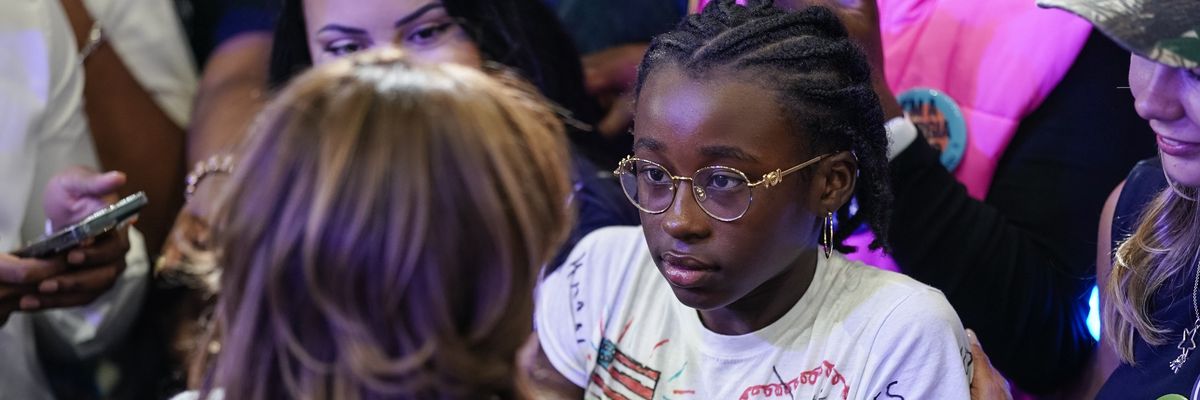
Then-Democratic presidential nominee, Vice President Kamala Harris, talks to a young girl after speaking at a campaign rally encouraging early voting on October 19, 2024 in Atlanta, Georgia.
Despite VP Harris’ loss, the results of this election cycle proved that investing in women is not only central to creating a more representative government; it’s also a strong electoral strategy.
It’s crushing to witness the inauguration of U.S. President-elect Donald Trump, a man who built his campaign, and his entire political career at large, on hatred, division, and lies.
Vice President Kamala Harris’ loss was a deeply devastating one for so many of us—and certainly one of the hardest I’ve had to swallow throughout my career in Democratic politics—but skepticism about the viability of a woman becoming president in our lifetimes has added even further insult to injury.
As the president of EMILYs List, one thing I know with certainty is this: Underestimating the strength of women candidates based on the outcome of the presidential race is a grave mistake. The results of this election cycle proved that investing in women is not only central to creating a more representative government; it’s also a strong electoral strategy.
Men lose campaigns all the time, particularly in the last 40 years as EMILYs List has grown, yet we never question whether another man can win in the future.
Across the ballot this year, women candidates were key to winning races under even the most difficult of circumstances and up against tremendous headwinds. Democratic women held onto highly competitive Senate seats in three battleground states that were won by Trump and won in four House districts that Trump carried. They flipped key Republican-held House seats from coast to coast—in Oregon’s 5th and New York’s 4th congressional districts. They broke Republican supermajorities in states across the country, and they protected and flipped vital state Supreme Court seats that are going to be essential to protecting our freedoms in years to come.
It’s clear: Women have what it takes to win. And Americans are ready and fired up to elect them.
That’s because voters know who crafts our policy matters. Women candidates bring personal perspectives and professional experiences that make a difference on the campaign trail and in our government. Whether it’s Lisa Blunt Rochester’s personal connection to IVF, Lucy McBath losing her son to gun violence, or Lauren Underwood’s experience as a public health expert—their deep understanding of these issues and their deep-rooted commitment to enacting change shapes policy in ways that better the lives of their constituents. When these women shared their stories on the campaign trail this year, voters responded by turning out in their favor.
Pundits will try to diminish the practicality of running Democratic women candidates for president in the future, and voters may feel disillusioned as they watch Donald Trump be sworn in. So we must be clear about the truth surrounding the presidential race: Kamala Harris is the reason that the election was as close as it was. At a time when Democrats were poised to lose big, her leadership galvanized millions of previously apathetic voters and evened the playing field for our party amid an immensely challenging environment.
Immediately after announcing her candidacy, Harris shattered fundraising records, hauling in $81 million in her first 24 hours as the nominee. She erased the enthusiasm gap among critical voters—creating a 56-point jump in young women’s motivation to vote and a 68% increase in motivation to vote among women in battleground states. She drove massive spikes across voter registration and volunteer sign-ups. And while it wasn’t enough to overcome the challenges she inherited, her ability to quickly narrow Democrats’ deficits against Donald Trump is a testament to the strength of women candidates and the continued need to invest in their leadership.
Men lose campaigns all the time, particularly in the last 40 years as EMILYs List has grown, yet we never question whether another man can win in the future. We don’t debate their electability or the shortcomings of their gender—and we don’t let those limitations stand between them and the highest levels of our government.
To let gendered biases overshadow women’s extensive qualifications, their ability to best represent our communities, and their demonstrable strength as candidates, is a disservice to the American people and to our future. Misconceptions about women’s electability become a self-fulfilling prophecy only if we let them.
Kamala Harris herself said it best: It hurts to break glass ceilings. But just because we haven’t broken our nation’s highest and hardest glass ceiling yet doesn’t mean we won’t.
The women who won in 2024 reinforced a vital lesson: investing in women candidates is a winning strategy for the Democratic Party. So now is not the time to doubt, question, or give up on them. It’s time to double down on them—because women are our best pathway to taking back power. And with their leadership, we will undoubtedly shatter our nation’s last glass ceiling.
Dear Common Dreams reader, It’s been nearly 30 years since I co-founded Common Dreams with my late wife, Lina Newhouser. We had the radical notion that journalism should serve the public good, not corporate profits. It was clear to us from the outset what it would take to build such a project. No paid advertisements. No corporate sponsors. No millionaire publisher telling us what to think or do. Many people said we wouldn't last a year, but we proved those doubters wrong. Together with a tremendous team of journalists and dedicated staff, we built an independent media outlet free from the constraints of profits and corporate control. Our mission has always been simple: To inform. To inspire. To ignite change for the common good. Building Common Dreams was not easy. Our survival was never guaranteed. When you take on the most powerful forces—Wall Street greed, fossil fuel industry destruction, Big Tech lobbyists, and uber-rich oligarchs who have spent billions upon billions rigging the economy and democracy in their favor—the only bulwark you have is supporters who believe in your work. But here’s the urgent message from me today. It's never been this bad out there. And it's never been this hard to keep us going. At the very moment Common Dreams is most needed, the threats we face are intensifying. We need your support now more than ever. We don't accept corporate advertising and never will. We don't have a paywall because we don't think people should be blocked from critical news based on their ability to pay. Everything we do is funded by the donations of readers like you. When everyone does the little they can afford, we are strong. But if that support retreats or dries up, so do we. Will you donate now to make sure Common Dreams not only survives but thrives? —Craig Brown, Co-founder |
It’s crushing to witness the inauguration of U.S. President-elect Donald Trump, a man who built his campaign, and his entire political career at large, on hatred, division, and lies.
Vice President Kamala Harris’ loss was a deeply devastating one for so many of us—and certainly one of the hardest I’ve had to swallow throughout my career in Democratic politics—but skepticism about the viability of a woman becoming president in our lifetimes has added even further insult to injury.
As the president of EMILYs List, one thing I know with certainty is this: Underestimating the strength of women candidates based on the outcome of the presidential race is a grave mistake. The results of this election cycle proved that investing in women is not only central to creating a more representative government; it’s also a strong electoral strategy.
Men lose campaigns all the time, particularly in the last 40 years as EMILYs List has grown, yet we never question whether another man can win in the future.
Across the ballot this year, women candidates were key to winning races under even the most difficult of circumstances and up against tremendous headwinds. Democratic women held onto highly competitive Senate seats in three battleground states that were won by Trump and won in four House districts that Trump carried. They flipped key Republican-held House seats from coast to coast—in Oregon’s 5th and New York’s 4th congressional districts. They broke Republican supermajorities in states across the country, and they protected and flipped vital state Supreme Court seats that are going to be essential to protecting our freedoms in years to come.
It’s clear: Women have what it takes to win. And Americans are ready and fired up to elect them.
That’s because voters know who crafts our policy matters. Women candidates bring personal perspectives and professional experiences that make a difference on the campaign trail and in our government. Whether it’s Lisa Blunt Rochester’s personal connection to IVF, Lucy McBath losing her son to gun violence, or Lauren Underwood’s experience as a public health expert—their deep understanding of these issues and their deep-rooted commitment to enacting change shapes policy in ways that better the lives of their constituents. When these women shared their stories on the campaign trail this year, voters responded by turning out in their favor.
Pundits will try to diminish the practicality of running Democratic women candidates for president in the future, and voters may feel disillusioned as they watch Donald Trump be sworn in. So we must be clear about the truth surrounding the presidential race: Kamala Harris is the reason that the election was as close as it was. At a time when Democrats were poised to lose big, her leadership galvanized millions of previously apathetic voters and evened the playing field for our party amid an immensely challenging environment.
Immediately after announcing her candidacy, Harris shattered fundraising records, hauling in $81 million in her first 24 hours as the nominee. She erased the enthusiasm gap among critical voters—creating a 56-point jump in young women’s motivation to vote and a 68% increase in motivation to vote among women in battleground states. She drove massive spikes across voter registration and volunteer sign-ups. And while it wasn’t enough to overcome the challenges she inherited, her ability to quickly narrow Democrats’ deficits against Donald Trump is a testament to the strength of women candidates and the continued need to invest in their leadership.
Men lose campaigns all the time, particularly in the last 40 years as EMILYs List has grown, yet we never question whether another man can win in the future. We don’t debate their electability or the shortcomings of their gender—and we don’t let those limitations stand between them and the highest levels of our government.
To let gendered biases overshadow women’s extensive qualifications, their ability to best represent our communities, and their demonstrable strength as candidates, is a disservice to the American people and to our future. Misconceptions about women’s electability become a self-fulfilling prophecy only if we let them.
Kamala Harris herself said it best: It hurts to break glass ceilings. But just because we haven’t broken our nation’s highest and hardest glass ceiling yet doesn’t mean we won’t.
The women who won in 2024 reinforced a vital lesson: investing in women candidates is a winning strategy for the Democratic Party. So now is not the time to doubt, question, or give up on them. It’s time to double down on them—because women are our best pathway to taking back power. And with their leadership, we will undoubtedly shatter our nation’s last glass ceiling.
It’s crushing to witness the inauguration of U.S. President-elect Donald Trump, a man who built his campaign, and his entire political career at large, on hatred, division, and lies.
Vice President Kamala Harris’ loss was a deeply devastating one for so many of us—and certainly one of the hardest I’ve had to swallow throughout my career in Democratic politics—but skepticism about the viability of a woman becoming president in our lifetimes has added even further insult to injury.
As the president of EMILYs List, one thing I know with certainty is this: Underestimating the strength of women candidates based on the outcome of the presidential race is a grave mistake. The results of this election cycle proved that investing in women is not only central to creating a more representative government; it’s also a strong electoral strategy.
Men lose campaigns all the time, particularly in the last 40 years as EMILYs List has grown, yet we never question whether another man can win in the future.
Across the ballot this year, women candidates were key to winning races under even the most difficult of circumstances and up against tremendous headwinds. Democratic women held onto highly competitive Senate seats in three battleground states that were won by Trump and won in four House districts that Trump carried. They flipped key Republican-held House seats from coast to coast—in Oregon’s 5th and New York’s 4th congressional districts. They broke Republican supermajorities in states across the country, and they protected and flipped vital state Supreme Court seats that are going to be essential to protecting our freedoms in years to come.
It’s clear: Women have what it takes to win. And Americans are ready and fired up to elect them.
That’s because voters know who crafts our policy matters. Women candidates bring personal perspectives and professional experiences that make a difference on the campaign trail and in our government. Whether it’s Lisa Blunt Rochester’s personal connection to IVF, Lucy McBath losing her son to gun violence, or Lauren Underwood’s experience as a public health expert—their deep understanding of these issues and their deep-rooted commitment to enacting change shapes policy in ways that better the lives of their constituents. When these women shared their stories on the campaign trail this year, voters responded by turning out in their favor.
Pundits will try to diminish the practicality of running Democratic women candidates for president in the future, and voters may feel disillusioned as they watch Donald Trump be sworn in. So we must be clear about the truth surrounding the presidential race: Kamala Harris is the reason that the election was as close as it was. At a time when Democrats were poised to lose big, her leadership galvanized millions of previously apathetic voters and evened the playing field for our party amid an immensely challenging environment.
Immediately after announcing her candidacy, Harris shattered fundraising records, hauling in $81 million in her first 24 hours as the nominee. She erased the enthusiasm gap among critical voters—creating a 56-point jump in young women’s motivation to vote and a 68% increase in motivation to vote among women in battleground states. She drove massive spikes across voter registration and volunteer sign-ups. And while it wasn’t enough to overcome the challenges she inherited, her ability to quickly narrow Democrats’ deficits against Donald Trump is a testament to the strength of women candidates and the continued need to invest in their leadership.
Men lose campaigns all the time, particularly in the last 40 years as EMILYs List has grown, yet we never question whether another man can win in the future. We don’t debate their electability or the shortcomings of their gender—and we don’t let those limitations stand between them and the highest levels of our government.
To let gendered biases overshadow women’s extensive qualifications, their ability to best represent our communities, and their demonstrable strength as candidates, is a disservice to the American people and to our future. Misconceptions about women’s electability become a self-fulfilling prophecy only if we let them.
Kamala Harris herself said it best: It hurts to break glass ceilings. But just because we haven’t broken our nation’s highest and hardest glass ceiling yet doesn’t mean we won’t.
The women who won in 2024 reinforced a vital lesson: investing in women candidates is a winning strategy for the Democratic Party. So now is not the time to doubt, question, or give up on them. It’s time to double down on them—because women are our best pathway to taking back power. And with their leadership, we will undoubtedly shatter our nation’s last glass ceiling.