
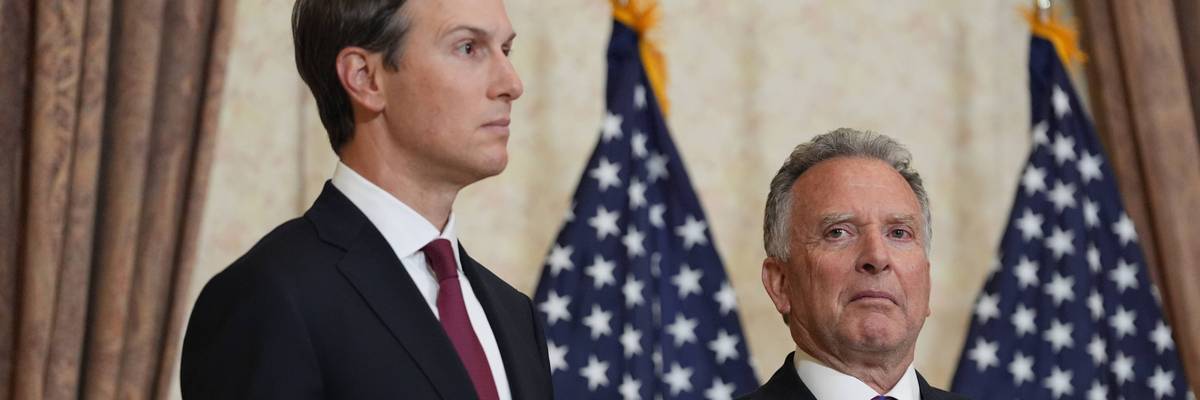
Jared Kushner, left, and Steve Witkoff, Special Envoy for Peace Missions listen as Vice President JD Vance speaks during a news conference after meeting with representatives from Pakistan and Iran, April 12, 2026 in Islamabad, Pakistan.
US-Iran Diplomacy Is Entrenching Crisis, Not Ending It
The failure of talks in Pakistan does not simply close a diplomatic episode. It clarifies the limits of what current diplomacy can realistically achieve.
The breakdown of recent US–Iran contacts in Pakistan does not represent an isolated diplomatic setback. It reflects something more structural: a relationship that is no longer moving toward resolution but instead stabilizing into a long-term cycle of managed confrontation.
In this emerging pattern, diplomacy has not disappeared, but its function has changed. It is no longer a pathway toward agreement; it has become part of the mechanism through which escalation is contained, calibrated, and periodically reset—without addressing the underlying conflict.
Recent signals that indirect contacts may still be continuing are not evidence of progress. Rather, they confirm the new logic of the relationship: diplomacy and coercion now operate in parallel. Negotiations persist, but without a shared framework, agreed end state, or credible roadmap toward settlement.
Diplomacy without resolution
Over the past several years, US-Iran engagement has increasingly shifted away from structured bargaining toward fragmented, episodic communication. The assumption that talks naturally lead toward de-escalation no longer holds.
Instead, both sides now use diplomacy tactically. It serves to manage risk, test boundaries, and signal restraint—while broader strategic competition continues uninterrupted.
This produces a paradox: dialogue continues, but trust erodes; engagement persists, but outcomes remain absent; communication expands, but political distance grows.
The breakdown of expectations following recent regional escalation and fragile ceasefire dynamics underscores this shift. The relationship is no longer oriented toward solving problems, but toward preventing them from spiraling out of control.
A fundamental strategic mismatch
At the core of this stalemate is not a failure of communication, but a deeper mismatch in strategic logic. The United States continues to approach diplomacy as an extension of pressure. Sanctions, military signaling, and containment strategies are intended to extract concessions on nuclear activity, regional influence, and security behavior. Iran, meanwhile, treats negotiations as a test of endurance and strategic recognition. It seeks economic relief and political acknowledgment of its regional position without fundamentally altering its core security doctrine.
These positions are not complementary. They are structurally incompatible. One side seeks behavioral change through pressure; the other seeks survival and recognition under pressure. As a result, negotiations do not converge toward compromise. They remain trapped within a constrained space of managed disagreement.
A region adapting to permanent instability
This dynamic is not confined to Washington and Tehran. It is reshaping the wider regional environment.
Pakistan’s role as a venue for indirect contacts highlights the growing importance of intermediary states attempting to contain escalation, even when their influence over outcomes is limited.
Turkey continues to balance mediation with strategic autonomy, engaging multiple actors while avoiding fixed alignment.
Russia benefits from prolonged US-Iran tensions, which divert Western attention and reinforce Moscow’s positioning as a partner for Tehran.
China prioritizes energy security and stability. It seeks to prevent open conflict but remains reluctant to assume a direct security role in the Gulf.
The combined effect is a fragmented regional order in which external actors are not neutral observers, but participants in managing—and at times exploiting—persistent instability.
Iran under layered pressure
Iran’s current strategic environment is shaped by three overlapping pressures: military, economic, and domestic.
Militarily, the likelihood of full-scale war remains relatively low. More plausible is a pattern of calibrated escalation—limited strikes, maritime tensions, cyber operations, and proxy activity.
Any sustained attempt to restrict Iranian-linked activity near critical maritime routes such as the Strait of Hormuz would mark a qualitative shift toward structural escalation, increasing long-term regional risk.
Iran, in turn, is unlikely to respond symmetrically. Its strategy relies on asymmetric tools: disruption of shipping, cyber capabilities, and the activation of regional networks. This produces a form of conflict that is continuous, dispersed, and difficult to resolve decisively.
Economically, the breakdown of talks reinforces Iran’s continued exclusion from the global financial system. Over time, sanctions have not only constrained Iran’s economy—they have reshaped it. Parallel trade networks, non-Western partnerships—particularly with Russia and China—and informal mechanisms have become structural features rather than temporary workarounds.
This reduces incentives for rapid compromise and increases the cost of reintegration into Western-led systems.
Domestically, sustained external pressure interacts with existing internal challenges. While external confrontation can temporarily reinforce political cohesion, it also intensifies long-term tensions between state capacity, economic performance, and public expectations.
The result is not collapse, but persistent strain.
The logic of strategic endurance
Taken together, these dynamics point toward a strategy best described as strategic endurance.
Iran’s likely trajectory is not decisive breakthrough or breakdown, but sustained resistance under pressure—preserving core capabilities, maintaining regional leverage, and keeping limited diplomatic channels open without major concessions.
This is not a strategy designed to resolve the conflict. It is a strategy designed to survive it.
The narrowing policy horizon in Washington
For the United States, the collapse of diplomatic momentum reinforces an increasingly familiar policy response: expanded sanctions, renewed military signaling, and limited tactical strikes against proxy-linked targets.
But the effectiveness of this approach is diminishing. Pressure without a credible political horizon tends to produce adaptation rather than compliance. It hardens positions, deepens fragmentation, and reduces the likelihood of negotiated outcomes over time.
What remains is a narrowing strategic space in which policy tools are still available, but less capable of producing meaningful change.
A durable cycle of confrontation
The most likely near-term trajectory is neither war nor resolution, but a prolonged cycle of managed confrontation.
This cycle will be characterized by intermittent escalation, partial and indirect diplomacy, and growing involvement of external actors attempting to prevent wider spillover.
Such an equilibrium may appear stable in the short term. Its danger lies in its durability. Conflicts that become structurally managed rather than resolved tend not to end through negotiation, but through accumulated crises that eventually exceed the system’s capacity to contain them.
The failure of talks in Pakistan does not simply close a diplomatic episode. It clarifies the limits of what current diplomacy can realistically achieve.
Unless the underlying strategic mismatch is addressed, US-Iran relations are likely to remain trapped in a pattern where escalation is managed, but resolution is continually deferred—at increasing cost to regional stability and global security.
We are at a crossroads
This country and this world are at a monumental crossroads. In a few short weeks, US voters will have an opportunity to beat back the forces of fascism and confront the billionaires who are rigging the economy, our media system, and our democracy, making it increasingly impossible for ordinary people to get by. We’re not just talking about the election. We’re talking about what must be done once these fascist elements are vanquished from power. We need a bolder set of solutions than what either major party has so far been willing to offer and a working-class movement ready to fight like hell for it. Trump didn't emerge from nowhere. The conditions that fueled MAGA authoritarianism were created by decades of radical neoliberal economic policies and a corrupt political system dominated by corporate interests. They slashed taxes on the super-rich, promising that the benefits would trickle down. They said giveaways to the corporate titans would make life more affordable for the rest of us. It was all bullshit. And when a bitter, betrayed populace searches for someone to blame, right-wing demagogues have little trouble finding scapegoats. People know when they're being lied to, but you won't hear any of this from the corporate media. Only independent journalism—powered and funded by people who believe in building a better world—can deliver truly trustworthy daily news. Our Fall Campaign is underway, and we need your help. To power our newsroom through the rest of the year, we need to raise $125,000 by midnight on October 31. So if you share our vision, please contribute whatever you can to sustain our work. |
The breakdown of recent US–Iran contacts in Pakistan does not represent an isolated diplomatic setback. It reflects something more structural: a relationship that is no longer moving toward resolution but instead stabilizing into a long-term cycle of managed confrontation.
In this emerging pattern, diplomacy has not disappeared, but its function has changed. It is no longer a pathway toward agreement; it has become part of the mechanism through which escalation is contained, calibrated, and periodically reset—without addressing the underlying conflict.
Recent signals that indirect contacts may still be continuing are not evidence of progress. Rather, they confirm the new logic of the relationship: diplomacy and coercion now operate in parallel. Negotiations persist, but without a shared framework, agreed end state, or credible roadmap toward settlement.
Diplomacy without resolution
Over the past several years, US-Iran engagement has increasingly shifted away from structured bargaining toward fragmented, episodic communication. The assumption that talks naturally lead toward de-escalation no longer holds.
Instead, both sides now use diplomacy tactically. It serves to manage risk, test boundaries, and signal restraint—while broader strategic competition continues uninterrupted.
This produces a paradox: dialogue continues, but trust erodes; engagement persists, but outcomes remain absent; communication expands, but political distance grows.
The breakdown of expectations following recent regional escalation and fragile ceasefire dynamics underscores this shift. The relationship is no longer oriented toward solving problems, but toward preventing them from spiraling out of control.
A fundamental strategic mismatch
At the core of this stalemate is not a failure of communication, but a deeper mismatch in strategic logic. The United States continues to approach diplomacy as an extension of pressure. Sanctions, military signaling, and containment strategies are intended to extract concessions on nuclear activity, regional influence, and security behavior. Iran, meanwhile, treats negotiations as a test of endurance and strategic recognition. It seeks economic relief and political acknowledgment of its regional position without fundamentally altering its core security doctrine.
These positions are not complementary. They are structurally incompatible. One side seeks behavioral change through pressure; the other seeks survival and recognition under pressure. As a result, negotiations do not converge toward compromise. They remain trapped within a constrained space of managed disagreement.
A region adapting to permanent instability
This dynamic is not confined to Washington and Tehran. It is reshaping the wider regional environment.
Pakistan’s role as a venue for indirect contacts highlights the growing importance of intermediary states attempting to contain escalation, even when their influence over outcomes is limited.
Turkey continues to balance mediation with strategic autonomy, engaging multiple actors while avoiding fixed alignment.
Russia benefits from prolonged US-Iran tensions, which divert Western attention and reinforce Moscow’s positioning as a partner for Tehran.
China prioritizes energy security and stability. It seeks to prevent open conflict but remains reluctant to assume a direct security role in the Gulf.
The combined effect is a fragmented regional order in which external actors are not neutral observers, but participants in managing—and at times exploiting—persistent instability.
Iran under layered pressure
Iran’s current strategic environment is shaped by three overlapping pressures: military, economic, and domestic.
Militarily, the likelihood of full-scale war remains relatively low. More plausible is a pattern of calibrated escalation—limited strikes, maritime tensions, cyber operations, and proxy activity.
Any sustained attempt to restrict Iranian-linked activity near critical maritime routes such as the Strait of Hormuz would mark a qualitative shift toward structural escalation, increasing long-term regional risk.
Iran, in turn, is unlikely to respond symmetrically. Its strategy relies on asymmetric tools: disruption of shipping, cyber capabilities, and the activation of regional networks. This produces a form of conflict that is continuous, dispersed, and difficult to resolve decisively.
Economically, the breakdown of talks reinforces Iran’s continued exclusion from the global financial system. Over time, sanctions have not only constrained Iran’s economy—they have reshaped it. Parallel trade networks, non-Western partnerships—particularly with Russia and China—and informal mechanisms have become structural features rather than temporary workarounds.
This reduces incentives for rapid compromise and increases the cost of reintegration into Western-led systems.
Domestically, sustained external pressure interacts with existing internal challenges. While external confrontation can temporarily reinforce political cohesion, it also intensifies long-term tensions between state capacity, economic performance, and public expectations.
The result is not collapse, but persistent strain.
The logic of strategic endurance
Taken together, these dynamics point toward a strategy best described as strategic endurance.
Iran’s likely trajectory is not decisive breakthrough or breakdown, but sustained resistance under pressure—preserving core capabilities, maintaining regional leverage, and keeping limited diplomatic channels open without major concessions.
This is not a strategy designed to resolve the conflict. It is a strategy designed to survive it.
The narrowing policy horizon in Washington
For the United States, the collapse of diplomatic momentum reinforces an increasingly familiar policy response: expanded sanctions, renewed military signaling, and limited tactical strikes against proxy-linked targets.
But the effectiveness of this approach is diminishing. Pressure without a credible political horizon tends to produce adaptation rather than compliance. It hardens positions, deepens fragmentation, and reduces the likelihood of negotiated outcomes over time.
What remains is a narrowing strategic space in which policy tools are still available, but less capable of producing meaningful change.
A durable cycle of confrontation
The most likely near-term trajectory is neither war nor resolution, but a prolonged cycle of managed confrontation.
This cycle will be characterized by intermittent escalation, partial and indirect diplomacy, and growing involvement of external actors attempting to prevent wider spillover.
Such an equilibrium may appear stable in the short term. Its danger lies in its durability. Conflicts that become structurally managed rather than resolved tend not to end through negotiation, but through accumulated crises that eventually exceed the system’s capacity to contain them.
The failure of talks in Pakistan does not simply close a diplomatic episode. It clarifies the limits of what current diplomacy can realistically achieve.
Unless the underlying strategic mismatch is addressed, US-Iran relations are likely to remain trapped in a pattern where escalation is managed, but resolution is continually deferred—at increasing cost to regional stability and global security.
The breakdown of recent US–Iran contacts in Pakistan does not represent an isolated diplomatic setback. It reflects something more structural: a relationship that is no longer moving toward resolution but instead stabilizing into a long-term cycle of managed confrontation.
In this emerging pattern, diplomacy has not disappeared, but its function has changed. It is no longer a pathway toward agreement; it has become part of the mechanism through which escalation is contained, calibrated, and periodically reset—without addressing the underlying conflict.
Recent signals that indirect contacts may still be continuing are not evidence of progress. Rather, they confirm the new logic of the relationship: diplomacy and coercion now operate in parallel. Negotiations persist, but without a shared framework, agreed end state, or credible roadmap toward settlement.
Diplomacy without resolution
Over the past several years, US-Iran engagement has increasingly shifted away from structured bargaining toward fragmented, episodic communication. The assumption that talks naturally lead toward de-escalation no longer holds.
Instead, both sides now use diplomacy tactically. It serves to manage risk, test boundaries, and signal restraint—while broader strategic competition continues uninterrupted.
This produces a paradox: dialogue continues, but trust erodes; engagement persists, but outcomes remain absent; communication expands, but political distance grows.
The breakdown of expectations following recent regional escalation and fragile ceasefire dynamics underscores this shift. The relationship is no longer oriented toward solving problems, but toward preventing them from spiraling out of control.
A fundamental strategic mismatch
At the core of this stalemate is not a failure of communication, but a deeper mismatch in strategic logic. The United States continues to approach diplomacy as an extension of pressure. Sanctions, military signaling, and containment strategies are intended to extract concessions on nuclear activity, regional influence, and security behavior. Iran, meanwhile, treats negotiations as a test of endurance and strategic recognition. It seeks economic relief and political acknowledgment of its regional position without fundamentally altering its core security doctrine.
These positions are not complementary. They are structurally incompatible. One side seeks behavioral change through pressure; the other seeks survival and recognition under pressure. As a result, negotiations do not converge toward compromise. They remain trapped within a constrained space of managed disagreement.
A region adapting to permanent instability
This dynamic is not confined to Washington and Tehran. It is reshaping the wider regional environment.
Pakistan’s role as a venue for indirect contacts highlights the growing importance of intermediary states attempting to contain escalation, even when their influence over outcomes is limited.
Turkey continues to balance mediation with strategic autonomy, engaging multiple actors while avoiding fixed alignment.
Russia benefits from prolonged US-Iran tensions, which divert Western attention and reinforce Moscow’s positioning as a partner for Tehran.
China prioritizes energy security and stability. It seeks to prevent open conflict but remains reluctant to assume a direct security role in the Gulf.
The combined effect is a fragmented regional order in which external actors are not neutral observers, but participants in managing—and at times exploiting—persistent instability.
Iran under layered pressure
Iran’s current strategic environment is shaped by three overlapping pressures: military, economic, and domestic.
Militarily, the likelihood of full-scale war remains relatively low. More plausible is a pattern of calibrated escalation—limited strikes, maritime tensions, cyber operations, and proxy activity.
Any sustained attempt to restrict Iranian-linked activity near critical maritime routes such as the Strait of Hormuz would mark a qualitative shift toward structural escalation, increasing long-term regional risk.
Iran, in turn, is unlikely to respond symmetrically. Its strategy relies on asymmetric tools: disruption of shipping, cyber capabilities, and the activation of regional networks. This produces a form of conflict that is continuous, dispersed, and difficult to resolve decisively.
Economically, the breakdown of talks reinforces Iran’s continued exclusion from the global financial system. Over time, sanctions have not only constrained Iran’s economy—they have reshaped it. Parallel trade networks, non-Western partnerships—particularly with Russia and China—and informal mechanisms have become structural features rather than temporary workarounds.
This reduces incentives for rapid compromise and increases the cost of reintegration into Western-led systems.
Domestically, sustained external pressure interacts with existing internal challenges. While external confrontation can temporarily reinforce political cohesion, it also intensifies long-term tensions between state capacity, economic performance, and public expectations.
The result is not collapse, but persistent strain.
The logic of strategic endurance
Taken together, these dynamics point toward a strategy best described as strategic endurance.
Iran’s likely trajectory is not decisive breakthrough or breakdown, but sustained resistance under pressure—preserving core capabilities, maintaining regional leverage, and keeping limited diplomatic channels open without major concessions.
This is not a strategy designed to resolve the conflict. It is a strategy designed to survive it.
The narrowing policy horizon in Washington
For the United States, the collapse of diplomatic momentum reinforces an increasingly familiar policy response: expanded sanctions, renewed military signaling, and limited tactical strikes against proxy-linked targets.
But the effectiveness of this approach is diminishing. Pressure without a credible political horizon tends to produce adaptation rather than compliance. It hardens positions, deepens fragmentation, and reduces the likelihood of negotiated outcomes over time.
What remains is a narrowing strategic space in which policy tools are still available, but less capable of producing meaningful change.
A durable cycle of confrontation
The most likely near-term trajectory is neither war nor resolution, but a prolonged cycle of managed confrontation.
This cycle will be characterized by intermittent escalation, partial and indirect diplomacy, and growing involvement of external actors attempting to prevent wider spillover.
Such an equilibrium may appear stable in the short term. Its danger lies in its durability. Conflicts that become structurally managed rather than resolved tend not to end through negotiation, but through accumulated crises that eventually exceed the system’s capacity to contain them.
The failure of talks in Pakistan does not simply close a diplomatic episode. It clarifies the limits of what current diplomacy can realistically achieve.
Unless the underlying strategic mismatch is addressed, US-Iran relations are likely to remain trapped in a pattern where escalation is managed, but resolution is continually deferred—at increasing cost to regional stability and global security.