
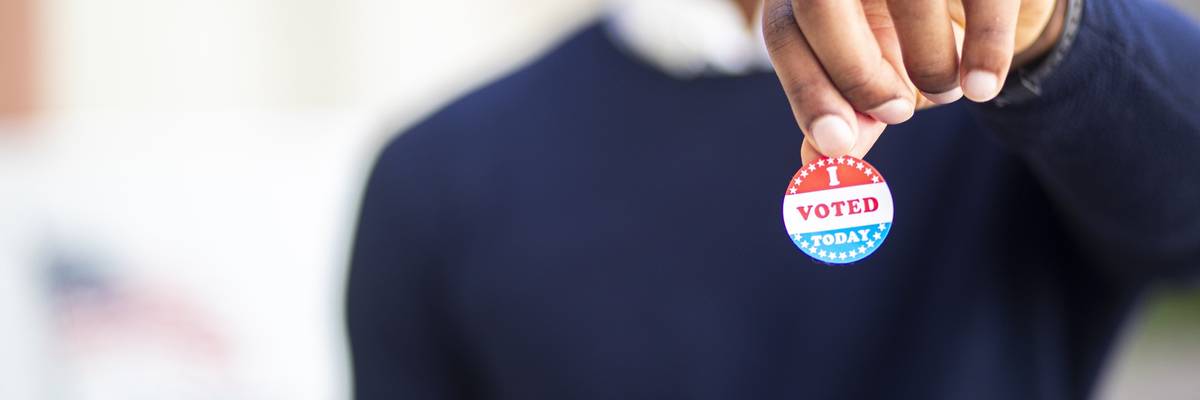
A young Black man holds up his "I voted" sticker after voting in an election.
Trump Is Waging a Psychological Warfare Campaign Against US Democracy
By constantly raising the alarm about election fraud, Trump seeks to stir fear, doubt, and confusion in the minds of voters.
With 112 days to go until Election Day, President Donald Trump’s drive to undermine the vote continues. As time runs short, his efforts grow more aggressive, more brazen. But they are facing pushback with ever greater assurance.
Last Friday, Trump pushed out the remaining commissioners on the Election Assistance Commission. This tiny agency exists to provide help and funding for states. Trump had previously tried to force the commission to implement his pet voter suppression policy—requiring a passport to register to vote—but a federal court barred it from doing so in a lawsuit brought last year by the Brennan Center and others. Now, without any commissioners, the agency can’t do much of anything.
Another federal judge quashed Justice Department subpoenas issued to hundreds of election workers in Fulton County, Georgia. The judge said the subpoenas were “staggering,” and that the Justice Department was engaged in a “fishing expedition.”
Also last week, the Department of Justice (DOJ) sent a scarifying letter to state officials warning that they will be held criminally liable if noncitizens are found on the voter rolls or voting.
All of us who care about free, fair, and secure elections in 2026 should say loud and clear: Voters can vote with certainty.
Utah’s Republican lieutenant governor, who runs elections in that state, wrote: “Got another love letter this morning from the DOJ sprinkled throughout with threats of criminal prosecution. I’m sure I’m not the only chief election officer of a state who is being targeted for following state and federal laws by resisting DOJ’s demands for private voter data that have thus far been ruled illegal by at least a dozen courts. This is truly bizarre behavior by the federal agency that is supposed to be protecting civil rights.”
Trump even claimed that recently deceased Sen. Lindsey Graham’s (R-SC) last conversation with him involved his allegedly ardent support for the anti-voter SAVE Act.
Now comes word that on Thursday, Trump will deliver an address to the nation, rumored to be when he will reveal that the 2020 election was hacked by... China? Iran? Whoever.
Why is the president continuing to press on like this? Yes, he’s relitigating the 2020 election. And some of his desired election policy changes, were they to become law, could restrict the vote for millions.
But the bigger reason is to stir fear, doubt, and confusion in the minds of voters.
We’re seeing a psychological warfare campaign waged against American democracy by leaders of its own government.
People tell me of encounters they’ve recently had with voters. One voter is convinced she will have a hard time voting because she changed her name when she got married from the one on her birth certificate, even though the SAVE Act has not become law. Another worries that the Supreme Court’s Voting Rights Act ruling in Louisiana v. Callais means they cannot vote.
Crazy rumors fly. That former Venezuelan leader Nicolás Maduro, for example, will “confess” to stealing the 2020 election in exchange for leniency. And so on. Few pan out. But the decibel level can be deafening.
All this requires deftness by those who would protect the vote. Every election year, voting advocates like the Brennan Center weigh carefully whether and how to reassure voters, as merely mentioning the potential threats to voting could backfire and scare people away from the polls.
Latino voters and other immigrants, for example, may fear Immigration and Custom Enforcement being present at polling places. Even though such a deployment would be illegal, simply raising it as a possibility may cause voters to stay home. Fear would have done its work.
For other voters, though, we may see a new phenomenon: Efforts at suppression could fuel mobilization. In the South, Black voters are outraged by the efforts to redraw election maps after the Supreme Court’s Callais decision gutted the Voting Rights Act. They could turn out in historic numbers. People get really mad when you try to take something from them—and when it’s representation and the vote, watch out.
All of us who care about free, fair, and secure elections in 2026 should say loud and clear: Voters can vote with certainty. Make a plan to vote. Vote as early as you can. In person, via drop box, in the mail.
One hundred twelve days. It will feel like longer. But when this year is done, the strong response across the country to an egregious effort to undermine our democracy may be the real story.
We are at a crossroads
This country and this world are at a monumental crossroads. In a few short weeks, US voters will have an opportunity to beat back the forces of fascism and confront the billionaires who are rigging the economy, our media system, and our democracy, making it increasingly impossible for ordinary people to get by. We’re not just talking about the election. We’re talking about what must be done once these fascist elements are vanquished from power. We need a bolder set of solutions than what either major party has so far been willing to offer and a working-class movement ready to fight like hell for it. Trump didn't emerge from nowhere. The conditions that fueled MAGA authoritarianism were created by decades of radical neoliberal economic policies and a corrupt political system dominated by corporate interests. They slashed taxes on the super-rich, promising that the benefits would trickle down. They said giveaways to the corporate titans would make life more affordable for the rest of us. It was all bullshit. And when a bitter, betrayed populace searches for someone to blame, right-wing demagogues have little trouble finding scapegoats. People know when they're being lied to, but you won't hear any of this from the corporate media. Only independent journalism—powered and funded by people who believe in building a better world—can deliver truly trustworthy daily news. Our Fall Campaign is underway, and we need your help. To power our newsroom through the rest of the year, we need to raise $125,000 by midnight on October 31. So if you share our vision, please contribute whatever you can to sustain our work. |
With 112 days to go until Election Day, President Donald Trump’s drive to undermine the vote continues. As time runs short, his efforts grow more aggressive, more brazen. But they are facing pushback with ever greater assurance.
Last Friday, Trump pushed out the remaining commissioners on the Election Assistance Commission. This tiny agency exists to provide help and funding for states. Trump had previously tried to force the commission to implement his pet voter suppression policy—requiring a passport to register to vote—but a federal court barred it from doing so in a lawsuit brought last year by the Brennan Center and others. Now, without any commissioners, the agency can’t do much of anything.
Another federal judge quashed Justice Department subpoenas issued to hundreds of election workers in Fulton County, Georgia. The judge said the subpoenas were “staggering,” and that the Justice Department was engaged in a “fishing expedition.”
Also last week, the Department of Justice (DOJ) sent a scarifying letter to state officials warning that they will be held criminally liable if noncitizens are found on the voter rolls or voting.
All of us who care about free, fair, and secure elections in 2026 should say loud and clear: Voters can vote with certainty.
Utah’s Republican lieutenant governor, who runs elections in that state, wrote: “Got another love letter this morning from the DOJ sprinkled throughout with threats of criminal prosecution. I’m sure I’m not the only chief election officer of a state who is being targeted for following state and federal laws by resisting DOJ’s demands for private voter data that have thus far been ruled illegal by at least a dozen courts. This is truly bizarre behavior by the federal agency that is supposed to be protecting civil rights.”
Trump even claimed that recently deceased Sen. Lindsey Graham’s (R-SC) last conversation with him involved his allegedly ardent support for the anti-voter SAVE Act.
Now comes word that on Thursday, Trump will deliver an address to the nation, rumored to be when he will reveal that the 2020 election was hacked by... China? Iran? Whoever.
Why is the president continuing to press on like this? Yes, he’s relitigating the 2020 election. And some of his desired election policy changes, were they to become law, could restrict the vote for millions.
But the bigger reason is to stir fear, doubt, and confusion in the minds of voters.
We’re seeing a psychological warfare campaign waged against American democracy by leaders of its own government.
People tell me of encounters they’ve recently had with voters. One voter is convinced she will have a hard time voting because she changed her name when she got married from the one on her birth certificate, even though the SAVE Act has not become law. Another worries that the Supreme Court’s Voting Rights Act ruling in Louisiana v. Callais means they cannot vote.
Crazy rumors fly. That former Venezuelan leader Nicolás Maduro, for example, will “confess” to stealing the 2020 election in exchange for leniency. And so on. Few pan out. But the decibel level can be deafening.
All this requires deftness by those who would protect the vote. Every election year, voting advocates like the Brennan Center weigh carefully whether and how to reassure voters, as merely mentioning the potential threats to voting could backfire and scare people away from the polls.
Latino voters and other immigrants, for example, may fear Immigration and Custom Enforcement being present at polling places. Even though such a deployment would be illegal, simply raising it as a possibility may cause voters to stay home. Fear would have done its work.
For other voters, though, we may see a new phenomenon: Efforts at suppression could fuel mobilization. In the South, Black voters are outraged by the efforts to redraw election maps after the Supreme Court’s Callais decision gutted the Voting Rights Act. They could turn out in historic numbers. People get really mad when you try to take something from them—and when it’s representation and the vote, watch out.
All of us who care about free, fair, and secure elections in 2026 should say loud and clear: Voters can vote with certainty. Make a plan to vote. Vote as early as you can. In person, via drop box, in the mail.
One hundred twelve days. It will feel like longer. But when this year is done, the strong response across the country to an egregious effort to undermine our democracy may be the real story.
- Is Trump Inciting a Civil War 2.0 to Steal the Midterms? ›
- The Real-Time Demise of American Democracy Under Trump ›
- 'At Least He Admits It': Trump Says Pro-Democracy Resolution Would Destroy GOP ›
- Trump Is Dismantling US Democracy at a Speed 'Unprecedented in Modern History': Watchdog ›
- Donald Trump Is the Biggest Failure in Recent US History ›
With 112 days to go until Election Day, President Donald Trump’s drive to undermine the vote continues. As time runs short, his efforts grow more aggressive, more brazen. But they are facing pushback with ever greater assurance.
Last Friday, Trump pushed out the remaining commissioners on the Election Assistance Commission. This tiny agency exists to provide help and funding for states. Trump had previously tried to force the commission to implement his pet voter suppression policy—requiring a passport to register to vote—but a federal court barred it from doing so in a lawsuit brought last year by the Brennan Center and others. Now, without any commissioners, the agency can’t do much of anything.
Another federal judge quashed Justice Department subpoenas issued to hundreds of election workers in Fulton County, Georgia. The judge said the subpoenas were “staggering,” and that the Justice Department was engaged in a “fishing expedition.”
Also last week, the Department of Justice (DOJ) sent a scarifying letter to state officials warning that they will be held criminally liable if noncitizens are found on the voter rolls or voting.
All of us who care about free, fair, and secure elections in 2026 should say loud and clear: Voters can vote with certainty.
Utah’s Republican lieutenant governor, who runs elections in that state, wrote: “Got another love letter this morning from the DOJ sprinkled throughout with threats of criminal prosecution. I’m sure I’m not the only chief election officer of a state who is being targeted for following state and federal laws by resisting DOJ’s demands for private voter data that have thus far been ruled illegal by at least a dozen courts. This is truly bizarre behavior by the federal agency that is supposed to be protecting civil rights.”
Trump even claimed that recently deceased Sen. Lindsey Graham’s (R-SC) last conversation with him involved his allegedly ardent support for the anti-voter SAVE Act.
Now comes word that on Thursday, Trump will deliver an address to the nation, rumored to be when he will reveal that the 2020 election was hacked by... China? Iran? Whoever.
Why is the president continuing to press on like this? Yes, he’s relitigating the 2020 election. And some of his desired election policy changes, were they to become law, could restrict the vote for millions.
But the bigger reason is to stir fear, doubt, and confusion in the minds of voters.
We’re seeing a psychological warfare campaign waged against American democracy by leaders of its own government.
People tell me of encounters they’ve recently had with voters. One voter is convinced she will have a hard time voting because she changed her name when she got married from the one on her birth certificate, even though the SAVE Act has not become law. Another worries that the Supreme Court’s Voting Rights Act ruling in Louisiana v. Callais means they cannot vote.
Crazy rumors fly. That former Venezuelan leader Nicolás Maduro, for example, will “confess” to stealing the 2020 election in exchange for leniency. And so on. Few pan out. But the decibel level can be deafening.
All this requires deftness by those who would protect the vote. Every election year, voting advocates like the Brennan Center weigh carefully whether and how to reassure voters, as merely mentioning the potential threats to voting could backfire and scare people away from the polls.
Latino voters and other immigrants, for example, may fear Immigration and Custom Enforcement being present at polling places. Even though such a deployment would be illegal, simply raising it as a possibility may cause voters to stay home. Fear would have done its work.
For other voters, though, we may see a new phenomenon: Efforts at suppression could fuel mobilization. In the South, Black voters are outraged by the efforts to redraw election maps after the Supreme Court’s Callais decision gutted the Voting Rights Act. They could turn out in historic numbers. People get really mad when you try to take something from them—and when it’s representation and the vote, watch out.
All of us who care about free, fair, and secure elections in 2026 should say loud and clear: Voters can vote with certainty. Make a plan to vote. Vote as early as you can. In person, via drop box, in the mail.
One hundred twelve days. It will feel like longer. But when this year is done, the strong response across the country to an egregious effort to undermine our democracy may be the real story.
- Is Trump Inciting a Civil War 2.0 to Steal the Midterms? ›
- The Real-Time Demise of American Democracy Under Trump ›
- 'At Least He Admits It': Trump Says Pro-Democracy Resolution Would Destroy GOP ›
- Trump Is Dismantling US Democracy at a Speed 'Unprecedented in Modern History': Watchdog ›
- Donald Trump Is the Biggest Failure in Recent US History ›