SUBSCRIBE TO OUR FREE NEWSLETTER
Daily news & progressive opinion—funded by the people, not the corporations—delivered straight to your inbox.
5
#000000
#FFFFFF
To donate by check, phone, or other method, see our More Ways to Give page.
Daily news & progressive opinion—funded by the people, not the corporations—delivered straight to your inbox.
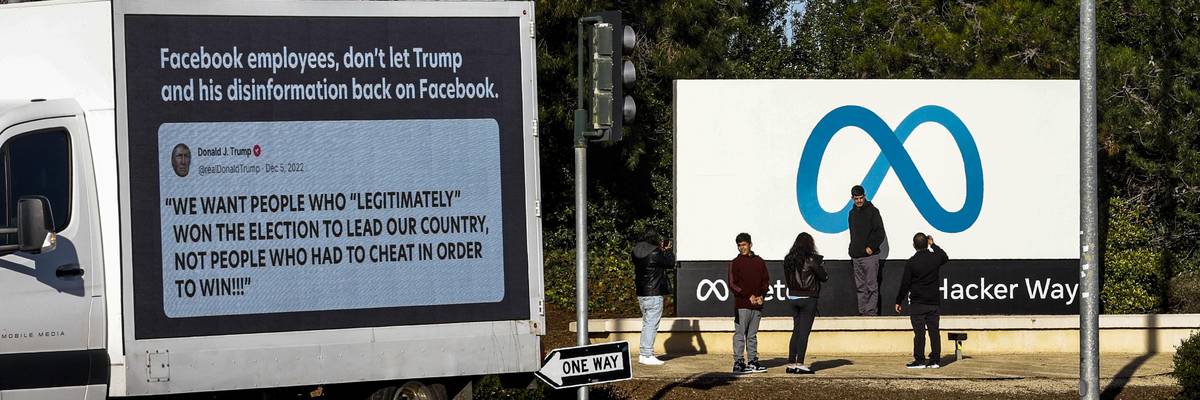
A mobile billboard, deployed by Accountable Tech, is seen outside the Meta Headquarter on January 17, 2023 in Menlo Park, California. Accountable Tech, an advocacy nonprofit, deployed the mobile billboards while Meta considered reinstating Donald Trump's Facebook page after a two-year suspension since the Capital insurrection. The social media giant announced on January 25, 2023 that Trump would be reinstated.
Trumpism online exploited what was already there: the profit-over-people business model of our digital spaces.
Start my morning with me in May 2020: I've just fed my dog. I'm brushing my teeth. I'm mentally making my to-do list and trying to decide if I should stay in sweatpants for the third day in a row. And suddenly none of my plans matter, because Trump just posted an insinuation that Black Lives Matter activists should be shot. Facebook declines to remove the post while Mark Zuckerberg fixes his fingers to defend his decision. And my day is toast.
Now that Meta has decided to let Trump back on Facebook and Instagram, I can't help but have flashbacks to recent years, when bracing myself for whatever fresh hell I would have to experience on the internet became a part of my morning routine.
As a campaigner working on issues related to disinformation and hate speech online, it was a daily struggle to contain harassment, patch up digital security gaps, and accurately distinguish between legitimate political discourse and incitement or even personal threats that could easily derail my life.
Fast forward to 2023. I was quietly enjoying the past two years of a Trump-free social media feed, until Elon Musk nearly burns down Twitter and then unbans Trump via poll results, while Facebook unleashes that man back into my feeds as well.
There's no doubt about it. Trumpism has made the U.S. an even more dangerous place, and Trump should absolutely not be allowed back on Facebook because he is a threat to not only democracy, but also public safety.
Trump is merely one part of a bigger issue. Trumpism online exploited what was already there: the profit-over-people business model of our digital spaces. As long as hate and disinformation can be monetized, social media companies will give platforms to Trump, mini-Trumps, disinformation bots, and other aspiring fascists.
It's not like the remedies are mysteries. In 2021, Kairos ran a campaign called The Facebook Logout, where we organized thousands of Facebook and Instagram users to temporarily log out of their accounts in a show of user power. The campaign's demands were simple: real data privacy, transparency, better content moderation, and an end to the free flow of hate speech and disinformation on the platforms. This campaign sparked a conversation about what users wanted Meta to do to make the platform safe for them. Our demands are still relevant today.
As is the activism: Accountable Tech and Media Matters has relaunched a campaign, bringing together other groups, communities, and individuals to put pressure on Meta to keep Trump off Facebook. And the return of Trump to Facebook is on Congress’s radar as well.
There has to be a world where social media companies spend less energy trying to keep a good public image and more time fixing the harms happening on their platform. This is the vision that campaigners, organizers, and users continue to work towards.
From 2016 until now, I've seen an increase in the number of people talking about the offline consequences of allowing bad actors to be online without moderation. And though it's important to continue that conversation, we cannot assume that if social media executives de-platformed bad actors the world would be a better place.
I remember Pizzagate, Covid-19 "miracle cures," "Stop the Steal," and that attempted coup, but I don't blame Trump alone. We can't simply point to one or some bad guys as the root of all our problems. The internet adds fuel to the fires individuals set—and the platforms profit by handing out matches. So, yes, let's extinguish what we can, but let's also dream and plan what our online spaces could look like if user safety and agency were acknowledged and respected. What would life be like if we users were involved in governing the online spaces that we live in?
My morning routines would probably go more like: feeding my dog, brushing my teeth, and opening my phone without fear. My accounts would already be opted out of targeted advertising by default. My feed would be full of people I choose to follow. My community's online organizing efforts wouldn't be subject to harassment. And by the time my aunt calls me to ask "did you see what's happening on the Facebook?" whatever outright lie she saw will have been removed.
I have moments of uncertainty but I always come back to what I am fighting for: a world where tech works for all. I still believe it is possible if we work towards it together.
Dear Common Dreams reader, It’s been nearly 30 years since I co-founded Common Dreams with my late wife, Lina Newhouser. We had the radical notion that journalism should serve the public good, not corporate profits. It was clear to us from the outset what it would take to build such a project. No paid advertisements. No corporate sponsors. No millionaire publisher telling us what to think or do. Many people said we wouldn't last a year, but we proved those doubters wrong. Together with a tremendous team of journalists and dedicated staff, we built an independent media outlet free from the constraints of profits and corporate control. Our mission has always been simple: To inform. To inspire. To ignite change for the common good. Building Common Dreams was not easy. Our survival was never guaranteed. When you take on the most powerful forces—Wall Street greed, fossil fuel industry destruction, Big Tech lobbyists, and uber-rich oligarchs who have spent billions upon billions rigging the economy and democracy in their favor—the only bulwark you have is supporters who believe in your work. But here’s the urgent message from me today. It's never been this bad out there. And it's never been this hard to keep us going. At the very moment Common Dreams is most needed, the threats we face are intensifying. We need your support now more than ever. We don't accept corporate advertising and never will. We don't have a paywall because we don't think people should be blocked from critical news based on their ability to pay. Everything we do is funded by the donations of readers like you. When everyone does the little they can afford, we are strong. But if that support retreats or dries up, so do we. Will you donate now to make sure Common Dreams not only survives but thrives? —Craig Brown, Co-founder |
Start my morning with me in May 2020: I've just fed my dog. I'm brushing my teeth. I'm mentally making my to-do list and trying to decide if I should stay in sweatpants for the third day in a row. And suddenly none of my plans matter, because Trump just posted an insinuation that Black Lives Matter activists should be shot. Facebook declines to remove the post while Mark Zuckerberg fixes his fingers to defend his decision. And my day is toast.
Now that Meta has decided to let Trump back on Facebook and Instagram, I can't help but have flashbacks to recent years, when bracing myself for whatever fresh hell I would have to experience on the internet became a part of my morning routine.
As a campaigner working on issues related to disinformation and hate speech online, it was a daily struggle to contain harassment, patch up digital security gaps, and accurately distinguish between legitimate political discourse and incitement or even personal threats that could easily derail my life.
Fast forward to 2023. I was quietly enjoying the past two years of a Trump-free social media feed, until Elon Musk nearly burns down Twitter and then unbans Trump via poll results, while Facebook unleashes that man back into my feeds as well.
There's no doubt about it. Trumpism has made the U.S. an even more dangerous place, and Trump should absolutely not be allowed back on Facebook because he is a threat to not only democracy, but also public safety.
Trump is merely one part of a bigger issue. Trumpism online exploited what was already there: the profit-over-people business model of our digital spaces. As long as hate and disinformation can be monetized, social media companies will give platforms to Trump, mini-Trumps, disinformation bots, and other aspiring fascists.
It's not like the remedies are mysteries. In 2021, Kairos ran a campaign called The Facebook Logout, where we organized thousands of Facebook and Instagram users to temporarily log out of their accounts in a show of user power. The campaign's demands were simple: real data privacy, transparency, better content moderation, and an end to the free flow of hate speech and disinformation on the platforms. This campaign sparked a conversation about what users wanted Meta to do to make the platform safe for them. Our demands are still relevant today.
As is the activism: Accountable Tech and Media Matters has relaunched a campaign, bringing together other groups, communities, and individuals to put pressure on Meta to keep Trump off Facebook. And the return of Trump to Facebook is on Congress’s radar as well.
There has to be a world where social media companies spend less energy trying to keep a good public image and more time fixing the harms happening on their platform. This is the vision that campaigners, organizers, and users continue to work towards.
From 2016 until now, I've seen an increase in the number of people talking about the offline consequences of allowing bad actors to be online without moderation. And though it's important to continue that conversation, we cannot assume that if social media executives de-platformed bad actors the world would be a better place.
I remember Pizzagate, Covid-19 "miracle cures," "Stop the Steal," and that attempted coup, but I don't blame Trump alone. We can't simply point to one or some bad guys as the root of all our problems. The internet adds fuel to the fires individuals set—and the platforms profit by handing out matches. So, yes, let's extinguish what we can, but let's also dream and plan what our online spaces could look like if user safety and agency were acknowledged and respected. What would life be like if we users were involved in governing the online spaces that we live in?
My morning routines would probably go more like: feeding my dog, brushing my teeth, and opening my phone without fear. My accounts would already be opted out of targeted advertising by default. My feed would be full of people I choose to follow. My community's online organizing efforts wouldn't be subject to harassment. And by the time my aunt calls me to ask "did you see what's happening on the Facebook?" whatever outright lie she saw will have been removed.
I have moments of uncertainty but I always come back to what I am fighting for: a world where tech works for all. I still believe it is possible if we work towards it together.
Start my morning with me in May 2020: I've just fed my dog. I'm brushing my teeth. I'm mentally making my to-do list and trying to decide if I should stay in sweatpants for the third day in a row. And suddenly none of my plans matter, because Trump just posted an insinuation that Black Lives Matter activists should be shot. Facebook declines to remove the post while Mark Zuckerberg fixes his fingers to defend his decision. And my day is toast.
Now that Meta has decided to let Trump back on Facebook and Instagram, I can't help but have flashbacks to recent years, when bracing myself for whatever fresh hell I would have to experience on the internet became a part of my morning routine.
As a campaigner working on issues related to disinformation and hate speech online, it was a daily struggle to contain harassment, patch up digital security gaps, and accurately distinguish between legitimate political discourse and incitement or even personal threats that could easily derail my life.
Fast forward to 2023. I was quietly enjoying the past two years of a Trump-free social media feed, until Elon Musk nearly burns down Twitter and then unbans Trump via poll results, while Facebook unleashes that man back into my feeds as well.
There's no doubt about it. Trumpism has made the U.S. an even more dangerous place, and Trump should absolutely not be allowed back on Facebook because he is a threat to not only democracy, but also public safety.
Trump is merely one part of a bigger issue. Trumpism online exploited what was already there: the profit-over-people business model of our digital spaces. As long as hate and disinformation can be monetized, social media companies will give platforms to Trump, mini-Trumps, disinformation bots, and other aspiring fascists.
It's not like the remedies are mysteries. In 2021, Kairos ran a campaign called The Facebook Logout, where we organized thousands of Facebook and Instagram users to temporarily log out of their accounts in a show of user power. The campaign's demands were simple: real data privacy, transparency, better content moderation, and an end to the free flow of hate speech and disinformation on the platforms. This campaign sparked a conversation about what users wanted Meta to do to make the platform safe for them. Our demands are still relevant today.
As is the activism: Accountable Tech and Media Matters has relaunched a campaign, bringing together other groups, communities, and individuals to put pressure on Meta to keep Trump off Facebook. And the return of Trump to Facebook is on Congress’s radar as well.
There has to be a world where social media companies spend less energy trying to keep a good public image and more time fixing the harms happening on their platform. This is the vision that campaigners, organizers, and users continue to work towards.
From 2016 until now, I've seen an increase in the number of people talking about the offline consequences of allowing bad actors to be online without moderation. And though it's important to continue that conversation, we cannot assume that if social media executives de-platformed bad actors the world would be a better place.
I remember Pizzagate, Covid-19 "miracle cures," "Stop the Steal," and that attempted coup, but I don't blame Trump alone. We can't simply point to one or some bad guys as the root of all our problems. The internet adds fuel to the fires individuals set—and the platforms profit by handing out matches. So, yes, let's extinguish what we can, but let's also dream and plan what our online spaces could look like if user safety and agency were acknowledged and respected. What would life be like if we users were involved in governing the online spaces that we live in?
My morning routines would probably go more like: feeding my dog, brushing my teeth, and opening my phone without fear. My accounts would already be opted out of targeted advertising by default. My feed would be full of people I choose to follow. My community's online organizing efforts wouldn't be subject to harassment. And by the time my aunt calls me to ask "did you see what's happening on the Facebook?" whatever outright lie she saw will have been removed.
I have moments of uncertainty but I always come back to what I am fighting for: a world where tech works for all. I still believe it is possible if we work towards it together.