SUBSCRIBE TO OUR FREE NEWSLETTER
Daily news & progressive opinion—funded by the people, not the corporations—delivered straight to your inbox.
5
#000000
#FFFFFF
To donate by check, phone, or other method, see our More Ways to Give page.
Daily news & progressive opinion—funded by the people, not the corporations—delivered straight to your inbox.
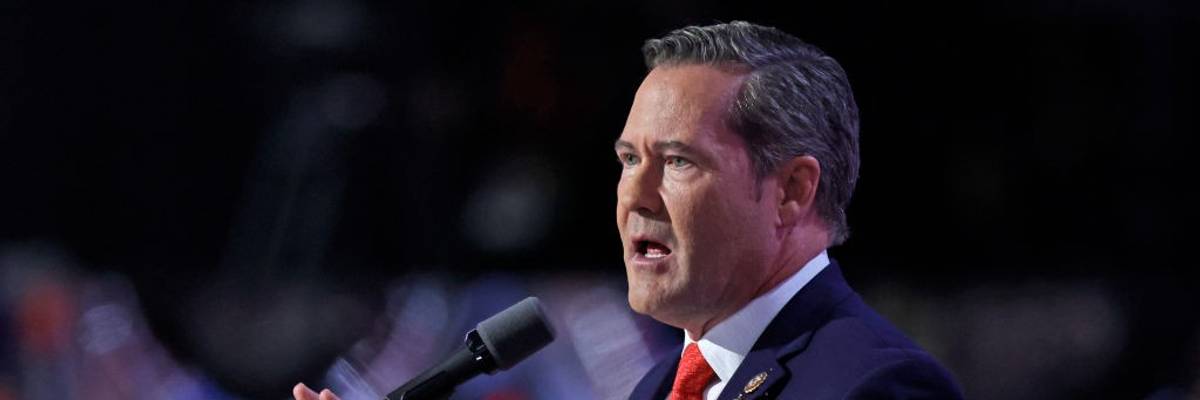
U.S. Representative from Florida Michael Waltz speaks during the third day of the 2024 Republican National Convention at the Fiserv Forum in Milwaukee, Wisconsin, on July 17, 2024.
None of these appointments bode well for advocates of U.S. foreign policy restraint, let alone for those who voted for Trump hoping he would prioritize domestic problems over endless foreign wars.
On the campaign trail, President-elect Donald Trump promised a very different foreign policy from business as usual in Washington.
He said he would prioritize peace over “victory” in the escalating war in Ukraine, pull the United States back from foreign entanglements to focus on domestic problems, and generally oversee a period of prolonged peace, instead of the cycle of endless Great Power conflict we seem trapped in.
Yet if personnel is policy, as the saying goes, then Trump’s presidency will be far more in line with his Democratic predecessor’s foreign policy than with the vision he laid out over the past year. So far, his National Security Council picks have been a series of hawks with a history of opposing diplomacy and the end of U.S. wars, as well as favoring a more aggressive posture toward China, including intervening in a possible war over Taiwan.
At best, Trump’s picks will seek to simply replace one dangerous, nuclear-tinged Great Power conflict with another.
Take Trump’s pick for national security adviser, Rep. Michael Waltz (R-Fla.). Since his selection, Waltz certainly talks in line with the more restraint-oriented vision Trump campaigned on, fretting about the Biden administration’s recent escalation in Ukraine and calling for a “responsible end” to the war there.
But until relatively recently, the Florida congressman viewed the war in very similar terms to those of his hawkish colleagues on the other side of the aisle, reacting to the Russian invasion by warning it “violates the very fabric of international norms” and threatens “our Western values,” lamenting that President Joe Biden had not been more confrontational with Russia beforehand, and calling for the United States to “support Ukrainian resistance efforts” and turn the country “into a bloody quagmire” for Russia.
Over the months that followed, Waltz backed escalating the war (“Send the damn MiGs,” he tweeted in March 2022), complained that U.S. policy on the war was a “fiddle fart” that provided just enough arms “instead of going for the kill, instead of going for the win right now,” and charged that Biden was “letting fear of escalation be the primary driver of our policy in Ukraine.”
Waltz has shifted since, but largely because he sees a U.S.-China confrontation as a bigger priority. Waltz views China as “the most threatening adversary America has ever faced,” believes that Washington is already locked in a “Cold War” with Beijing and must “curb” its power, step up military aid to Taiwan, and end the policy of “strategic ambiguity” over the island nation, which has been at the core of decades of successful U.S. policy balancing deterrence without tipping into disastrous war.
He has also disparaged diplomacy with the Chinese government, and thinks U.S. forces should have stayed in Afghanistan to hang on to Bagram Airfield for possible use as a “second front” in a future U.S.-China war.
The rest of Trump’s national security team holds similar views. Sebastian Gorka, nominated for deputy assistant to the president, sees the Ukraine war in literally indistinguishable terms from hawks in the outgoing Biden administration: It is “unprovoked Russian aggression” that is not about NATO expansion but rather enlarging Russian territory; negotiations, peace, or an off-ramp are as futile as Neville Chamberlain’s deal with Hitler was; and the United States must continue military aid “to make the Russians bleed,” or Russian President Vladimir Putin will “take Poland and the Baltic states.”
Gorka is also a hawk on China, which he calls “the greatest threat to America.”
“We know the regime there wishes to have every nation in the world a defeated, vanquished nation, or a satrapy, a tributary nation,” Gorka said this past October, while giving a fawning interview to Gordon Chang, a discredited “China expert” who has repeatedly predicted the imminent collapse of the Chinese state.
In his 2018 book, Gorka called China’s undoubted goal of becoming a world power, and partly doing so through economic investment in the Global South, a form of “irregular warfare” (even as he admits it is little different from the actions “of the West a couple of centuries ago”). He has repeatedly suggested that China was about to invade Taiwan, including after its wayward spy balloon; gave former House Speaker Kevin McCarthy “kudos” for taking the inflammatory step of traveling to the island; and implied that U.S. lives should be expended to defend it.
Alex Wong, Trump’s pick for deputy national security adviser, agrees. Wong believes that Americans “have to be prepared for a level of tension, regional destabilization, and—yes—possible conflict [with China] that we have not seen since the end of World War II.” Wong noted he deliberately used that destructive, hot conflict as a reference point and not the Cold War.
A former foreign policy adviser for the super-hawkish Sen. Tom Cotton (R-Ark.) and the merely hawkish 2012 Mitt Romney presidential campaign, Wong served most recently as vice chair of a congressional commission that recommended training Taiwanese troops on U.S. soil—a highly provocative move to China’s leadership.
Because China is, unlike the former Soviet Union, highly integrated into the “system of the free world,” Wong has said, the U.S.-China conflict requires not just “out-competing them but extruding”—meaning, pushing out—“China from certain systems, whether economically, technologically, politically.” What that means for Wong is not just continuing the Biden administration’s economic warfare with the country, but also “an increased U.S. military presence” in the Indo-Pacific and to “seriously look at new investments in strategic nuclear forces, intermediate-range missiles, our naval fleet, and certain capabilities tuned to turning back an invasion of Taiwan,” as well as “expand[ing] the aperture of our military alliances” in the region, specifically with Japan and under AUKUS.
Wong does seem to favor extricating the United States from Ukraine, but, like Waltz, it’s because he views “Ukraine as an unfortunate diversion of U.S. attention from the Indo-Pacific” and wants to “responsibly shift U.S. military resources eastward”—in a way that, to take his words literally, will ramp up conflict with China and see the U.S. go directly to war in the case of a Chinese invasion of Taiwan.
None of these appointments bode well for advocates of U.S. foreign policy restraint, let alone for those who voted for Trump hoping he would prioritize domestic problems over endless foreign wars. At best, Trump’s picks will seek to simply replace one dangerous, nuclear-tinged Great Power conflict with another. At worst, they will not do the former, and embroil the United States into two of the latter.
Dear Common Dreams reader, It’s been nearly 30 years since I co-founded Common Dreams with my late wife, Lina Newhouser. We had the radical notion that journalism should serve the public good, not corporate profits. It was clear to us from the outset what it would take to build such a project. No paid advertisements. No corporate sponsors. No millionaire publisher telling us what to think or do. Many people said we wouldn't last a year, but we proved those doubters wrong. Together with a tremendous team of journalists and dedicated staff, we built an independent media outlet free from the constraints of profits and corporate control. Our mission has always been simple: To inform. To inspire. To ignite change for the common good. Building Common Dreams was not easy. Our survival was never guaranteed. When you take on the most powerful forces—Wall Street greed, fossil fuel industry destruction, Big Tech lobbyists, and uber-rich oligarchs who have spent billions upon billions rigging the economy and democracy in their favor—the only bulwark you have is supporters who believe in your work. But here’s the urgent message from me today. It's never been this bad out there. And it's never been this hard to keep us going. At the very moment Common Dreams is most needed, the threats we face are intensifying. We need your support now more than ever. We don't accept corporate advertising and never will. We don't have a paywall because we don't think people should be blocked from critical news based on their ability to pay. Everything we do is funded by the donations of readers like you. When everyone does the little they can afford, we are strong. But if that support retreats or dries up, so do we. Will you donate now to make sure Common Dreams not only survives but thrives? —Craig Brown, Co-founder |
On the campaign trail, President-elect Donald Trump promised a very different foreign policy from business as usual in Washington.
He said he would prioritize peace over “victory” in the escalating war in Ukraine, pull the United States back from foreign entanglements to focus on domestic problems, and generally oversee a period of prolonged peace, instead of the cycle of endless Great Power conflict we seem trapped in.
Yet if personnel is policy, as the saying goes, then Trump’s presidency will be far more in line with his Democratic predecessor’s foreign policy than with the vision he laid out over the past year. So far, his National Security Council picks have been a series of hawks with a history of opposing diplomacy and the end of U.S. wars, as well as favoring a more aggressive posture toward China, including intervening in a possible war over Taiwan.
At best, Trump’s picks will seek to simply replace one dangerous, nuclear-tinged Great Power conflict with another.
Take Trump’s pick for national security adviser, Rep. Michael Waltz (R-Fla.). Since his selection, Waltz certainly talks in line with the more restraint-oriented vision Trump campaigned on, fretting about the Biden administration’s recent escalation in Ukraine and calling for a “responsible end” to the war there.
But until relatively recently, the Florida congressman viewed the war in very similar terms to those of his hawkish colleagues on the other side of the aisle, reacting to the Russian invasion by warning it “violates the very fabric of international norms” and threatens “our Western values,” lamenting that President Joe Biden had not been more confrontational with Russia beforehand, and calling for the United States to “support Ukrainian resistance efforts” and turn the country “into a bloody quagmire” for Russia.
Over the months that followed, Waltz backed escalating the war (“Send the damn MiGs,” he tweeted in March 2022), complained that U.S. policy on the war was a “fiddle fart” that provided just enough arms “instead of going for the kill, instead of going for the win right now,” and charged that Biden was “letting fear of escalation be the primary driver of our policy in Ukraine.”
Waltz has shifted since, but largely because he sees a U.S.-China confrontation as a bigger priority. Waltz views China as “the most threatening adversary America has ever faced,” believes that Washington is already locked in a “Cold War” with Beijing and must “curb” its power, step up military aid to Taiwan, and end the policy of “strategic ambiguity” over the island nation, which has been at the core of decades of successful U.S. policy balancing deterrence without tipping into disastrous war.
He has also disparaged diplomacy with the Chinese government, and thinks U.S. forces should have stayed in Afghanistan to hang on to Bagram Airfield for possible use as a “second front” in a future U.S.-China war.
The rest of Trump’s national security team holds similar views. Sebastian Gorka, nominated for deputy assistant to the president, sees the Ukraine war in literally indistinguishable terms from hawks in the outgoing Biden administration: It is “unprovoked Russian aggression” that is not about NATO expansion but rather enlarging Russian territory; negotiations, peace, or an off-ramp are as futile as Neville Chamberlain’s deal with Hitler was; and the United States must continue military aid “to make the Russians bleed,” or Russian President Vladimir Putin will “take Poland and the Baltic states.”
Gorka is also a hawk on China, which he calls “the greatest threat to America.”
“We know the regime there wishes to have every nation in the world a defeated, vanquished nation, or a satrapy, a tributary nation,” Gorka said this past October, while giving a fawning interview to Gordon Chang, a discredited “China expert” who has repeatedly predicted the imminent collapse of the Chinese state.
In his 2018 book, Gorka called China’s undoubted goal of becoming a world power, and partly doing so through economic investment in the Global South, a form of “irregular warfare” (even as he admits it is little different from the actions “of the West a couple of centuries ago”). He has repeatedly suggested that China was about to invade Taiwan, including after its wayward spy balloon; gave former House Speaker Kevin McCarthy “kudos” for taking the inflammatory step of traveling to the island; and implied that U.S. lives should be expended to defend it.
Alex Wong, Trump’s pick for deputy national security adviser, agrees. Wong believes that Americans “have to be prepared for a level of tension, regional destabilization, and—yes—possible conflict [with China] that we have not seen since the end of World War II.” Wong noted he deliberately used that destructive, hot conflict as a reference point and not the Cold War.
A former foreign policy adviser for the super-hawkish Sen. Tom Cotton (R-Ark.) and the merely hawkish 2012 Mitt Romney presidential campaign, Wong served most recently as vice chair of a congressional commission that recommended training Taiwanese troops on U.S. soil—a highly provocative move to China’s leadership.
Because China is, unlike the former Soviet Union, highly integrated into the “system of the free world,” Wong has said, the U.S.-China conflict requires not just “out-competing them but extruding”—meaning, pushing out—“China from certain systems, whether economically, technologically, politically.” What that means for Wong is not just continuing the Biden administration’s economic warfare with the country, but also “an increased U.S. military presence” in the Indo-Pacific and to “seriously look at new investments in strategic nuclear forces, intermediate-range missiles, our naval fleet, and certain capabilities tuned to turning back an invasion of Taiwan,” as well as “expand[ing] the aperture of our military alliances” in the region, specifically with Japan and under AUKUS.
Wong does seem to favor extricating the United States from Ukraine, but, like Waltz, it’s because he views “Ukraine as an unfortunate diversion of U.S. attention from the Indo-Pacific” and wants to “responsibly shift U.S. military resources eastward”—in a way that, to take his words literally, will ramp up conflict with China and see the U.S. go directly to war in the case of a Chinese invasion of Taiwan.
None of these appointments bode well for advocates of U.S. foreign policy restraint, let alone for those who voted for Trump hoping he would prioritize domestic problems over endless foreign wars. At best, Trump’s picks will seek to simply replace one dangerous, nuclear-tinged Great Power conflict with another. At worst, they will not do the former, and embroil the United States into two of the latter.
On the campaign trail, President-elect Donald Trump promised a very different foreign policy from business as usual in Washington.
He said he would prioritize peace over “victory” in the escalating war in Ukraine, pull the United States back from foreign entanglements to focus on domestic problems, and generally oversee a period of prolonged peace, instead of the cycle of endless Great Power conflict we seem trapped in.
Yet if personnel is policy, as the saying goes, then Trump’s presidency will be far more in line with his Democratic predecessor’s foreign policy than with the vision he laid out over the past year. So far, his National Security Council picks have been a series of hawks with a history of opposing diplomacy and the end of U.S. wars, as well as favoring a more aggressive posture toward China, including intervening in a possible war over Taiwan.
At best, Trump’s picks will seek to simply replace one dangerous, nuclear-tinged Great Power conflict with another.
Take Trump’s pick for national security adviser, Rep. Michael Waltz (R-Fla.). Since his selection, Waltz certainly talks in line with the more restraint-oriented vision Trump campaigned on, fretting about the Biden administration’s recent escalation in Ukraine and calling for a “responsible end” to the war there.
But until relatively recently, the Florida congressman viewed the war in very similar terms to those of his hawkish colleagues on the other side of the aisle, reacting to the Russian invasion by warning it “violates the very fabric of international norms” and threatens “our Western values,” lamenting that President Joe Biden had not been more confrontational with Russia beforehand, and calling for the United States to “support Ukrainian resistance efforts” and turn the country “into a bloody quagmire” for Russia.
Over the months that followed, Waltz backed escalating the war (“Send the damn MiGs,” he tweeted in March 2022), complained that U.S. policy on the war was a “fiddle fart” that provided just enough arms “instead of going for the kill, instead of going for the win right now,” and charged that Biden was “letting fear of escalation be the primary driver of our policy in Ukraine.”
Waltz has shifted since, but largely because he sees a U.S.-China confrontation as a bigger priority. Waltz views China as “the most threatening adversary America has ever faced,” believes that Washington is already locked in a “Cold War” with Beijing and must “curb” its power, step up military aid to Taiwan, and end the policy of “strategic ambiguity” over the island nation, which has been at the core of decades of successful U.S. policy balancing deterrence without tipping into disastrous war.
He has also disparaged diplomacy with the Chinese government, and thinks U.S. forces should have stayed in Afghanistan to hang on to Bagram Airfield for possible use as a “second front” in a future U.S.-China war.
The rest of Trump’s national security team holds similar views. Sebastian Gorka, nominated for deputy assistant to the president, sees the Ukraine war in literally indistinguishable terms from hawks in the outgoing Biden administration: It is “unprovoked Russian aggression” that is not about NATO expansion but rather enlarging Russian territory; negotiations, peace, or an off-ramp are as futile as Neville Chamberlain’s deal with Hitler was; and the United States must continue military aid “to make the Russians bleed,” or Russian President Vladimir Putin will “take Poland and the Baltic states.”
Gorka is also a hawk on China, which he calls “the greatest threat to America.”
“We know the regime there wishes to have every nation in the world a defeated, vanquished nation, or a satrapy, a tributary nation,” Gorka said this past October, while giving a fawning interview to Gordon Chang, a discredited “China expert” who has repeatedly predicted the imminent collapse of the Chinese state.
In his 2018 book, Gorka called China’s undoubted goal of becoming a world power, and partly doing so through economic investment in the Global South, a form of “irregular warfare” (even as he admits it is little different from the actions “of the West a couple of centuries ago”). He has repeatedly suggested that China was about to invade Taiwan, including after its wayward spy balloon; gave former House Speaker Kevin McCarthy “kudos” for taking the inflammatory step of traveling to the island; and implied that U.S. lives should be expended to defend it.
Alex Wong, Trump’s pick for deputy national security adviser, agrees. Wong believes that Americans “have to be prepared for a level of tension, regional destabilization, and—yes—possible conflict [with China] that we have not seen since the end of World War II.” Wong noted he deliberately used that destructive, hot conflict as a reference point and not the Cold War.
A former foreign policy adviser for the super-hawkish Sen. Tom Cotton (R-Ark.) and the merely hawkish 2012 Mitt Romney presidential campaign, Wong served most recently as vice chair of a congressional commission that recommended training Taiwanese troops on U.S. soil—a highly provocative move to China’s leadership.
Because China is, unlike the former Soviet Union, highly integrated into the “system of the free world,” Wong has said, the U.S.-China conflict requires not just “out-competing them but extruding”—meaning, pushing out—“China from certain systems, whether economically, technologically, politically.” What that means for Wong is not just continuing the Biden administration’s economic warfare with the country, but also “an increased U.S. military presence” in the Indo-Pacific and to “seriously look at new investments in strategic nuclear forces, intermediate-range missiles, our naval fleet, and certain capabilities tuned to turning back an invasion of Taiwan,” as well as “expand[ing] the aperture of our military alliances” in the region, specifically with Japan and under AUKUS.
Wong does seem to favor extricating the United States from Ukraine, but, like Waltz, it’s because he views “Ukraine as an unfortunate diversion of U.S. attention from the Indo-Pacific” and wants to “responsibly shift U.S. military resources eastward”—in a way that, to take his words literally, will ramp up conflict with China and see the U.S. go directly to war in the case of a Chinese invasion of Taiwan.
None of these appointments bode well for advocates of U.S. foreign policy restraint, let alone for those who voted for Trump hoping he would prioritize domestic problems over endless foreign wars. At best, Trump’s picks will seek to simply replace one dangerous, nuclear-tinged Great Power conflict with another. At worst, they will not do the former, and embroil the United States into two of the latter.