

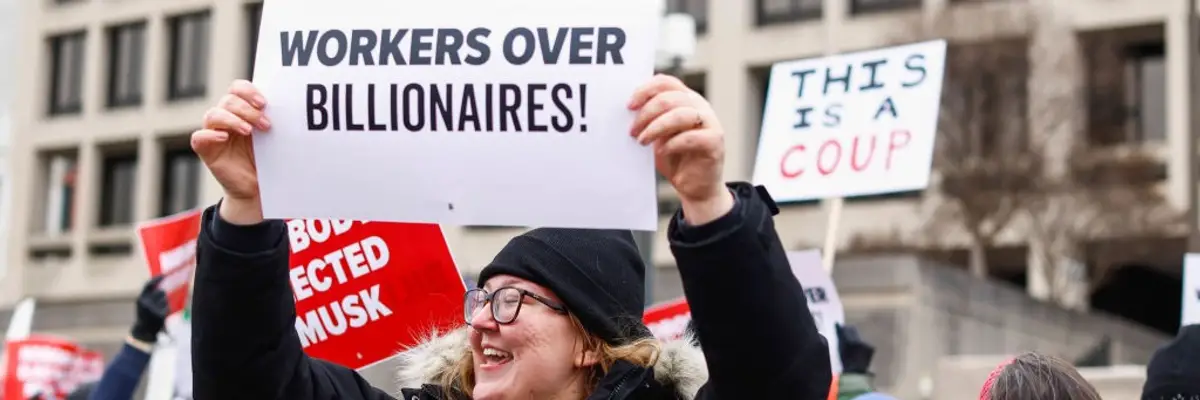
Protesters rally against the Department of Government Efficiency (DOGE) outside the U.S. Department of Labor (DOL) on February 05, 2025 in Washington, DC. Workers and supporters protested ahead of a scheduled meeting between members of Elon Musk's DOGE staff and DOL management.
Trump’s Labor Department Tries to Redefine Workers Out of Their Rights
A proposed rule would make it easier to classify employees as contractors—and harder to claim minimum wage and overtime protections.
Last week, Trump’s Labor Department proposed a rule aimed at making it easier for businesses to call workers “independent contractors” instead of employees under the Fair Labor Standards Act. It’s the latest round in a regulatory back-and-forth. The legal details get dense fast. But the real-world implications are straightforward: millions of workers are at risk of losing foundational minimum wage and overtime protections, exacerbating their financial precarity.
The Fair Labor Standards Act (FLSA) provides employees with minimum wage and overtime protections. When Congress passed the FLSA, it sought to cover the broadest concept of employees possible, including those who were performing piece rate garment work out of their kitchens - something that today might look like gig work.
Since the 1940s, courts across the country and in vastly different employment contexts have consistently held that someone is an employee if they are economically dependent on the employer for work. Despite this broad protection in the law, too many employers today misclassify workers as independent contractors—including dishwashers at restaurants, auto mechanic technicians, and even nurses—in order to sidestep legal obligations and lower labor costs. These misclassified workers don’t just lose out on minimum wage and overtime protections. They are often misclassified under other employment laws too, leaving them saddled with higher payroll tax burdens, all while not having the protections of Unemployment Insurance if they are let go, Workers’ Compensation if they are injured on the job, or other typical benefits associated with employment.
Trump’s latest proposed rule would give employers cover to misclassify more workers as independent contractors. Specifically, it tosses aside a decades-long test that the Wage and Hour Division uses when determining a worker’s economic dependence, and instead advances a slimmed down version of the test that will enable businesses to more easily skirt their responsibilities under the FLSA. The Department believes that the long-standing test as articulated in the Biden 2024 Final Rule leads to “unnecessary classification of….workers as employees” and makes the independent contractor classification “more difficult.”
In short, the Department thinks the current test is too complicated, and employers are erring too often on the side of classifying workers as employees. The Department further claims that a slimmed-down test of classification would be a better fit for the modern economy. But at a time when businesses’ relationships with workers is getting more complicated, the test for determining classification shouldn’t be narrowed; it should remain probative. At a moment when we need a high-powered microscope to understand the complex layers of business models and management practices, the Department of Labor is seemingly saying a simple magnifying glass will do just fine. This approach will only exacerbate trends already underway in industries and occupations that have traditionally provided stable, middle-class jobs. Take, for example, nursing.
You might assume that someone working as a nurse in a hospital or nursing home is surely an employee of those entities. Not so anymore. Already, hospitals are relying on staffing agencies to fill nursing positions, and these agencies, in some cases, are misclassifying nurses as independent contractors. Research from the Roosevelt Institute has also highlighted how new app-based companies are using Uber-like platforms to hire, place, and manage nurses, all while claiming they are independent contractors. On these platforms, workers must compete for shifts and bid on pay, sometimes not knowing until the morning of whether they got a shift. These gig platforms have created a race to the bottom in wages and job quality, leaving some nurses without their own health insurance and relying on second jobs to make ends meet. Under Trump’s proposed rule, it will be far harder for workers under these models of management to realize their rights under the Fair Labor Standards Act. And it will only encourage other businesses to follow suit.
To be sure, there are many legitimate independent contractors who are in business for themselves. These small businesses are important parts of our economy. But a dishwasher in the back of a restaurant isn’t in business for herself. An auto technician who shows up to the same shop day in and day out likely isn’t in business for himself. And surely a nurse caring for patients in a hospital isn’t in business for themselves.
The Trump Administration pulled out a sledgehammer on a cornerstone of the New Deal. Trump’s DOL and others who are proponents of making it easier to classify workers as independent contractors often claim this provides workers with greater flexibility in their life. But flexibility doesn’t mean better outcomes. Weakening the FLSA doesn’t result in a better life for more workers.
In fact, recent research on job quality experienced by workers shows stark differences in outcomes between independent contractors and employees across some key metrics. Independent contractors, for example, are more likely to report receiving less than 24 hours notice of when they need to work. At the same time, they are no more likely than W-2 employees to say they have input on when they can take a few hours off for personal reasons. Yet, independent contractors remain more likely to report wanting to work more hours and receive more money.
Last week’s proposed rule sadly isn’t a surprise but it is a stark reminder of how little this Administration cares about using the tools of government to enforce laws and advance policies that enable workers to secure a better life.
We are at a crossroads
This country and this world are at a monumental crossroads. In a few short weeks, US voters will have an opportunity to beat back the forces of fascism and confront the billionaires who are rigging the economy, our media system, and our democracy, making it increasingly impossible for ordinary people to get by. We’re not just talking about the election. We’re talking about what must be done once these fascist elements are vanquished from power. We need a bolder set of solutions than what either major party has so far been willing to offer and a working-class movement ready to fight like hell for it. Trump didn't emerge from nowhere. The conditions that fueled MAGA authoritarianism were created by decades of radical neoliberal economic policies and a corrupt political system dominated by corporate interests. They slashed taxes on the super-rich, promising that the benefits would trickle down. They said giveaways to the corporate titans would make life more affordable for the rest of us. It was all bullshit. And when a bitter, betrayed populace searches for someone to blame, right-wing demagogues have little trouble finding scapegoats. People know when they're being lied to, but you won't hear any of this from the corporate media. Only independent journalism—powered and funded by people who believe in building a better world—can deliver truly trustworthy daily news. Our Fall Campaign is underway, and we need your help. To power our newsroom through the rest of the year, we need to raise $125,000 by midnight on October 31. So if you share our vision, please contribute whatever you can to sustain our work. |
Last week, Trump’s Labor Department proposed a rule aimed at making it easier for businesses to call workers “independent contractors” instead of employees under the Fair Labor Standards Act. It’s the latest round in a regulatory back-and-forth. The legal details get dense fast. But the real-world implications are straightforward: millions of workers are at risk of losing foundational minimum wage and overtime protections, exacerbating their financial precarity.
The Fair Labor Standards Act (FLSA) provides employees with minimum wage and overtime protections. When Congress passed the FLSA, it sought to cover the broadest concept of employees possible, including those who were performing piece rate garment work out of their kitchens - something that today might look like gig work.
Since the 1940s, courts across the country and in vastly different employment contexts have consistently held that someone is an employee if they are economically dependent on the employer for work. Despite this broad protection in the law, too many employers today misclassify workers as independent contractors—including dishwashers at restaurants, auto mechanic technicians, and even nurses—in order to sidestep legal obligations and lower labor costs. These misclassified workers don’t just lose out on minimum wage and overtime protections. They are often misclassified under other employment laws too, leaving them saddled with higher payroll tax burdens, all while not having the protections of Unemployment Insurance if they are let go, Workers’ Compensation if they are injured on the job, or other typical benefits associated with employment.
Trump’s latest proposed rule would give employers cover to misclassify more workers as independent contractors. Specifically, it tosses aside a decades-long test that the Wage and Hour Division uses when determining a worker’s economic dependence, and instead advances a slimmed down version of the test that will enable businesses to more easily skirt their responsibilities under the FLSA. The Department believes that the long-standing test as articulated in the Biden 2024 Final Rule leads to “unnecessary classification of….workers as employees” and makes the independent contractor classification “more difficult.”
In short, the Department thinks the current test is too complicated, and employers are erring too often on the side of classifying workers as employees. The Department further claims that a slimmed-down test of classification would be a better fit for the modern economy. But at a time when businesses’ relationships with workers is getting more complicated, the test for determining classification shouldn’t be narrowed; it should remain probative. At a moment when we need a high-powered microscope to understand the complex layers of business models and management practices, the Department of Labor is seemingly saying a simple magnifying glass will do just fine. This approach will only exacerbate trends already underway in industries and occupations that have traditionally provided stable, middle-class jobs. Take, for example, nursing.
You might assume that someone working as a nurse in a hospital or nursing home is surely an employee of those entities. Not so anymore. Already, hospitals are relying on staffing agencies to fill nursing positions, and these agencies, in some cases, are misclassifying nurses as independent contractors. Research from the Roosevelt Institute has also highlighted how new app-based companies are using Uber-like platforms to hire, place, and manage nurses, all while claiming they are independent contractors. On these platforms, workers must compete for shifts and bid on pay, sometimes not knowing until the morning of whether they got a shift. These gig platforms have created a race to the bottom in wages and job quality, leaving some nurses without their own health insurance and relying on second jobs to make ends meet. Under Trump’s proposed rule, it will be far harder for workers under these models of management to realize their rights under the Fair Labor Standards Act. And it will only encourage other businesses to follow suit.
To be sure, there are many legitimate independent contractors who are in business for themselves. These small businesses are important parts of our economy. But a dishwasher in the back of a restaurant isn’t in business for herself. An auto technician who shows up to the same shop day in and day out likely isn’t in business for himself. And surely a nurse caring for patients in a hospital isn’t in business for themselves.
The Trump Administration pulled out a sledgehammer on a cornerstone of the New Deal. Trump’s DOL and others who are proponents of making it easier to classify workers as independent contractors often claim this provides workers with greater flexibility in their life. But flexibility doesn’t mean better outcomes. Weakening the FLSA doesn’t result in a better life for more workers.
In fact, recent research on job quality experienced by workers shows stark differences in outcomes between independent contractors and employees across some key metrics. Independent contractors, for example, are more likely to report receiving less than 24 hours notice of when they need to work. At the same time, they are no more likely than W-2 employees to say they have input on when they can take a few hours off for personal reasons. Yet, independent contractors remain more likely to report wanting to work more hours and receive more money.
Last week’s proposed rule sadly isn’t a surprise but it is a stark reminder of how little this Administration cares about using the tools of government to enforce laws and advance policies that enable workers to secure a better life.
Last week, Trump’s Labor Department proposed a rule aimed at making it easier for businesses to call workers “independent contractors” instead of employees under the Fair Labor Standards Act. It’s the latest round in a regulatory back-and-forth. The legal details get dense fast. But the real-world implications are straightforward: millions of workers are at risk of losing foundational minimum wage and overtime protections, exacerbating their financial precarity.
The Fair Labor Standards Act (FLSA) provides employees with minimum wage and overtime protections. When Congress passed the FLSA, it sought to cover the broadest concept of employees possible, including those who were performing piece rate garment work out of their kitchens - something that today might look like gig work.
Since the 1940s, courts across the country and in vastly different employment contexts have consistently held that someone is an employee if they are economically dependent on the employer for work. Despite this broad protection in the law, too many employers today misclassify workers as independent contractors—including dishwashers at restaurants, auto mechanic technicians, and even nurses—in order to sidestep legal obligations and lower labor costs. These misclassified workers don’t just lose out on minimum wage and overtime protections. They are often misclassified under other employment laws too, leaving them saddled with higher payroll tax burdens, all while not having the protections of Unemployment Insurance if they are let go, Workers’ Compensation if they are injured on the job, or other typical benefits associated with employment.
Trump’s latest proposed rule would give employers cover to misclassify more workers as independent contractors. Specifically, it tosses aside a decades-long test that the Wage and Hour Division uses when determining a worker’s economic dependence, and instead advances a slimmed down version of the test that will enable businesses to more easily skirt their responsibilities under the FLSA. The Department believes that the long-standing test as articulated in the Biden 2024 Final Rule leads to “unnecessary classification of….workers as employees” and makes the independent contractor classification “more difficult.”
In short, the Department thinks the current test is too complicated, and employers are erring too often on the side of classifying workers as employees. The Department further claims that a slimmed-down test of classification would be a better fit for the modern economy. But at a time when businesses’ relationships with workers is getting more complicated, the test for determining classification shouldn’t be narrowed; it should remain probative. At a moment when we need a high-powered microscope to understand the complex layers of business models and management practices, the Department of Labor is seemingly saying a simple magnifying glass will do just fine. This approach will only exacerbate trends already underway in industries and occupations that have traditionally provided stable, middle-class jobs. Take, for example, nursing.
You might assume that someone working as a nurse in a hospital or nursing home is surely an employee of those entities. Not so anymore. Already, hospitals are relying on staffing agencies to fill nursing positions, and these agencies, in some cases, are misclassifying nurses as independent contractors. Research from the Roosevelt Institute has also highlighted how new app-based companies are using Uber-like platforms to hire, place, and manage nurses, all while claiming they are independent contractors. On these platforms, workers must compete for shifts and bid on pay, sometimes not knowing until the morning of whether they got a shift. These gig platforms have created a race to the bottom in wages and job quality, leaving some nurses without their own health insurance and relying on second jobs to make ends meet. Under Trump’s proposed rule, it will be far harder for workers under these models of management to realize their rights under the Fair Labor Standards Act. And it will only encourage other businesses to follow suit.
To be sure, there are many legitimate independent contractors who are in business for themselves. These small businesses are important parts of our economy. But a dishwasher in the back of a restaurant isn’t in business for herself. An auto technician who shows up to the same shop day in and day out likely isn’t in business for himself. And surely a nurse caring for patients in a hospital isn’t in business for themselves.
The Trump Administration pulled out a sledgehammer on a cornerstone of the New Deal. Trump’s DOL and others who are proponents of making it easier to classify workers as independent contractors often claim this provides workers with greater flexibility in their life. But flexibility doesn’t mean better outcomes. Weakening the FLSA doesn’t result in a better life for more workers.
In fact, recent research on job quality experienced by workers shows stark differences in outcomes between independent contractors and employees across some key metrics. Independent contractors, for example, are more likely to report receiving less than 24 hours notice of when they need to work. At the same time, they are no more likely than W-2 employees to say they have input on when they can take a few hours off for personal reasons. Yet, independent contractors remain more likely to report wanting to work more hours and receive more money.
Last week’s proposed rule sadly isn’t a surprise but it is a stark reminder of how little this Administration cares about using the tools of government to enforce laws and advance policies that enable workers to secure a better life.