SUBSCRIBE TO OUR FREE NEWSLETTER
Daily news & progressive opinion—funded by the people, not the corporations—delivered straight to your inbox.
5
#000000
#FFFFFF
To donate by check, phone, or other method, see our More Ways to Give page.
Daily news & progressive opinion—funded by the people, not the corporations—delivered straight to your inbox.
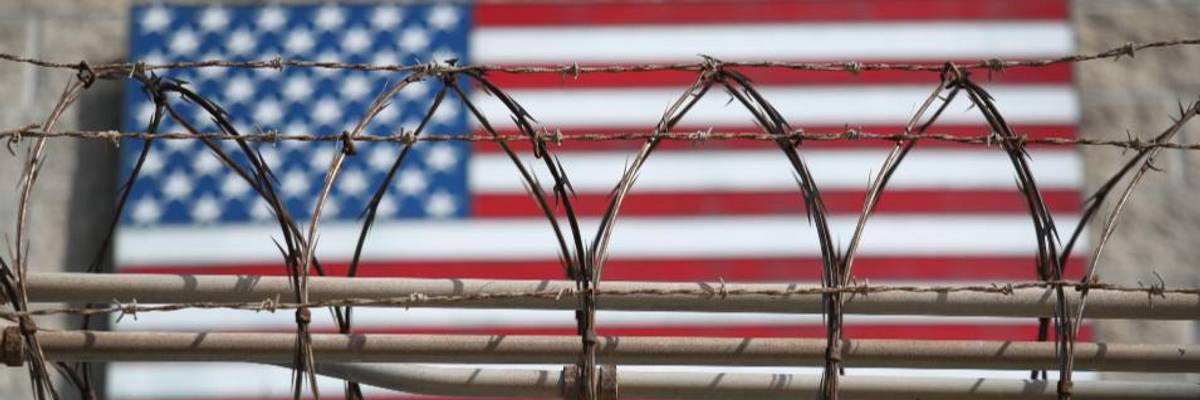
Razor wire lines the fence of the 'Gitmo' maximum security detention center on October 22, 2016 at the U.S. Naval Station at Guantánamo Bay, Cuba.
Trump’s intention to expand the Gitmo prison is symbolic as well as practical: It revitalizes the Bush-era war on terror; it brings the war home.
Gitmo, of course!! It’s the freest place “we” have—by which I mean the American government, aka President Donald Trump. No rules apply there, be they international humanitarian law or the U.S. Constitution. It’s a dumping ground, a black hole.
It’s the most secure place for America to hold, as Trump put it a few weeks ago, “the worst criminal illegal aliens threatening the American people. Some of them are so bad we don’t even trust their countries to hold them because we don’t want them coming back.”
His plan is to expand the infamous Guantánamo Bay Detention Center, part of the U.S. naval base in Cuba, which George W, Bush began using as he waged his horrific “war on terror” in the Middle East. He began imprisoning alleged terrorists, often arbitrarily arrested, in a hellhole where they had zero rights. Some are still there, several decades later. Trump’s plan is to expand the detention center to hold 30,000 people, which would be, oh, more than double the size of two unforgettable Nazi concentration camps combined: Dachau and Treblinka.
What’s different about the Trump plan, according to PolifiFact, quoted at Al Jazeera, is that the U.S. has never sent people who were detained in the United States to Guantánamo.
And these migrants would be stuck there entirely under the control of an American government that has declared them to be the country’s biggest enemy of the moment: the biggest threat to our national safety. No rights for them!
If you want to be a great national leader, this is step one: Create an enemy. Stir fear and hatred, then demonstrate that only you can protect us, by doing what’s necessary: dehumanize, dehumanize, dehumanize. That is to say, keep things simple: us vs. them. This is what the masses understand, apparently.
Oh God, I don’t believe this at all, but the reality of it seems unshakable—with Trump in the White House, more so than ever. There was a time when I believed we were moving beyond the militaristic simplism of Superpower America, with political hope bubbling all the way up to former U.S. President Barack Obama’s election in 2008. Yeah, the Bush era’s dead! But then... wars continued, not much changed. Obama had promised to close the Gitmo prison in his first year. That didn’t happen—and that’s when I started to realize that the progressive movement in this country had no real political traction.
What we have instead is ongoing outrage, fueled by truth and introspection. Trump wants to “make America great again” and keeps ironically raging about the migrant invasion. The days of American greatness for which he’s reaching go well past the civil rights (the “political correctness”) era, past the women’s rights era, past the Great Depression. America’s greatness began with the European invasion of what came to be called the Americas—several hundred years of obliterating native cultures and dehumanizing them as “savages.” Our “greatness” preceded the American Revolution and continued well after it.
Trump’s intention to expand the Gitmo prison is symbolic as well as practical: It revitalizes the Bush-era war on terror; it brings the war home. Today’s terrorist equivalents are the migrant invaders. If you’re interested in reclaiming the actual history of that period, I recommend the book Witnesses of the Unseen: Seven Years in Guantánamo, written by two Algerian men randomly arrested in Bosnia in 2001: Lakhdar Boumediene and Mustafa Ait Idir. They were falsely accused of being terrorists and spent seven years imprisoned for no reason at Gitmo—pulled away from their wives, their children... witnessing, and enduring, horrendous treatment, trapped in the American black hole with zero rights. The book contains fragments of our national history: what we can do in the wake of creating and dehumanizing an enemy.
Some years ago, I wrote about the book, about the hell they endured: “stuffed into cages, interrogated endlessly and pointlessly, humiliated, force-fed (in Lakhdar’s case)... and finally, finally, ordered by a U.S. judge to be freed, when their case was at long last heard in a real court and the lack of evidence against them became appallingly clear.” This happened thanks to the unending aid they received from a U.S. law firm that spent more than 35,000 pro bono hours litigating the case.
“The book is the story of the courage it takes to survive.”
As well as alleged terrorists, Gitmo has also long been used to detain immigrants intercepted at sea. At Gitmo, they lacked “access to basic human necessities, appropriate medical care, education, and potable water,” according to the International Refugee Assistance Project. And they had no option to seek asylum in the U.S.
What’s different about the Trump plan, according to PolifiFact, quoted at Al Jazeera, is that the U.S. has never sent people who were detained in the United States to Guantánamo. Those arrested here actually had certain rights and protections—which could essentially disappear at Gitmo. Somehow that seems like the point of it all: Americans first. Americans only!
Progressive sanity will re-emerge politically, or so I believe, but how this will happen is anything but clear. The Republican right has certain serious political advantages, even if their basic agenda has only minority support. The prime advantage is billionaire dollars backing their cause. And, of course, creating an “us vs. them” governing mentality has a lot more immediate impact than addressing the world—even one’s enemies—with empathy, understanding, and a sense of connection.
Another difficulty the progressive movement faces is the Democrats, who have drifted ever more centrist-right since the Reagan era, refusing to challenge the Republican agenda head-on and gently cradling the nation’s expanding militarism.
It almost seems like we need to start over: Rosa Parks must refuse to give up her seat on the bus again. What might this mean? If nothing else, the truth about American history must continue to flow and efforts to ban it from libraries and classrooms, to burn it in book fires, must be endlessly challenged. And truth still speaks to us from the mountaintop:
“So even though we face the difficulties of today and tomorrow, I still have a dream. It is a dream deeply rooted in the American dream. I have a dream that one day this nation will rise up and live out the true meaning of its creed: We hold these truths to be self-evident, that all men are created equal.”
This country and this world are at a monumental crossroads. US voters have an opportunity to beat back the forces of fascism and confront the billionaires who are rigging the economy, our media system, and our democracy, making it increasingly impossible for ordinary people to get by. We’re not just talking about the election. We’re talking about what must be done once these fascist elements are vanquished from power. We need a bolder set of solutions than what either major party has so far been willing to offer and a working-class movement ready to fight like hell for it. Trump didn't emerge from nowhere. The conditions that fueled MAGA authoritarianism were created by decades of radical neoliberal economic policies and a corrupt political system dominated by corporate interests. They slashed taxes on the super-rich, promising that the benefits would trickle down. They said giveaways to the corporate titans would make life more affordable for the rest of us. It was all bullshit. And when a bitter, betrayed populace searches for someone to blame, right-wing demagogues have little trouble finding scapegoats. People know when they're being lied to, but you won't hear any of this from the corporate media. Only independent journalism—powered and funded by people who believe in building a better world—can deliver truly trustworthy daily news. If you share our vision, please contribute whatever you can to sustain our work. |
Gitmo, of course!! It’s the freest place “we” have—by which I mean the American government, aka President Donald Trump. No rules apply there, be they international humanitarian law or the U.S. Constitution. It’s a dumping ground, a black hole.
It’s the most secure place for America to hold, as Trump put it a few weeks ago, “the worst criminal illegal aliens threatening the American people. Some of them are so bad we don’t even trust their countries to hold them because we don’t want them coming back.”
His plan is to expand the infamous Guantánamo Bay Detention Center, part of the U.S. naval base in Cuba, which George W, Bush began using as he waged his horrific “war on terror” in the Middle East. He began imprisoning alleged terrorists, often arbitrarily arrested, in a hellhole where they had zero rights. Some are still there, several decades later. Trump’s plan is to expand the detention center to hold 30,000 people, which would be, oh, more than double the size of two unforgettable Nazi concentration camps combined: Dachau and Treblinka.
What’s different about the Trump plan, according to PolifiFact, quoted at Al Jazeera, is that the U.S. has never sent people who were detained in the United States to Guantánamo.
And these migrants would be stuck there entirely under the control of an American government that has declared them to be the country’s biggest enemy of the moment: the biggest threat to our national safety. No rights for them!
If you want to be a great national leader, this is step one: Create an enemy. Stir fear and hatred, then demonstrate that only you can protect us, by doing what’s necessary: dehumanize, dehumanize, dehumanize. That is to say, keep things simple: us vs. them. This is what the masses understand, apparently.
Oh God, I don’t believe this at all, but the reality of it seems unshakable—with Trump in the White House, more so than ever. There was a time when I believed we were moving beyond the militaristic simplism of Superpower America, with political hope bubbling all the way up to former U.S. President Barack Obama’s election in 2008. Yeah, the Bush era’s dead! But then... wars continued, not much changed. Obama had promised to close the Gitmo prison in his first year. That didn’t happen—and that’s when I started to realize that the progressive movement in this country had no real political traction.
What we have instead is ongoing outrage, fueled by truth and introspection. Trump wants to “make America great again” and keeps ironically raging about the migrant invasion. The days of American greatness for which he’s reaching go well past the civil rights (the “political correctness”) era, past the women’s rights era, past the Great Depression. America’s greatness began with the European invasion of what came to be called the Americas—several hundred years of obliterating native cultures and dehumanizing them as “savages.” Our “greatness” preceded the American Revolution and continued well after it.
Trump’s intention to expand the Gitmo prison is symbolic as well as practical: It revitalizes the Bush-era war on terror; it brings the war home. Today’s terrorist equivalents are the migrant invaders. If you’re interested in reclaiming the actual history of that period, I recommend the book Witnesses of the Unseen: Seven Years in Guantánamo, written by two Algerian men randomly arrested in Bosnia in 2001: Lakhdar Boumediene and Mustafa Ait Idir. They were falsely accused of being terrorists and spent seven years imprisoned for no reason at Gitmo—pulled away from their wives, their children... witnessing, and enduring, horrendous treatment, trapped in the American black hole with zero rights. The book contains fragments of our national history: what we can do in the wake of creating and dehumanizing an enemy.
Some years ago, I wrote about the book, about the hell they endured: “stuffed into cages, interrogated endlessly and pointlessly, humiliated, force-fed (in Lakhdar’s case)... and finally, finally, ordered by a U.S. judge to be freed, when their case was at long last heard in a real court and the lack of evidence against them became appallingly clear.” This happened thanks to the unending aid they received from a U.S. law firm that spent more than 35,000 pro bono hours litigating the case.
“The book is the story of the courage it takes to survive.”
As well as alleged terrorists, Gitmo has also long been used to detain immigrants intercepted at sea. At Gitmo, they lacked “access to basic human necessities, appropriate medical care, education, and potable water,” according to the International Refugee Assistance Project. And they had no option to seek asylum in the U.S.
What’s different about the Trump plan, according to PolifiFact, quoted at Al Jazeera, is that the U.S. has never sent people who were detained in the United States to Guantánamo. Those arrested here actually had certain rights and protections—which could essentially disappear at Gitmo. Somehow that seems like the point of it all: Americans first. Americans only!
Progressive sanity will re-emerge politically, or so I believe, but how this will happen is anything but clear. The Republican right has certain serious political advantages, even if their basic agenda has only minority support. The prime advantage is billionaire dollars backing their cause. And, of course, creating an “us vs. them” governing mentality has a lot more immediate impact than addressing the world—even one’s enemies—with empathy, understanding, and a sense of connection.
Another difficulty the progressive movement faces is the Democrats, who have drifted ever more centrist-right since the Reagan era, refusing to challenge the Republican agenda head-on and gently cradling the nation’s expanding militarism.
It almost seems like we need to start over: Rosa Parks must refuse to give up her seat on the bus again. What might this mean? If nothing else, the truth about American history must continue to flow and efforts to ban it from libraries and classrooms, to burn it in book fires, must be endlessly challenged. And truth still speaks to us from the mountaintop:
“So even though we face the difficulties of today and tomorrow, I still have a dream. It is a dream deeply rooted in the American dream. I have a dream that one day this nation will rise up and live out the true meaning of its creed: We hold these truths to be self-evident, that all men are created equal.”