

SUBSCRIBE TO OUR FREE NEWSLETTER
Daily news & progressive opinion—funded by the people, not the corporations—delivered straight to your inbox.
5
#000000
#FFFFFF
To donate by check, phone, or other method, see our More Ways to Give page.
Daily news & progressive opinion—funded by the people, not the corporations—delivered straight to your inbox.
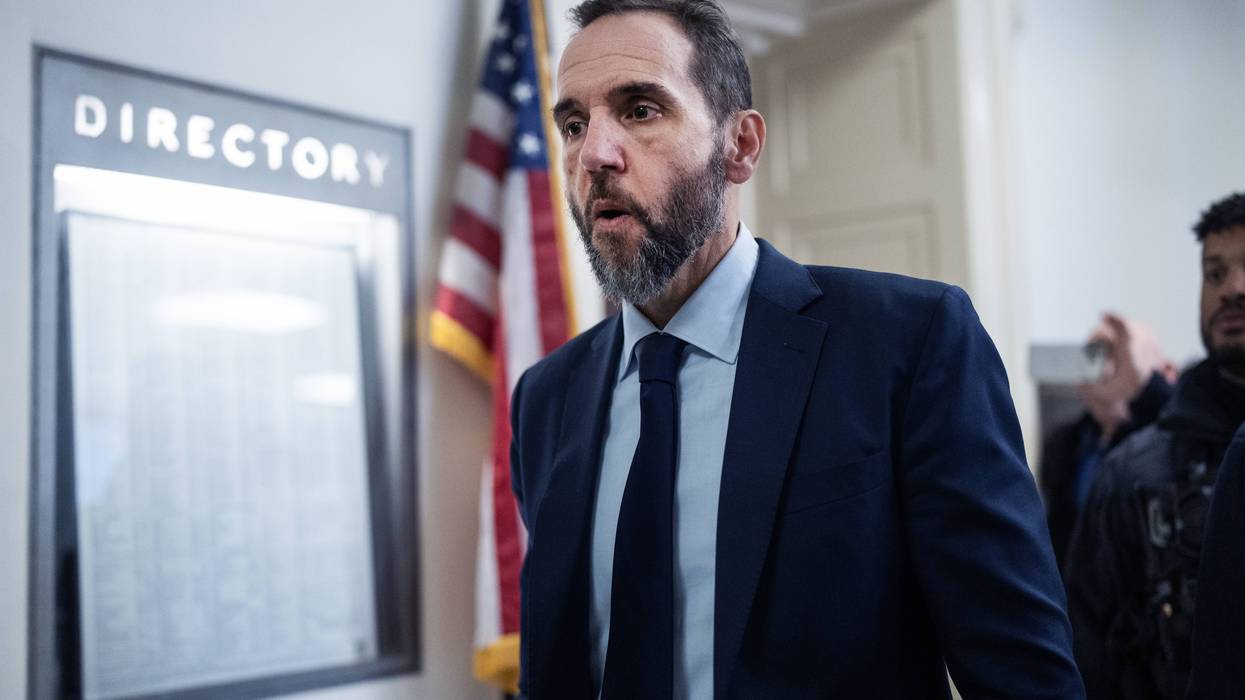
"Does he want the Smith report to be locked up with the Epstein files?"
As his administration continues dragging its feet in releasing the Epstein files, President Donald Trump is pushing to keep another potentially damning set of Justice Department documents hidden from the public.
On Tuesday, Trump filed a 19-page motion requesting that the US District Court of the Southern District of Florida step in to prohibit the DOJ’s planned release of Volume II of the final report prepared by former Special Counsel Jack Smith next month. The volume relates to the president’s handling of classified documents after leaving office in 2021.
Trump was indicted by a grand jury for 37 felony counts following Smith's investigation, 31 of which involved violations of the Espionage Act, after transporting "scores of boxes" full of classified materials, including top-level military and intelligence secrets, to his home at Mar-a-Lago and showing them off to people without security clearances.
But Smith ultimately dropped the case in November 2024 after it became clear that Trump's reelection would shield him from legal liability.
It's strange for the President of the United States to be litigating in his personal capacity against the Justice Department he runs — but he's seeking an order barring "current, former and future" DOJ officials from releasing Jack Smith's second volume. storage.courtlistener.com/recap/gov.us...
[image or embed]
— Kyle Cheney (@kyledcheney.bsky.social) January 20, 2026 at 6:38 PM
On January 7, 2025, just days before Trump reassumed office, the DOJ released Volume I of Smith's report, which pertained to Trump's attempts to overturn his loss in the 2020 election by spreading false claims of widespread voter fraud, which culminated in the attack on the US Capitol building by a mob of his supporters on January 6, 2021.
Though Trump's indictment in that case was also dropped following his reelection, the report was released under DOJ rules requiring public disclosure of all investigative reports after cases conclude.
That report described Trump as having undertaken an “unprecedented criminal effort to overturn the legitimate results of the election in order to retain power,” a scheme in which he knowingly spread information casting doubt on the election result even after his own staff confirmed it to be false and he acknowledged his loss in private.
Unlike the election case, the classified documents case was dismissed in July 2024 by the Trump-appointed federal judge Aileen Cannon of the same district court, who ruled that Smith's appointment as special counsel was unlawful.
Cannon also issued an injunction blocking the release of the report to Congress, but only until February 24, 2026, so as not to prejudice the legal proceedings against Trump's co-defendants, former aide Walt Nauta and Mar-a-Lago employee Carlos De Oliveira, who were accused of helping him illegally stash documents and hide them from investigators.
Citing her previous ruling, Trump is now asking Cannon to permanently block the report, claiming that, because of her ruling against Smith, "all acts undertaken" by him, including the creation and release of the report, are "void."
Not only does he seek to prohibit the "current" DOJ from releasing it, but also "former and future" DOJ officials from ever releasing it, as it would result in the "public dissemination of sensitive grand jury materials, attorney-client privileged information, and other informationderived from protected discovery materials, raising significant statutory, due process, and privacy concerns for President Trump and his former co-defendants."
Trump's request to permanently spike the report immediately drew comparisons to the Epstein files, which remain almost entirely unreleased by the DOJ nearly a month after the deadline mandated by law, which was signed by Trump himself after being passed in November.
For over a year, efforts to halt the release of Smith's report have fueled concerns of a cover-up and raised questions about whether Cannon has any authority to issue rulings at all, since the case has been dismissed.
In a piece for MS NOW (then MSNBC) last year, after the first report was released, legal analyst Glenn Kirschner warned that if the second one were buried in perpetuity, it could allow Trump to escape legal consequences after his term is up.
"If there is no disclosure of Volume II to members of Congress, what might a Trump-led DOJ do to the evidence?" he asked. "Might it be destroyed in an attempt to make sure Trump is never held to account for the classified documents crimes? Recall that the documents case was dismissed without prejudice, which means the case could theoretically be refiled once Trump leaves office."
His colleague, former US Attorney Joyce Vance, noted the peculiarity of Cannon's assertion of authority in a case that had already been dismissed.
"The strangest thing about this entire proceeding is that Judge Cannon continues to issue orders when there is no case pending in front of her," she said. "That’s not how a court’s jurisdiction is supposed to work.”
After appearing at a closed-door deposition last month as part of an inquiry launched by Republicans, Smith is scheduled to testify publicly before the House Judiciary Committee on Thursday at 10 am ET.
Smith's lawyer, Lanny Breuer, told the Associated Press earlier this month that "Jack has been clear for months he is ready and willing to answer questions in a public hearing about his investigations into President Trump's alleged unlawful efforts to overturn the 2020 election and his mishandling of classified documents."
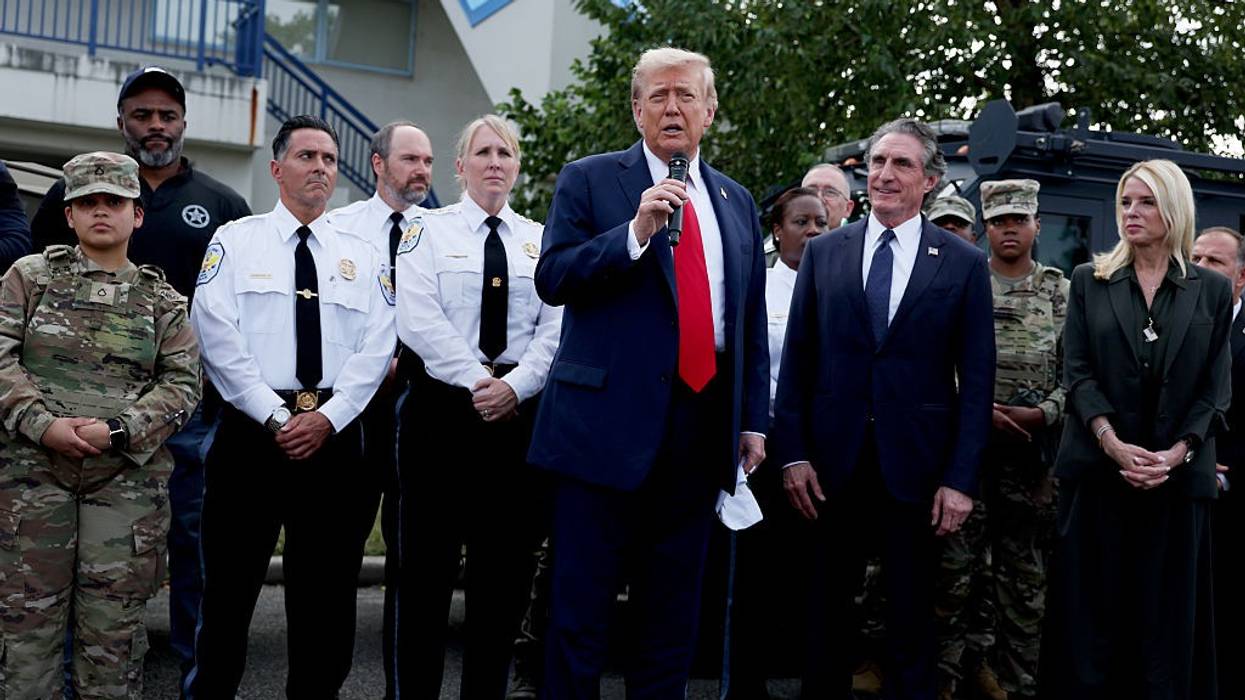
Why then is the press mesmerized by the declining street crime in DC, luridly inflated by the serial prevaricator, Trump, without so much as a mention of serial White House and K Street crimes?
US President Donald Trump, always looking to distract attention from his many crimes, has deployed National Guard troops and federal law enforcement officials in Washington, DC. After his usual wild exaggerations about “…violent gangs and bloodthirsty criminals, roving mobs of wild youths, drugged-out maniacs and homeless people,” he moves to impose what is becoming his police state over an overwhelmingly Democratic city
As Trump’s troops fan out across more of the city, they are told to be aggressive, take credit for arrests made by the local DC police force, and arbitrarily interrogate DC residents, for example, people waiting at bus stops, minding their own business.
Trump, during his first and current terms, rarely stepped out of his limousine to see what DC is like (See James Fallows’ article “What It Actually ‘Feels Like’ in DC” August 13, 2025). He finally visited with a cluster of his police and troops yesterday, passing out “cheeseburgers prepared by the White House chef’s staff and around 100 pizzas from Wiseguy Pizza,” and quickly declared Washington a safer city after less than two weeks of his forces patrolling largely tourist and downtown business areas.
The reaction from DC residents is mostly negative. Business is already slowing for DC restaurants and will only get worse as Trump brings in more National Guard troops from Republican states, paid for by the taxpayers.
Why is the word “crime” never associated with the far greater “crime in the suites” but only with crime in the streets?
Homicides in DC are at a 30-year low. They are far lower than in many cities in the red states headed by white mayors. Trump seems to go after cities that happen to have Black mayors, further illustrating his racist bigotry, along with downplaying slavery and reinstalling Confederate statues and returning Confederate names to military bases.
To be sure, there ARE two grave and deadly ongoing crime waves in DC. One is clearly the violence surging from Trump’s White House, with big weapons and big tax dollars to fund and shield mega-terrorist Israeli Prime Minister Benjamin Netanyahu’s slaughtering genocide of civilians in Gaza, and increasingly the West Bank.
Trump has continued the “co-belligerency” that former President Joe Biden established with the Israeli regime. Every day, far more babies, children, mothers, and fathers have been killed from this brutal Trump-Netanyahu axis than are killed in a year in DC.
The deliberate cutoff of lifesaving medical, food, and water assistance to millions of the impoverished in less developed countries occurred when Trump illegally closed the US Agency for International Development (USAID). Humanitarian relief groups already count the preventable deaths in the many thousands. Cutting off food and vaccines will have devastating long-term consequences.
Domestically, convicted felon Trump openly violates many criminal statutes and constitutional provisions (See the April 30, 2025, letter to President Trump citing 22 Impeachable Offenses). For example, he daily violates the Anti-Deficiency Act by spending large sums of money NOT appropriated by Congress. He violates the Hatch Act, which prohibits the use of federal property for electoral campaign purposes. (See the June 28, 2023, letter to Attorney General Merrick Garland by me and Bruce Fein.) He glories in obstruction of justice—a felony. His former first-term national security adviser, John Bolton, wrote in his memoir that “obstruction of justice was a way of life at the White House.”
Trump is continuing this offense in his second term with vengeance. He engages in flat-out open extortion in dealing with universities and several large corporate law firms. The list goes on. Recall that Trump said in 2019 that “with Article II, I can do whatever I want as President” and has repeatedly declared that he has never done anything wrong in elective office. It is understandable that scores of psychologists have described him as a dangerous and delusional personality. The worst is yet to come from the egomaniacal Trump.
As for the K Street offices of hundreds of corporate lobbyists, where does one start? They are, along with heaping piles of campaign cash, making sure that neither Congress nor government agencies of the Executive Branch stop the corporate crime wave. The Big Business paymasters spend whatever it takes to ensure that crime in the suites is never aggressively prosecuted.
Read the weekly Corporate Crime Reporter? (Give your library a gift subscription.) For 39 years, it has been reporting documented corporate crimes of violence (toxic pollution, dangerous products, workplace casualties), and economic crimes and thefts from workers, consumers, investors, students, and pensioners.
Imagine the mainstream media reports on more corporate crimes than budget-starved law enforcement can begin to prosecute. Check out “60 Minutes,” the New York Times, Washington Post, AP, Reuters, and even the Wall Street Journal. For enjoyable, factual reading, try the books by Jim Hightower and his regular newsletter, The Hightower Lowdown.
Hundreds of thousands of preventable deaths occur annually from these violations, and the preventable injuries and illnesses are much larger in number.
Why then is the press mesmerized by the declining street crime in DC, luridly inflated by the serial prevaricator, Trump, without so much as a mention of serial White House and K Street crimes? Why is the word “crime” never associated with the far greater “crime in the suites” but only with crime in the streets? To ask is to answer. Power, money, and greed camouflage the corporate criminal deeds from journalists who do not or are not allowed to see them in plain sight.
We have a political economy steeped in self-deception, taking the federal cops off the corporate crime beat and not making the lethal corrosions on peace and justice serious campaign issues in elections. Voters, of course, can end this cowardly silence.
Who will be the first reporter to ask Trump in his many informal gatherings with the press, about these two booming crime scenes representing the Oligarchy and the Plutocracy?
When will the reporters and their editors stop wallowing in a cultural rut where common candor requires uncommon courage?
Remember, it’s all in plain sight to behold and then be told.
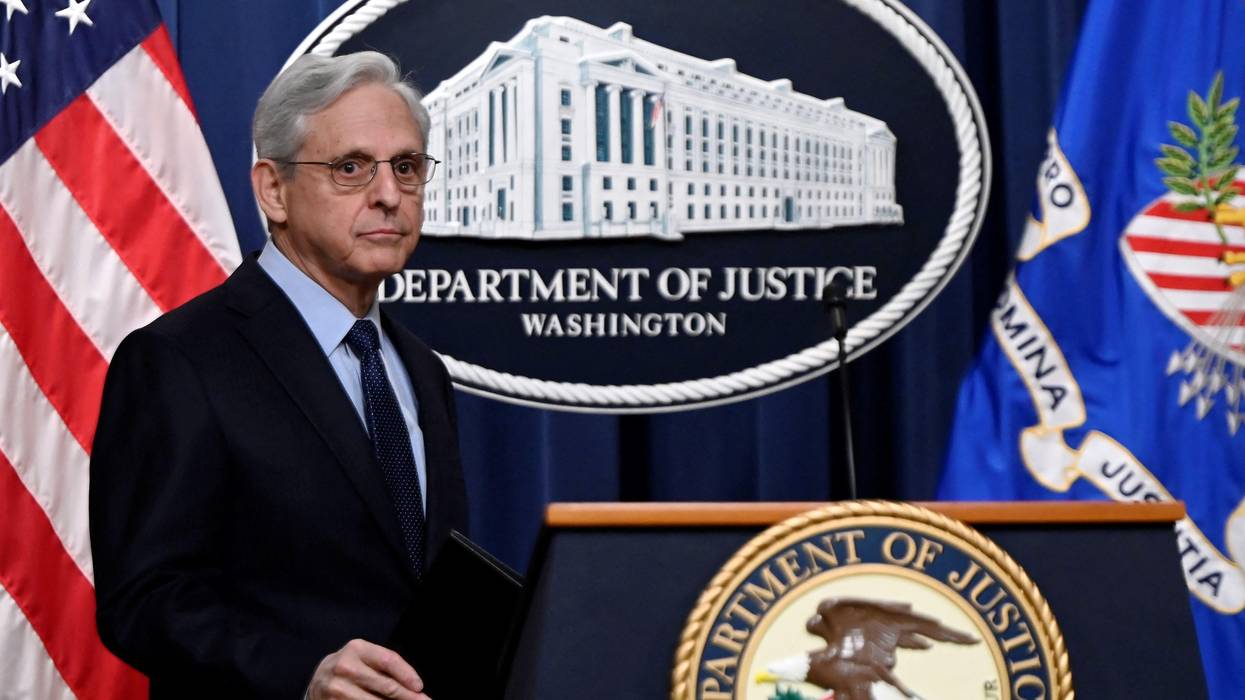
Decades from now, historians will memorialize Garland not as a dedicated public servant but as the head of the Justice Department who brought a butter knife to an existential gunfight with Trump, quickening our collective descent into neo-fascism.
It’s hard to say who is the worst attorney general in American history. The candidates are many and comprise a veritable rogue’s gallery of sadists, reactionaries, and incompetents. They range from A. Mitchell Palmer, mastermind of the original Red Scare that decimated the left in the wake of the First World War, to Jefferson Beauregard Sessions III and William Pelham Barr, who sacrificed the rule of law in service to Donald Trump.
Merrick Garland may not share the malignancies of his fellow train wrecks, but he deserves to be in the discussion. Decades from now, historians will memorialize Garland not as a dedicated public servant and fair-minded federal judge whose nomination to the Supreme Court was torpedoed by Mitch McConnell and Senate Republicans, but as the head of the Justice Department who brought a butter knife to an existential gunfight with Trump, quickening our collective descent into neo-fascism.
After his appointment to helm the DOJ, Garland had one overarching mission: to swiftly convene a grand jury to investigate Trump for his role in inciting the Jan. 6, 2021, insurrection at the Capitol. This was a task a third-year law student could easily have accomplished. Garland failed, abjectly.
Garland will forever bear the principal stain of wimping out when courage and—to put it in the vernacular—balls were needed to stop Trump.
Probable cause for an early indictment was abundant and obvious. On January 6, millions of Americans watched Trump stand on the Ellipse at the south end of the White House and urge his supporters to march on the Capitol and “fight like hell.” Millions watched the actual assault that followed, blow by medieval blow. Even the corrupt McConnell, who voted to acquit Trump in his second impeachment trial in February 2021, declared on the Senate floor, “There’s no question, none, that President Trump is practically and morally responsible for provoking the events of the day [January 6].”
Instead of targeting Trump and his chief lieutenants immediately, Garland set out to arrest and try the foot soldiers of the uprising. And while he did a commendable job in that respect (eventually charging more than 1,500 with federal crimes), he dithered on Trump until November 2022, when he appointed Jack Smith as a special counsel to probe Trump for the insurrection and absconding from the White House with a trove of highly classified documents.
By then, it was too late.
Although Smith secured an indictment of Trump in Washington, D.C., for conspiracy, obstruction, and election subversion on August 1, 2023, the indictment was gutted by the Supreme Court (Trump v. United States) the following July in a decision that granted Trump sweeping and unprecedented immunity from criminal prosecution.
Written by Chief Justice John Roberts, a lifelong conservative activist with an undeserved reputation as a judicial institutionalist, the ruling is arguably the worst edict handed down by the high court since the Dred Scott case of 1857. “Trump v. United States is distinct as a deliberate attack on the core institutions and principles of the republic, preparing the way for a MAGA authoritarian regime much as Dred Scott tried to do for the slavocracy,” wrote Sean Wilenz in a scathing article for The New York Review of Books.
Smith also indicted Trump in Florida in the documents case, but that prosecution was subsequently scuttled by District Court Judge Aileen Mercedes Cannon, an inexperienced MAGA sycophant whom Trump installed on the federal bench in the runup to the 2020 election.
In addition to Garland, the Supreme Court, and Cannon, former President Joe Biden also shares responsibility for letting Trump off the hook. From Day 1, Biden should have used the bully pulpit to attack, isolate, and destroy Trump and his MAGA base. Instead, he pursued a politics of accommodation, preaching a return to the false neoliberal normalcy of bipartisanship. Most critically of all, Biden decided to seek a second term, when it was apparent to everyone with two eyes and ears that he was no longer fit, either physically or mentally, for another stint behind the Resolute Desk. With Biden’s approval rating plunging to 40%, former Vice President Kamala Harris had little to no chance of defeating Trump at the polls.
But standing atop the heap, Garland will forever bear the principal stain of wimping out when courage and—to put it in the vernacular—balls were needed to stop Trump before the forces of reaction had time to regroup and reorganize. They are now in control.

We are seeing in real time how autocracy happens, by creating hopelessness and despair among the mass of people who once might have fought back.
It took only hours after a majority of Americans chose to return Donald Trump as a strongman-style president for the first billionaire supplicant to come forward on bended knee. Amazon founder Jeff Bezos, the third-richest person on the planet, had already made his intentions clear in the waning days of the 2024 campaign when the influential newspaper he owns, The Washington Post, spiked a long-planned endorsement of rival Kamala Harris at his instruction.
In a rare tweet Wednesday, Bezos—beneficiary of massive federal contracts—laid it on thick. “Big congratulations to our 45th and now 47th President on an extraordinary political comeback and decisive victory,” Bezos posted on X, which is owned by the richest person on the planet, Elon Musk. “No nation has bigger opportunities. Wishing @realDonaldTrump all success in leading and uniting the America we all love.”
It almost goes without saying that Bezos said nothing Wednesday about the fact that, as owner of the Post, he is also the keeper of a remarkable legacy of watchdog journalism, which defied the White House in 1971 in publishing the secret Pentagon Papers and then produced the investigative reporting that helped bring down Richard Nixon in Watergate. There was no Bezos pep talk to his journalists that such heroism for democracy would be acted out now. Less than 48 hours after Trump’s election as the 47th president, this kind of silence has been deafening.
From the obsequious Bezos to the end of resistance from everyday folk, we are seeing the once unthinkable: the start of American autocracy.
Although it feels almost normal to flip on CNN and watch talking heads speculate on whom the president-elect is picking for his cabinet, there is nothing normal about the Trump transition, even with a president who’s been elected before. So much has changed since the tumultuous autumn of 2016. This time, America is rolling out a red carpet for a king—one who will, in the ultimate irony, preside over the 250th anniversary of that time when we overthrew a monarchy.
I know that sounds like hyperbole, or what The 51% calls “Trump derangement syndrome.” But the nation already on Wednesday received its first major bit of news—and there are going to be many, many more to come—making it clear that Trump is returning to the White House with stunning absolute powers that none of his 44 predecessors (Grover Cleveland, and now Trump, twice) either possessed or were willing to exercise over the American people.
It came in the form of a revelation from the U.S. Justice Department that special counsel Jack Smith—who aggressively, if too belatedly, brought federal indictments against Trump for the 2020 efforts to overturn the last presidential election that culminated in the January 6, 2021 insurrection, and for Trump taking highly classified documents—is planning steps that would have the likely impact of ending his cases before Trump takes the oath of office.
Multiple news outlets quoted sources within the Justice Department that Smith is now is active talks about how to “wind down” the two cases against Trump—with the one about classified documents already on life support after a zealously pro-Trump, Trump-appointed lower court judge dismissed the charges for now—before he becomes president again on January 20. It’s not yet clear whether Smith is planning to permanently dismiss the charges or—more likely—put them on some type of hold that would nonetheless make justice nearly impossible, since Trump would be 82 if he leaves office as scheduled in 2029, and there would be questions about the statute of limitations.
Such maneuvers would be in line with the controversial and legally debated Justice Department decision from the Nixon era that sitting presidents cannot be prosecuted, which already gave any POTUS a unique standing above the law. But remember that Trump was on track to stand trial in the January 6 case this year, if not for the U.S. Supreme Court’s stunning 6-3 ruling earlier this year giving presidents sweeping legal immunity for broadly defined “official acts.”
When Smith does appear before U.S. District Court Judge Tanya Chutkan to end the case, it will be a triple exclamation point on how a once revolutionary nation turned a president into a king.
Some legal experts are arguing that Smith is playing the horrendous hand that he’s been dealt here, perhaps scrambling to issue an in-depth report about Trump’s alleged wrongdoing before the new president’s MAGA appointees can fire him. I get that, but my nonlawyer gut tells me that Smith should make Trump and his lackeys dismiss the case themselves, as one more reminder that Trump is trashing every last democratic norm we have.
But how 2017-ish of me to even think that. The decision has already been made in all our former watchdog institutions to obey the new authoritarianism in advance. You can hear it in the quiet of an unseasonably warm November breeze.
The dogs of 2016 and 2017 are not barking. There are no people in the streets chanting, “We! Reject! The president-elect!” or carrying “Not My President” signs like eight years ago. Kids aren’t walking out of high school, and college presidents—reflecting the catastrophic erosions of free speech in America that go well beyond Trumpism—are not issuing statements.
New York Times columnist Michelle Goldberg wrote Thursday about the Russian lifestyle of “internal emigration”—turning away from politics to emphasize family or books or gardening or anything else besides the seeming hopelessness of opposing autocracy.
This is exactly what I’m hearing from so many friends and even family here in Greater Philadelphia and on social media. People are leaving Musk’s X in droves, partly to protest the billionaire, but mostly to disengage from politics, at least for now. One boomer woman who threw herself into the so-called Trump Resistance in 2016 wrote me Thursday to say she is done. Protesting Trump, she wrote, “was an utter failure. I’m tired, demoralized, and bitter.”
I don’t blame her, nor would I think of criticizing the many people emphasizing their own mental health over politics at a moment when it’s not even clear what to do next. We are seeing in real time how autocracy happens, by creating hopelessness and despair among the mass of people who once might have fought back. From the obsequious Bezos to the end of resistance from everyday folk, we are seeing the once unthinkable: the start of American autocracy.
I was fortunate Thursday morning to connect with one of the nation’s top experts on authoritarian regimes, the Yale University historian Timothy Snyder, whose words—especially, “do not obey in advance”—from his essential On Tyranny are frequently quoted here. I wanted to ask him the question on so many people’s minds since Tuesday: What has history taught us about how to live now?
Snyder told me the most important thing for the moment is to avoid isolation and be around other people. “They want you to be alone,” the historian said of autocratic governments because isolation feeds the sense of powerlessness that allows the regime to do its dirty work unimpeded. “Nobody is going to fix this alone,” Snyder said. “That’s not how this works.”
Second, he suggested: “This is a good time to figure out what you’re good at. Define some little human-sized zone, whether it’s your library or your garden or your trade union. Take something positive that you know and do it.” He also noted that the political feeling of despair in opposing Trump and his MAGA movement doesn’t mean you can’t work for change on the state and local level, where one can still hash out issues with forward-minded politicians.
Snyder then suggested, with a laugh, what he called “a dumb little idea”—except that it wasn’t.
“Take a moment and write down a letter about the things you care about, that you’re willing to take a stand about. Write that down, put it in an envelope, and take it out of your desk as we’re going through these things”—like when Trump takes office in January, or early in his term.
Those of us who opposed Trump, and who were devastated to learn how many of our fellow citizens want to live under his strongman rule, need time to mourn this week’s news. But it’s well worth listening to Snyder’s words about not just living under tyranny, but someday soon finding reasonable ways to confront it. We are going to need each other, whether it’s in the streets or just at the dog park. And you—we—are not alone.
On a telephone call-in to Fox & Friends, Trump said Vice President Kamala Harris was “real garbage.” It is now fair game for her to take it up and use it against him.
Former U.S. President Donald Trump just gave Vice President Kamala Harris what might prove to be the most effective line of attack for the entire presidential election campaign.
On a telephone call-in to Fox & Friends, Trump said Harris was “real garbage.” It was typical of Trump’s ad hominem attacks against all of his opponents.
But such attacks have never really been effectively parried, so he’s gotten away with them. They’ve worked. Everybody remembers “Crooked Hillary,” “Little Marco,” and other epithets.
But since it was Trump who uttered the line, it is now fair game for Harris to take it up and use it against him. It will be utterly devastating, throwing back into his face the truth about who he is.
“Who’s the real garbage,” curated to an epigram in the culture, can become the four-word death knell for Trump’s re-election bid, exposing in his own words, and illustrated by his own actions, just how unfit he is to be president.
First, let’s remember who Kamala Harris is.
She has a law degree from the University of California Hastings School of Law. In 2003, she was elected district attorney of San Francisco. From there, she was elected attorney general for the state of California. In 2016, she was elected to the U.S. Senate, the second African-American woman to serve in the Senate and the first Asian-American woman to serve.
In 2020, she was elected vice president of the United States, receiving over 81 million votes on the ticket with Joe Biden. That is almost 8 million more votes than were cast for Donald Trump. She is the first woman ever to hold that office, the highest elective office in the U.S. ever filled by a woman.
She has performed those duties for a president, Joe Biden, who is already ranked as the 14th best president in American history by 154 presidential scholars. In that same survey, Trump was voted the worst president in history.
This is the profile of one of the highest achieving women in the history of the country, and a double-minority one, to boot. In no world is it even close to “garbage.”
But since Trump offered the opening, Harris should make it a standard part of every appearance she makes—from rallies to debates—asking, “Who’s the real garbage?” And then, marching through the astonishing litany of Donald Trump’s character as revealed by his own actions.
For example…
Donald Trump has accused me of being “real garbage.” I’m serious! Let’s take a look at who’s the real garbage.
I’m not a convicted criminal. He is. Thirty-four times over! So, who’s the real garbage?
I never had an affair with a porn star and tried to hide it by buying her off to keep her quiet. He did. So, who’s the real garbage?
I don’t owe more than half a billion dollars(!) in legal judgements for things like tax evasion and defamation, but he does. So, who’s the real garbage?
The Washington Post says—and I’m quoting here—“Trump Was Found to Have Raped E. Jean Carroll.” Let me say that again. This is the headline. Quote: “Trump Was Found to Have Raped E. Jean Carroll.” RAPE! So, who’s the real garbage?
My boss wasn’t ranked the worst president in American history by a group of 154 presidential scholars. HE was. The worst president in American history. Look it up. So, who’s the real garbage?
I didn’t try to overturn a presidential election and steal the votes of 81 MILLION people who voted for Joe Biden and me. He did. So, who’s the real garbage?
And, I haven’t been lying about it for four years because I couldn’t admit that I was a loser. But he has. He’s not just a loser. He’s a sore loser, which everybody hates. So, who’s the real garbage?
I didn’t inherit $413 million from my daddy, and then pretend for decades that I was a self-made man. But, he did. So, who’s the real garbage?
I didn’t go bankrupt six times while stiffing thousands of workers of their rightful pay. All the while claiming to be a business genius. He did. So, who’s the real garbage?
I’m not a pathological liar, telling more than 30,000 DOCUMENTED lies during four years in office. THIRTY THOUSAND! But he did. So, who’s the real garbage?
Very quickly, the refrain will be taken up by everybody in the audience, in a question-response manner that will become a signature statement of the campaign. It will carry from rally to rally, through the convention, naming the lowlife for what he is, in a way that he will never be able to escape.
This is so important. We can already see that Trump is going to wage a vicious, scurrilous campaign. Harris cannot let him control the narrative, nor define her in his terms, as he’s trying to do with “real garbage.” Trump’s prior opponents have mistakenly allowed him to do that.
“Who’s the real garbage?” needs to become the “Lock her up” of Harris’ campaign. That is, the repeated, raucous, reflexive recitation of contempt for Trump that becomes embedded into the culture and, therefore, larger than life.
“Who’s the real garbage,” curated to an epigram in the culture, can become the four-word death knell for Trump’s re-election bid, exposing in his own words, and illustrated by his own actions, just how unfit he is to be president. Every American will know it.
The deliciousness of it comes from the fact that it’s all true, and that somebody, for the first time, is truly nailing Trump for who he is. It will make him the central figure in the campaign, as he’s always so desperate to be. He deserves no less. Nor do we.
In a unanimous opinion, the U.S. Court of Appeals for the District of Columbia Circuit said it could not endorse Trump’s “contention that the Executive has carte blanche to violate the rights of individual citizens to vote and to have their votes count.”
A federal appeals court in Washington on Tuesday rejected Donald Trump’s assertion that he cannot be prosecuted for his attempts to overturn the 2020 presidential election. This landmark ruling marks a significant step in efforts to hold the former president accountable, clearing the way for him to go to trial for his multi-pronged effort to thwart the peaceful transfer of power. All eyes now turn to the U.S. Supreme Court, whose potential review of the appeals court’s ruling could introduce additional delays.
In a unanimous opinion, the U.S. Court of Appeals for the District of Columbia Circuit said it could not endorse Trump’s “contention that the Executive has carte blanche to violate the rights of individual citizens to vote and to have their votes count.” The ruling stems from Trump’s criminal prosecution in federal district court in Washington. The August 2023 indictment in that case, United States v. Trump, alleges that Trump orchestrated and participated in a conspiracy to overturn the 2020 election results, a driving force behind the January 6 attack on the Capitol.
The federal government charges that Trump and his allies promoted false claims of election fraud, pushed state officials to ignore the results of the popular vote, organized slates of false Trump electors, pressured the Justice Department to conduct sham election-crime investigations, and tried to get Vice President Mike Pence to replace authentic electors with phony ones.
The court emphasized that Trump’s alleged crimes violated foundational democratic values that the president is sworn to uphold and represented too severe a threat to the continued functioning of our democratic system of government to be shielded from prosecution.
Seeking to derail the prosecution, Trump argued that his case should be dismissed because presidents enjoy immunity for any “official” acts they undertake while in office—a radical claim that would put presidents above the law. The trial court rejected this argument in December, and Trump appealed to the D.C. Circuit.
The appeals court’s unanimous affirmation of the trial court comes from three judges appointed by both Republican and Democratic presidents. Their opinion held that a president may be prosecuted for any criminal acts he undertook as president. Echoing the trial court, the three-judge panel rejected Trump’s “contention that he is entitled to categorical immunity from criminal liability for any assertedly ‘official’ action that he took as President—a contention that is unsupported by precedent, history, or the text and structure of the Constitution.”
The court’s opinion expressly refrained from comment on whether Trump did in fact commit the crimes he is charged with. But the court concluded that if federal prosecutors are able to prove them, Trump could not claim immunity to escape punishment. In other words, “former President Trump has become citizen Trump” since leaving office, subject to criminal prosecution like all other people. The court explained that ruling otherwise would create a “striking paradox” of allowing “the president, who alone is vested with the constitutional duty to ‘take Care that the Laws be faithfully executed,’” to be the “sole officer capable of defying those laws with impunity.”
The court emphasized that Trump’s alleged crimes violated foundational democratic values that the president is sworn to uphold and represented too severe a threat to the continued functioning of our democratic system of government to be shielded from prosecution. Noting that “[f]ormer President Trump’s alleged efforts to remain in power despite losing the 2020 election were, if proven, an unprecedented assault on the structure of our government,” the court refused to accept Trump’s “claim that a President has unbounded authority to commit crimes that would neutralize the most fundamental check on executive power—the recognition and implementation of election results.”
The court also concluded that Trump’s argument in favor of immunity, if accepted, would “collapse of our system of separated powers by placing the president beyond the reach of all three branches,” by stopping Congress from declaring certain acts illegal, preventing future presidents from holding lawbreakers accountable, and blocking courts from holding trials. The court underscored that while a former president has never been prosecuted federally, past presidents thought they could be—as evidenced by Gerald Ford offering, and Richard Nixon accepting, a pardon “to avoid Nixon’s post-resignation indictment,” and Bill Clinton “agree[ing] to a five-year suspension of his law license and a $25,000 fine” to avoid prosecution.
The district court’s preparations for Trump’s trial have been on hold since December while the D.C. Circuit has been considering his appeal on the question of immunity. The trial preparations can restart after February 12, unless Trump appeals his case to the Supreme Court or if a panel comprised of the whole D.C. Circuit decides to take it up.
Regardless of any further appeals, the significance of the D.C. Circuit’s decision cannot be overstated. The criminal case brought by Special Counsel Jack Smith remains a powerful tool for holding Trump accountable for his attempts to overthrow our democracy, with the potential of lengthy jail time for Trump. Today, the judiciary has made its voice clear: no one is above the law.

The Scottsboro Boys were victims of racism; Trump, conversely, has long been known for his racism.
“War Is Peace, Freedom Is Slavery, Ignorance Is Strength.” So wrote George Orwell in 1984, his famous dystopian novel about authoritarianism. The book gave us the term “Orwellian,” describing situations where facts are ignored, truth is turned on its head, and 2+2=5. Now, almost 75 years after its publication, the United States is confronting its own brush with authoritarianism, by prosecuting former President Donald Trump for his attempt to seize power after losing the 2020 election.
One of Trump’s recent federal court filings is truly Orwellian. Trump was trying to delay his trial by almost three years. The filing compares Trump, a self-proclaimed billionaire, to the Scottsboro Boys, nine Black youths who suffered one of the most notoriously racist judicial persecutions in U.S. history,
On March 25, 1931, a freight train was passing through Alabama en route from Chattanooga to Memphis. Two white women on the train, 23-year-old Victoria Price and 17-year-old Ruby Bates, accused a group of Black youths of gang raping them. Aged 12 to 20, they were arrested and hauled to jail in nearby Scottsboro, Alabama. A mob formed outside the jail, hoping to lynch the accused. Fortunately for the prisoners, both the sheriff and Alabama’s governor were opposed to lynching. The governor ordered the Alabama National Guard to surround the jail.
Retired California Superior Court Judge LaDoris Hazzard Cordell called Trump’s failed comparison to the Scottsboro Boys “stunningly stupid” on CNN
While protected from the mob, the Scottsboro Boys had no defense against Alabama’s deeply racist justice system. The day after their arrest, all nine were indicted. Two weeks later, eight of the Scottsboro Boys had been tried, found guilty, and sentenced to death. Their ordeal continued for decades. Ruby Bates subsequently recanted her accusation and testified on behalf of the nine. Two appeals made it to the U.S. Supreme Court, resulting in remarkable rulings that set the standards for requiring effective counsel and adequate time to prepare a defense, and barring racist exclusion of people of color from juries.
Which brings us to Donald Trump. On August 1, Trump was indicted on four counts related to his efforts to overturn his 2020 election loss—including the charge of conspiracy against rights, originally enacted in 1870 to prosecute the Ku Klux Klan for denying freed Black citizens their right to vote. Special Counsel Jack Smith asked for the trial to begin in January, 2024.
Trump’s lawyers countered with a request to delay his trial until April, 2026. In their court filing, they invoked the Scottsboro Boys’ Supreme Court decision, Powell v. Alabama, in which the Court ruled that the scandalously fast pace of their arrest and sentencing to death, along with the shoddy legal representation they received, were unconstitutional.
In rejecting Trump’s outlandish request, U.S. District Judge Tanya Chutkan said, “Many cases are unduly delayed because a defendant lacks adequate representation or cannot properly review discovery because they are detained. That is not the case here.”
Retired California Superior Court Judge LaDoris Hazzard Cordell called Trump’s failed comparison to the Scottsboro Boys “stunningly stupid” on CNN.
Anthony Michael Kreis, assistant professor of law at Georgia State University, said on the Democracy Now! news hour, “The important lesson from the Scottsboro Boys case is that in Alabama in the early 1930s, you had powers that be who used the criminal justice system in order to reinforce white supremacy—all-white juries, rushed sham trials, lack of criminal process and procedure. That’s just not what’s happening here in Washington, D.C., in the special counsel’s case at all. Donald Trump has been afforded every opportunity to have a robust defense.”
The Scottsboro Boys were victims of racism. Trump, conversely, has long been known for his racism, from discriminating against people of color as prospective tenants in the 1970s, to calling for the execution of the wrongfully accused Central Park Five in a full-page newspaper ad. Trump refused to apologize or retract his demand, despite their exoneration after spending years in prison. In 2017, he referred to the white supremacist mob in Charlottesville, Virginia, including Klansmen and neo-Nazis, as “very fine people.”
The Scottsboro Boys were falsely accused of rape, and had their lives ruined. Trump has been accused of sexual misconduct, sexual assault, or rape by no less than 26 women, and has so far avoided any consequences save a recent $5 million civil court verdict finding he had sexually abused writer E. Jean Carroll.
Clarence Norris was the sole living Scottsboro Boy to receive a pardon, in 1976. He died in 1989. In 2013, the remaining Scottsboro Boys received posthumous pardons from the State of Alabama. Their story of justice denied and delayed belongs in every school curriculum, not purged with Black history as is happening in red states from Arkansas to Florida. The Scottsboro Boys have no place, however, in cynical, Orwellian court filings from criminal defendants like Donald Trump.
District Court Judge Aileen Mercedes Cannon was confirmed by the Senate on November 12, 2020, nine days after Trump lost the presidential election, despite having only four minor jury trials on her resume as a practicing attorney.
Amid all the excitement generated by the indictments against Donald Trump in Washington, D.C., and in Fulton County, Georgia, for election subversion, it’s easy to lose sight of the Mar-a-Lago documents case, which is set for trial next May. But of all Trump’s legal woes, that case is the only one that looks like a slam dunk.
Trump stands accused of committing 40 felonies for absconding from the White House with a trove of classified and top-secret papers, stashing them at his Palm Beach golf resort, and refusing to return them to the federal government on demand. Two other defendants—Walt Nauta, Trump’s longtime valet; and Carlos de Oliveira, the resort’s property manager—are accused of committing some crimes jointly with Trump and others on their own.
Unfortunately, there is one big problem facing Special Counsel Jack Smith’s team in the Sunshine State: The trial will be presided over by District Court Judge Aileen Mercedes Cannon, who may just be in the metaphorical tank for the former President.
Given the broad authority of federal trial judges and her obvious pro-Trump bias, Cannon will be uniquely positioned to help the ex-President as the case unfolds.
Cannon, who was born in Colombia and grew up in Miami, was nominated by Trump in May 2020 to serve on the United States District Court for the Southern District of Florida. She was 39-years-old, relatively young by federal judicial standards.
Cannon was confirmed by the Senate on November 12, 2020, nine days after Trump lost the presidential election, despite having only four minor jury trials on her resume as a practicing attorney. Her scant record as a published author at the time of her nomination included a series of human-interest pieces she wrote as an undergraduate for El Nuevo Herald, a Miami-based Spanish-language daily newspaper. Among the topics she covered were prenatal yoga, the health benefits of tomatoes, and flamenco dance.
By all appearances, Cannon grew more serious in law school at the University of Michigan, joining the Federalist Society and establishing herself as a staunch conservative. She served as an assistant U.S. attorney in southern Florida from 2013 to 2020, and in that capacity, caught the eye of the Trump Administration as a worthy candidate to add to the growing cadre of right-wing judges the ex-President had appointed.
Once enrobed, Cannon was assigned to a courtroom in Fort Pierce, north of West Palm Beach. Under normal circumstances, she would have remained under the radar for years, handling a challenging but standard docket of civil and criminal litigation. The FBI’s search of Mar-a-Lago on August 8, 2022, changed that trajectory in a flash.
Cannon was assigned to hear a highly unusual civil lawsuit Trump’s lawyers filed on August 22, seeking an emergency protective order to block the government from indicting Trump until the propriety of the search could be reviewed by an independent arbiter known as a “special master.” Suddenly, she found herself in the national spotlight.
To the shock and dismay of many legal observers, Cannon ruled quickly in Trump’s favor, issuing an order on September 5, appointing a special master, and reasoning that Trump was entitled to be treated differently than other criminal suspects in order to avoid the “reputational harm” that could have resulted from a hasty indictment. “As a function of Plaintiff’s former position as President of the United States,” Cannon wrote, “the stigma associated with the subject seizure is in a league of its own.”
At the Special Counsel’s request, the 11th Circuit Court of Appeals quickly intervened and rebuked Cannon in a stinging reversal, holding:
The law is clear. We cannot write a rule that allows any subject of a search warrant to block government investigations after the execution of the warrant. Nor can we write a rule that allows only former presidents to do so. Either approach would be a radical reordering of our case law limiting the federal courts’ involvement in criminal investigations. And both would violate bedrock separation-of-powers limitations.
Incredibly, now that Trump has actually been indicted, Cannon is once again presiding, apparently impervious to demands that she recuse herself due to the appearance of bias. According to the district-court clerk, she was randomly selected to act as the trial judge from a total pool of seven active judges.
Given the broad authority of federal trial judges and her obvious pro-Trump bias, Cannon will be uniquely positioned to help the ex-President as the case unfolds. She will rule on all pretrial motions, including any motions to suppress the documents on Fourth Amendment grounds, as well as any that seek to dismiss the indictment for selective prosecution or prosecutorial misconduct. She will also have the last word on the admissibility of evidence at trial.
Cannon’s greatest impact, however, may be on jury selection. Under the federal rules of criminal procedure, the prosecution will only have six peremptory jury challenges, allowing it to automatically exclude potential jurors it believes will be unfair. After that, the prosecution will be limited to challenges for cause (such as implied or actual bias), which Cannon will have the sole power to grant or deny. It will only take one rogue juror who holds out for acquittal regardless of the evidence to spare Trump.
Even if Cannon were not biased herself, there is good reason to doubt her ability to supervise the high-profile selection of Trump’s jury. In a recent criminal case, according to a transcript obtained by Reuters, she arguably committed an egregious Sixth Amendment error when she excluded the family of a criminal defendant and the general public from her courtroom during jury selection, pointing to a lack of space. She also neglected to swear in the jury pool, and was forced to restart jury selection after realizing her mistake.
Cannon could also play a decisive role post-trial if Trump’s attorneys ask her to issue a directed verdict that would take the question of guilt out of the jury’s hands. Such motions are routinely made in criminal trials, but are rarely granted.
If all this seems like a prescription for disaster, take heart: Trump will soon be in the dock in the District of Columbia, Georgia, and New York State—all far beyond Judge Cannon’s reach.

Readers and viewers need journalists to unravel the ever-devolving Trump and Trumpism and cover the neglected civil democratic society as part of the exchanges in this “marketplace of ideas.”
Marc Fisher of The Washington Post is often the “go-to” reporter editors choose to write Page One stories that synthesize and analyze the Big Story of the Day. On August 17, Mr. Fisher delivered a lengthy feature titled, “Trump Follows Tested ‘Counterpuncher’ Playbook in Face of Indictments.” Alas, he gave readers a useful summary of what has been reported countless times, when I, for one, expected him to extend his acumen into fresh analysis.
Had Trump read Fisher’s piece, he would have been pleased. Outrageous verbatim repetitions of Trump’s belligerent intimidating words showcased Donald’s sneering confidence in his ability to manipulate the media’s focus on ratings coursed through Fisher’s article. Once again, we are told about Trump’s propensity to file frivolous lawsuits (after one was dismissed, he bragged that he cost a reporter “a lot of time and a lot of energy and a lot of money.”)
Trump is quoted to show his chronic, pathological lying, his bigotry, his brutish assault on women, his malicious defaming of people, and his bragging about bullying to build his “personal brand.” The profit-seeking mass media cannot resist this package.
The media is purportedly wiser, helped by the facts cited in lengthy indictments. But Trump still plays his basic cards.
OK, we’ve heard this all before, but assume it was needed to set the framework for Fisher’s analytic thoughts. For example, why do members of Trump’s base seem to have no limits to bonding with this narcissistic creature who has given new meaning to the word “egomaniac”? Why was no right of reply given to Trump’s publicized smears? Why has our country allowed this failed gambling czar to escape existing constitutional and statutory law enforcement over too many years as a corporate crook and political outlaw?
Are not reticent law enforcers and the media part of a story about Trump and his “Counterpuncher” playbook?
Now that some sheriffs have finally caught up with Trump, who is facing four indictments, he is counterpunching daily against people who either cannot respond because they are public servants, or people who believe responding gets them no media coverage, only an avalanche of cowardly anonymous hate talk over social media, or people fearful of Trump suing them and not having the money to defend themselves and countersue him for “malicious prosecution,” which is a tort.
The nonprofit civic groups that factually and normatively assail Trump receive no media whatsoever. My many articles and two books with Mark Green on Trump— Fake President: Decoding Trump’s Gaslighting, Corruption, and General Bullsh*t and Wrecking America: How Trump’s Lawbreaking and Lies Betray All—have been blacked out in our presumed free and fair press.
What can be done about Trump’s continued, successful shoving of the media into being his constant profitable bullhorn?
Well, Marc Fisher and his colleagues can read or reread the October 12, 2022, “manifesto” by Margaret Sullivan, the Post’s own (now retired) media columnist. She advised that “if Trump runs again, do not cover him the same way.”
Sullivan continues, “Too many times, we acted as his stenographers or megaphones. Too often, we failed to refer to his many falsehoods as lies. It took too long to stop believing that, whenever he calmed down for a moment, he was becoming ‘presidential.’ And it took too long to moderate our instinct to give equal weight to both sides, even when one side was using misinformation for political gain.”
That was then. The media is purportedly wiser, helped by the facts cited in lengthy indictments. But Trump still plays his basic cards. His daily fulminations are publicized as soliloquies, and his trumpeters are still allowed to get media for anonymously conveyed viciousness. The latter should be corrected by the wardens of the internet, such as the resistant Mark Zuckerberg’s Facebook or Meta. (See Robert Fellmeth’s Open Letter to Mark Zuckerberg). Newspapers require printed letters to the editor to be signed. Anonymous hate speech itself is a profoundly significant story for perceptive reporters like Marc Fisher to write about.
As for the soliloquy phenomenon, a major public education responsibility is on the civic, labor, and religious communities. They need to respond repeatedly and comprehensively to Trump and his movement to suppress democracy with a fascistic-style concentration of power that denies realities such as climate crises, who won elections, and enabling Big Business to continue bolstering the corporate state. President Franklin Delano Roosevelt characterized the corporate state as “fascism” in a 1938 message to Congress.
For example, the National Council of Churches should be speaking out for the religiously based standards of secular human behavior that Trump has brazenly violated, including 7 of the 10 Commandments.
The AFL-CIO should use its public outreach capacities to reach affiliated unions’ 13 million members, along with many more non-unionized workers, to convey Trump’s morbid hatred of unions, his evisceration, while president, of workers’ rights—including their health and safety—his opposition to an increase in the frozen federal minimum wage of $7.25 per hour, and his corporatization of both the National Labor Relations Board and the Department of Labor.
The major environmental groups, civil liberties, and civil rights associations, and the consumer protection organizations, should be rebutting and exposing Trump as their regular mission. After all, the man is the big GOP favorite to run as president in 2024.
Trump is the worst abuser of women ever to dwell in the White House. His policies were cruel to children. The major women’s and children’s protection advocacy organizations should have their own Daily Watch countering his soliloquies.
Last but not least, where are the lawyers and the bar associations? They are supposed to be the “first responders” to Trump’s open contempt for the Constitution and his serial violations of criminal and civil laws. Trump’s White House national security advisor John Bolton wrote that “obstruction of justice was a way of life at the White House.” So far, the American Bar Association remains silent and so have all the state bar associations. (See the May 25, 2023 Letter to ABA President-elect Mary Smith). So much for their professional respect for the rule of law.
Enough of the mass media’s repeating Trump and his tweets. Readers and viewers need journalists to unravel the ever-devolving Trump and Trumpism and cover the neglected civil democratic society as part of the exchanges in this “marketplace of ideas.”
Granted the media has exposed Teflon Trump’s wrongdoings. But civic groups analyze Trump in different and, for their millions of members, more credible ways.

War is all about inflicting sufficient violence to achieve goals; that was the basic method of the pro-Trump mob that attacked the Capitol in a desperate attempt to prevent Joe Biden from becoming president.
Ever since Donald Trump became a former president, news outlets and commentators have cited polls showing that many Republicans believe violence might be needed to save the country. As Trump’s legal woes increase, so do mainstream media alarms about the specter of violent responses. But we’ve heard virtually nothing about connections between two decades of nonstop U.S. warfare overseas and attitudes favoring political violence at home.
For more than 20 years, a bipartisan approach in Congress and the Oval Office has made sure that the United States uses enormous and lethal violence abroad. Stripped of the usual noble rhetoric, that approach amounts to might-makes-right, an easy conceit when the U.S. military is by far the most powerful in the world. Reinforced in the name of a “war on terror,” the righteous posturing has made perpetual war seem normal.
When Trump loyalists attacked the Capitol building on January 6, 2021, a disproportionately high number of those who led and participated in the assault were military veterans. By then, two decades of ongoing U.S. warfare had fueled the presumption that using deadly force is justified when all else fails.
“It was like a war zone,” some House and Senate members have recalled, using identical words to describe and deplore what they saw that day. But Congress actually likes—and lavishly subsidizes—real war zones.
War is all about inflicting sufficient violence to achieve goals. That was the basic method of the pro-Trump mob that attacked the Capitol in a desperate attempt to prevent Joe Biden from becoming president.
Those who laid siege to the Capitol two and half years ago were responding to what they understood as an order from commander in chief Trump. And many of the assault’s leaders drew on their military training and know-how to pull off the successful breach of security on Capitol Hill.
“It was like a war zone,” some House and Senate members have recalled, using identical words to describe and deplore what they saw that day. But Congress actually likes—and lavishly subsidizes—real war zones. Hefty majorities of Democrats and Republicans keep approving huge appropriations to create faraway war zones or make them more deadly.
As a result—along with several million deaths inside attacked countries as well as terrible injuries to bodies and minds—the still-continuing “war on terror” has meant large numbers of violence-traumatized veterans. “Between 1.9 and 3 million service members have served in post-9/11 war operations in Afghanistan and Iraq, and over half of them have deployed more than once,” the Costs of War project at Brown University reports. “Many times that number of Americans have borne the costs of war as spouses, parents, children, and friends cope with their loved ones’ absence, mourn their deaths, or greet the changed person who often returns.”
All along the way, the U.S. media and political establishment has glorified the ostensibly heroic exploits of the Pentagon’s forces as they’ve implemented vast violence. War making is routinely equated with ultimate patriotism.
The war machine does not have an automatic “off” switch when soldiers return home. Military drills can morph into political maneuvers. And some key takeaways from the rigidly authoritarian structure of the military are well suited for MAGA forces.
“With thresholds of acceptability declining in domestic political life, the Trump frenzy came more and more to resemble the mentalities of warfare,” I wrote in the new book War Made Invisible. And “the insurrectionists, exhibiting loyalty to the man at the top of the command structure, escalated to violence when all else had failed... Trump was drawing on a deeply militaristic cultural mentality, fueled by nearly 20 years of nonstop war at that point; the ‘training’ of his militant and dangerous supporters was most importantly about mindsets.”
The classic military strategist Carl von Clausewitz wrote two centuries ago that “war is nothing but a continuation of politics with the admixture of other means.” Now, some of Trump’s true believers are eager to adapt the violent precepts of perpetual war to American politics.