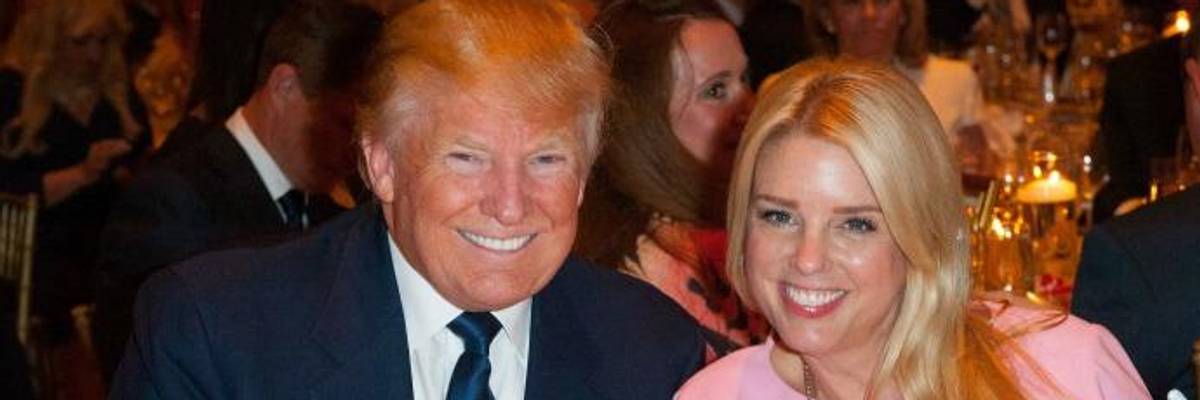
President-elect Donald Trump sits next to Pam Bondi at the Palm Beach Lincoln Day Dinner at Mar-a-Lago, Palm Beach, Florida, on March 20, 2016.
Trump’s Pick For AG Perfectly Exemplifies His MO—Cronyism and Corruption
Pam Bondi has a worrying history of receiving support from corporate actors before seemingly using her power to shield them from legal action.
In late November, President-elect Donald Trump announced Pam Bondi—former Florida attorney general, current partner at Ballard Partners, and long-time Trump-world regular—as his nominee for attorney general. Bondi perfectly exemplifies Trump’s approach to staffing the executive branch: prioritizing loyalists with a history of defending him personally and actively creating opportunities for revolver-induced corruption.
Going into the second Trump administration, the Department of Justice (DOJ) faces a broad array of issues, from counter-intelligence to civil rights enforcement. But in many respects the Justice Department is most central and critical as the enforcer of laws that limit corporate misbehavior. From monopolistic collusion and tax evasion to wage theft and polluting the air, the DOJ is constantly deciding whether to pursue potential civil and criminal actions against a wide array of corporations.
Is someone whose (virtual) rolodex is full of contacts at large tech companies likely to be enthusiastic about supporting antitrust enforcement against the very tech executives she has a warm working relationship with?
If confirmed, Bondi will be a classic corporate revolver. While at Ballard, she’s worked with a slate of corporate clients, prominently including Amazon, which has pending cases before the DOJ and Federal Trade Commission. As attorney general, Bondi would stand to oversee cases against a number of her former clients and their ilk, creating at the very least the appearance of a conflict of interest.
Bondi would also have the power to influence resource allocation decisions, determining how much effort the federal government puts toward enforcing the law against corporate actors and individuals alike. With many of Bondi and her Ballard peers’ clients and former clients number among those who stand to face federal enforcement, there are clear reasons to worry she might de-emphasize corporate misconduct and prioritize Trump’s political enemies.
Is someone whose (virtual) rolodex is full of contacts at large tech companies likely to be enthusiastic about supporting antitrust enforcement against the very tech executives she has a warm working relationship with? Questions like this seem to answer themselves, and the outlook isn’t good for those of us who see the role of government as protecting most of us from the greed and abuses of wealthy and powerful corporations and executives.
Beyond concerns about corporate revolver dynamics that could undercut DOJ’s efficacy in cracking down on corporate wrongdoing, Bondi herself has a worrying history of receiving support from corporate actors before seemingly using her power to shield them from legal action.
In 2011, newly inaugurated Florida Attorney General Bondi led the charge to fire two attorneys who had been investigating Lender Processing Services (LPS)—a mortgage services company that later pled guilty to having forged documents to illegally repossess borrowers’ homes—after Bondi received substantial campaign contributions from LPS. In 2013, Bondi directly solicited a reelection campaign donation from the Donald J. Trump Foundation. Shortly after Bondi received the $25,000 donation, her office declined to continue investigating complaints against Trump University. Also during Bondi’s first term as Florida attorney general, she had an extended relationship with lawyers from firm Dickstein Shapiro who met with Bondi to represent an array of corporate clients. In several documented cases, Bondi declined to use her AG powers to pursue action against these companies, as The New York Times reported in a Pulitzer-winning 2014 series. (As the Miami Herald reports, a brochure from the firm even boasts that “we persuaded AGs not to sue Accretive Health.”)
These corruption concerns don’t even scratch the surface of Bondi’s broad network of financial and personal relationships with conservative interest groups and influential corporate actors, not to mention her lobbying work for the nation of Qatar. As such, Bondi's confirmation would likely become quite difficult, as every issue from how to deal with Foreign Agents Registration Act enforcement to antitrust policy is implicated by her time at Ballard.
These blatant concerns with Bondi’s fitness for the role were drawn out to some extent in her first confirmation hearing on Wednesday. Bondi repeatedly took a combative tone in response to questions. She dodged or evaded numerous questions about how her loyalty to Trump might influence her decision-making as attorney general, even making the blanket statement, “I’ll never speak on a hypothetical, especially one saying that the president would do something illegal”—a concerning hard line for her to take, given Trump's multiple, non-hypothetical, criminal convictions.
Bondi’s second hearing, scheduled for on Thursday, promises to produce more eventful and contentious testimony, as hearings for Trump nominees continue this week.
We are at a crossroads
This country and this world are at a monumental crossroads. In a few short weeks, US voters will have an opportunity to beat back the forces of fascism and confront the billionaires who are rigging the economy, our media system, and our democracy, making it increasingly impossible for ordinary people to get by. We’re not just talking about the election. We’re talking about what must be done once these fascist elements are vanquished from power. We need a bolder set of solutions than what either major party has so far been willing to offer and a working-class movement ready to fight like hell for it. Trump didn't emerge from nowhere. The conditions that fueled MAGA authoritarianism were created by decades of radical neoliberal economic policies and a corrupt political system dominated by corporate interests. They slashed taxes on the super-rich, promising that the benefits would trickle down. They said giveaways to the corporate titans would make life more affordable for the rest of us. It was all bullshit. And when a bitter, betrayed populace searches for someone to blame, right-wing demagogues have little trouble finding scapegoats. People know when they're being lied to, but you won't hear any of this from the corporate media. Only independent journalism—powered and funded by people who believe in building a better world—can deliver truly trustworthy daily news. Our Fall Campaign is underway, and we need your help. To power our newsroom through the rest of the year, we need to raise $125,000 by midnight on October 31. So if you share our vision, please contribute whatever you can to sustain our work. |
In late November, President-elect Donald Trump announced Pam Bondi—former Florida attorney general, current partner at Ballard Partners, and long-time Trump-world regular—as his nominee for attorney general. Bondi perfectly exemplifies Trump’s approach to staffing the executive branch: prioritizing loyalists with a history of defending him personally and actively creating opportunities for revolver-induced corruption.
Going into the second Trump administration, the Department of Justice (DOJ) faces a broad array of issues, from counter-intelligence to civil rights enforcement. But in many respects the Justice Department is most central and critical as the enforcer of laws that limit corporate misbehavior. From monopolistic collusion and tax evasion to wage theft and polluting the air, the DOJ is constantly deciding whether to pursue potential civil and criminal actions against a wide array of corporations.
Is someone whose (virtual) rolodex is full of contacts at large tech companies likely to be enthusiastic about supporting antitrust enforcement against the very tech executives she has a warm working relationship with?
If confirmed, Bondi will be a classic corporate revolver. While at Ballard, she’s worked with a slate of corporate clients, prominently including Amazon, which has pending cases before the DOJ and Federal Trade Commission. As attorney general, Bondi would stand to oversee cases against a number of her former clients and their ilk, creating at the very least the appearance of a conflict of interest.
Bondi would also have the power to influence resource allocation decisions, determining how much effort the federal government puts toward enforcing the law against corporate actors and individuals alike. With many of Bondi and her Ballard peers’ clients and former clients number among those who stand to face federal enforcement, there are clear reasons to worry she might de-emphasize corporate misconduct and prioritize Trump’s political enemies.
Is someone whose (virtual) rolodex is full of contacts at large tech companies likely to be enthusiastic about supporting antitrust enforcement against the very tech executives she has a warm working relationship with? Questions like this seem to answer themselves, and the outlook isn’t good for those of us who see the role of government as protecting most of us from the greed and abuses of wealthy and powerful corporations and executives.
Beyond concerns about corporate revolver dynamics that could undercut DOJ’s efficacy in cracking down on corporate wrongdoing, Bondi herself has a worrying history of receiving support from corporate actors before seemingly using her power to shield them from legal action.
In 2011, newly inaugurated Florida Attorney General Bondi led the charge to fire two attorneys who had been investigating Lender Processing Services (LPS)—a mortgage services company that later pled guilty to having forged documents to illegally repossess borrowers’ homes—after Bondi received substantial campaign contributions from LPS. In 2013, Bondi directly solicited a reelection campaign donation from the Donald J. Trump Foundation. Shortly after Bondi received the $25,000 donation, her office declined to continue investigating complaints against Trump University. Also during Bondi’s first term as Florida attorney general, she had an extended relationship with lawyers from firm Dickstein Shapiro who met with Bondi to represent an array of corporate clients. In several documented cases, Bondi declined to use her AG powers to pursue action against these companies, as The New York Times reported in a Pulitzer-winning 2014 series. (As the Miami Herald reports, a brochure from the firm even boasts that “we persuaded AGs not to sue Accretive Health.”)
These corruption concerns don’t even scratch the surface of Bondi’s broad network of financial and personal relationships with conservative interest groups and influential corporate actors, not to mention her lobbying work for the nation of Qatar. As such, Bondi's confirmation would likely become quite difficult, as every issue from how to deal with Foreign Agents Registration Act enforcement to antitrust policy is implicated by her time at Ballard.
These blatant concerns with Bondi’s fitness for the role were drawn out to some extent in her first confirmation hearing on Wednesday. Bondi repeatedly took a combative tone in response to questions. She dodged or evaded numerous questions about how her loyalty to Trump might influence her decision-making as attorney general, even making the blanket statement, “I’ll never speak on a hypothetical, especially one saying that the president would do something illegal”—a concerning hard line for her to take, given Trump's multiple, non-hypothetical, criminal convictions.
Bondi’s second hearing, scheduled for on Thursday, promises to produce more eventful and contentious testimony, as hearings for Trump nominees continue this week.
- Durbin Demands Answers on Bondi's Foreign, Corporate Lobbying Clients ›
- Report: Trump AG Pick Bondi Frequently Sold Out Her Former Office to Big Corporate Donors at Public’s Expense ›
- Watchdogs Call Out Trump AG Pick Pam Bondi's Corporate Lobbying ›
- The Transactional World of Pam Bondi ›
- Trump's New Attorney General Pick: A Corporate Lobbyist Who Did Wall Street's Bidding ›
- Bondi's First Acts as AG Curb Enforcement of Foreign Lobbying and Corporate Misconduct Laws | Common Dreams ›
- Ousted DOJ Lawyer Says Bondi Appointees Let Corporate Lobbyists 'Rule' Over Antitrust Enforcement | Common Dreams ›
In late November, President-elect Donald Trump announced Pam Bondi—former Florida attorney general, current partner at Ballard Partners, and long-time Trump-world regular—as his nominee for attorney general. Bondi perfectly exemplifies Trump’s approach to staffing the executive branch: prioritizing loyalists with a history of defending him personally and actively creating opportunities for revolver-induced corruption.
Going into the second Trump administration, the Department of Justice (DOJ) faces a broad array of issues, from counter-intelligence to civil rights enforcement. But in many respects the Justice Department is most central and critical as the enforcer of laws that limit corporate misbehavior. From monopolistic collusion and tax evasion to wage theft and polluting the air, the DOJ is constantly deciding whether to pursue potential civil and criminal actions against a wide array of corporations.
Is someone whose (virtual) rolodex is full of contacts at large tech companies likely to be enthusiastic about supporting antitrust enforcement against the very tech executives she has a warm working relationship with?
If confirmed, Bondi will be a classic corporate revolver. While at Ballard, she’s worked with a slate of corporate clients, prominently including Amazon, which has pending cases before the DOJ and Federal Trade Commission. As attorney general, Bondi would stand to oversee cases against a number of her former clients and their ilk, creating at the very least the appearance of a conflict of interest.
Bondi would also have the power to influence resource allocation decisions, determining how much effort the federal government puts toward enforcing the law against corporate actors and individuals alike. With many of Bondi and her Ballard peers’ clients and former clients number among those who stand to face federal enforcement, there are clear reasons to worry she might de-emphasize corporate misconduct and prioritize Trump’s political enemies.
Is someone whose (virtual) rolodex is full of contacts at large tech companies likely to be enthusiastic about supporting antitrust enforcement against the very tech executives she has a warm working relationship with? Questions like this seem to answer themselves, and the outlook isn’t good for those of us who see the role of government as protecting most of us from the greed and abuses of wealthy and powerful corporations and executives.
Beyond concerns about corporate revolver dynamics that could undercut DOJ’s efficacy in cracking down on corporate wrongdoing, Bondi herself has a worrying history of receiving support from corporate actors before seemingly using her power to shield them from legal action.
In 2011, newly inaugurated Florida Attorney General Bondi led the charge to fire two attorneys who had been investigating Lender Processing Services (LPS)—a mortgage services company that later pled guilty to having forged documents to illegally repossess borrowers’ homes—after Bondi received substantial campaign contributions from LPS. In 2013, Bondi directly solicited a reelection campaign donation from the Donald J. Trump Foundation. Shortly after Bondi received the $25,000 donation, her office declined to continue investigating complaints against Trump University. Also during Bondi’s first term as Florida attorney general, she had an extended relationship with lawyers from firm Dickstein Shapiro who met with Bondi to represent an array of corporate clients. In several documented cases, Bondi declined to use her AG powers to pursue action against these companies, as The New York Times reported in a Pulitzer-winning 2014 series. (As the Miami Herald reports, a brochure from the firm even boasts that “we persuaded AGs not to sue Accretive Health.”)
These corruption concerns don’t even scratch the surface of Bondi’s broad network of financial and personal relationships with conservative interest groups and influential corporate actors, not to mention her lobbying work for the nation of Qatar. As such, Bondi's confirmation would likely become quite difficult, as every issue from how to deal with Foreign Agents Registration Act enforcement to antitrust policy is implicated by her time at Ballard.
These blatant concerns with Bondi’s fitness for the role were drawn out to some extent in her first confirmation hearing on Wednesday. Bondi repeatedly took a combative tone in response to questions. She dodged or evaded numerous questions about how her loyalty to Trump might influence her decision-making as attorney general, even making the blanket statement, “I’ll never speak on a hypothetical, especially one saying that the president would do something illegal”—a concerning hard line for her to take, given Trump's multiple, non-hypothetical, criminal convictions.
Bondi’s second hearing, scheduled for on Thursday, promises to produce more eventful and contentious testimony, as hearings for Trump nominees continue this week.
- Durbin Demands Answers on Bondi's Foreign, Corporate Lobbying Clients ›
- Report: Trump AG Pick Bondi Frequently Sold Out Her Former Office to Big Corporate Donors at Public’s Expense ›
- Watchdogs Call Out Trump AG Pick Pam Bondi's Corporate Lobbying ›
- The Transactional World of Pam Bondi ›
- Trump's New Attorney General Pick: A Corporate Lobbyist Who Did Wall Street's Bidding ›
- Bondi's First Acts as AG Curb Enforcement of Foreign Lobbying and Corporate Misconduct Laws | Common Dreams ›
- Ousted DOJ Lawyer Says Bondi Appointees Let Corporate Lobbyists 'Rule' Over Antitrust Enforcement | Common Dreams ›