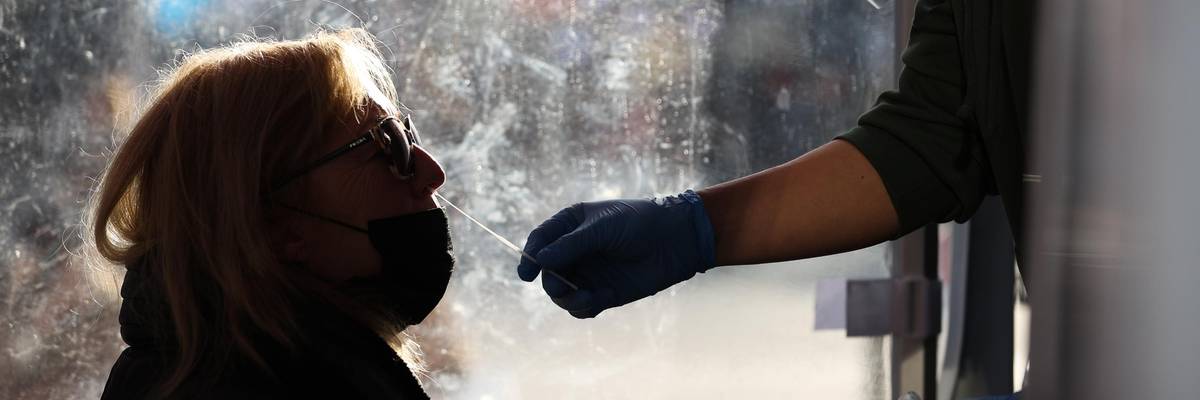
A woman gets a Covid-19 test at a Covid-19 mobile testing site at Times Square in New York City on December 6, 2021.
The Threat of Another Pandemic Haunts Our Sleep
We need to curb the wildlife and exotic pet trades, better protect tropical forests, and markedly improve practices in intensive poultry and pig farming.
For most of us, it almost seems like the Covid-19 pandemic never happened. It’s like a bad dream that we woke up from and desperately want to forget—so much so that most governments stopped tracking current caseloads. In the U.S., hospitalizations and deaths are increasing, but obtaining an actual count of infections is not a priority.
Three years ago, much of the world was in a different place, grappling with lockdowns amid deep uncertainty about the Covid-19 pandemic. Governments had set up teams to hunt down supplies of face masks, oxygen, and ventilators—the wealthy nations were more successful than low- and middle-income nations. Anthony Fauci predicted that 100,000 Americans could die, and people thought he was crazy. We now know that over 1 million died from Covid-19 in the United States alone with global estimates now reaching 25 million people.
The virus has also found a home in many other species, including dogs, cats, white-tailed deer, mink, and bats. It will continue to evolve and could later spill back into humans in new and unpredictable forms.
The greatest risk may be from the crowded conditions the poultry and pig industries have “perfected” to grow meat as fast and cheaply as possible in factory farms—especially in the U.S.
Most pandemics and countless other local outbreaks of new diseases, in fact, are the result of viruses that live “out there” in wildlife and then somehow find their way into people. This can happen when people come into contact or consume wildlife directly and deliberately, such as through the exotic pet trade or in wild meat markets. Inadvertent contact also happens when people move into forested regions, especially in the tropics, to clear vegetation to grow food or for logging and mining.
The next pandemic could start closer to home. The greatest risk may be from the crowded conditions the poultry and pig industries have “perfected” to grow meat as fast and cheaply as possible in factory farms—especially in the U.S. Tens of thousands of highly stressed animals with potentially weakened immunity living in very close contact with each other make the perfect environment for new diseases to spread and evolve.
The next deadly flu pandemic could start with one of these unfortunate creatures being infected by a new virus that then quickly spreads, mutates, and finds its way into farm laborers—most of whom wear biohazard suits when working inside the barns.
Most people assume it is the job of government to protect us all from these dangers. However, with their uncanny abilities to focus only on what people want to hear, politicians seem to be studiously avoiding any talk of pandemics.
The next attempt from those government officials committed to keeping pandemics high on the political agenda will be at the U.N. General Assembly in New York City on September 20, where we hope at least some heads of state will gather with ministers to issue a high-level declaration on pandemics. Months of negotiations have produced a 16-page document filled with good yet toothless intentions, with the only specific proposed follow-up action being–drum roll–another meeting in 2026.
Meanwhile, in Geneva, the home of the World Health Organization, negotiations are grinding along as governments work to develop a global accord, with potentially important binding commitments and provisions to help prevent and prepare for future pandemics. This process began with much enthusiasm and energy at the height of the pandemic but has now descended into the usual acrimony of disagreement between rich and poor countries. Some of the former refuse to relax patents on vaccines and medicines and the latter refuse to commit to actions for which they say additional funding and resources are needed first.
It gets even worse when considering where the pandemics come from. Big meat producers like the United States, Brazil, and China are concerned about provisions that might affect this industry even though it is a major source of risk of new diseases. China seems keen to avoid any language on wildlife trade and markets.
In Washington D.C., the World Bank, home of The Pandemic Fund, is struggling to raise meaningful resources to help governments tackle future pandemics. The fund, propelled initially by the White House and Brussels, had aimed to disburse about $10 billion annually. So far it has commitments of $2 billion, and this year will get only about $300 million out the door, at best, spreading funds thinly to dozens of countries. At least half these funds will likely end up covering the administration costs and salaries of international civil servants as they pass through the hands of various agencies on their way to the ground globally.
Even worse, these processes largely ignore the underlying causes of pandemics, the human actions and behaviors that heighten the risk of spillover of viruses from wildlife to humans and our livestock in the first place.
We need to curb the wildlife and exotic pet trades, better protect tropical forests, and markedly improve practices in intensive poultry and pig farming. Vested interests, siloed policymaking and funding, and narrow views of what constitutes prevention and public health have stymied progress on these underlying drivers of new disease emergence.
Covid-19 cannot be forgotten. It will happen again. And like a bad night’s sleep, the next time could be more nightmarish, especially if governments, funders, and the public health establishment do not redouble efforts to address the underlying causes of viral spillover.
We are at a crossroads
This country and this world are at a monumental crossroads. In a few short weeks, US voters will have an opportunity to beat back the forces of fascism and confront the billionaires who are rigging the economy, our media system, and our democracy, making it increasingly impossible for ordinary people to get by. We’re not just talking about the election. We’re talking about what must be done once these fascist elements are vanquished from power. We need a bolder set of solutions than what either major party has so far been willing to offer and a working-class movement ready to fight like hell for it. Trump didn't emerge from nowhere. The conditions that fueled MAGA authoritarianism were created by decades of radical neoliberal economic policies and a corrupt political system dominated by corporate interests. They slashed taxes on the super-rich, promising that the benefits would trickle down. They said giveaways to the corporate titans would make life more affordable for the rest of us. It was all bullshit. And when a bitter, betrayed populace searches for someone to blame, right-wing demagogues have little trouble finding scapegoats. People know when they're being lied to, but you won't hear any of this from the corporate media. Only independent journalism—powered and funded by people who believe in building a better world—can deliver truly trustworthy daily news. Our Fall Campaign is underway, and we need your help. To power our newsroom through the rest of the year, we need to raise $125,000 by midnight on October 31. So if you share our vision, please contribute whatever you can to sustain our work. |
For most of us, it almost seems like the Covid-19 pandemic never happened. It’s like a bad dream that we woke up from and desperately want to forget—so much so that most governments stopped tracking current caseloads. In the U.S., hospitalizations and deaths are increasing, but obtaining an actual count of infections is not a priority.
Three years ago, much of the world was in a different place, grappling with lockdowns amid deep uncertainty about the Covid-19 pandemic. Governments had set up teams to hunt down supplies of face masks, oxygen, and ventilators—the wealthy nations were more successful than low- and middle-income nations. Anthony Fauci predicted that 100,000 Americans could die, and people thought he was crazy. We now know that over 1 million died from Covid-19 in the United States alone with global estimates now reaching 25 million people.
The virus has also found a home in many other species, including dogs, cats, white-tailed deer, mink, and bats. It will continue to evolve and could later spill back into humans in new and unpredictable forms.
The greatest risk may be from the crowded conditions the poultry and pig industries have “perfected” to grow meat as fast and cheaply as possible in factory farms—especially in the U.S.
Most pandemics and countless other local outbreaks of new diseases, in fact, are the result of viruses that live “out there” in wildlife and then somehow find their way into people. This can happen when people come into contact or consume wildlife directly and deliberately, such as through the exotic pet trade or in wild meat markets. Inadvertent contact also happens when people move into forested regions, especially in the tropics, to clear vegetation to grow food or for logging and mining.
The next pandemic could start closer to home. The greatest risk may be from the crowded conditions the poultry and pig industries have “perfected” to grow meat as fast and cheaply as possible in factory farms—especially in the U.S. Tens of thousands of highly stressed animals with potentially weakened immunity living in very close contact with each other make the perfect environment for new diseases to spread and evolve.
The next deadly flu pandemic could start with one of these unfortunate creatures being infected by a new virus that then quickly spreads, mutates, and finds its way into farm laborers—most of whom wear biohazard suits when working inside the barns.
Most people assume it is the job of government to protect us all from these dangers. However, with their uncanny abilities to focus only on what people want to hear, politicians seem to be studiously avoiding any talk of pandemics.
The next attempt from those government officials committed to keeping pandemics high on the political agenda will be at the U.N. General Assembly in New York City on September 20, where we hope at least some heads of state will gather with ministers to issue a high-level declaration on pandemics. Months of negotiations have produced a 16-page document filled with good yet toothless intentions, with the only specific proposed follow-up action being–drum roll–another meeting in 2026.
Meanwhile, in Geneva, the home of the World Health Organization, negotiations are grinding along as governments work to develop a global accord, with potentially important binding commitments and provisions to help prevent and prepare for future pandemics. This process began with much enthusiasm and energy at the height of the pandemic but has now descended into the usual acrimony of disagreement between rich and poor countries. Some of the former refuse to relax patents on vaccines and medicines and the latter refuse to commit to actions for which they say additional funding and resources are needed first.
It gets even worse when considering where the pandemics come from. Big meat producers like the United States, Brazil, and China are concerned about provisions that might affect this industry even though it is a major source of risk of new diseases. China seems keen to avoid any language on wildlife trade and markets.
In Washington D.C., the World Bank, home of The Pandemic Fund, is struggling to raise meaningful resources to help governments tackle future pandemics. The fund, propelled initially by the White House and Brussels, had aimed to disburse about $10 billion annually. So far it has commitments of $2 billion, and this year will get only about $300 million out the door, at best, spreading funds thinly to dozens of countries. At least half these funds will likely end up covering the administration costs and salaries of international civil servants as they pass through the hands of various agencies on their way to the ground globally.
Even worse, these processes largely ignore the underlying causes of pandemics, the human actions and behaviors that heighten the risk of spillover of viruses from wildlife to humans and our livestock in the first place.
We need to curb the wildlife and exotic pet trades, better protect tropical forests, and markedly improve practices in intensive poultry and pig farming. Vested interests, siloed policymaking and funding, and narrow views of what constitutes prevention and public health have stymied progress on these underlying drivers of new disease emergence.
Covid-19 cannot be forgotten. It will happen again. And like a bad night’s sleep, the next time could be more nightmarish, especially if governments, funders, and the public health establishment do not redouble efforts to address the underlying causes of viral spillover.
- As Covid-19 Cases Rise, Global Task Force Lays Out How to Avert Future Pandemics ›
- Report: America's Massive Wildlife Imports Fuel Global Pandemic Risks ›
- Spread of Bird Flu to Mammals Could Put Humans in Danger, Scientists Warn ›
- Scientists to G7 Leaders: Prepare for Next Pandemic by Combating Big Pharma Greed ›
- 'Unprecedented Threat' for East Africa as Larger Second Wave of Locust Crisis Arrives Amid Pandemic ›
For most of us, it almost seems like the Covid-19 pandemic never happened. It’s like a bad dream that we woke up from and desperately want to forget—so much so that most governments stopped tracking current caseloads. In the U.S., hospitalizations and deaths are increasing, but obtaining an actual count of infections is not a priority.
Three years ago, much of the world was in a different place, grappling with lockdowns amid deep uncertainty about the Covid-19 pandemic. Governments had set up teams to hunt down supplies of face masks, oxygen, and ventilators—the wealthy nations were more successful than low- and middle-income nations. Anthony Fauci predicted that 100,000 Americans could die, and people thought he was crazy. We now know that over 1 million died from Covid-19 in the United States alone with global estimates now reaching 25 million people.
The virus has also found a home in many other species, including dogs, cats, white-tailed deer, mink, and bats. It will continue to evolve and could later spill back into humans in new and unpredictable forms.
The greatest risk may be from the crowded conditions the poultry and pig industries have “perfected” to grow meat as fast and cheaply as possible in factory farms—especially in the U.S.
Most pandemics and countless other local outbreaks of new diseases, in fact, are the result of viruses that live “out there” in wildlife and then somehow find their way into people. This can happen when people come into contact or consume wildlife directly and deliberately, such as through the exotic pet trade or in wild meat markets. Inadvertent contact also happens when people move into forested regions, especially in the tropics, to clear vegetation to grow food or for logging and mining.
The next pandemic could start closer to home. The greatest risk may be from the crowded conditions the poultry and pig industries have “perfected” to grow meat as fast and cheaply as possible in factory farms—especially in the U.S. Tens of thousands of highly stressed animals with potentially weakened immunity living in very close contact with each other make the perfect environment for new diseases to spread and evolve.
The next deadly flu pandemic could start with one of these unfortunate creatures being infected by a new virus that then quickly spreads, mutates, and finds its way into farm laborers—most of whom wear biohazard suits when working inside the barns.
Most people assume it is the job of government to protect us all from these dangers. However, with their uncanny abilities to focus only on what people want to hear, politicians seem to be studiously avoiding any talk of pandemics.
The next attempt from those government officials committed to keeping pandemics high on the political agenda will be at the U.N. General Assembly in New York City on September 20, where we hope at least some heads of state will gather with ministers to issue a high-level declaration on pandemics. Months of negotiations have produced a 16-page document filled with good yet toothless intentions, with the only specific proposed follow-up action being–drum roll–another meeting in 2026.
Meanwhile, in Geneva, the home of the World Health Organization, negotiations are grinding along as governments work to develop a global accord, with potentially important binding commitments and provisions to help prevent and prepare for future pandemics. This process began with much enthusiasm and energy at the height of the pandemic but has now descended into the usual acrimony of disagreement between rich and poor countries. Some of the former refuse to relax patents on vaccines and medicines and the latter refuse to commit to actions for which they say additional funding and resources are needed first.
It gets even worse when considering where the pandemics come from. Big meat producers like the United States, Brazil, and China are concerned about provisions that might affect this industry even though it is a major source of risk of new diseases. China seems keen to avoid any language on wildlife trade and markets.
In Washington D.C., the World Bank, home of The Pandemic Fund, is struggling to raise meaningful resources to help governments tackle future pandemics. The fund, propelled initially by the White House and Brussels, had aimed to disburse about $10 billion annually. So far it has commitments of $2 billion, and this year will get only about $300 million out the door, at best, spreading funds thinly to dozens of countries. At least half these funds will likely end up covering the administration costs and salaries of international civil servants as they pass through the hands of various agencies on their way to the ground globally.
Even worse, these processes largely ignore the underlying causes of pandemics, the human actions and behaviors that heighten the risk of spillover of viruses from wildlife to humans and our livestock in the first place.
We need to curb the wildlife and exotic pet trades, better protect tropical forests, and markedly improve practices in intensive poultry and pig farming. Vested interests, siloed policymaking and funding, and narrow views of what constitutes prevention and public health have stymied progress on these underlying drivers of new disease emergence.
Covid-19 cannot be forgotten. It will happen again. And like a bad night’s sleep, the next time could be more nightmarish, especially if governments, funders, and the public health establishment do not redouble efforts to address the underlying causes of viral spillover.
- As Covid-19 Cases Rise, Global Task Force Lays Out How to Avert Future Pandemics ›
- Report: America's Massive Wildlife Imports Fuel Global Pandemic Risks ›
- Spread of Bird Flu to Mammals Could Put Humans in Danger, Scientists Warn ›
- Scientists to G7 Leaders: Prepare for Next Pandemic by Combating Big Pharma Greed ›
- 'Unprecedented Threat' for East Africa as Larger Second Wave of Locust Crisis Arrives Amid Pandemic ›