SUBSCRIBE TO OUR FREE NEWSLETTER
Daily news & progressive opinion—funded by the people, not the corporations—delivered straight to your inbox.
5
#000000
#FFFFFF
To donate by check, phone, or other method, see our More Ways to Give page.
Daily news & progressive opinion—funded by the people, not the corporations—delivered straight to your inbox.
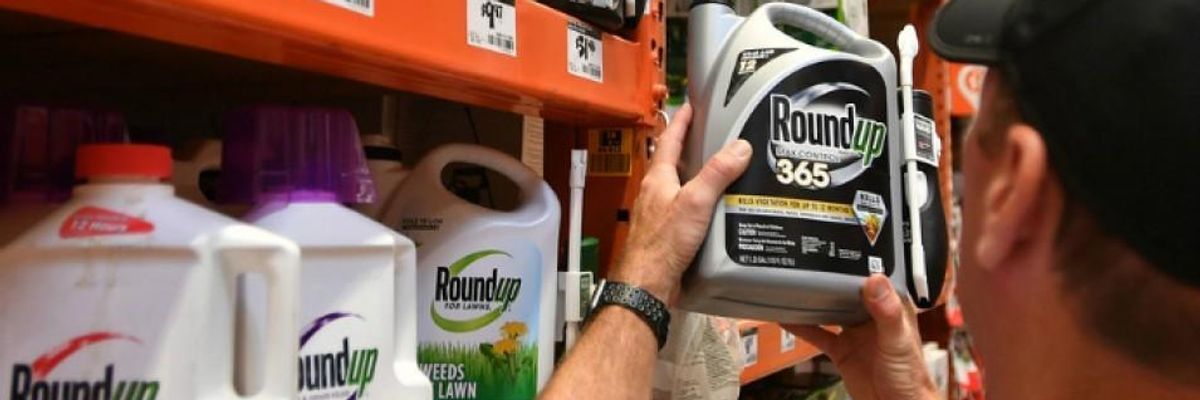
A shopper lifts a bottle of Roundup from a shelf.
"With the new formulations of Roundup, Bayer had the opportunity to make us safer, but it did the opposite," one expert said.
Facing tens of thousands of lawsuits after it acquired Monsanto, Bayer promised to remove cancer-linked glyphosate from its commercial Roundup weed killers by 2023. But an analysis published by Friends of the Earth on Tuesday reveals that the replacement is even more dangerous.
The environmental group found that many residential Roundup products still do contain glyphosate, and those that don't have replaced it with a chemical cocktail that is 45 times more toxic to human health following long-term exposure.
"With the new formulations of Roundup, Bayer had the opportunity to make us safer, but it did the opposite," Kendra Klein, deputy director of science for Friends of the Earth, said in a statement. "Bayer's willingness to deceive the public and disregard our health as it continues to cash in on the Roundup brand name is outrageous."
"In short, the new Roundup is not the old Roundup—it's worse."
Roundup weed killer was first commercially released by Monsanto 50 years ago. Since then, tens of thousands of people say they have come down with Non-Hodgkin lymphoma after repeated use of the product and its active ingredient glyphosate, which the World Health Organization's International Agency for Research on Cancer says is "probably carcinogenic to humans." Despite the risk, it is so widely used that it has been found in 80% of a test of U.S. urine samples.
"The human toll of Roundup is enormous—tens of thousands of people have lost their lives and their health because of this toxic weed killer," Klein said.
In response to both legal challenges and popular pressure, Bayer announced in 2021 that it would remove glyphosate from residential Roundup sold in the U.S. within two years.
To track how well Bayer kept that promise, Friends of the Earth assessed the Roundup products for sale at Lowe's and Home Depot—the largest home and garden stores in the U.S.—between June and October of 2024.
It found that seven of the Roundup products for sale still contained glyphosate, while the eight that did not used chemicals "of dramatically greater concern."
Bayer has replaced glyphosate with a combination of four chemicals—fluazifop-P-butyl, triclopyr, diquat dibromide, and imazapic—the latter two of which are banned in the European Union. All four chemicals are even more dangerous to health than glyphosate on average following chronic exposure, according to the Environmental Protection Agency's (EPA) analysis of safety studies. The new ingredients have been linked to kidney and liver damage; reproductive, birth, and development problems; and allergic reactions or irritation that impact the eyes, skin, and respiratory system.
While all four are toxic, one stands out: Diquat dibromide is 200 times more toxic than glyphosate and is considered a "highly hazardous pesticide."
The new ingredients also pose a greater risk to the environment. They are, on average, more likely to threaten bees, birds, worms, and fish and other aquatic life. They are also less likely to break down in the environment, and therefore more likely to infiltrate groundwater and pollute rivers and drinking water.
"In short, the new Roundup is not the old Roundup—it's worse," Friends of the Earth concluded in the report.
The environmental group also criticized Bayer for not providing a warning to consumers about the altered ingredients, as well as lax federal law that does not require pesticide makers to alert shoppers when they change the ingredients of a known brand. While pesticide makers do have to list the active ingredients of a pesticide on the container, the average consumer may not be aware of the relative toxicity of these chemicals. A frequent Roundup user is also likely to assume that anything sold under that brand is similarly toxic to products they have used before.
"Drug companies are not allowed to replace the aspirin in a brand-name pain reliever with oxycontin or fentanyl, and for good reason," Friends of the Earth senior campaigner Sarah Starman said. "It is unconscionable that the Environmental Protection Agency allows this toxic sleight of hand and unethical that Bayer is exposing consumers to dramatically greater risks with no warning."
Friends of the Earth called on Bayer to develop safer chemicals and retire toxic brands like Roundup. At the very least, it urged the company to sell the new formulations under a different brand and warn buyers of the new products' health and environmental risks.
Home and garden retailers, the group argued, should also step up by removing all Roundup products from their stores and online catalogs, or at least selling them with clear warnings of the new risks; phase out toxic pesticides; and offer safer and more organic options.
Finally, the group called on the EPA to toughen its regulations by requiring ingredient-specific safety warnings on commercial pesticides, mandating that new formulations be sold under a new brand, and banning chemicals that harm human health and the environment from consumer products.
"Bayer, like other chemical companies, cannot be trusted to protect our health," Starman said. "We need serious reform at the EPA to ensure that the agency does its duty to protect people and the environment from dangerous pesticides."
Dear Common Dreams reader, It’s been nearly 30 years since I co-founded Common Dreams with my late wife, Lina Newhouser. We had the radical notion that journalism should serve the public good, not corporate profits. It was clear to us from the outset what it would take to build such a project. No paid advertisements. No corporate sponsors. No millionaire publisher telling us what to think or do. Many people said we wouldn't last a year, but we proved those doubters wrong. Together with a tremendous team of journalists and dedicated staff, we built an independent media outlet free from the constraints of profits and corporate control. Our mission has always been simple: To inform. To inspire. To ignite change for the common good. Building Common Dreams was not easy. Our survival was never guaranteed. When you take on the most powerful forces—Wall Street greed, fossil fuel industry destruction, Big Tech lobbyists, and uber-rich oligarchs who have spent billions upon billions rigging the economy and democracy in their favor—the only bulwark you have is supporters who believe in your work. But here’s the urgent message from me today. It's never been this bad out there. And it's never been this hard to keep us going. At the very moment Common Dreams is most needed, the threats we face are intensifying. We need your support now more than ever. We don't accept corporate advertising and never will. We don't have a paywall because we don't think people should be blocked from critical news based on their ability to pay. Everything we do is funded by the donations of readers like you. When everyone does the little they can afford, we are strong. But if that support retreats or dries up, so do we. Will you donate now to make sure Common Dreams not only survives but thrives? —Craig Brown, Co-founder |
Facing tens of thousands of lawsuits after it acquired Monsanto, Bayer promised to remove cancer-linked glyphosate from its commercial Roundup weed killers by 2023. But an analysis published by Friends of the Earth on Tuesday reveals that the replacement is even more dangerous.
The environmental group found that many residential Roundup products still do contain glyphosate, and those that don't have replaced it with a chemical cocktail that is 45 times more toxic to human health following long-term exposure.
"With the new formulations of Roundup, Bayer had the opportunity to make us safer, but it did the opposite," Kendra Klein, deputy director of science for Friends of the Earth, said in a statement. "Bayer's willingness to deceive the public and disregard our health as it continues to cash in on the Roundup brand name is outrageous."
"In short, the new Roundup is not the old Roundup—it's worse."
Roundup weed killer was first commercially released by Monsanto 50 years ago. Since then, tens of thousands of people say they have come down with Non-Hodgkin lymphoma after repeated use of the product and its active ingredient glyphosate, which the World Health Organization's International Agency for Research on Cancer says is "probably carcinogenic to humans." Despite the risk, it is so widely used that it has been found in 80% of a test of U.S. urine samples.
"The human toll of Roundup is enormous—tens of thousands of people have lost their lives and their health because of this toxic weed killer," Klein said.
In response to both legal challenges and popular pressure, Bayer announced in 2021 that it would remove glyphosate from residential Roundup sold in the U.S. within two years.
To track how well Bayer kept that promise, Friends of the Earth assessed the Roundup products for sale at Lowe's and Home Depot—the largest home and garden stores in the U.S.—between June and October of 2024.
It found that seven of the Roundup products for sale still contained glyphosate, while the eight that did not used chemicals "of dramatically greater concern."
Bayer has replaced glyphosate with a combination of four chemicals—fluazifop-P-butyl, triclopyr, diquat dibromide, and imazapic—the latter two of which are banned in the European Union. All four chemicals are even more dangerous to health than glyphosate on average following chronic exposure, according to the Environmental Protection Agency's (EPA) analysis of safety studies. The new ingredients have been linked to kidney and liver damage; reproductive, birth, and development problems; and allergic reactions or irritation that impact the eyes, skin, and respiratory system.
While all four are toxic, one stands out: Diquat dibromide is 200 times more toxic than glyphosate and is considered a "highly hazardous pesticide."
The new ingredients also pose a greater risk to the environment. They are, on average, more likely to threaten bees, birds, worms, and fish and other aquatic life. They are also less likely to break down in the environment, and therefore more likely to infiltrate groundwater and pollute rivers and drinking water.
"In short, the new Roundup is not the old Roundup—it's worse," Friends of the Earth concluded in the report.
The environmental group also criticized Bayer for not providing a warning to consumers about the altered ingredients, as well as lax federal law that does not require pesticide makers to alert shoppers when they change the ingredients of a known brand. While pesticide makers do have to list the active ingredients of a pesticide on the container, the average consumer may not be aware of the relative toxicity of these chemicals. A frequent Roundup user is also likely to assume that anything sold under that brand is similarly toxic to products they have used before.
"Drug companies are not allowed to replace the aspirin in a brand-name pain reliever with oxycontin or fentanyl, and for good reason," Friends of the Earth senior campaigner Sarah Starman said. "It is unconscionable that the Environmental Protection Agency allows this toxic sleight of hand and unethical that Bayer is exposing consumers to dramatically greater risks with no warning."
Friends of the Earth called on Bayer to develop safer chemicals and retire toxic brands like Roundup. At the very least, it urged the company to sell the new formulations under a different brand and warn buyers of the new products' health and environmental risks.
Home and garden retailers, the group argued, should also step up by removing all Roundup products from their stores and online catalogs, or at least selling them with clear warnings of the new risks; phase out toxic pesticides; and offer safer and more organic options.
Finally, the group called on the EPA to toughen its regulations by requiring ingredient-specific safety warnings on commercial pesticides, mandating that new formulations be sold under a new brand, and banning chemicals that harm human health and the environment from consumer products.
"Bayer, like other chemical companies, cannot be trusted to protect our health," Starman said. "We need serious reform at the EPA to ensure that the agency does its duty to protect people and the environment from dangerous pesticides."
Facing tens of thousands of lawsuits after it acquired Monsanto, Bayer promised to remove cancer-linked glyphosate from its commercial Roundup weed killers by 2023. But an analysis published by Friends of the Earth on Tuesday reveals that the replacement is even more dangerous.
The environmental group found that many residential Roundup products still do contain glyphosate, and those that don't have replaced it with a chemical cocktail that is 45 times more toxic to human health following long-term exposure.
"With the new formulations of Roundup, Bayer had the opportunity to make us safer, but it did the opposite," Kendra Klein, deputy director of science for Friends of the Earth, said in a statement. "Bayer's willingness to deceive the public and disregard our health as it continues to cash in on the Roundup brand name is outrageous."
"In short, the new Roundup is not the old Roundup—it's worse."
Roundup weed killer was first commercially released by Monsanto 50 years ago. Since then, tens of thousands of people say they have come down with Non-Hodgkin lymphoma after repeated use of the product and its active ingredient glyphosate, which the World Health Organization's International Agency for Research on Cancer says is "probably carcinogenic to humans." Despite the risk, it is so widely used that it has been found in 80% of a test of U.S. urine samples.
"The human toll of Roundup is enormous—tens of thousands of people have lost their lives and their health because of this toxic weed killer," Klein said.
In response to both legal challenges and popular pressure, Bayer announced in 2021 that it would remove glyphosate from residential Roundup sold in the U.S. within two years.
To track how well Bayer kept that promise, Friends of the Earth assessed the Roundup products for sale at Lowe's and Home Depot—the largest home and garden stores in the U.S.—between June and October of 2024.
It found that seven of the Roundup products for sale still contained glyphosate, while the eight that did not used chemicals "of dramatically greater concern."
Bayer has replaced glyphosate with a combination of four chemicals—fluazifop-P-butyl, triclopyr, diquat dibromide, and imazapic—the latter two of which are banned in the European Union. All four chemicals are even more dangerous to health than glyphosate on average following chronic exposure, according to the Environmental Protection Agency's (EPA) analysis of safety studies. The new ingredients have been linked to kidney and liver damage; reproductive, birth, and development problems; and allergic reactions or irritation that impact the eyes, skin, and respiratory system.
While all four are toxic, one stands out: Diquat dibromide is 200 times more toxic than glyphosate and is considered a "highly hazardous pesticide."
The new ingredients also pose a greater risk to the environment. They are, on average, more likely to threaten bees, birds, worms, and fish and other aquatic life. They are also less likely to break down in the environment, and therefore more likely to infiltrate groundwater and pollute rivers and drinking water.
"In short, the new Roundup is not the old Roundup—it's worse," Friends of the Earth concluded in the report.
The environmental group also criticized Bayer for not providing a warning to consumers about the altered ingredients, as well as lax federal law that does not require pesticide makers to alert shoppers when they change the ingredients of a known brand. While pesticide makers do have to list the active ingredients of a pesticide on the container, the average consumer may not be aware of the relative toxicity of these chemicals. A frequent Roundup user is also likely to assume that anything sold under that brand is similarly toxic to products they have used before.
"Drug companies are not allowed to replace the aspirin in a brand-name pain reliever with oxycontin or fentanyl, and for good reason," Friends of the Earth senior campaigner Sarah Starman said. "It is unconscionable that the Environmental Protection Agency allows this toxic sleight of hand and unethical that Bayer is exposing consumers to dramatically greater risks with no warning."
Friends of the Earth called on Bayer to develop safer chemicals and retire toxic brands like Roundup. At the very least, it urged the company to sell the new formulations under a different brand and warn buyers of the new products' health and environmental risks.
Home and garden retailers, the group argued, should also step up by removing all Roundup products from their stores and online catalogs, or at least selling them with clear warnings of the new risks; phase out toxic pesticides; and offer safer and more organic options.
Finally, the group called on the EPA to toughen its regulations by requiring ingredient-specific safety warnings on commercial pesticides, mandating that new formulations be sold under a new brand, and banning chemicals that harm human health and the environment from consumer products.
"Bayer, like other chemical companies, cannot be trusted to protect our health," Starman said. "We need serious reform at the EPA to ensure that the agency does its duty to protect people and the environment from dangerous pesticides."