SUBSCRIBE TO OUR FREE NEWSLETTER
Daily news & progressive opinion—funded by the people, not the corporations—delivered straight to your inbox.
5
#000000
#FFFFFF
To donate by check, phone, or other method, see our More Ways to Give page.
Daily news & progressive opinion—funded by the people, not the corporations—delivered straight to your inbox.
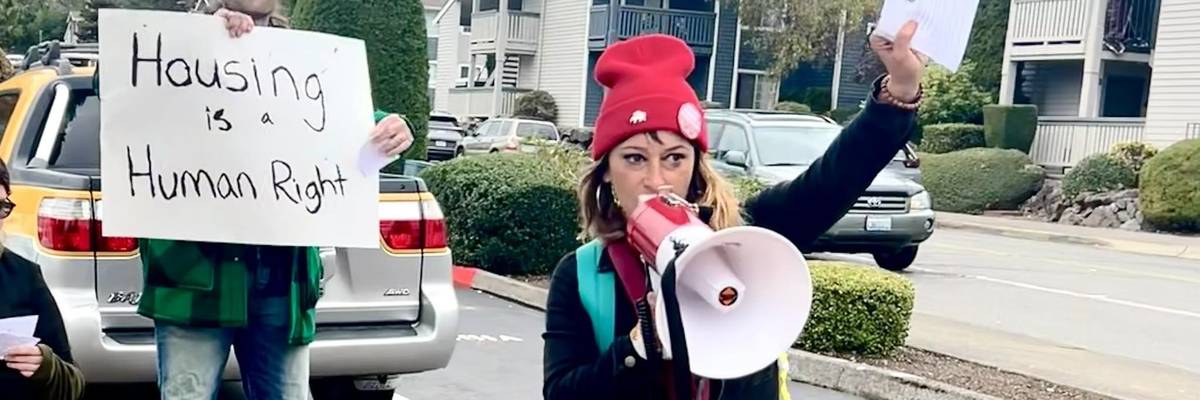
With mainstream US politics offering at the moment only Trumpian neofascism and tepid, corporate-friendly Democratic progressivism, a group of left-wing activists in Tacoma, Washington are showing the potential for mobilizing ordinary Americans on behalf of economic justice.
Tacoma, Washington is a city of about 222,000 persons, 35 miles southwest of Seattle along Interstate 5. It, and the broader Pierce County of which it is the largest city, are typical of many areas of the United States: majority white but with visible communities of color—including many first generation immigrants—and a largely working class population heavily dependent on low-wage, mostly non-union, service sector employment.
As is the case with the vast majority of Americans, most Tacoma residents are only intermittently interested in politics, concentrating on the day to day struggle of living paycheck to paycheck. Politics in the city is dominated by business interests, with elected representatives running the cliched gamut from tepid centrist progressives to right-wing Republicans.
Recently, the Tacoma chapter of the Democratic Socialists of America (DSA) and United Food and Commercial Workers (UFCW) Local 367 have successfully mobilized ordinary people to fight for greater housing security, affordability, and pro-worker politics. Several years ago, for example, both organizations launched Tacoma 4 All (T4A), an organization whose activism succeeded in securing from the city’s voters in November 2023 the passage of what has been informally called the Tenants Bill of Rights—its formal legal title is the Landlord Fairness Code (LFC). The main features of the LFC were a $10 cap on late rental fees, a moratorium on rental evictions within the city during winter months, and a limit on rent increases at 5% annually. If landlords chose to raise the rent by more than 5% per year (and the tenant did not accept the rent increase), they were required to provide the tenant with relocation assistance.
T4A’s grassroots power has been on display in recent months during Tacoma City Council meetings as the organization has mobilized Tacoma residents—in what Tacoma’s business-friendly Democratic Mayor Victoria Woodards called "unprecedented" numbers for the December 9 meeting—to speak out during the meetings in support of the LFC. At the meetings, working class person after working class person has arisen to give testimony as to how the measures' regulations—particularly the winter month eviction moratorium—have given them desperately needed breathing space when temporary financial difficulties have made it impossible for them to pay rent. Such grassroots mobilization helped keep most of the LFC intact when the Tacoma City Council voted during the December 9 meeting on Council Member Sarah Rumbaugh’s proposal to make the LFC more landlord friendly.
The situation of ordinary Tacomans is a microcosm of broader economic injustices facing Washington state (and the United States as a whole).
The popular mobilization helped defeat some of Rumbaugh’s worst proposals, but other landlord-friendly revisions made it into the final revised LFC legislation, which the council approved by a 7-2 margin. The winter eviction moratorium was reduced from five months to four months; the $10 late fee cap was replaced by a charge of 1.5% of monthly rent; residents of nonprofit-owned buildings and Tacoma Housing Authority properties were removed from LFC winter eviction moratorium protections, as were “small landlords,” those defined as owning four or fewer properties in Tacoma and implied as being mom-and-pop landlords but who, in reality, are often large corporations, including private equity firms.
Tacoma DSA, T4A and, UFCW 367 have also sought to mobilize ordinary Tacomans to expand workers’ rights. By late June 2025, the three organizations had collected 10,000 signatures (twice the required number) for a Worker’s Bill of Rights Initiative to be put before Tacoma voters. The proposed measure would increase Tacoma’s minimum wage with relative rapidity to $20 an hour (it now sits at $16.66 an hour, equivalent to Washington state’s minimum wage); implement fair scheduling regulations (requiring Tacoma employers to give workers adequate advanced notice of shift schedule changes); and improve worker safety conditions.
Since last summer—and although the proposed ballot initiative gained the required number of validated signatures—the Tacoma city government has successfully sued in court to delay the placement of the Worker’s Bill of Rights on voters’ ballots. The majority of the Tacoma City Council has requested these delays on the grounds that more time is needed to study the measure and have expressed the fear that it could derail business investment in the city. In the meantime, the struggle continues with T4A, Tacoma DSA, and Local 367 continuing the fight in the courts and at the grassroots to finally get the Worker’s Bill of Rights before Tacoma voters.
As Tacoma city officials fret over the Workers Bill of Rights as potentially creating a less favorable investment climate in the city by raising worker wages, it is crucial to consider some important context. Tacoma residents are struggling with stagnating wages and increasingly unaffordable rent. The situation of ordinary Tacomans is a microcosm of broader economic injustices facing Washington state (and the United States as a whole). The New York Times reported in April that “between 2001 to 2023, median residential rents in Washington state rose by 43%, adjusted for inflation” while state renter income grew by only 26% during the same time period.
What is remarkable about the social justice activism that I’ve outlined above is that it has featured a determination to use the push for relatively modest progressive reform as a mechanism to empower and raise the political consciousness of ordinary people in potentially more radical directions.
For example, since the passage of the Landlord Fairness Code (LFC) in 2023, T4A activists have been frequently visiting Tacoma’s apartment complexes, informing tenants of their rights under the LFC, engaging in dialogue with residents about the ownership by predatory private equity firms of rental properties, and offering pro bono legal assistance for tenants having problems with landlords. T4A structures membership meetings to have organizational policy democratically determined by the group’s paying members. Meanwhile, earlier this month, T4A helped launch Tacoma’s first tenant union at one of the city’s privately owned apartment complexes. T4A, Tacoma DSA, and Local 367 are in the beginning stages of attempting to extend their organizing model from Tacoma into the rest of Pierce County.
It is the model of groups like T4A in patiently dialoguing with ordinary people over a long period of time and seeking to slowly but surely build popular power through organizing and consciousness raising that has the best chance of eventually replacing political rule by MAGA neofacists and neoliberal Democrats with the true economic and political empowerment of ordinary people.
Dear Common Dreams reader, It’s been nearly 30 years since I co-founded Common Dreams with my late wife, Lina Newhouser. We had the radical notion that journalism should serve the public good, not corporate profits. It was clear to us from the outset what it would take to build such a project. No paid advertisements. No corporate sponsors. No millionaire publisher telling us what to think or do. Many people said we wouldn't last a year, but we proved those doubters wrong. Together with a tremendous team of journalists and dedicated staff, we built an independent media outlet free from the constraints of profits and corporate control. Our mission has always been simple: To inform. To inspire. To ignite change for the common good. Building Common Dreams was not easy. Our survival was never guaranteed. When you take on the most powerful forces—Wall Street greed, fossil fuel industry destruction, Big Tech lobbyists, and uber-rich oligarchs who have spent billions upon billions rigging the economy and democracy in their favor—the only bulwark you have is supporters who believe in your work. But here’s the urgent message from me today. It's never been this bad out there. And it's never been this hard to keep us going. At the very moment Common Dreams is most needed, the threats we face are intensifying. We need your support now more than ever. We don't accept corporate advertising and never will. We don't have a paywall because we don't think people should be blocked from critical news based on their ability to pay. Everything we do is funded by the donations of readers like you. When everyone does the little they can afford, we are strong. But if that support retreats or dries up, so do we. Will you donate now to make sure Common Dreams not only survives but thrives? —Craig Brown, Co-founder |
Tacoma, Washington is a city of about 222,000 persons, 35 miles southwest of Seattle along Interstate 5. It, and the broader Pierce County of which it is the largest city, are typical of many areas of the United States: majority white but with visible communities of color—including many first generation immigrants—and a largely working class population heavily dependent on low-wage, mostly non-union, service sector employment.
As is the case with the vast majority of Americans, most Tacoma residents are only intermittently interested in politics, concentrating on the day to day struggle of living paycheck to paycheck. Politics in the city is dominated by business interests, with elected representatives running the cliched gamut from tepid centrist progressives to right-wing Republicans.
Recently, the Tacoma chapter of the Democratic Socialists of America (DSA) and United Food and Commercial Workers (UFCW) Local 367 have successfully mobilized ordinary people to fight for greater housing security, affordability, and pro-worker politics. Several years ago, for example, both organizations launched Tacoma 4 All (T4A), an organization whose activism succeeded in securing from the city’s voters in November 2023 the passage of what has been informally called the Tenants Bill of Rights—its formal legal title is the Landlord Fairness Code (LFC). The main features of the LFC were a $10 cap on late rental fees, a moratorium on rental evictions within the city during winter months, and a limit on rent increases at 5% annually. If landlords chose to raise the rent by more than 5% per year (and the tenant did not accept the rent increase), they were required to provide the tenant with relocation assistance.
T4A’s grassroots power has been on display in recent months during Tacoma City Council meetings as the organization has mobilized Tacoma residents—in what Tacoma’s business-friendly Democratic Mayor Victoria Woodards called "unprecedented" numbers for the December 9 meeting—to speak out during the meetings in support of the LFC. At the meetings, working class person after working class person has arisen to give testimony as to how the measures' regulations—particularly the winter month eviction moratorium—have given them desperately needed breathing space when temporary financial difficulties have made it impossible for them to pay rent. Such grassroots mobilization helped keep most of the LFC intact when the Tacoma City Council voted during the December 9 meeting on Council Member Sarah Rumbaugh’s proposal to make the LFC more landlord friendly.
The situation of ordinary Tacomans is a microcosm of broader economic injustices facing Washington state (and the United States as a whole).
The popular mobilization helped defeat some of Rumbaugh’s worst proposals, but other landlord-friendly revisions made it into the final revised LFC legislation, which the council approved by a 7-2 margin. The winter eviction moratorium was reduced from five months to four months; the $10 late fee cap was replaced by a charge of 1.5% of monthly rent; residents of nonprofit-owned buildings and Tacoma Housing Authority properties were removed from LFC winter eviction moratorium protections, as were “small landlords,” those defined as owning four or fewer properties in Tacoma and implied as being mom-and-pop landlords but who, in reality, are often large corporations, including private equity firms.
Tacoma DSA, T4A and, UFCW 367 have also sought to mobilize ordinary Tacomans to expand workers’ rights. By late June 2025, the three organizations had collected 10,000 signatures (twice the required number) for a Worker’s Bill of Rights Initiative to be put before Tacoma voters. The proposed measure would increase Tacoma’s minimum wage with relative rapidity to $20 an hour (it now sits at $16.66 an hour, equivalent to Washington state’s minimum wage); implement fair scheduling regulations (requiring Tacoma employers to give workers adequate advanced notice of shift schedule changes); and improve worker safety conditions.
Since last summer—and although the proposed ballot initiative gained the required number of validated signatures—the Tacoma city government has successfully sued in court to delay the placement of the Worker’s Bill of Rights on voters’ ballots. The majority of the Tacoma City Council has requested these delays on the grounds that more time is needed to study the measure and have expressed the fear that it could derail business investment in the city. In the meantime, the struggle continues with T4A, Tacoma DSA, and Local 367 continuing the fight in the courts and at the grassroots to finally get the Worker’s Bill of Rights before Tacoma voters.
As Tacoma city officials fret over the Workers Bill of Rights as potentially creating a less favorable investment climate in the city by raising worker wages, it is crucial to consider some important context. Tacoma residents are struggling with stagnating wages and increasingly unaffordable rent. The situation of ordinary Tacomans is a microcosm of broader economic injustices facing Washington state (and the United States as a whole). The New York Times reported in April that “between 2001 to 2023, median residential rents in Washington state rose by 43%, adjusted for inflation” while state renter income grew by only 26% during the same time period.
What is remarkable about the social justice activism that I’ve outlined above is that it has featured a determination to use the push for relatively modest progressive reform as a mechanism to empower and raise the political consciousness of ordinary people in potentially more radical directions.
For example, since the passage of the Landlord Fairness Code (LFC) in 2023, T4A activists have been frequently visiting Tacoma’s apartment complexes, informing tenants of their rights under the LFC, engaging in dialogue with residents about the ownership by predatory private equity firms of rental properties, and offering pro bono legal assistance for tenants having problems with landlords. T4A structures membership meetings to have organizational policy democratically determined by the group’s paying members. Meanwhile, earlier this month, T4A helped launch Tacoma’s first tenant union at one of the city’s privately owned apartment complexes. T4A, Tacoma DSA, and Local 367 are in the beginning stages of attempting to extend their organizing model from Tacoma into the rest of Pierce County.
It is the model of groups like T4A in patiently dialoguing with ordinary people over a long period of time and seeking to slowly but surely build popular power through organizing and consciousness raising that has the best chance of eventually replacing political rule by MAGA neofacists and neoliberal Democrats with the true economic and political empowerment of ordinary people.
Tacoma, Washington is a city of about 222,000 persons, 35 miles southwest of Seattle along Interstate 5. It, and the broader Pierce County of which it is the largest city, are typical of many areas of the United States: majority white but with visible communities of color—including many first generation immigrants—and a largely working class population heavily dependent on low-wage, mostly non-union, service sector employment.
As is the case with the vast majority of Americans, most Tacoma residents are only intermittently interested in politics, concentrating on the day to day struggle of living paycheck to paycheck. Politics in the city is dominated by business interests, with elected representatives running the cliched gamut from tepid centrist progressives to right-wing Republicans.
Recently, the Tacoma chapter of the Democratic Socialists of America (DSA) and United Food and Commercial Workers (UFCW) Local 367 have successfully mobilized ordinary people to fight for greater housing security, affordability, and pro-worker politics. Several years ago, for example, both organizations launched Tacoma 4 All (T4A), an organization whose activism succeeded in securing from the city’s voters in November 2023 the passage of what has been informally called the Tenants Bill of Rights—its formal legal title is the Landlord Fairness Code (LFC). The main features of the LFC were a $10 cap on late rental fees, a moratorium on rental evictions within the city during winter months, and a limit on rent increases at 5% annually. If landlords chose to raise the rent by more than 5% per year (and the tenant did not accept the rent increase), they were required to provide the tenant with relocation assistance.
T4A’s grassroots power has been on display in recent months during Tacoma City Council meetings as the organization has mobilized Tacoma residents—in what Tacoma’s business-friendly Democratic Mayor Victoria Woodards called "unprecedented" numbers for the December 9 meeting—to speak out during the meetings in support of the LFC. At the meetings, working class person after working class person has arisen to give testimony as to how the measures' regulations—particularly the winter month eviction moratorium—have given them desperately needed breathing space when temporary financial difficulties have made it impossible for them to pay rent. Such grassroots mobilization helped keep most of the LFC intact when the Tacoma City Council voted during the December 9 meeting on Council Member Sarah Rumbaugh’s proposal to make the LFC more landlord friendly.
The situation of ordinary Tacomans is a microcosm of broader economic injustices facing Washington state (and the United States as a whole).
The popular mobilization helped defeat some of Rumbaugh’s worst proposals, but other landlord-friendly revisions made it into the final revised LFC legislation, which the council approved by a 7-2 margin. The winter eviction moratorium was reduced from five months to four months; the $10 late fee cap was replaced by a charge of 1.5% of monthly rent; residents of nonprofit-owned buildings and Tacoma Housing Authority properties were removed from LFC winter eviction moratorium protections, as were “small landlords,” those defined as owning four or fewer properties in Tacoma and implied as being mom-and-pop landlords but who, in reality, are often large corporations, including private equity firms.
Tacoma DSA, T4A and, UFCW 367 have also sought to mobilize ordinary Tacomans to expand workers’ rights. By late June 2025, the three organizations had collected 10,000 signatures (twice the required number) for a Worker’s Bill of Rights Initiative to be put before Tacoma voters. The proposed measure would increase Tacoma’s minimum wage with relative rapidity to $20 an hour (it now sits at $16.66 an hour, equivalent to Washington state’s minimum wage); implement fair scheduling regulations (requiring Tacoma employers to give workers adequate advanced notice of shift schedule changes); and improve worker safety conditions.
Since last summer—and although the proposed ballot initiative gained the required number of validated signatures—the Tacoma city government has successfully sued in court to delay the placement of the Worker’s Bill of Rights on voters’ ballots. The majority of the Tacoma City Council has requested these delays on the grounds that more time is needed to study the measure and have expressed the fear that it could derail business investment in the city. In the meantime, the struggle continues with T4A, Tacoma DSA, and Local 367 continuing the fight in the courts and at the grassroots to finally get the Worker’s Bill of Rights before Tacoma voters.
As Tacoma city officials fret over the Workers Bill of Rights as potentially creating a less favorable investment climate in the city by raising worker wages, it is crucial to consider some important context. Tacoma residents are struggling with stagnating wages and increasingly unaffordable rent. The situation of ordinary Tacomans is a microcosm of broader economic injustices facing Washington state (and the United States as a whole). The New York Times reported in April that “between 2001 to 2023, median residential rents in Washington state rose by 43%, adjusted for inflation” while state renter income grew by only 26% during the same time period.
What is remarkable about the social justice activism that I’ve outlined above is that it has featured a determination to use the push for relatively modest progressive reform as a mechanism to empower and raise the political consciousness of ordinary people in potentially more radical directions.
For example, since the passage of the Landlord Fairness Code (LFC) in 2023, T4A activists have been frequently visiting Tacoma’s apartment complexes, informing tenants of their rights under the LFC, engaging in dialogue with residents about the ownership by predatory private equity firms of rental properties, and offering pro bono legal assistance for tenants having problems with landlords. T4A structures membership meetings to have organizational policy democratically determined by the group’s paying members. Meanwhile, earlier this month, T4A helped launch Tacoma’s first tenant union at one of the city’s privately owned apartment complexes. T4A, Tacoma DSA, and Local 367 are in the beginning stages of attempting to extend their organizing model from Tacoma into the rest of Pierce County.
It is the model of groups like T4A in patiently dialoguing with ordinary people over a long period of time and seeking to slowly but surely build popular power through organizing and consciousness raising that has the best chance of eventually replacing political rule by MAGA neofacists and neoliberal Democrats with the true economic and political empowerment of ordinary people.