5
#000000
#FFFFFF
To donate by check, phone, or other method, see our More Ways to Give page.
Daily news & progressive opinion—funded by the people, not the corporations—delivered straight to your inbox.
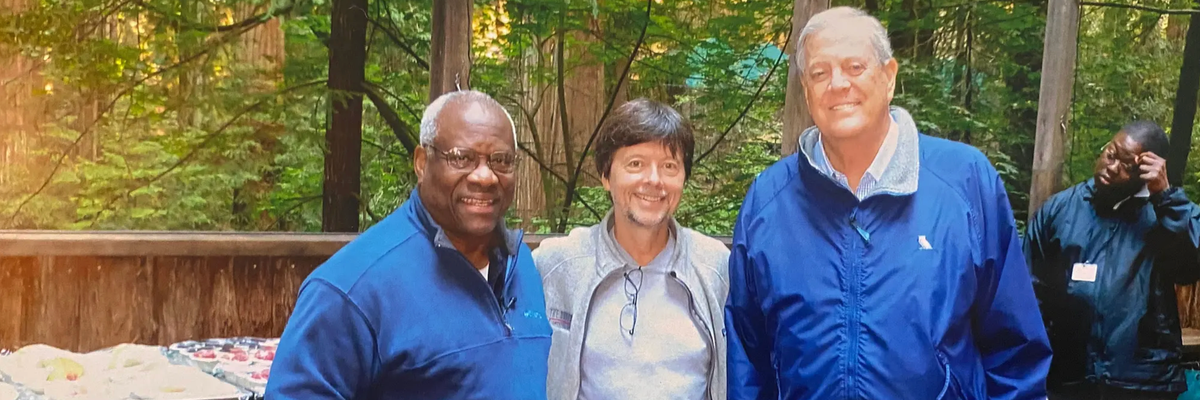
U.S. Supreme Court Justice Clarence Thomas (left) is pictured at the Bohemian Grove with billionaire industrialist David Koch (right) and documentary filmmaker Ken Burns (center).
The court is letting other government officials off the hook to shelter itself from scrutiny about the justices’ own deep-seated corruption.
Opinion by opinion, the U.S. Supreme Court has moved toward a judicial framework that insulates justices from growing public concern about their own corruption. In a series of cases, the court has overturned corruption convictions of public officials who received substantial gifts and other things of value in exchange for government favors in decisions that detail the officials’ egregious behavior and yet absolve them of it.
In his law review article “Corruption and the Supreme Court,” Georgetown law professor Josh Chafetz exposes the self-serving nature of these decisions: The court is letting other government officials off the hook to shelter itself from scrutiny about the justices’ own deep-seated corruption.
Professor Chafetz’s disturbing theory is borne out by the evidence. In five cases concerning public corruption heard within the past decade, the Supreme Court issued in each one an opinion that diminished anti-corruption statutes by either framing them as too broad and vague, or by recategorizing corrupt behavior as simple acts natural to government life. As Chafetz stated to The New York Times, which recently wrote an article about his work:
In all five of the decisions, the court’s message has been that “federal law must be interpreted so as not to cover behavior that looks, to any reasonable observer, sketchy as hell...” Taken together, he added, the decisions make a basic point and a more subtle one. The basic one, he said, is that “the justices keep letting crooked politicians off the hook.”
From honest services fraud to quid pro quo bribery, in case after case in which the Department of Justice, a U.S. district court, a unanimous jury, and a U.S. court of appeals have found the official’s conduct to be egregious enough to warrant a felony conviction, the Supreme Court has thrown out convictions and shielded government officials from accountability. And as Chafetz explained, it has done this to shield its own misconduct from criticism. The justices responsible for weakening our anti-corruption laws include not just Justices Samuel Alito and Clarence Thomas, whose records of lavish gifts have recently been exposed, but all justices who in at least some cases voted unanimously to throw out the convictions of corrupt government officials.
The Supreme Court’s forgiving rhetoric on corruption is not new. Its recent opinions emerge from dangerous precedent set in campaign finance law cases, like Citizens United. The Supreme Court has overlooked evidence of undue influence in elections by entities capable of vast political spending, and instead informed the federal and state governments that their only legitimate anti-corruption state interest is in blocking quid pro quo corruption or its appearance. That skyscraper bar, which notoriously is difficult to document, has proven deficient and led to unprecedented levels of campaign spending where the risk of corruption can only be higher. The court’s early refusal to enforce a thorough and meaningful framework of corruption created a slippery slope, unraveling corruption law altogether. And now, the Supreme Court is relieving public officials accused of serious misconduct at all levels.
The Supreme Court’s shocking leniency on matters of corruption does not quell growing concerns about public erosion of trust in government systems, but rather pushes to the public a reimagination of its own corruption as being equally ordinary. It is not. The Supreme Court’s tolerance of public corruption is a self-serving feat to insulate the justices from growing reports about the court’s own corruption. It must end now.
Dear Common Dreams reader, It’s been nearly 30 years since I co-founded Common Dreams with my late wife, Lina Newhouser. We had the radical notion that journalism should serve the public good, not corporate profits. It was clear to us from the outset what it would take to build such a project. No paid advertisements. No corporate sponsors. No millionaire publisher telling us what to think or do. Many people said we wouldn't last a year, but we proved those doubters wrong. Together with a tremendous team of journalists and dedicated staff, we built an independent media outlet free from the constraints of profits and corporate control. Our mission has always been simple: To inform. To inspire. To ignite change for the common good. Building Common Dreams was not easy. Our survival was never guaranteed. When you take on the most powerful forces—Wall Street greed, fossil fuel industry destruction, Big Tech lobbyists, and uber-rich oligarchs who have spent billions upon billions rigging the economy and democracy in their favor—the only bulwark you have is supporters who believe in your work. But here’s the urgent message from me today. It's never been this bad out there. And it's never been this hard to keep us going. At the very moment Common Dreams is most needed, the threats we face are intensifying. We need your support now more than ever. We don't accept corporate advertising and never will. We don't have a paywall because we don't think people should be blocked from critical news based on their ability to pay. Everything we do is funded by the donations of readers like you. When everyone does the little they can afford, we are strong. But if that support retreats or dries up, so do we. Will you donate now to make sure Common Dreams not only survives but thrives? —Craig Brown, Co-founder |
Opinion by opinion, the U.S. Supreme Court has moved toward a judicial framework that insulates justices from growing public concern about their own corruption. In a series of cases, the court has overturned corruption convictions of public officials who received substantial gifts and other things of value in exchange for government favors in decisions that detail the officials’ egregious behavior and yet absolve them of it.
In his law review article “Corruption and the Supreme Court,” Georgetown law professor Josh Chafetz exposes the self-serving nature of these decisions: The court is letting other government officials off the hook to shelter itself from scrutiny about the justices’ own deep-seated corruption.
Professor Chafetz’s disturbing theory is borne out by the evidence. In five cases concerning public corruption heard within the past decade, the Supreme Court issued in each one an opinion that diminished anti-corruption statutes by either framing them as too broad and vague, or by recategorizing corrupt behavior as simple acts natural to government life. As Chafetz stated to The New York Times, which recently wrote an article about his work:
In all five of the decisions, the court’s message has been that “federal law must be interpreted so as not to cover behavior that looks, to any reasonable observer, sketchy as hell...” Taken together, he added, the decisions make a basic point and a more subtle one. The basic one, he said, is that “the justices keep letting crooked politicians off the hook.”
From honest services fraud to quid pro quo bribery, in case after case in which the Department of Justice, a U.S. district court, a unanimous jury, and a U.S. court of appeals have found the official’s conduct to be egregious enough to warrant a felony conviction, the Supreme Court has thrown out convictions and shielded government officials from accountability. And as Chafetz explained, it has done this to shield its own misconduct from criticism. The justices responsible for weakening our anti-corruption laws include not just Justices Samuel Alito and Clarence Thomas, whose records of lavish gifts have recently been exposed, but all justices who in at least some cases voted unanimously to throw out the convictions of corrupt government officials.
The Supreme Court’s forgiving rhetoric on corruption is not new. Its recent opinions emerge from dangerous precedent set in campaign finance law cases, like Citizens United. The Supreme Court has overlooked evidence of undue influence in elections by entities capable of vast political spending, and instead informed the federal and state governments that their only legitimate anti-corruption state interest is in blocking quid pro quo corruption or its appearance. That skyscraper bar, which notoriously is difficult to document, has proven deficient and led to unprecedented levels of campaign spending where the risk of corruption can only be higher. The court’s early refusal to enforce a thorough and meaningful framework of corruption created a slippery slope, unraveling corruption law altogether. And now, the Supreme Court is relieving public officials accused of serious misconduct at all levels.
The Supreme Court’s shocking leniency on matters of corruption does not quell growing concerns about public erosion of trust in government systems, but rather pushes to the public a reimagination of its own corruption as being equally ordinary. It is not. The Supreme Court’s tolerance of public corruption is a self-serving feat to insulate the justices from growing reports about the court’s own corruption. It must end now.
Opinion by opinion, the U.S. Supreme Court has moved toward a judicial framework that insulates justices from growing public concern about their own corruption. In a series of cases, the court has overturned corruption convictions of public officials who received substantial gifts and other things of value in exchange for government favors in decisions that detail the officials’ egregious behavior and yet absolve them of it.
In his law review article “Corruption and the Supreme Court,” Georgetown law professor Josh Chafetz exposes the self-serving nature of these decisions: The court is letting other government officials off the hook to shelter itself from scrutiny about the justices’ own deep-seated corruption.
Professor Chafetz’s disturbing theory is borne out by the evidence. In five cases concerning public corruption heard within the past decade, the Supreme Court issued in each one an opinion that diminished anti-corruption statutes by either framing them as too broad and vague, or by recategorizing corrupt behavior as simple acts natural to government life. As Chafetz stated to The New York Times, which recently wrote an article about his work:
In all five of the decisions, the court’s message has been that “federal law must be interpreted so as not to cover behavior that looks, to any reasonable observer, sketchy as hell...” Taken together, he added, the decisions make a basic point and a more subtle one. The basic one, he said, is that “the justices keep letting crooked politicians off the hook.”
From honest services fraud to quid pro quo bribery, in case after case in which the Department of Justice, a U.S. district court, a unanimous jury, and a U.S. court of appeals have found the official’s conduct to be egregious enough to warrant a felony conviction, the Supreme Court has thrown out convictions and shielded government officials from accountability. And as Chafetz explained, it has done this to shield its own misconduct from criticism. The justices responsible for weakening our anti-corruption laws include not just Justices Samuel Alito and Clarence Thomas, whose records of lavish gifts have recently been exposed, but all justices who in at least some cases voted unanimously to throw out the convictions of corrupt government officials.
The Supreme Court’s forgiving rhetoric on corruption is not new. Its recent opinions emerge from dangerous precedent set in campaign finance law cases, like Citizens United. The Supreme Court has overlooked evidence of undue influence in elections by entities capable of vast political spending, and instead informed the federal and state governments that their only legitimate anti-corruption state interest is in blocking quid pro quo corruption or its appearance. That skyscraper bar, which notoriously is difficult to document, has proven deficient and led to unprecedented levels of campaign spending where the risk of corruption can only be higher. The court’s early refusal to enforce a thorough and meaningful framework of corruption created a slippery slope, unraveling corruption law altogether. And now, the Supreme Court is relieving public officials accused of serious misconduct at all levels.
The Supreme Court’s shocking leniency on matters of corruption does not quell growing concerns about public erosion of trust in government systems, but rather pushes to the public a reimagination of its own corruption as being equally ordinary. It is not. The Supreme Court’s tolerance of public corruption is a self-serving feat to insulate the justices from growing reports about the court’s own corruption. It must end now.