
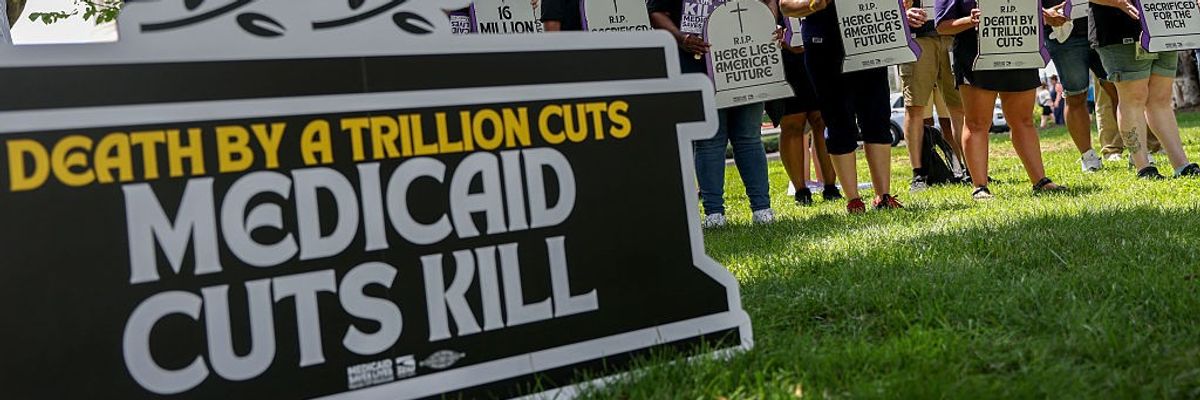
Workers from Service Employees International Union protest the proposed Republican Medicaid cuts near the US Capitol building on June 23, 2025, in Washington, DC.
How States and Cities Can Take Care of Those Left Behind by the GOP’s Big Ugly Bill
With Trump and Congress turning their backs on American families, states have to rise to the moment.
The new tax law US President Donald Trump and congressional Republicans passed this summer drastically reduces taxes on the wealthiest, slashes essential spending, and adds over $4 trillion to the deficit over a decade.
The law weakens healthcare and food assistance more than any legislation in history. Combined with tax cuts that give a whopping $1 trillion to the richest 1%, no law has ever done so much to enrich the wealthy while hurting those of modest income.
What does it mean for your state and community? For starters, states will lose billions in federal funding for healthcare, food, and other necessities.
Federal funds provided more than 1 of every 3 dollars that states spent last year—and much more in places like Mississippi, Indiana, and South Dakota. In Louisiana, federal aid delivers fully half of state spending. But we’re likely to see layoffs of federal employees in every state—and potentially of state and local employees whose paychecks rely on federal dollars, too.
All in all, this law will leave our communities sicker, less educated, and less safe.
For families, it means less access to the basics.
Hospitals and nonprofits (like food banks) depend on federal funding and will reduce staff at best and shutter at worst. More than 300 rural hospitals face likely elimination. And because of Trump’s healthcare cuts, more than 50,000 Americans will die early every single year.
In addition to these cuts, Trump has also illegally withheld congressionally authorized funding for healthcare, Head Start, child care, disease control, disability services, and more, causing crises at organizations nationwide.
Funding is also getting cut for community colleges, four-year universities, financial aid, loans, and first-generation students. This will block access to degrees for working class kids coast to coast.
Federal emergency funding, long the bedrock of state response to floods, hurricanes, and other disasters, is also on the chopping block—meaning more devastation, less recovery, and billions in costs shifted to states. Transportation projects will stall too, harming commuters and construction jobs.
All in all, this law will leave our communities sicker, less educated, and less safe.
Only the federal government can raise sufficient funds from those most able to pay and distribute them to poorer states like Alabama, Mississippi, and West Virginia, who have less capacity to raise dollars locally.
But policymakers can fill some of the gap with improved state and local taxation. With Trump and Congress turning their backs on American families, states have to rise to the moment.
States have many options.
They can raise more by bolstering income taxes on the wealthiest—policies that have won recently in Maryland, Massachusetts, New Jersey, and Minnesota. They can also tax income from wealth by improving capital gains income taxation. Washington, Maryland, Minnesota, and New Mexico have passed such reforms recently.
And they can stop corporations from hiding profits in other states, as most states now do, or in other countries, something innovators are increasingly proposing.
Localities have options too: enacting mansion taxes, as cities in California, Connecticut, Illinois, Maryland, New Mexico, and New York have done, and passing local income taxes as thousands of communities in Ohio, Indiana, and 13 other states do. At the very least, local policymakers could rein in costly corporate tax breaks that shortchange schools.
Tax dollars pay for essentials that make America healthy, educated, and safe. If Trump and his allies slash those fundamentals to enrich the richest, we must insist that states and cities get creative in taking care of the rest of us.
We are at a crossroads
This country and this world are at a monumental crossroads. In a few short weeks, US voters will have an opportunity to beat back the forces of fascism and confront the billionaires who are rigging the economy, our media system, and our democracy, making it increasingly impossible for ordinary people to get by. We’re not just talking about the election. We’re talking about what must be done once these fascist elements are vanquished from power. We need a bolder set of solutions than what either major party has so far been willing to offer and a working-class movement ready to fight like hell for it. Trump didn't emerge from nowhere. The conditions that fueled MAGA authoritarianism were created by decades of radical neoliberal economic policies and a corrupt political system dominated by corporate interests. They slashed taxes on the super-rich, promising that the benefits would trickle down. They said giveaways to the corporate titans would make life more affordable for the rest of us. It was all bullshit. And when a bitter, betrayed populace searches for someone to blame, right-wing demagogues have little trouble finding scapegoats. People know when they're being lied to, but you won't hear any of this from the corporate media. Only independent journalism—powered and funded by people who believe in building a better world—can deliver truly trustworthy daily news. Our Fall Campaign is underway, and we need your help. To power our newsroom through the rest of the year, we need to raise $125,000 by midnight on October 31. So if you share our vision, please contribute whatever you can to sustain our work. |
The new tax law US President Donald Trump and congressional Republicans passed this summer drastically reduces taxes on the wealthiest, slashes essential spending, and adds over $4 trillion to the deficit over a decade.
The law weakens healthcare and food assistance more than any legislation in history. Combined with tax cuts that give a whopping $1 trillion to the richest 1%, no law has ever done so much to enrich the wealthy while hurting those of modest income.
What does it mean for your state and community? For starters, states will lose billions in federal funding for healthcare, food, and other necessities.
Federal funds provided more than 1 of every 3 dollars that states spent last year—and much more in places like Mississippi, Indiana, and South Dakota. In Louisiana, federal aid delivers fully half of state spending. But we’re likely to see layoffs of federal employees in every state—and potentially of state and local employees whose paychecks rely on federal dollars, too.
All in all, this law will leave our communities sicker, less educated, and less safe.
For families, it means less access to the basics.
Hospitals and nonprofits (like food banks) depend on federal funding and will reduce staff at best and shutter at worst. More than 300 rural hospitals face likely elimination. And because of Trump’s healthcare cuts, more than 50,000 Americans will die early every single year.
In addition to these cuts, Trump has also illegally withheld congressionally authorized funding for healthcare, Head Start, child care, disease control, disability services, and more, causing crises at organizations nationwide.
Funding is also getting cut for community colleges, four-year universities, financial aid, loans, and first-generation students. This will block access to degrees for working class kids coast to coast.
Federal emergency funding, long the bedrock of state response to floods, hurricanes, and other disasters, is also on the chopping block—meaning more devastation, less recovery, and billions in costs shifted to states. Transportation projects will stall too, harming commuters and construction jobs.
All in all, this law will leave our communities sicker, less educated, and less safe.
Only the federal government can raise sufficient funds from those most able to pay and distribute them to poorer states like Alabama, Mississippi, and West Virginia, who have less capacity to raise dollars locally.
But policymakers can fill some of the gap with improved state and local taxation. With Trump and Congress turning their backs on American families, states have to rise to the moment.
States have many options.
They can raise more by bolstering income taxes on the wealthiest—policies that have won recently in Maryland, Massachusetts, New Jersey, and Minnesota. They can also tax income from wealth by improving capital gains income taxation. Washington, Maryland, Minnesota, and New Mexico have passed such reforms recently.
And they can stop corporations from hiding profits in other states, as most states now do, or in other countries, something innovators are increasingly proposing.
Localities have options too: enacting mansion taxes, as cities in California, Connecticut, Illinois, Maryland, New Mexico, and New York have done, and passing local income taxes as thousands of communities in Ohio, Indiana, and 13 other states do. At the very least, local policymakers could rein in costly corporate tax breaks that shortchange schools.
Tax dollars pay for essentials that make America healthy, educated, and safe. If Trump and his allies slash those fundamentals to enrich the richest, we must insist that states and cities get creative in taking care of the rest of us.
- 'Not Going Anywhere': Poor, Low-wealth People From Over 40 States Demand Nation's Attention During DC Assembly ›
- Trump's GOP Megabill Slams Door on Progress of the 20th Century ›
- The Billionaire Oligarchs Are Dancing in the Street ›
- The Republican Nursing Home Apocalypse ›
- Outrage Pours in After House GOP Approves 'One of the Most Catastrophic Bills Passed in Modern History' ›
- Tens of Thousands March Against 'Big Ugly Budget Bill' With Call to Put 'Families First' ›
The new tax law US President Donald Trump and congressional Republicans passed this summer drastically reduces taxes on the wealthiest, slashes essential spending, and adds over $4 trillion to the deficit over a decade.
The law weakens healthcare and food assistance more than any legislation in history. Combined with tax cuts that give a whopping $1 trillion to the richest 1%, no law has ever done so much to enrich the wealthy while hurting those of modest income.
What does it mean for your state and community? For starters, states will lose billions in federal funding for healthcare, food, and other necessities.
Federal funds provided more than 1 of every 3 dollars that states spent last year—and much more in places like Mississippi, Indiana, and South Dakota. In Louisiana, federal aid delivers fully half of state spending. But we’re likely to see layoffs of federal employees in every state—and potentially of state and local employees whose paychecks rely on federal dollars, too.
All in all, this law will leave our communities sicker, less educated, and less safe.
For families, it means less access to the basics.
Hospitals and nonprofits (like food banks) depend on federal funding and will reduce staff at best and shutter at worst. More than 300 rural hospitals face likely elimination. And because of Trump’s healthcare cuts, more than 50,000 Americans will die early every single year.
In addition to these cuts, Trump has also illegally withheld congressionally authorized funding for healthcare, Head Start, child care, disease control, disability services, and more, causing crises at organizations nationwide.
Funding is also getting cut for community colleges, four-year universities, financial aid, loans, and first-generation students. This will block access to degrees for working class kids coast to coast.
Federal emergency funding, long the bedrock of state response to floods, hurricanes, and other disasters, is also on the chopping block—meaning more devastation, less recovery, and billions in costs shifted to states. Transportation projects will stall too, harming commuters and construction jobs.
All in all, this law will leave our communities sicker, less educated, and less safe.
Only the federal government can raise sufficient funds from those most able to pay and distribute them to poorer states like Alabama, Mississippi, and West Virginia, who have less capacity to raise dollars locally.
But policymakers can fill some of the gap with improved state and local taxation. With Trump and Congress turning their backs on American families, states have to rise to the moment.
States have many options.
They can raise more by bolstering income taxes on the wealthiest—policies that have won recently in Maryland, Massachusetts, New Jersey, and Minnesota. They can also tax income from wealth by improving capital gains income taxation. Washington, Maryland, Minnesota, and New Mexico have passed such reforms recently.
And they can stop corporations from hiding profits in other states, as most states now do, or in other countries, something innovators are increasingly proposing.
Localities have options too: enacting mansion taxes, as cities in California, Connecticut, Illinois, Maryland, New Mexico, and New York have done, and passing local income taxes as thousands of communities in Ohio, Indiana, and 13 other states do. At the very least, local policymakers could rein in costly corporate tax breaks that shortchange schools.
Tax dollars pay for essentials that make America healthy, educated, and safe. If Trump and his allies slash those fundamentals to enrich the richest, we must insist that states and cities get creative in taking care of the rest of us.
- 'Not Going Anywhere': Poor, Low-wealth People From Over 40 States Demand Nation's Attention During DC Assembly ›
- Trump's GOP Megabill Slams Door on Progress of the 20th Century ›
- The Billionaire Oligarchs Are Dancing in the Street ›
- The Republican Nursing Home Apocalypse ›
- Outrage Pours in After House GOP Approves 'One of the Most Catastrophic Bills Passed in Modern History' ›
- Tens of Thousands March Against 'Big Ugly Budget Bill' With Call to Put 'Families First' ›