5
#000000
#FFFFFF
To donate by check, phone, or other method, see our More Ways to Give page.
Daily news & progressive opinion—funded by the people, not the corporations—delivered straight to your inbox.
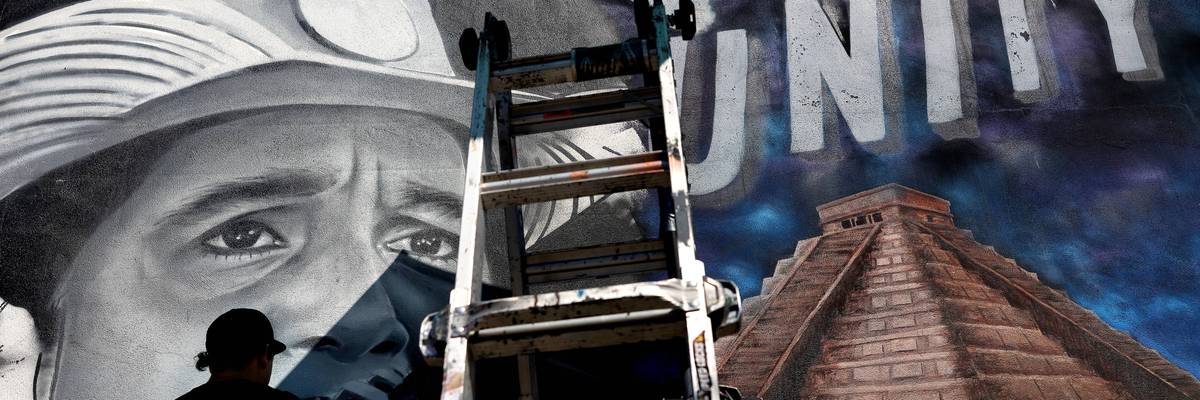
Artist MisterAlek replaces a portrait of Cesar Chavez, in a mural that he created in 2021, with a portrait of Delores Huerta, at the Watts/Century Latino Organization in Los Angeles on Friday, March 20, 2026.
If we are serious about building a world where women have equal power—economic, political, and personal—then we have to be serious about accountability within our own ranks
In the span of a month, two stories have laid bare an uncomfortable truth about progressive politics: Too many people will protect powerful men at the expense of the women they harm, whether to protect a movement, a party, or because they’ve been conditioned to believe this is how power works.
Rep. Eric Swalwell (D-Calif.) announced his resignation from Congress last Month after multiple women came forward with allegations of sexual harassment and assault. March’s revelation by Dolores Huerta that iconic labor leader Cesar Chavez sexually abused girls and women for decades is still reverberating through communities that revered him. In both cases, the pattern is the same: Whisper networks carried warnings for years, but survivors who came forward were silenced or discredited for the sake of the “greater good.”
Why? Because Swalwell was seen as a rising Democratic star, a useful weapon against President Donald Trump. Because Chavez was a civil rights icon whose legacy anchored an entire movement. Because people convinced themselves that exposing the truth would do more damage than burying it.
They were wrong. Silence doesn’t protect movements, it protects oppressors. It tells every woman who has been harassed, groped, or assaulted by a powerful man on “our side” that her pain is an acceptable cost of doing business.
Letting people in power abuse women is never acceptable, regardless of party, regardless of legacy, regardless of how inconvenient the timing might feel.
We have seen this calculation before—the quiet bargain where accountability is sacrificed on the altar of political convenience. It never works. The truth always surfaces. And when it does, the cover-up inflicts its own damage, compounding the harm to survivors and eroding the moral authority these movements depend on.
Consider the moment we’re in. We have a president who was found liable by a jury for sexually abusing a woman, and accused by at least 28 others, and has faced no meaningful consequences for it. A president who has made clear, through word and policy, that he believes powerful men can do whatever they want. His administration is rolling back decades of progress on combatting sexual harassment and assault in workplaces and schools; gutting protections against discrimination; and dismantling the legal infrastructure women depend on for safe, equitable workplaces. The Supreme Court, made up of one-third of Trump appointees, is the first since the 1950s to rule against women and people of color in a majority of civil rights cases.
This is the landscape women are navigating right now. And into this landscape, we are supposed to accept that the men or other abusers on “our side” get a pass? No.
If we are serious about building a world where women have equal power—economic, political, and personal—then we have to be serious about accountability within our own ranks. Not because it’s easy, but because the alternative is corrosive. Every time we look the other way, we tell the next generation that a woman’s safety matters less than a man’s career. We weaken the very movements we claim to be protecting.
The women who came forward about Swalwell, including content creators who had no institutional backing, no legal team—just their own platforms and conviction—showed extraordinary courage. So did the survivors who finally broke decades of silence about Chavez. They did what the political establishment was unwilling to do. They chose the truth.
The lesson here is not that our movements are broken. It’s that they are only as strong as our willingness to hold everyone in them accountable. Letting people in power abuse women is never acceptable, regardless of party, regardless of legacy, regardless of how inconvenient the timing might feel.
We are in a fight for women’s futures in this country. That fight requires moral clarity. It requires us to stop treating accountability as a threat and start treating it as the foundation. Good things, lasting things, come from doing what is right, even when it’s hard. Especially when it’s hard.
Dear Common Dreams reader, It’s been nearly 30 years since I co-founded Common Dreams with my late wife, Lina Newhouser. We had the radical notion that journalism should serve the public good, not corporate profits. It was clear to us from the outset what it would take to build such a project. No paid advertisements. No corporate sponsors. No millionaire publisher telling us what to think or do. Many people said we wouldn't last a year, but we proved those doubters wrong. Together with a tremendous team of journalists and dedicated staff, we built an independent media outlet free from the constraints of profits and corporate control. Our mission has always been simple: To inform. To inspire. To ignite change for the common good. Building Common Dreams was not easy. Our survival was never guaranteed. When you take on the most powerful forces—Wall Street greed, fossil fuel industry destruction, Big Tech lobbyists, and uber-rich oligarchs who have spent billions upon billions rigging the economy and democracy in their favor—the only bulwark you have is supporters who believe in your work. But here’s the urgent message from me today. It's never been this bad out there. And it's never been this hard to keep us going. At the very moment Common Dreams is most needed, the threats we face are intensifying. We need your support now more than ever. We don't accept corporate advertising and never will. We don't have a paywall because we don't think people should be blocked from critical news based on their ability to pay. Everything we do is funded by the donations of readers like you. When everyone does the little they can afford, we are strong. But if that support retreats or dries up, so do we. Will you donate now to make sure Common Dreams not only survives but thrives? —Craig Brown, Co-founder |
In the span of a month, two stories have laid bare an uncomfortable truth about progressive politics: Too many people will protect powerful men at the expense of the women they harm, whether to protect a movement, a party, or because they’ve been conditioned to believe this is how power works.
Rep. Eric Swalwell (D-Calif.) announced his resignation from Congress last Month after multiple women came forward with allegations of sexual harassment and assault. March’s revelation by Dolores Huerta that iconic labor leader Cesar Chavez sexually abused girls and women for decades is still reverberating through communities that revered him. In both cases, the pattern is the same: Whisper networks carried warnings for years, but survivors who came forward were silenced or discredited for the sake of the “greater good.”
Why? Because Swalwell was seen as a rising Democratic star, a useful weapon against President Donald Trump. Because Chavez was a civil rights icon whose legacy anchored an entire movement. Because people convinced themselves that exposing the truth would do more damage than burying it.
They were wrong. Silence doesn’t protect movements, it protects oppressors. It tells every woman who has been harassed, groped, or assaulted by a powerful man on “our side” that her pain is an acceptable cost of doing business.
Letting people in power abuse women is never acceptable, regardless of party, regardless of legacy, regardless of how inconvenient the timing might feel.
We have seen this calculation before—the quiet bargain where accountability is sacrificed on the altar of political convenience. It never works. The truth always surfaces. And when it does, the cover-up inflicts its own damage, compounding the harm to survivors and eroding the moral authority these movements depend on.
Consider the moment we’re in. We have a president who was found liable by a jury for sexually abusing a woman, and accused by at least 28 others, and has faced no meaningful consequences for it. A president who has made clear, through word and policy, that he believes powerful men can do whatever they want. His administration is rolling back decades of progress on combatting sexual harassment and assault in workplaces and schools; gutting protections against discrimination; and dismantling the legal infrastructure women depend on for safe, equitable workplaces. The Supreme Court, made up of one-third of Trump appointees, is the first since the 1950s to rule against women and people of color in a majority of civil rights cases.
This is the landscape women are navigating right now. And into this landscape, we are supposed to accept that the men or other abusers on “our side” get a pass? No.
If we are serious about building a world where women have equal power—economic, political, and personal—then we have to be serious about accountability within our own ranks. Not because it’s easy, but because the alternative is corrosive. Every time we look the other way, we tell the next generation that a woman’s safety matters less than a man’s career. We weaken the very movements we claim to be protecting.
The women who came forward about Swalwell, including content creators who had no institutional backing, no legal team—just their own platforms and conviction—showed extraordinary courage. So did the survivors who finally broke decades of silence about Chavez. They did what the political establishment was unwilling to do. They chose the truth.
The lesson here is not that our movements are broken. It’s that they are only as strong as our willingness to hold everyone in them accountable. Letting people in power abuse women is never acceptable, regardless of party, regardless of legacy, regardless of how inconvenient the timing might feel.
We are in a fight for women’s futures in this country. That fight requires moral clarity. It requires us to stop treating accountability as a threat and start treating it as the foundation. Good things, lasting things, come from doing what is right, even when it’s hard. Especially when it’s hard.
In the span of a month, two stories have laid bare an uncomfortable truth about progressive politics: Too many people will protect powerful men at the expense of the women they harm, whether to protect a movement, a party, or because they’ve been conditioned to believe this is how power works.
Rep. Eric Swalwell (D-Calif.) announced his resignation from Congress last Month after multiple women came forward with allegations of sexual harassment and assault. March’s revelation by Dolores Huerta that iconic labor leader Cesar Chavez sexually abused girls and women for decades is still reverberating through communities that revered him. In both cases, the pattern is the same: Whisper networks carried warnings for years, but survivors who came forward were silenced or discredited for the sake of the “greater good.”
Why? Because Swalwell was seen as a rising Democratic star, a useful weapon against President Donald Trump. Because Chavez was a civil rights icon whose legacy anchored an entire movement. Because people convinced themselves that exposing the truth would do more damage than burying it.
They were wrong. Silence doesn’t protect movements, it protects oppressors. It tells every woman who has been harassed, groped, or assaulted by a powerful man on “our side” that her pain is an acceptable cost of doing business.
Letting people in power abuse women is never acceptable, regardless of party, regardless of legacy, regardless of how inconvenient the timing might feel.
We have seen this calculation before—the quiet bargain where accountability is sacrificed on the altar of political convenience. It never works. The truth always surfaces. And when it does, the cover-up inflicts its own damage, compounding the harm to survivors and eroding the moral authority these movements depend on.
Consider the moment we’re in. We have a president who was found liable by a jury for sexually abusing a woman, and accused by at least 28 others, and has faced no meaningful consequences for it. A president who has made clear, through word and policy, that he believes powerful men can do whatever they want. His administration is rolling back decades of progress on combatting sexual harassment and assault in workplaces and schools; gutting protections against discrimination; and dismantling the legal infrastructure women depend on for safe, equitable workplaces. The Supreme Court, made up of one-third of Trump appointees, is the first since the 1950s to rule against women and people of color in a majority of civil rights cases.
This is the landscape women are navigating right now. And into this landscape, we are supposed to accept that the men or other abusers on “our side” get a pass? No.
If we are serious about building a world where women have equal power—economic, political, and personal—then we have to be serious about accountability within our own ranks. Not because it’s easy, but because the alternative is corrosive. Every time we look the other way, we tell the next generation that a woman’s safety matters less than a man’s career. We weaken the very movements we claim to be protecting.
The women who came forward about Swalwell, including content creators who had no institutional backing, no legal team—just their own platforms and conviction—showed extraordinary courage. So did the survivors who finally broke decades of silence about Chavez. They did what the political establishment was unwilling to do. They chose the truth.
The lesson here is not that our movements are broken. It’s that they are only as strong as our willingness to hold everyone in them accountable. Letting people in power abuse women is never acceptable, regardless of party, regardless of legacy, regardless of how inconvenient the timing might feel.
We are in a fight for women’s futures in this country. That fight requires moral clarity. It requires us to stop treating accountability as a threat and start treating it as the foundation. Good things, lasting things, come from doing what is right, even when it’s hard. Especially when it’s hard.