
The Cautionary Tale of Saikat Chakrabarti
The campaign did not turn out as hoped for the individual who helped catapult Alexandria Ocasio-Cortez into Congress and co-founded Justice Democrats.
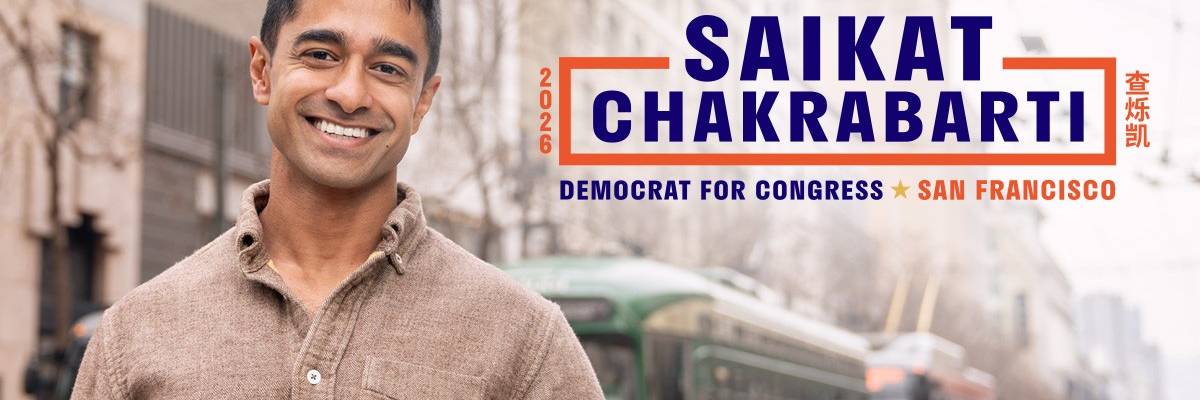
As those active in the field will often say, politics is a tough business – it ain’t for everyone. Saikat Chakrabarti, would-be successor to retiring San Francisco Representative and past Speaker of the House Nancy Pelosi, is a recent case in point: a candidate who seemed a perfect fit for the city’s political scene, yet failed to win one of the two slots in the November final. What is unusual about the Chakrabarti story is while we’re all too familiar with political figures who have mastered the art of winning and holding office at the expense of developing a clear vision of why they’re doing it, his problem has largely been the reverse.
Chakrabarti brought two major assets to the race: ideas and money. Some of his past ideas had been quite impactful. After significant involvement in Bernie Sanders’ seminal 2016 presidential campaign, he co-founded Brand New Congress to recruit new congressional candidates, one of whom was Alexandria Ocasio-Cortez. While Brand New Congress proved ephemeral, Justice Democrats, a subsequent organization he also co-founded, has proven to have staying power, continuing to promote Sanders-stripe candidates – with notable successes. Chakrabarti’s money derives from his role as a founding engineer of the then-start-up Stripe, a payments processing company. He is known to be a centimillionaire.
The connection with Ocasio-Cortez went on to became substantial, as he served as her campaign manager, chief of staff following her 2018 upset election to Congress, and a principal in the formulation of the Green New Deal legislation that she introduced in the House. Unfortunately, Chakrabarti himself did not fare so well within the walls of the House as he had without. He soon drew fire within the Democratic Caucus for sending out tweets criticizing other House members by name. Although he had previously shown great facility in dealing with both “big picture” political questions as well as the mechanics of campaigning, the curriculum doesn’t stop there. What he had apparently failed to understand was that while members of Congress may choose to criticize their colleagues by name, their staff are not expected to do so without the approval of the elected representative. Before her first year in office was out, he and Ocasio-Cortez would part ways. He went on to work on Green New Deal-type issues in an outside organization. Neither would subsequently speak in great detail about the parting. She did not endorse his congressional run.
In October 2025, Chakrabarti formally announced his candidacy for the San Francisco congressional seat. It was widely expected that the Speaker Emerita would not be running for re-election, but then she had surprised many by running for the term she was now serving after losing the speakership to the Republicans and stepping down from party leadership – and had made no statement regarding her 2026 intentions. Chakrabarti’s move forced the hand of State Senator Scott Wiener whose desire to succeed Pelosi was well known. (It had also previously been widely assumed that when Wiener did run he would ultimately get the nod of the Pelosi-Willie Brown establishment wing of the party, something that did not happen, presumably in part due to his announcing for the seat before Pelosi indicated her intention to leave it.)
To one unfamiliar with the details of San Francisco politics the Chakrabarti candidacy would likely have seemed a welcome development for the a left that has long been frustrated by city’s domination by what they considered the corporate-oriented wing of the Democratic Party – here was a big picture candidate with the capacity to run a high budget campaign. (Chakrabarti put in something like $10 million of his own money over the course of the campaign.) And he even seemed to recognize the fundamental truth that the wealthy will generally deny to their dying days – that all value comes from labor, telling supporters at his kick-off rally, “I ended up making a lot of money, and that was a profoundly weird and radicalizing experience,” but “I did not work harder than my teacher or a nurse or the people cleaning our offices ...I just won the startup lottery.”
But the campaign did not turn out as hoped. At the time of this writing the latest tally shows him at 17 percent, trailing Weiner at 41 percent and Supervisor Connie Chan at 29 percent. Chan, who much of the city’s left ultimately rallied around, might never have run if Chakrabarti had actually proved to be that hoped-for candidate. So what went wrong? Well, for one thing it wasn’t that his potential base refused to vote for a wealthy candidate who appeared to be trying to buy the office. Billionaire gubernatorial candidate Tom Steyer, who spent over $200 million on his race, carried San Francisco by a 38-25 percent margin over statewide frontrunner Xavier Becerra, the voters apparently deciding that he been putting his ill-gotten gains to good use.
A San Francisco Chronicle post mortem maintained that Chakrabarti’s problem was that he didn’t meet the right people. An article painting the city’s politics as special – which they are, just like every other city’s politics are special – described “San Francisco’s bare-knuckled political scene that is famously described as a ‘knife-fight in a phone booth’” to which “San Francisco Democratic Party Chair Nancy Tung added a telling detail ... ‘It’s a knife fight in a phone booth where you know everybody in the phone booth.’” The article goes on to say that, “Chakrabarti didn’t reach out to Tung,” and “More surprisingly, he didn’t reach out to [former Supervisor Aaron] Peskin, who is deeply wired into the city’s left.” Here the Chronicle ever so slightly touches on the real story, one that was covered by the city’s online publications, particularly 48 Hills and Mission Local.
Unmentioned in the Chronicle article is the fact that Peskin had been the candidate of the left in the city’s 2024 mayoral election and not only did Chakrabarti fail to meet Peskin, but he supported his opponent, the winner and current mayor Daniel Lurie (who has just successfully led the opposition to a ballot question proposing an increase to the rate and scope of the city’s Overpaid Executive Tax that is levied on companies with executives making more than 100 times the median employee compensation.) Perhaps even more importantly though, Chakrabarti also supported the candidate who supplanted Dean Preston on the city’s Board of Supervisors. Preston, a member of the Democratic Socialists of America, had been the city’s elected official most prominently championing the type of politics that Chakrabarti proclaimed that he was all about. And not just did he support Bilal Mahmood against Preston in 2024, but he donated to his campaign funds – plural because while contributions to supervisorial races are limited to $500, candidates can and often do simultaneously run campaigns for the Democratic County Central Committee, a race run without that contribution limit – the money spent on one race obviously redounding to the benefit of both. Chakrabarti contributed not only the maximum $500 to Mahmood’s supervisorial campaign, but also an additional $10,000 to his successful DCCC campaign in which he ran on what 48 Hills called “the right-wing corporate slate that took over the local Democratic Party” – ironically the same one that Party Chair Nancy Tung ran on.
It’s an unfortunate story really. The tangle of policy, principle, friendship, relationships, and future prospects that may go into endorsement decisions can be a thorny matter for anyone involved in politics, but in this case the opposition to Preston was really not a close question. For many it was simply disqualifying – after all, if he was off on this, what else might he be off on? Absent such egregious errors Chakrabarti might have been the candidate the San Francisco left was hoping for; he was talking a more radical talk than Chan does. Hopefully he’ll go on to make further useful policy contributions. Who knows maybe he’ll even try the electoral route again some time. But if he does, maybe he will have learned by then that there’s more to it than just knowing which way you’d vote on the big bills. Politics is a tough business – it ain’t for everyone.
We are at a crossroads
This country and this world are at a monumental crossroads. In a few short weeks, US voters will have an opportunity to beat back the forces of fascism and confront the billionaires who are rigging the economy, our media system, and our democracy, making it increasingly impossible for ordinary people to get by. We’re not just talking about the election. We’re talking about what must be done once these fascist elements are vanquished from power. We need a bolder set of solutions than what either major party has so far been willing to offer and a working-class movement ready to fight like hell for it. Trump didn't emerge from nowhere. The conditions that fueled MAGA authoritarianism were created by decades of radical neoliberal economic policies and a corrupt political system dominated by corporate interests. They slashed taxes on the super-rich, promising that the benefits would trickle down. They said giveaways to the corporate titans would make life more affordable for the rest of us. It was all bullshit. And when a bitter, betrayed populace searches for someone to blame, right-wing demagogues have little trouble finding scapegoats. People know when they're being lied to, but you won't hear any of this from the corporate media. Only independent journalism—powered and funded by people who believe in building a better world—can deliver truly trustworthy daily news. Our Fall Campaign is underway, and we need your help. To power our newsroom through the rest of the year, we need to raise $125,000 by midnight on October 31. So if you share our vision, please contribute whatever you can to sustain our work. |
As those active in the field will often say, politics is a tough business – it ain’t for everyone. Saikat Chakrabarti, would-be successor to retiring San Francisco Representative and past Speaker of the House Nancy Pelosi, is a recent case in point: a candidate who seemed a perfect fit for the city’s political scene, yet failed to win one of the two slots in the November final. What is unusual about the Chakrabarti story is while we’re all too familiar with political figures who have mastered the art of winning and holding office at the expense of developing a clear vision of why they’re doing it, his problem has largely been the reverse.
Chakrabarti brought two major assets to the race: ideas and money. Some of his past ideas had been quite impactful. After significant involvement in Bernie Sanders’ seminal 2016 presidential campaign, he co-founded Brand New Congress to recruit new congressional candidates, one of whom was Alexandria Ocasio-Cortez. While Brand New Congress proved ephemeral, Justice Democrats, a subsequent organization he also co-founded, has proven to have staying power, continuing to promote Sanders-stripe candidates – with notable successes. Chakrabarti’s money derives from his role as a founding engineer of the then-start-up Stripe, a payments processing company. He is known to be a centimillionaire.
The connection with Ocasio-Cortez went on to became substantial, as he served as her campaign manager, chief of staff following her 2018 upset election to Congress, and a principal in the formulation of the Green New Deal legislation that she introduced in the House. Unfortunately, Chakrabarti himself did not fare so well within the walls of the House as he had without. He soon drew fire within the Democratic Caucus for sending out tweets criticizing other House members by name. Although he had previously shown great facility in dealing with both “big picture” political questions as well as the mechanics of campaigning, the curriculum doesn’t stop there. What he had apparently failed to understand was that while members of Congress may choose to criticize their colleagues by name, their staff are not expected to do so without the approval of the elected representative. Before her first year in office was out, he and Ocasio-Cortez would part ways. He went on to work on Green New Deal-type issues in an outside organization. Neither would subsequently speak in great detail about the parting. She did not endorse his congressional run.
In October 2025, Chakrabarti formally announced his candidacy for the San Francisco congressional seat. It was widely expected that the Speaker Emerita would not be running for re-election, but then she had surprised many by running for the term she was now serving after losing the speakership to the Republicans and stepping down from party leadership – and had made no statement regarding her 2026 intentions. Chakrabarti’s move forced the hand of State Senator Scott Wiener whose desire to succeed Pelosi was well known. (It had also previously been widely assumed that when Wiener did run he would ultimately get the nod of the Pelosi-Willie Brown establishment wing of the party, something that did not happen, presumably in part due to his announcing for the seat before Pelosi indicated her intention to leave it.)
To one unfamiliar with the details of San Francisco politics the Chakrabarti candidacy would likely have seemed a welcome development for the a left that has long been frustrated by city’s domination by what they considered the corporate-oriented wing of the Democratic Party – here was a big picture candidate with the capacity to run a high budget campaign. (Chakrabarti put in something like $10 million of his own money over the course of the campaign.) And he even seemed to recognize the fundamental truth that the wealthy will generally deny to their dying days – that all value comes from labor, telling supporters at his kick-off rally, “I ended up making a lot of money, and that was a profoundly weird and radicalizing experience,” but “I did not work harder than my teacher or a nurse or the people cleaning our offices ...I just won the startup lottery.”
But the campaign did not turn out as hoped. At the time of this writing the latest tally shows him at 17 percent, trailing Weiner at 41 percent and Supervisor Connie Chan at 29 percent. Chan, who much of the city’s left ultimately rallied around, might never have run if Chakrabarti had actually proved to be that hoped-for candidate. So what went wrong? Well, for one thing it wasn’t that his potential base refused to vote for a wealthy candidate who appeared to be trying to buy the office. Billionaire gubernatorial candidate Tom Steyer, who spent over $200 million on his race, carried San Francisco by a 38-25 percent margin over statewide frontrunner Xavier Becerra, the voters apparently deciding that he been putting his ill-gotten gains to good use.
A San Francisco Chronicle post mortem maintained that Chakrabarti’s problem was that he didn’t meet the right people. An article painting the city’s politics as special – which they are, just like every other city’s politics are special – described “San Francisco’s bare-knuckled political scene that is famously described as a ‘knife-fight in a phone booth’” to which “San Francisco Democratic Party Chair Nancy Tung added a telling detail ... ‘It’s a knife fight in a phone booth where you know everybody in the phone booth.’” The article goes on to say that, “Chakrabarti didn’t reach out to Tung,” and “More surprisingly, he didn’t reach out to [former Supervisor Aaron] Peskin, who is deeply wired into the city’s left.” Here the Chronicle ever so slightly touches on the real story, one that was covered by the city’s online publications, particularly 48 Hills and Mission Local.
Unmentioned in the Chronicle article is the fact that Peskin had been the candidate of the left in the city’s 2024 mayoral election and not only did Chakrabarti fail to meet Peskin, but he supported his opponent, the winner and current mayor Daniel Lurie (who has just successfully led the opposition to a ballot question proposing an increase to the rate and scope of the city’s Overpaid Executive Tax that is levied on companies with executives making more than 100 times the median employee compensation.) Perhaps even more importantly though, Chakrabarti also supported the candidate who supplanted Dean Preston on the city’s Board of Supervisors. Preston, a member of the Democratic Socialists of America, had been the city’s elected official most prominently championing the type of politics that Chakrabarti proclaimed that he was all about. And not just did he support Bilal Mahmood against Preston in 2024, but he donated to his campaign funds – plural because while contributions to supervisorial races are limited to $500, candidates can and often do simultaneously run campaigns for the Democratic County Central Committee, a race run without that contribution limit – the money spent on one race obviously redounding to the benefit of both. Chakrabarti contributed not only the maximum $500 to Mahmood’s supervisorial campaign, but also an additional $10,000 to his successful DCCC campaign in which he ran on what 48 Hills called “the right-wing corporate slate that took over the local Democratic Party” – ironically the same one that Party Chair Nancy Tung ran on.
It’s an unfortunate story really. The tangle of policy, principle, friendship, relationships, and future prospects that may go into endorsement decisions can be a thorny matter for anyone involved in politics, but in this case the opposition to Preston was really not a close question. For many it was simply disqualifying – after all, if he was off on this, what else might he be off on? Absent such egregious errors Chakrabarti might have been the candidate the San Francisco left was hoping for; he was talking a more radical talk than Chan does. Hopefully he’ll go on to make further useful policy contributions. Who knows maybe he’ll even try the electoral route again some time. But if he does, maybe he will have learned by then that there’s more to it than just knowing which way you’d vote on the big bills. Politics is a tough business – it ain’t for everyone.
As those active in the field will often say, politics is a tough business – it ain’t for everyone. Saikat Chakrabarti, would-be successor to retiring San Francisco Representative and past Speaker of the House Nancy Pelosi, is a recent case in point: a candidate who seemed a perfect fit for the city’s political scene, yet failed to win one of the two slots in the November final. What is unusual about the Chakrabarti story is while we’re all too familiar with political figures who have mastered the art of winning and holding office at the expense of developing a clear vision of why they’re doing it, his problem has largely been the reverse.
Chakrabarti brought two major assets to the race: ideas and money. Some of his past ideas had been quite impactful. After significant involvement in Bernie Sanders’ seminal 2016 presidential campaign, he co-founded Brand New Congress to recruit new congressional candidates, one of whom was Alexandria Ocasio-Cortez. While Brand New Congress proved ephemeral, Justice Democrats, a subsequent organization he also co-founded, has proven to have staying power, continuing to promote Sanders-stripe candidates – with notable successes. Chakrabarti’s money derives from his role as a founding engineer of the then-start-up Stripe, a payments processing company. He is known to be a centimillionaire.
The connection with Ocasio-Cortez went on to became substantial, as he served as her campaign manager, chief of staff following her 2018 upset election to Congress, and a principal in the formulation of the Green New Deal legislation that she introduced in the House. Unfortunately, Chakrabarti himself did not fare so well within the walls of the House as he had without. He soon drew fire within the Democratic Caucus for sending out tweets criticizing other House members by name. Although he had previously shown great facility in dealing with both “big picture” political questions as well as the mechanics of campaigning, the curriculum doesn’t stop there. What he had apparently failed to understand was that while members of Congress may choose to criticize their colleagues by name, their staff are not expected to do so without the approval of the elected representative. Before her first year in office was out, he and Ocasio-Cortez would part ways. He went on to work on Green New Deal-type issues in an outside organization. Neither would subsequently speak in great detail about the parting. She did not endorse his congressional run.
In October 2025, Chakrabarti formally announced his candidacy for the San Francisco congressional seat. It was widely expected that the Speaker Emerita would not be running for re-election, but then she had surprised many by running for the term she was now serving after losing the speakership to the Republicans and stepping down from party leadership – and had made no statement regarding her 2026 intentions. Chakrabarti’s move forced the hand of State Senator Scott Wiener whose desire to succeed Pelosi was well known. (It had also previously been widely assumed that when Wiener did run he would ultimately get the nod of the Pelosi-Willie Brown establishment wing of the party, something that did not happen, presumably in part due to his announcing for the seat before Pelosi indicated her intention to leave it.)
To one unfamiliar with the details of San Francisco politics the Chakrabarti candidacy would likely have seemed a welcome development for the a left that has long been frustrated by city’s domination by what they considered the corporate-oriented wing of the Democratic Party – here was a big picture candidate with the capacity to run a high budget campaign. (Chakrabarti put in something like $10 million of his own money over the course of the campaign.) And he even seemed to recognize the fundamental truth that the wealthy will generally deny to their dying days – that all value comes from labor, telling supporters at his kick-off rally, “I ended up making a lot of money, and that was a profoundly weird and radicalizing experience,” but “I did not work harder than my teacher or a nurse or the people cleaning our offices ...I just won the startup lottery.”
But the campaign did not turn out as hoped. At the time of this writing the latest tally shows him at 17 percent, trailing Weiner at 41 percent and Supervisor Connie Chan at 29 percent. Chan, who much of the city’s left ultimately rallied around, might never have run if Chakrabarti had actually proved to be that hoped-for candidate. So what went wrong? Well, for one thing it wasn’t that his potential base refused to vote for a wealthy candidate who appeared to be trying to buy the office. Billionaire gubernatorial candidate Tom Steyer, who spent over $200 million on his race, carried San Francisco by a 38-25 percent margin over statewide frontrunner Xavier Becerra, the voters apparently deciding that he been putting his ill-gotten gains to good use.
A San Francisco Chronicle post mortem maintained that Chakrabarti’s problem was that he didn’t meet the right people. An article painting the city’s politics as special – which they are, just like every other city’s politics are special – described “San Francisco’s bare-knuckled political scene that is famously described as a ‘knife-fight in a phone booth’” to which “San Francisco Democratic Party Chair Nancy Tung added a telling detail ... ‘It’s a knife fight in a phone booth where you know everybody in the phone booth.’” The article goes on to say that, “Chakrabarti didn’t reach out to Tung,” and “More surprisingly, he didn’t reach out to [former Supervisor Aaron] Peskin, who is deeply wired into the city’s left.” Here the Chronicle ever so slightly touches on the real story, one that was covered by the city’s online publications, particularly 48 Hills and Mission Local.
Unmentioned in the Chronicle article is the fact that Peskin had been the candidate of the left in the city’s 2024 mayoral election and not only did Chakrabarti fail to meet Peskin, but he supported his opponent, the winner and current mayor Daniel Lurie (who has just successfully led the opposition to a ballot question proposing an increase to the rate and scope of the city’s Overpaid Executive Tax that is levied on companies with executives making more than 100 times the median employee compensation.) Perhaps even more importantly though, Chakrabarti also supported the candidate who supplanted Dean Preston on the city’s Board of Supervisors. Preston, a member of the Democratic Socialists of America, had been the city’s elected official most prominently championing the type of politics that Chakrabarti proclaimed that he was all about. And not just did he support Bilal Mahmood against Preston in 2024, but he donated to his campaign funds – plural because while contributions to supervisorial races are limited to $500, candidates can and often do simultaneously run campaigns for the Democratic County Central Committee, a race run without that contribution limit – the money spent on one race obviously redounding to the benefit of both. Chakrabarti contributed not only the maximum $500 to Mahmood’s supervisorial campaign, but also an additional $10,000 to his successful DCCC campaign in which he ran on what 48 Hills called “the right-wing corporate slate that took over the local Democratic Party” – ironically the same one that Party Chair Nancy Tung ran on.
It’s an unfortunate story really. The tangle of policy, principle, friendship, relationships, and future prospects that may go into endorsement decisions can be a thorny matter for anyone involved in politics, but in this case the opposition to Preston was really not a close question. For many it was simply disqualifying – after all, if he was off on this, what else might he be off on? Absent such egregious errors Chakrabarti might have been the candidate the San Francisco left was hoping for; he was talking a more radical talk than Chan does. Hopefully he’ll go on to make further useful policy contributions. Who knows maybe he’ll even try the electoral route again some time. But if he does, maybe he will have learned by then that there’s more to it than just knowing which way you’d vote on the big bills. Politics is a tough business – it ain’t for everyone.