SUBSCRIBE TO OUR FREE NEWSLETTER
Daily news & progressive opinion—funded by the people, not the corporations—delivered straight to your inbox.
5
#000000
#FFFFFF
To donate by check, phone, or other method, see our More Ways to Give page.
Daily news & progressive opinion—funded by the people, not the corporations—delivered straight to your inbox.
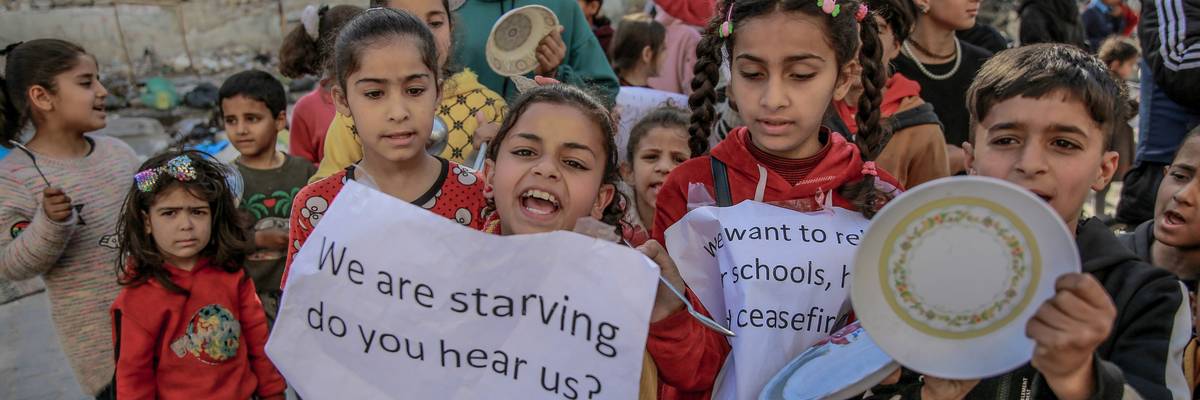
Palestinian children holding banners and empty bowls gather to protest the food shortages in the city due to Israeli attacks and demand a cease-fire in Gaza City, Gaza on March 12, 2024.
Omar El Akkad’s excellent and troubling book, One Day, Everyone Will Have Always Been Against This, is an appeal to readers not to wait for “one day” in the distant future to act.
Egyptian-born Omar El Akkad had studied in the United States and been 10 years a journalist when, in the summer of 2021, he became an American citizen. Covering the War on Terror in Afghanistan and at the U.S. detention center in Guantánamo Bay exposed him to the “deep ugly cracks in the bedrock of this thing they called ‘the free world.’” Yet he believed the cracks could be repaired—“Until the fall of 2023. Until the slaughter.”
The slaughter was Israel’s razing of Gaza following Hamas’ rampage into Israel on October 7, 2023. The Israeli assault escalated to include massive bombardment; enforced hunger; destruction of hospitals and schools; bulldozing of dwellings; deprivation of medical care; torture; and the slaughter of tens of thousands of men, women, and children. The onslaught caused Akkad to despair for Gaza’s Palestinians and for his adopted country, whose financing and weapons enabled it. He channelled that despair into the rage that inspired this excellent and troubling book.
One Day, Everyone Will Have Always Been Against This is neither polemic nor memoir, although it contains elements of both. Akkad’s prose is an appeal to readers not to wait for “one day” in the distant future to resist injustice not only in Gaza, but in the wider world; “In the coming years there will be much written about what took place in Gaza, the horrors that have been meticulously documented by Palestinians as they happened and meticulously brushed aside by the major media apparatus of the western world.” When the killing ceases, as with genocides of native Americans, Tasmanians, Namibia’s Hereros and Namas, Armenians, Jews, and Tutsis, it will be too late.
Akkad’s condemnation of U.S. policy in the formerly colonized world sits uneasily beside his choice to live and raise his children in the land that torments people who, like him, are brown or Muslim or doomed to live under American-supported Arab dictators or Israeli occupation. His rationale is as simple as it is understandable: “I live here because it will always be safer to live on the launching side of the missiles. I live here because I am afraid.”
He is unafraid to speak against the Biden administration’s veto of United Nations resolutions calling for cease-fires in Gaza (“untroubled when they say a cease-fire resolution represents a greater threat to lasting peace than the ongoing obliteration of an entire people”) and its termination of funding for the United Nations Relief and Works Agency (UNRWA) that was the primary supplier of food, medical care, and education to Palestinian refugees. Yet speaking out seems futile. As the author of the award-winning novel American War and a sometime columnist, he does not spare himself and other writers for political impotence: “What is this work we do? What are we good for?” He quotes Egyptian-American poet Marwa Helal:
this is where the
poets will say: show, don’t tell
but that
assumes most people
can see.
Too many seek refuge in propaganda that what is being done to Palestinians is necessary. Akkad quotes an Israeli newspaper post’s headline from seven months prior to October 7: “When Genocide is Permissible.” Palestinians are killed every day in Gaza, “but the unsaid thing is that it is all right because that’s what those people do, they die.”
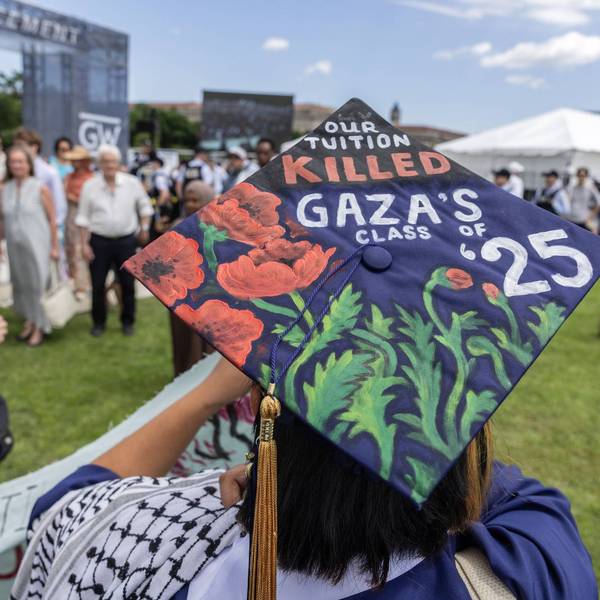
This book is not devoid of hope, which he finds in resistance that can be positive (“showing up to protests and speaking out”) and negative (“refusing to participate”). He praises students “risking expulsion and defamation, risking their livelihoods, their entire careers” and Jewish protestors “being arrested on the streets of Frankfurt, blocking Grand Central Station in New York, fighting for peace.” Their efforts, however ineffective, absolve them of the culpability of waiting for everyone else to be “against this.”
Dear Common Dreams reader, It’s been nearly 30 years since I co-founded Common Dreams with my late wife, Lina Newhouser. We had the radical notion that journalism should serve the public good, not corporate profits. It was clear to us from the outset what it would take to build such a project. No paid advertisements. No corporate sponsors. No millionaire publisher telling us what to think or do. Many people said we wouldn't last a year, but we proved those doubters wrong. Together with a tremendous team of journalists and dedicated staff, we built an independent media outlet free from the constraints of profits and corporate control. Our mission has always been simple: To inform. To inspire. To ignite change for the common good. Building Common Dreams was not easy. Our survival was never guaranteed. When you take on the most powerful forces—Wall Street greed, fossil fuel industry destruction, Big Tech lobbyists, and uber-rich oligarchs who have spent billions upon billions rigging the economy and democracy in their favor—the only bulwark you have is supporters who believe in your work. But here’s the urgent message from me today. It's never been this bad out there. And it's never been this hard to keep us going. At the very moment Common Dreams is most needed, the threats we face are intensifying. We need your support now more than ever. We don't accept corporate advertising and never will. We don't have a paywall because we don't think people should be blocked from critical news based on their ability to pay. Everything we do is funded by the donations of readers like you. When everyone does the little they can afford, we are strong. But if that support retreats or dries up, so do we. Will you donate now to make sure Common Dreams not only survives but thrives? —Craig Brown, Co-founder |
Egyptian-born Omar El Akkad had studied in the United States and been 10 years a journalist when, in the summer of 2021, he became an American citizen. Covering the War on Terror in Afghanistan and at the U.S. detention center in Guantánamo Bay exposed him to the “deep ugly cracks in the bedrock of this thing they called ‘the free world.’” Yet he believed the cracks could be repaired—“Until the fall of 2023. Until the slaughter.”
The slaughter was Israel’s razing of Gaza following Hamas’ rampage into Israel on October 7, 2023. The Israeli assault escalated to include massive bombardment; enforced hunger; destruction of hospitals and schools; bulldozing of dwellings; deprivation of medical care; torture; and the slaughter of tens of thousands of men, women, and children. The onslaught caused Akkad to despair for Gaza’s Palestinians and for his adopted country, whose financing and weapons enabled it. He channelled that despair into the rage that inspired this excellent and troubling book.
One Day, Everyone Will Have Always Been Against This is neither polemic nor memoir, although it contains elements of both. Akkad’s prose is an appeal to readers not to wait for “one day” in the distant future to resist injustice not only in Gaza, but in the wider world; “In the coming years there will be much written about what took place in Gaza, the horrors that have been meticulously documented by Palestinians as they happened and meticulously brushed aside by the major media apparatus of the western world.” When the killing ceases, as with genocides of native Americans, Tasmanians, Namibia’s Hereros and Namas, Armenians, Jews, and Tutsis, it will be too late.
Akkad’s condemnation of U.S. policy in the formerly colonized world sits uneasily beside his choice to live and raise his children in the land that torments people who, like him, are brown or Muslim or doomed to live under American-supported Arab dictators or Israeli occupation. His rationale is as simple as it is understandable: “I live here because it will always be safer to live on the launching side of the missiles. I live here because I am afraid.”
He is unafraid to speak against the Biden administration’s veto of United Nations resolutions calling for cease-fires in Gaza (“untroubled when they say a cease-fire resolution represents a greater threat to lasting peace than the ongoing obliteration of an entire people”) and its termination of funding for the United Nations Relief and Works Agency (UNRWA) that was the primary supplier of food, medical care, and education to Palestinian refugees. Yet speaking out seems futile. As the author of the award-winning novel American War and a sometime columnist, he does not spare himself and other writers for political impotence: “What is this work we do? What are we good for?” He quotes Egyptian-American poet Marwa Helal:
this is where the
poets will say: show, don’t tell
but that
assumes most people
can see.
Too many seek refuge in propaganda that what is being done to Palestinians is necessary. Akkad quotes an Israeli newspaper post’s headline from seven months prior to October 7: “When Genocide is Permissible.” Palestinians are killed every day in Gaza, “but the unsaid thing is that it is all right because that’s what those people do, they die.”
This book is not devoid of hope, which he finds in resistance that can be positive (“showing up to protests and speaking out”) and negative (“refusing to participate”). He praises students “risking expulsion and defamation, risking their livelihoods, their entire careers” and Jewish protestors “being arrested on the streets of Frankfurt, blocking Grand Central Station in New York, fighting for peace.” Their efforts, however ineffective, absolve them of the culpability of waiting for everyone else to be “against this.”
Egyptian-born Omar El Akkad had studied in the United States and been 10 years a journalist when, in the summer of 2021, he became an American citizen. Covering the War on Terror in Afghanistan and at the U.S. detention center in Guantánamo Bay exposed him to the “deep ugly cracks in the bedrock of this thing they called ‘the free world.’” Yet he believed the cracks could be repaired—“Until the fall of 2023. Until the slaughter.”
The slaughter was Israel’s razing of Gaza following Hamas’ rampage into Israel on October 7, 2023. The Israeli assault escalated to include massive bombardment; enforced hunger; destruction of hospitals and schools; bulldozing of dwellings; deprivation of medical care; torture; and the slaughter of tens of thousands of men, women, and children. The onslaught caused Akkad to despair for Gaza’s Palestinians and for his adopted country, whose financing and weapons enabled it. He channelled that despair into the rage that inspired this excellent and troubling book.
One Day, Everyone Will Have Always Been Against This is neither polemic nor memoir, although it contains elements of both. Akkad’s prose is an appeal to readers not to wait for “one day” in the distant future to resist injustice not only in Gaza, but in the wider world; “In the coming years there will be much written about what took place in Gaza, the horrors that have been meticulously documented by Palestinians as they happened and meticulously brushed aside by the major media apparatus of the western world.” When the killing ceases, as with genocides of native Americans, Tasmanians, Namibia’s Hereros and Namas, Armenians, Jews, and Tutsis, it will be too late.
Akkad’s condemnation of U.S. policy in the formerly colonized world sits uneasily beside his choice to live and raise his children in the land that torments people who, like him, are brown or Muslim or doomed to live under American-supported Arab dictators or Israeli occupation. His rationale is as simple as it is understandable: “I live here because it will always be safer to live on the launching side of the missiles. I live here because I am afraid.”
He is unafraid to speak against the Biden administration’s veto of United Nations resolutions calling for cease-fires in Gaza (“untroubled when they say a cease-fire resolution represents a greater threat to lasting peace than the ongoing obliteration of an entire people”) and its termination of funding for the United Nations Relief and Works Agency (UNRWA) that was the primary supplier of food, medical care, and education to Palestinian refugees. Yet speaking out seems futile. As the author of the award-winning novel American War and a sometime columnist, he does not spare himself and other writers for political impotence: “What is this work we do? What are we good for?” He quotes Egyptian-American poet Marwa Helal:
this is where the
poets will say: show, don’t tell
but that
assumes most people
can see.
Too many seek refuge in propaganda that what is being done to Palestinians is necessary. Akkad quotes an Israeli newspaper post’s headline from seven months prior to October 7: “When Genocide is Permissible.” Palestinians are killed every day in Gaza, “but the unsaid thing is that it is all right because that’s what those people do, they die.”
This book is not devoid of hope, which he finds in resistance that can be positive (“showing up to protests and speaking out”) and negative (“refusing to participate”). He praises students “risking expulsion and defamation, risking their livelihoods, their entire careers” and Jewish protestors “being arrested on the streets of Frankfurt, blocking Grand Central Station in New York, fighting for peace.” Their efforts, however ineffective, absolve them of the culpability of waiting for everyone else to be “against this.”