SUBSCRIBE TO OUR FREE NEWSLETTER
Daily news & progressive opinion—funded by the people, not the corporations—delivered straight to your inbox.
5
#000000
#FFFFFF
To donate by check, phone, or other method, see our More Ways to Give page.
Daily news & progressive opinion—funded by the people, not the corporations—delivered straight to your inbox.
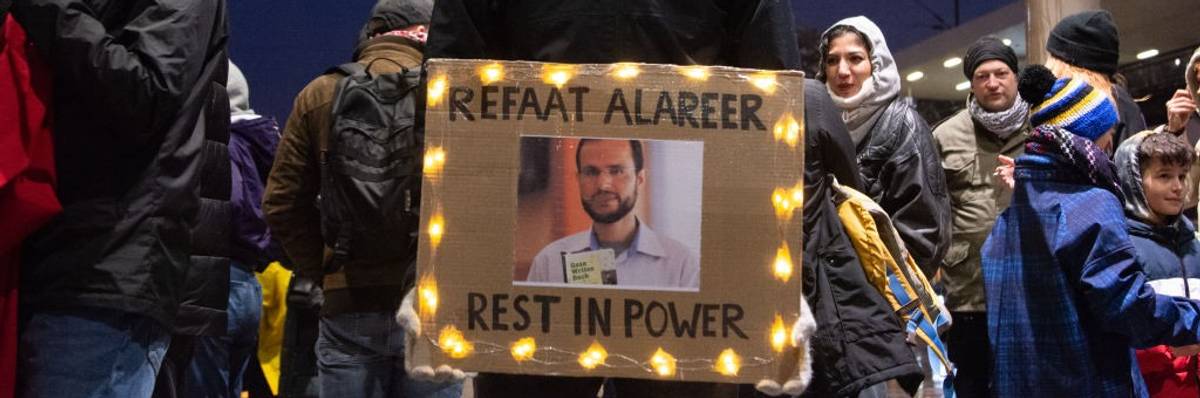
A photo of the renowned Palestinian poet Refaat Alareer, who was killed, is being displayed while about a hundred people are protesting for a ceasefire and a free Palestine at Breslauf Square in Cologne, Germany, on December 9, 2023, following the US veto of a UN resolution calling for a Gaza ceasefire.
The state of Israel has killed our storytellers in Gaza with the hope that the stories will die with them. But they will not.
What is taking place in Gaza is meant for the history books: an epic tale of a small nation under a long, brutal siege for many years, facing one of the greatest military powers in the world. And yet, it refuses to be defeated.
Not even the legendary tenacity of Leo Tolstoy’s ‘War and Peace’ characters can be compared to the heroism of Gazans, living over a tiny stretch of land while subsisting on the precipice of calamity, even long before the Israeli genocide.
But if Gaza has already been declared uninhabitable by the United Nations Conference on Trade and Development (UNCTAD) as early as 2020, how is it able to cope with everything that took place since then, particularly the grueling and unprecedented Israeli war, starting on October 7?
“I have ordered a complete siege on the Gaza Strip. There will be no electricity, no food, no fuel, everything is closed,” said Israeli Defense Minister Yoav Gallant on October 9. In fact, Israel carried out far greater war crimes than the choking of 2.3 million people.
“No place is safe, not even hospitals and schools,” the UN Office for the Coordination of Humanitarian Affairs (OCHA) said on X on November 11. Things have become far worse since that statement was made.
And, because Gazans refused to leave their homeland, the 365 sq kilometers—approx. 141 square miles—turned into a hunting ground of human beings, who were killed in every way imaginable. Those who did not die under the rubble of their homes or were gunned down by attack helicopters while attempting to escape from one region to another, are now dying from disease and hunger.
Not a single category of Palestinians has been spared this horrible fate: the children, the women, the educators, the doctors and medics, the rescuers, even the artists and the poets. Each one of these groups has an ever-growing list of names, updated daily.
Fully aware of the extent of its war crimes in Gaza, Israel has systematically targeted Gaza’s storytellers - its journalists and their families, the bloggers, the intellectuals and even the social media influencers.
While Palestinians insist that their collective pain—and resistance—must be televised, Israel is doing everything in its power to eliminate the storytellers.
The Palestinian Journalists Syndicate said in a statement on December 6 that 75 Palestinian Journalists and media workers have been killed by Israel since the beginning of the war.
The above number does not include many citizen journalists and writers who do not necessarily operate in an official capacity. It also does not include members of their families, like the family of journalist Wael al-Dahdouh or the family of Moamen Al Sharafi.
Aware that their intellectuals are targets for Israel, Gazans have, for years, attempted to produce yet more storytellers. In 2015, a group of young journalists and students formed a group they called ‘We Are Not Numbers.’ “We Are Not Numbers tells the stories behind the numbers of Palestinians in the news and advocates for their human rights,” WANN described itself.
A co-founder of the group, Professor Refaat Alareer, is a beloved Palestinian educator from Gaza. A young intellectual, whose brilliance is only matched by his kindness, Alareer believed that the story of Palestine, Gaza in particular, should be told by the Palestinians themselves, whose relationship to the Palestinian discourse cannot be marginal.
“As Gaza keeps gasping for life, we struggle for it to pass, we have no choice but to fight back and tell her stories. For Palestine,” Alareer wrote in his contribution in the volume ‘Light in Gaza: Writing Born of Fire.’
He edited several books—including ‘Gaza Writes Back’ and ‘Gaza Unsilenced’—which also allowed him to take the message of other Palestinian intellectuals in Gaza to the rest of the world.
“Sometimes a homeland becomes a tale. We love the story because it is about our homeland and we love our homeland even more because of the story,” he wrote in ‘Gaza Writes Back.’
Alareer reportedly refused to leave northern Gaza, even after Israel had managed to isolate it from the rest of the Strip, subjecting it to countless massacres.
As if aware of the fate awaiting him, Alareer tweeted this line, along with a poem he had penned: “If I must die, let it be a tale.”
On December 7, the writers’ collective, We Are Not Numbers, declared that their beloved founder, Refaat Alareer, was killed in an Israeli airstrike in northern Gaza.
Alareer was not the only member of the collective who was killed by Israel. On October 14, Yousef Dawas and on November 24, Mohammed Zaher Hammo, were killed, with members of their families, in Israeli strikes on various parts of the Gaza Strip.
In one of the workshops I did with the group, prior to the war, Yousef Dawas stood out, and not only because of his unusually long hair, but because of his clever and pointed questions.
He wanted to tell the stories of ordinary Gazans, so that other ordinary people around the world can appreciate the everyday struggle of the Palestinian people, their righteous quest for justice and their hope for a better future.
These storytellers were all killed by Israel, with the hope that the stories will die with them. But Israel will fail because the collective story is bigger than all of us. A nation that has produced the likes of Ghassan Kanafani, Basil al-Araj, and Refaat Alareer will always produce great intellectuals, who will serve the historic role of telling the story of Palestine and her liberation.
This is the last poem shared by Alareer.
If I must die,
you must live
to tell my story
to sell my things
to buy a piece of cloth
and some strings,
(make it white with a long tail)
so that a child, somewhere in Gaza
while looking heaven in the eye
awaiting his dad who left in a blaze—
and bid no one farewell
not even to his flesh
not even to himself—
sees the kite, my kite you made, flying up
above
and thinks for a moment an angel is there
bringing back love
If I must die
let it bring hope
let it be a tale.
Dear Common Dreams reader, It’s been nearly 30 years since I co-founded Common Dreams with my late wife, Lina Newhouser. We had the radical notion that journalism should serve the public good, not corporate profits. It was clear to us from the outset what it would take to build such a project. No paid advertisements. No corporate sponsors. No millionaire publisher telling us what to think or do. Many people said we wouldn't last a year, but we proved those doubters wrong. Together with a tremendous team of journalists and dedicated staff, we built an independent media outlet free from the constraints of profits and corporate control. Our mission has always been simple: To inform. To inspire. To ignite change for the common good. Building Common Dreams was not easy. Our survival was never guaranteed. When you take on the most powerful forces—Wall Street greed, fossil fuel industry destruction, Big Tech lobbyists, and uber-rich oligarchs who have spent billions upon billions rigging the economy and democracy in their favor—the only bulwark you have is supporters who believe in your work. But here’s the urgent message from me today. It's never been this bad out there. And it's never been this hard to keep us going. At the very moment Common Dreams is most needed, the threats we face are intensifying. We need your support now more than ever. We don't accept corporate advertising and never will. We don't have a paywall because we don't think people should be blocked from critical news based on their ability to pay. Everything we do is funded by the donations of readers like you. When everyone does the little they can afford, we are strong. But if that support retreats or dries up, so do we. Will you donate now to make sure Common Dreams not only survives but thrives? —Craig Brown, Co-founder |
What is taking place in Gaza is meant for the history books: an epic tale of a small nation under a long, brutal siege for many years, facing one of the greatest military powers in the world. And yet, it refuses to be defeated.
Not even the legendary tenacity of Leo Tolstoy’s ‘War and Peace’ characters can be compared to the heroism of Gazans, living over a tiny stretch of land while subsisting on the precipice of calamity, even long before the Israeli genocide.
But if Gaza has already been declared uninhabitable by the United Nations Conference on Trade and Development (UNCTAD) as early as 2020, how is it able to cope with everything that took place since then, particularly the grueling and unprecedented Israeli war, starting on October 7?
“I have ordered a complete siege on the Gaza Strip. There will be no electricity, no food, no fuel, everything is closed,” said Israeli Defense Minister Yoav Gallant on October 9. In fact, Israel carried out far greater war crimes than the choking of 2.3 million people.
“No place is safe, not even hospitals and schools,” the UN Office for the Coordination of Humanitarian Affairs (OCHA) said on X on November 11. Things have become far worse since that statement was made.
And, because Gazans refused to leave their homeland, the 365 sq kilometers—approx. 141 square miles—turned into a hunting ground of human beings, who were killed in every way imaginable. Those who did not die under the rubble of their homes or were gunned down by attack helicopters while attempting to escape from one region to another, are now dying from disease and hunger.
Not a single category of Palestinians has been spared this horrible fate: the children, the women, the educators, the doctors and medics, the rescuers, even the artists and the poets. Each one of these groups has an ever-growing list of names, updated daily.
Fully aware of the extent of its war crimes in Gaza, Israel has systematically targeted Gaza’s storytellers - its journalists and their families, the bloggers, the intellectuals and even the social media influencers.
While Palestinians insist that their collective pain—and resistance—must be televised, Israel is doing everything in its power to eliminate the storytellers.
The Palestinian Journalists Syndicate said in a statement on December 6 that 75 Palestinian Journalists and media workers have been killed by Israel since the beginning of the war.
The above number does not include many citizen journalists and writers who do not necessarily operate in an official capacity. It also does not include members of their families, like the family of journalist Wael al-Dahdouh or the family of Moamen Al Sharafi.
Aware that their intellectuals are targets for Israel, Gazans have, for years, attempted to produce yet more storytellers. In 2015, a group of young journalists and students formed a group they called ‘We Are Not Numbers.’ “We Are Not Numbers tells the stories behind the numbers of Palestinians in the news and advocates for their human rights,” WANN described itself.
A co-founder of the group, Professor Refaat Alareer, is a beloved Palestinian educator from Gaza. A young intellectual, whose brilliance is only matched by his kindness, Alareer believed that the story of Palestine, Gaza in particular, should be told by the Palestinians themselves, whose relationship to the Palestinian discourse cannot be marginal.
“As Gaza keeps gasping for life, we struggle for it to pass, we have no choice but to fight back and tell her stories. For Palestine,” Alareer wrote in his contribution in the volume ‘Light in Gaza: Writing Born of Fire.’
He edited several books—including ‘Gaza Writes Back’ and ‘Gaza Unsilenced’—which also allowed him to take the message of other Palestinian intellectuals in Gaza to the rest of the world.
“Sometimes a homeland becomes a tale. We love the story because it is about our homeland and we love our homeland even more because of the story,” he wrote in ‘Gaza Writes Back.’
Alareer reportedly refused to leave northern Gaza, even after Israel had managed to isolate it from the rest of the Strip, subjecting it to countless massacres.
As if aware of the fate awaiting him, Alareer tweeted this line, along with a poem he had penned: “If I must die, let it be a tale.”
On December 7, the writers’ collective, We Are Not Numbers, declared that their beloved founder, Refaat Alareer, was killed in an Israeli airstrike in northern Gaza.
Alareer was not the only member of the collective who was killed by Israel. On October 14, Yousef Dawas and on November 24, Mohammed Zaher Hammo, were killed, with members of their families, in Israeli strikes on various parts of the Gaza Strip.
In one of the workshops I did with the group, prior to the war, Yousef Dawas stood out, and not only because of his unusually long hair, but because of his clever and pointed questions.
He wanted to tell the stories of ordinary Gazans, so that other ordinary people around the world can appreciate the everyday struggle of the Palestinian people, their righteous quest for justice and their hope for a better future.
These storytellers were all killed by Israel, with the hope that the stories will die with them. But Israel will fail because the collective story is bigger than all of us. A nation that has produced the likes of Ghassan Kanafani, Basil al-Araj, and Refaat Alareer will always produce great intellectuals, who will serve the historic role of telling the story of Palestine and her liberation.
This is the last poem shared by Alareer.
If I must die,
you must live
to tell my story
to sell my things
to buy a piece of cloth
and some strings,
(make it white with a long tail)
so that a child, somewhere in Gaza
while looking heaven in the eye
awaiting his dad who left in a blaze—
and bid no one farewell
not even to his flesh
not even to himself—
sees the kite, my kite you made, flying up
above
and thinks for a moment an angel is there
bringing back love
If I must die
let it bring hope
let it be a tale.
What is taking place in Gaza is meant for the history books: an epic tale of a small nation under a long, brutal siege for many years, facing one of the greatest military powers in the world. And yet, it refuses to be defeated.
Not even the legendary tenacity of Leo Tolstoy’s ‘War and Peace’ characters can be compared to the heroism of Gazans, living over a tiny stretch of land while subsisting on the precipice of calamity, even long before the Israeli genocide.
But if Gaza has already been declared uninhabitable by the United Nations Conference on Trade and Development (UNCTAD) as early as 2020, how is it able to cope with everything that took place since then, particularly the grueling and unprecedented Israeli war, starting on October 7?
“I have ordered a complete siege on the Gaza Strip. There will be no electricity, no food, no fuel, everything is closed,” said Israeli Defense Minister Yoav Gallant on October 9. In fact, Israel carried out far greater war crimes than the choking of 2.3 million people.
“No place is safe, not even hospitals and schools,” the UN Office for the Coordination of Humanitarian Affairs (OCHA) said on X on November 11. Things have become far worse since that statement was made.
And, because Gazans refused to leave their homeland, the 365 sq kilometers—approx. 141 square miles—turned into a hunting ground of human beings, who were killed in every way imaginable. Those who did not die under the rubble of their homes or were gunned down by attack helicopters while attempting to escape from one region to another, are now dying from disease and hunger.
Not a single category of Palestinians has been spared this horrible fate: the children, the women, the educators, the doctors and medics, the rescuers, even the artists and the poets. Each one of these groups has an ever-growing list of names, updated daily.
Fully aware of the extent of its war crimes in Gaza, Israel has systematically targeted Gaza’s storytellers - its journalists and their families, the bloggers, the intellectuals and even the social media influencers.
While Palestinians insist that their collective pain—and resistance—must be televised, Israel is doing everything in its power to eliminate the storytellers.
The Palestinian Journalists Syndicate said in a statement on December 6 that 75 Palestinian Journalists and media workers have been killed by Israel since the beginning of the war.
The above number does not include many citizen journalists and writers who do not necessarily operate in an official capacity. It also does not include members of their families, like the family of journalist Wael al-Dahdouh or the family of Moamen Al Sharafi.
Aware that their intellectuals are targets for Israel, Gazans have, for years, attempted to produce yet more storytellers. In 2015, a group of young journalists and students formed a group they called ‘We Are Not Numbers.’ “We Are Not Numbers tells the stories behind the numbers of Palestinians in the news and advocates for their human rights,” WANN described itself.
A co-founder of the group, Professor Refaat Alareer, is a beloved Palestinian educator from Gaza. A young intellectual, whose brilliance is only matched by his kindness, Alareer believed that the story of Palestine, Gaza in particular, should be told by the Palestinians themselves, whose relationship to the Palestinian discourse cannot be marginal.
“As Gaza keeps gasping for life, we struggle for it to pass, we have no choice but to fight back and tell her stories. For Palestine,” Alareer wrote in his contribution in the volume ‘Light in Gaza: Writing Born of Fire.’
He edited several books—including ‘Gaza Writes Back’ and ‘Gaza Unsilenced’—which also allowed him to take the message of other Palestinian intellectuals in Gaza to the rest of the world.
“Sometimes a homeland becomes a tale. We love the story because it is about our homeland and we love our homeland even more because of the story,” he wrote in ‘Gaza Writes Back.’
Alareer reportedly refused to leave northern Gaza, even after Israel had managed to isolate it from the rest of the Strip, subjecting it to countless massacres.
As if aware of the fate awaiting him, Alareer tweeted this line, along with a poem he had penned: “If I must die, let it be a tale.”
On December 7, the writers’ collective, We Are Not Numbers, declared that their beloved founder, Refaat Alareer, was killed in an Israeli airstrike in northern Gaza.
Alareer was not the only member of the collective who was killed by Israel. On October 14, Yousef Dawas and on November 24, Mohammed Zaher Hammo, were killed, with members of their families, in Israeli strikes on various parts of the Gaza Strip.
In one of the workshops I did with the group, prior to the war, Yousef Dawas stood out, and not only because of his unusually long hair, but because of his clever and pointed questions.
He wanted to tell the stories of ordinary Gazans, so that other ordinary people around the world can appreciate the everyday struggle of the Palestinian people, their righteous quest for justice and their hope for a better future.
These storytellers were all killed by Israel, with the hope that the stories will die with them. But Israel will fail because the collective story is bigger than all of us. A nation that has produced the likes of Ghassan Kanafani, Basil al-Araj, and Refaat Alareer will always produce great intellectuals, who will serve the historic role of telling the story of Palestine and her liberation.
This is the last poem shared by Alareer.
If I must die,
you must live
to tell my story
to sell my things
to buy a piece of cloth
and some strings,
(make it white with a long tail)
so that a child, somewhere in Gaza
while looking heaven in the eye
awaiting his dad who left in a blaze—
and bid no one farewell
not even to his flesh
not even to himself—
sees the kite, my kite you made, flying up
above
and thinks for a moment an angel is there
bringing back love
If I must die
let it bring hope
let it be a tale.