5
#000000
#FFFFFF
To donate by check, phone, or other method, see our More Ways to Give page.
Daily news & progressive opinion—funded by the people, not the corporations—delivered straight to your inbox.
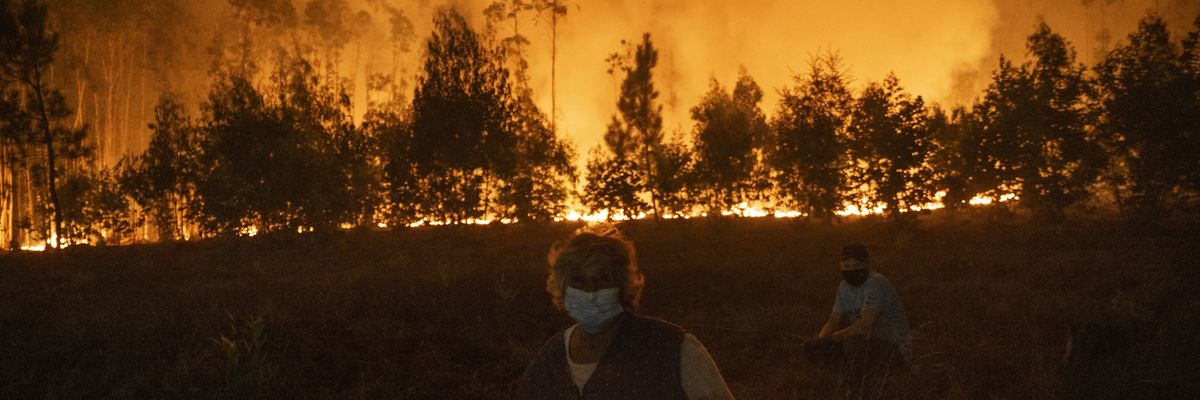
People stand watching the progression of a wildfire at Veiga village in Agueda, Aveiro, Portugal on September 17, 2024.
Company managers knew they were condemning people to death, devastation, and extinction through climate and social collapse with their actions. That didn’t stop them.
In just six days, 121,000 hectares burned, seven people died, and over a hundred were injured in the fires that ravaged Portugal. Luís Montenegro, the country’s prime minister, faced with this calamity, promised to go “after those responsible” who, “in the name of private interests, are capable of jeopardizing the rights, freedoms, and guarantees, and the very lives” of citizens. This is a bold statement. Arson and blame in the face of the fires that annually devastate the country are a permanent reality.
We speak of arson when referring to the intentional and deliberate act of igniting a fire. For example, it is considered arson if someone sets fire to a forested area, whether motivated by malice, economic reasons, or merely for fun. In Portugal, arson is a variable that is far from explaining the devastating fires that destroy lives each year. Like in other Mediterranean countries, about one-third of the fires have a criminal, deliberate origin. However, the final outcome of these ignitions in Portugal is significantly different from that of countries that can be compared to ours.
The atmospheric conditions, increasingly characteristic of the Mediterranean territory—extreme drought and heat—combined with strong winds, low humidity, and nighttime heat, along with abandoned lands and extensive eucalyptus monocultures, create the perfect conditions for fires to ignite with the proportions and impacts of those that killed 66 people in Pedrogão Grande in 2017, 45 people on October 15 of the same year, and seven people in the fires of mid-September this year.
We can be certain that for these companies, the destruction of our lives will not lead to a reduction in profitability—at least until there is nothing left to destroy.
These conditions are neither “natural” nor mere coincidence. They derive from intentional acts, the consequences of which were known and taken into account by companies and governments. For decades, major emitting companies have been aware of the impacts of burning fossil fuels and the greenhouse gas emissions from their economic activities. They knew that these impacts would lead to loss of life on a global scale and could culminate in the extinction of the human species. Despite this, they continued to invest in these activities, expand them, and profit from them. For decades, governments have received warnings from the scientific community, and they even acknowledged this problem with weak laws that pretend to address the issue. But even today they continue to subsidize fossil fuels and emitting industries, facilitating projects that increase emissions. Government leaders and company managers knew they were condemning people to death, devastation, and extinction through climate and social collapse.
Cellulose companies, such as Navigator and Altri, supported and assisted by successive national governments, have turned Portugal into the perfect ground for chaos to ignite. Portugal has the largest relative area of eucalyptus in the world and, in absolute terms, competes with giants like Australia, Brazil, China, and India. These companies profit from the export of paste and paper, fully aware of the impacts of their activities on the territories and populations where they operate. It is relevant to remember that the cellulose business is highly emission-intensive, and Navigator is the company responsible for the most greenhouse gas emissions in Portugal. In addition to being aware that they are driving the planet toward chaos, they simultaneously invest in bioenergy, biomass, and green hydrogen businesses, allowing them to enhance their propaganda through new ventures masked as green, even monetizing the burned raw materials, further maximizing their profits. We can be certain that for these companies, the destruction of our lives will not lead to a reduction in profitability—at least until there is nothing left to destroy.
These companies effectively “in the name of private interests are capable of jeopardizing the rights, freedoms, and guarantees, and the very lives” of all living people, and also of those yet to be born. Together with other emitting companies and the governments that support them, they are setting fire to all people and the planet. Montenegro’s promises and words are empty, coinciding with a state budget that adds more fire to society and is also a reiteration of violence against ordinary people. It is in our hands to stop normalizing these attacks and to halt them, united and with strength.
Dear Common Dreams reader, It’s been nearly 30 years since I co-founded Common Dreams with my late wife, Lina Newhouser. We had the radical notion that journalism should serve the public good, not corporate profits. It was clear to us from the outset what it would take to build such a project. No paid advertisements. No corporate sponsors. No millionaire publisher telling us what to think or do. Many people said we wouldn't last a year, but we proved those doubters wrong. Together with a tremendous team of journalists and dedicated staff, we built an independent media outlet free from the constraints of profits and corporate control. Our mission has always been simple: To inform. To inspire. To ignite change for the common good. Building Common Dreams was not easy. Our survival was never guaranteed. When you take on the most powerful forces—Wall Street greed, fossil fuel industry destruction, Big Tech lobbyists, and uber-rich oligarchs who have spent billions upon billions rigging the economy and democracy in their favor—the only bulwark you have is supporters who believe in your work. But here’s the urgent message from me today. It's never been this bad out there. And it's never been this hard to keep us going. At the very moment Common Dreams is most needed, the threats we face are intensifying. We need your support now more than ever. We don't accept corporate advertising and never will. We don't have a paywall because we don't think people should be blocked from critical news based on their ability to pay. Everything we do is funded by the donations of readers like you. When everyone does the little they can afford, we are strong. But if that support retreats or dries up, so do we. Will you donate now to make sure Common Dreams not only survives but thrives? —Craig Brown, Co-founder |
In just six days, 121,000 hectares burned, seven people died, and over a hundred were injured in the fires that ravaged Portugal. Luís Montenegro, the country’s prime minister, faced with this calamity, promised to go “after those responsible” who, “in the name of private interests, are capable of jeopardizing the rights, freedoms, and guarantees, and the very lives” of citizens. This is a bold statement. Arson and blame in the face of the fires that annually devastate the country are a permanent reality.
We speak of arson when referring to the intentional and deliberate act of igniting a fire. For example, it is considered arson if someone sets fire to a forested area, whether motivated by malice, economic reasons, or merely for fun. In Portugal, arson is a variable that is far from explaining the devastating fires that destroy lives each year. Like in other Mediterranean countries, about one-third of the fires have a criminal, deliberate origin. However, the final outcome of these ignitions in Portugal is significantly different from that of countries that can be compared to ours.
The atmospheric conditions, increasingly characteristic of the Mediterranean territory—extreme drought and heat—combined with strong winds, low humidity, and nighttime heat, along with abandoned lands and extensive eucalyptus monocultures, create the perfect conditions for fires to ignite with the proportions and impacts of those that killed 66 people in Pedrogão Grande in 2017, 45 people on October 15 of the same year, and seven people in the fires of mid-September this year.
We can be certain that for these companies, the destruction of our lives will not lead to a reduction in profitability—at least until there is nothing left to destroy.
These conditions are neither “natural” nor mere coincidence. They derive from intentional acts, the consequences of which were known and taken into account by companies and governments. For decades, major emitting companies have been aware of the impacts of burning fossil fuels and the greenhouse gas emissions from their economic activities. They knew that these impacts would lead to loss of life on a global scale and could culminate in the extinction of the human species. Despite this, they continued to invest in these activities, expand them, and profit from them. For decades, governments have received warnings from the scientific community, and they even acknowledged this problem with weak laws that pretend to address the issue. But even today they continue to subsidize fossil fuels and emitting industries, facilitating projects that increase emissions. Government leaders and company managers knew they were condemning people to death, devastation, and extinction through climate and social collapse.
Cellulose companies, such as Navigator and Altri, supported and assisted by successive national governments, have turned Portugal into the perfect ground for chaos to ignite. Portugal has the largest relative area of eucalyptus in the world and, in absolute terms, competes with giants like Australia, Brazil, China, and India. These companies profit from the export of paste and paper, fully aware of the impacts of their activities on the territories and populations where they operate. It is relevant to remember that the cellulose business is highly emission-intensive, and Navigator is the company responsible for the most greenhouse gas emissions in Portugal. In addition to being aware that they are driving the planet toward chaos, they simultaneously invest in bioenergy, biomass, and green hydrogen businesses, allowing them to enhance their propaganda through new ventures masked as green, even monetizing the burned raw materials, further maximizing their profits. We can be certain that for these companies, the destruction of our lives will not lead to a reduction in profitability—at least until there is nothing left to destroy.
These companies effectively “in the name of private interests are capable of jeopardizing the rights, freedoms, and guarantees, and the very lives” of all living people, and also of those yet to be born. Together with other emitting companies and the governments that support them, they are setting fire to all people and the planet. Montenegro’s promises and words are empty, coinciding with a state budget that adds more fire to society and is also a reiteration of violence against ordinary people. It is in our hands to stop normalizing these attacks and to halt them, united and with strength.
In just six days, 121,000 hectares burned, seven people died, and over a hundred were injured in the fires that ravaged Portugal. Luís Montenegro, the country’s prime minister, faced with this calamity, promised to go “after those responsible” who, “in the name of private interests, are capable of jeopardizing the rights, freedoms, and guarantees, and the very lives” of citizens. This is a bold statement. Arson and blame in the face of the fires that annually devastate the country are a permanent reality.
We speak of arson when referring to the intentional and deliberate act of igniting a fire. For example, it is considered arson if someone sets fire to a forested area, whether motivated by malice, economic reasons, or merely for fun. In Portugal, arson is a variable that is far from explaining the devastating fires that destroy lives each year. Like in other Mediterranean countries, about one-third of the fires have a criminal, deliberate origin. However, the final outcome of these ignitions in Portugal is significantly different from that of countries that can be compared to ours.
The atmospheric conditions, increasingly characteristic of the Mediterranean territory—extreme drought and heat—combined with strong winds, low humidity, and nighttime heat, along with abandoned lands and extensive eucalyptus monocultures, create the perfect conditions for fires to ignite with the proportions and impacts of those that killed 66 people in Pedrogão Grande in 2017, 45 people on October 15 of the same year, and seven people in the fires of mid-September this year.
We can be certain that for these companies, the destruction of our lives will not lead to a reduction in profitability—at least until there is nothing left to destroy.
These conditions are neither “natural” nor mere coincidence. They derive from intentional acts, the consequences of which were known and taken into account by companies and governments. For decades, major emitting companies have been aware of the impacts of burning fossil fuels and the greenhouse gas emissions from their economic activities. They knew that these impacts would lead to loss of life on a global scale and could culminate in the extinction of the human species. Despite this, they continued to invest in these activities, expand them, and profit from them. For decades, governments have received warnings from the scientific community, and they even acknowledged this problem with weak laws that pretend to address the issue. But even today they continue to subsidize fossil fuels and emitting industries, facilitating projects that increase emissions. Government leaders and company managers knew they were condemning people to death, devastation, and extinction through climate and social collapse.
Cellulose companies, such as Navigator and Altri, supported and assisted by successive national governments, have turned Portugal into the perfect ground for chaos to ignite. Portugal has the largest relative area of eucalyptus in the world and, in absolute terms, competes with giants like Australia, Brazil, China, and India. These companies profit from the export of paste and paper, fully aware of the impacts of their activities on the territories and populations where they operate. It is relevant to remember that the cellulose business is highly emission-intensive, and Navigator is the company responsible for the most greenhouse gas emissions in Portugal. In addition to being aware that they are driving the planet toward chaos, they simultaneously invest in bioenergy, biomass, and green hydrogen businesses, allowing them to enhance their propaganda through new ventures masked as green, even monetizing the burned raw materials, further maximizing their profits. We can be certain that for these companies, the destruction of our lives will not lead to a reduction in profitability—at least until there is nothing left to destroy.
These companies effectively “in the name of private interests are capable of jeopardizing the rights, freedoms, and guarantees, and the very lives” of all living people, and also of those yet to be born. Together with other emitting companies and the governments that support them, they are setting fire to all people and the planet. Montenegro’s promises and words are empty, coinciding with a state budget that adds more fire to society and is also a reiteration of violence against ordinary people. It is in our hands to stop normalizing these attacks and to halt them, united and with strength.