SUBSCRIBE TO OUR FREE NEWSLETTER
Daily news & progressive opinion—funded by the people, not the corporations—delivered straight to your inbox.
5
#000000
#FFFFFF
To donate by check, phone, or other method, see our More Ways to Give page.
Daily news & progressive opinion—funded by the people, not the corporations—delivered straight to your inbox.
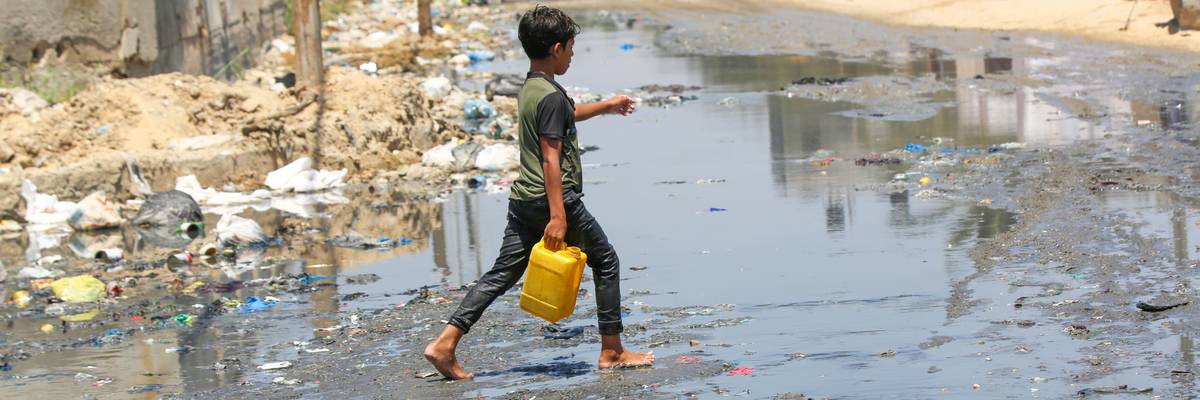
A child goes to get clean water on a street flooded with leaked sewage as sewage treatment plants suspend services due to Israel's attacks and blockade in Deir al Balah, Gaza on July 16, 2024.
In a region where political solutions are often slow to materialize, efforts that begin with basic human needs—like access to clean water and sustainable energy—can pave the way for diplomacy and political solutions.
When we think of solutions to longstanding conflicts in the Middle East, clean water and solar power may not be the first things that come to mind.
But in my region, where our shared environmental challenges intensify daily, environmental initiatives may be the tools to bridge this conflict.
Nature knows no borders. Today, Israelis, Palestinians, Jordanians, and people across the region are facing a more unpredictable climate that threatens natural resources. The region’s unique geological and ecological status makes it especially vulnerable to the effects of climate change. Higher temperatures alone will also pose serious health risks, including increased mortality rates, and lead to infrastructure challenges across the region.
Environmental cooperation is not some vague political gesture. People who live and work in the region recognize that it is a practical necessity for the Middle East.
Moreover, the Middle East and North Africa have been experiencing almost continuous drought since 1998, which is the most severe dry spell in nine centuries. As climate-induced water scarcity grows across the region, environmental degradation will likely fuel further unrest, threatening livelihoods, intensifying the competition for resources, and contributing to an increase in climate refugees, which may impact regional stability.
So, environmental cooperation is not some vague political gesture. People who live and work in the region recognize that it is a practical necessity for the Middle East.
While the political challenges in the region are difficult to navigate, I know that cooperation is possible because I’ve seen it firsthand. The educational and research institute I lead, the Arava Institute for Environmental Studies, is located in the Arava Valley in the Negev Desert. Since 1996, we have brought together more than 1,900 Palestinian, Israeli, Jordanian, American, and other international students to learn from and alongside one another.
This work and cooperation allows us to address practical challenges, like developing off-grid systems that use solar power for irrigation and water purification. We’ve also been developing programs to protect native plants, including a date palm tree cultivated from a 2,000-year-old date seed.
But this work isn’t just about the environment—it’s also an opportunity to facilitate mutual understanding, shared trust, and civil discourse among communities that have been locked in conflict for years.
Of course, conflict has interrupted our work over the years. At the Arava Institute, we were only five weeks into our academic session before the outbreak of the war between Israel and Hamas.
Rather than returning to their homes, Israelis and Palestinians chose to remain together on campus through the fall 2023 semester. As Israeli and Palestinian students left and returned over the semester, they checked in with each other about the well-being of their families. They conducted fundraising campaigns to help families in Gaza and families of Israeli hostages.
They even wrote songs about peace.
This display of empathy and understanding was only possible because our students had the opportunity to see the humanity in one another before conflict broke out. Part of our curriculum requires our students to engage in weekly dialogue sessions where they discuss topics important to their identities, cultures, and history. That includes emotional, challenging topics like the Nakba and the Holocaust.
Those dialogue sessions kept communication lines open across cultural divides in the wake of October 7—and ultimately, they enabled our students, faculty, and partners to turn back to building a more sustainable future for the region.
Since the war began, we’ve launched the Jumpstarting Hope in Gaza initiative, which aims to establish secure, self-sustaining shelters for 20,000 people across Gaza. These shelters integrate advanced off-grid WASH (Water, Sanitation, and Hygiene) and energy solutions, ensuring long-term sustainability and independence for displaced communities.
Through this initiative, the Arava Institute and our partners aim to deploy desalination systems to ensure reliable access to clean water, along with solar power for sustainable energy, off-grid wastewater treatment, and biodigesters to convert waste into energy. We’ve already deployed four pilot shelters in Al-Mawasi Hamad and Dir Albalah, providing refuge and essential services to over 5,000 people.
Rebuilding the infrastructure in Gaza will take years, but these solutions can offer an immediate public health response, while also facilitating cooperation between people of all backgrounds in the region.
In a region where political solutions are often slow to materialize, efforts that begin with basic human needs—like access to clean water and sustainable energy—can pave the way for genuine, people-centered diplomacy and political solutions.
The work being done here in the Negev Desert is a potent reminder: In places where politics remain stagnant, perhaps the solutions can start with something as universal as clean water.
Dear Common Dreams reader, It’s been nearly 30 years since I co-founded Common Dreams with my late wife, Lina Newhouser. We had the radical notion that journalism should serve the public good, not corporate profits. It was clear to us from the outset what it would take to build such a project. No paid advertisements. No corporate sponsors. No millionaire publisher telling us what to think or do. Many people said we wouldn't last a year, but we proved those doubters wrong. Together with a tremendous team of journalists and dedicated staff, we built an independent media outlet free from the constraints of profits and corporate control. Our mission has always been simple: To inform. To inspire. To ignite change for the common good. Building Common Dreams was not easy. Our survival was never guaranteed. When you take on the most powerful forces—Wall Street greed, fossil fuel industry destruction, Big Tech lobbyists, and uber-rich oligarchs who have spent billions upon billions rigging the economy and democracy in their favor—the only bulwark you have is supporters who believe in your work. But here’s the urgent message from me today. It's never been this bad out there. And it's never been this hard to keep us going. At the very moment Common Dreams is most needed, the threats we face are intensifying. We need your support now more than ever. We don't accept corporate advertising and never will. We don't have a paywall because we don't think people should be blocked from critical news based on their ability to pay. Everything we do is funded by the donations of readers like you. When everyone does the little they can afford, we are strong. But if that support retreats or dries up, so do we. Will you donate now to make sure Common Dreams not only survives but thrives? —Craig Brown, Co-founder |
When we think of solutions to longstanding conflicts in the Middle East, clean water and solar power may not be the first things that come to mind.
But in my region, where our shared environmental challenges intensify daily, environmental initiatives may be the tools to bridge this conflict.
Nature knows no borders. Today, Israelis, Palestinians, Jordanians, and people across the region are facing a more unpredictable climate that threatens natural resources. The region’s unique geological and ecological status makes it especially vulnerable to the effects of climate change. Higher temperatures alone will also pose serious health risks, including increased mortality rates, and lead to infrastructure challenges across the region.
Environmental cooperation is not some vague political gesture. People who live and work in the region recognize that it is a practical necessity for the Middle East.
Moreover, the Middle East and North Africa have been experiencing almost continuous drought since 1998, which is the most severe dry spell in nine centuries. As climate-induced water scarcity grows across the region, environmental degradation will likely fuel further unrest, threatening livelihoods, intensifying the competition for resources, and contributing to an increase in climate refugees, which may impact regional stability.
So, environmental cooperation is not some vague political gesture. People who live and work in the region recognize that it is a practical necessity for the Middle East.
While the political challenges in the region are difficult to navigate, I know that cooperation is possible because I’ve seen it firsthand. The educational and research institute I lead, the Arava Institute for Environmental Studies, is located in the Arava Valley in the Negev Desert. Since 1996, we have brought together more than 1,900 Palestinian, Israeli, Jordanian, American, and other international students to learn from and alongside one another.
This work and cooperation allows us to address practical challenges, like developing off-grid systems that use solar power for irrigation and water purification. We’ve also been developing programs to protect native plants, including a date palm tree cultivated from a 2,000-year-old date seed.
But this work isn’t just about the environment—it’s also an opportunity to facilitate mutual understanding, shared trust, and civil discourse among communities that have been locked in conflict for years.
Of course, conflict has interrupted our work over the years. At the Arava Institute, we were only five weeks into our academic session before the outbreak of the war between Israel and Hamas.
Rather than returning to their homes, Israelis and Palestinians chose to remain together on campus through the fall 2023 semester. As Israeli and Palestinian students left and returned over the semester, they checked in with each other about the well-being of their families. They conducted fundraising campaigns to help families in Gaza and families of Israeli hostages.
They even wrote songs about peace.
This display of empathy and understanding was only possible because our students had the opportunity to see the humanity in one another before conflict broke out. Part of our curriculum requires our students to engage in weekly dialogue sessions where they discuss topics important to their identities, cultures, and history. That includes emotional, challenging topics like the Nakba and the Holocaust.
Those dialogue sessions kept communication lines open across cultural divides in the wake of October 7—and ultimately, they enabled our students, faculty, and partners to turn back to building a more sustainable future for the region.
Since the war began, we’ve launched the Jumpstarting Hope in Gaza initiative, which aims to establish secure, self-sustaining shelters for 20,000 people across Gaza. These shelters integrate advanced off-grid WASH (Water, Sanitation, and Hygiene) and energy solutions, ensuring long-term sustainability and independence for displaced communities.
Through this initiative, the Arava Institute and our partners aim to deploy desalination systems to ensure reliable access to clean water, along with solar power for sustainable energy, off-grid wastewater treatment, and biodigesters to convert waste into energy. We’ve already deployed four pilot shelters in Al-Mawasi Hamad and Dir Albalah, providing refuge and essential services to over 5,000 people.
Rebuilding the infrastructure in Gaza will take years, but these solutions can offer an immediate public health response, while also facilitating cooperation between people of all backgrounds in the region.
In a region where political solutions are often slow to materialize, efforts that begin with basic human needs—like access to clean water and sustainable energy—can pave the way for genuine, people-centered diplomacy and political solutions.
The work being done here in the Negev Desert is a potent reminder: In places where politics remain stagnant, perhaps the solutions can start with something as universal as clean water.
When we think of solutions to longstanding conflicts in the Middle East, clean water and solar power may not be the first things that come to mind.
But in my region, where our shared environmental challenges intensify daily, environmental initiatives may be the tools to bridge this conflict.
Nature knows no borders. Today, Israelis, Palestinians, Jordanians, and people across the region are facing a more unpredictable climate that threatens natural resources. The region’s unique geological and ecological status makes it especially vulnerable to the effects of climate change. Higher temperatures alone will also pose serious health risks, including increased mortality rates, and lead to infrastructure challenges across the region.
Environmental cooperation is not some vague political gesture. People who live and work in the region recognize that it is a practical necessity for the Middle East.
Moreover, the Middle East and North Africa have been experiencing almost continuous drought since 1998, which is the most severe dry spell in nine centuries. As climate-induced water scarcity grows across the region, environmental degradation will likely fuel further unrest, threatening livelihoods, intensifying the competition for resources, and contributing to an increase in climate refugees, which may impact regional stability.
So, environmental cooperation is not some vague political gesture. People who live and work in the region recognize that it is a practical necessity for the Middle East.
While the political challenges in the region are difficult to navigate, I know that cooperation is possible because I’ve seen it firsthand. The educational and research institute I lead, the Arava Institute for Environmental Studies, is located in the Arava Valley in the Negev Desert. Since 1996, we have brought together more than 1,900 Palestinian, Israeli, Jordanian, American, and other international students to learn from and alongside one another.
This work and cooperation allows us to address practical challenges, like developing off-grid systems that use solar power for irrigation and water purification. We’ve also been developing programs to protect native plants, including a date palm tree cultivated from a 2,000-year-old date seed.
But this work isn’t just about the environment—it’s also an opportunity to facilitate mutual understanding, shared trust, and civil discourse among communities that have been locked in conflict for years.
Of course, conflict has interrupted our work over the years. At the Arava Institute, we were only five weeks into our academic session before the outbreak of the war between Israel and Hamas.
Rather than returning to their homes, Israelis and Palestinians chose to remain together on campus through the fall 2023 semester. As Israeli and Palestinian students left and returned over the semester, they checked in with each other about the well-being of their families. They conducted fundraising campaigns to help families in Gaza and families of Israeli hostages.
They even wrote songs about peace.
This display of empathy and understanding was only possible because our students had the opportunity to see the humanity in one another before conflict broke out. Part of our curriculum requires our students to engage in weekly dialogue sessions where they discuss topics important to their identities, cultures, and history. That includes emotional, challenging topics like the Nakba and the Holocaust.
Those dialogue sessions kept communication lines open across cultural divides in the wake of October 7—and ultimately, they enabled our students, faculty, and partners to turn back to building a more sustainable future for the region.
Since the war began, we’ve launched the Jumpstarting Hope in Gaza initiative, which aims to establish secure, self-sustaining shelters for 20,000 people across Gaza. These shelters integrate advanced off-grid WASH (Water, Sanitation, and Hygiene) and energy solutions, ensuring long-term sustainability and independence for displaced communities.
Through this initiative, the Arava Institute and our partners aim to deploy desalination systems to ensure reliable access to clean water, along with solar power for sustainable energy, off-grid wastewater treatment, and biodigesters to convert waste into energy. We’ve already deployed four pilot shelters in Al-Mawasi Hamad and Dir Albalah, providing refuge and essential services to over 5,000 people.
Rebuilding the infrastructure in Gaza will take years, but these solutions can offer an immediate public health response, while also facilitating cooperation between people of all backgrounds in the region.
In a region where political solutions are often slow to materialize, efforts that begin with basic human needs—like access to clean water and sustainable energy—can pave the way for genuine, people-centered diplomacy and political solutions.
The work being done here in the Negev Desert is a potent reminder: In places where politics remain stagnant, perhaps the solutions can start with something as universal as clean water.