SUBSCRIBE TO OUR FREE NEWSLETTER
Daily news & progressive opinion—funded by the people, not the corporations—delivered straight to your inbox.
5
#000000
#FFFFFF
To donate by check, phone, or other method, see our More Ways to Give page.
Daily news & progressive opinion—funded by the people, not the corporations—delivered straight to your inbox.
A reminder that the Trump administration wasn’t the first to threaten the civilizational destruction of a country.
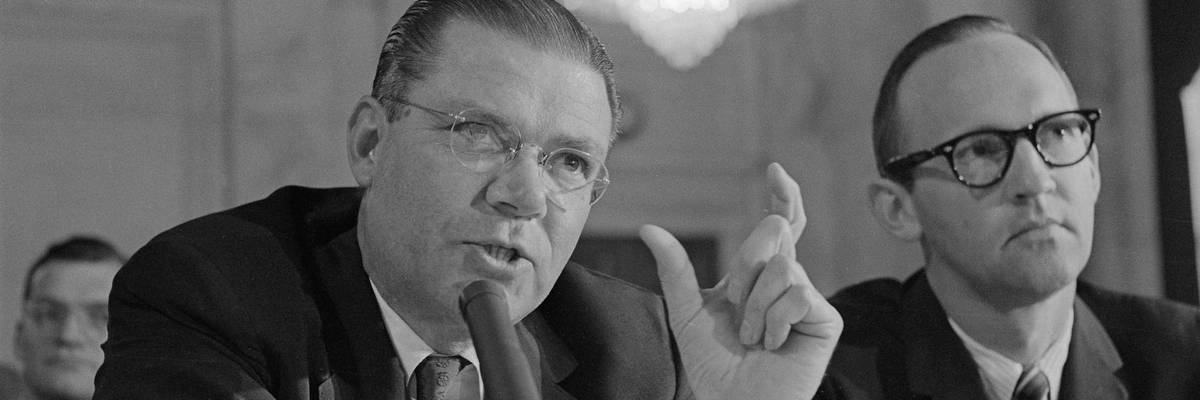
In a memorandum to President Lyndon Johnson in 1964, Defense Secretary Robert McNamara wrote that “the current strategic posture” of the United States “is to destroy both the Soviet Union and Communist China as viable societies even after a well-planned and executed surprise attack on our forces.”
In a 1967 speech in San Francisco that he called “Mutual Deterrence,” the formal introduction to the public of Mutual Assured Destruction (MAD), McNamara said “we must be able to absorb the total weight of nuclear attack on our country — on our retaliatory forces, on our command and control apparatus, on our industrial capacity, on our cities, and on our population — and still be capable of damaging the aggressor to the point that his society would be simply no longer viable in twentieth-century terms.” McNamara described this as “our assured-destruction capability.”
What this means is that the Trump administration wasn’t the first to threaten the civilizational destruction of a country. That threat has been embedded in the conceptual framework of the MAD US nuclear posture since at least 1967, which includes the perverse menace to absorb “the total weight of nuclear attack” on our own country. No president since then, or defense secretary or national security adviser, or majority party of Congress, has thought to get ourselves and the rest of the world out of the MAD policy.
In the 1960s, there was little to no knowledge of nuclear winter as a nuclear-war induced catastrophic climate effect. However, a 1963 classified nuclear war-game study by President Kennedy’s National Security Council, which described “the combined effects on survivors of radiation, blast, fires, floods, substandard diet and sanitary conditions, and lack of medical services and care” of a nuclear exchange between the United States and Soviet Union should have sufficiently informed McNamara of at least the direct effects of absorbing the full weight of a Soviet nuclear attack. The same war-games study also estimated US fatalities from 63 million to 134 million and Soviet fatalities from 136 million to 143 million. The US MAD nuclear posture was developed in the immediate aftermath of this report.
The thinking among MAD policy planners at the time, and today, is that rational actors on both the US and Soviet side would not launch a nuclear first-strike knowing that it would be suicidal for the country that launched first.
This is one of several MAD fallacies. For example, last year, three academics in New Zealand authored a study titled, “The Frequently Impaired Health of Leaders of Nuclear Weapons States.” They reported personality disorders, substance use disorders, multi-infarct dementia, depression, and anxiety among a sizeable percentage of leaders. The authors concluded: “These findings indicate that physical and mental health conditions among leaders of these nuclear weapon states have been common.” They advised: “Given the importance of the decision-making around nuclear weapons by political leaders, further research on this group should be prioritized.”
Twenty years after McNamara established Mutual Assured Destruction as US nuclear policy, Carl Sagan’s pioneering study, “Nuclear Winter: Global Consequences of Multiple Nuclear Explosions,” published in the journal Science in 1983, opened the door to extensive scientific study of the climate-related effects of nuclear war.
Using more sophisticated climate models as applied to nuclear winter, prominent climate scientists reported in Nature Food in 2022 that “more than 2 billion people could die from nuclear war between India and Pakistan, and more than 5 billion could die from a war between the United States and Russia, underlining the importance of global cooperation in preventing nuclear war.”
Alan Robock, a coauthor of the study and a leading climate scientist from Rutgers University, had previously described nuclear winter as follows: “Nuclear winter is the term for a theory describing the climatic effects of nuclear war. Smoke from the fires started by nuclear weapons, especially the black, sooty smoke from cities and industrial facilities, would be heated by the Sun, lofted into the upper atmosphere, and spread globally, lasting for years. The resulting cool, dark, dry conditions at Earth’s surface would prevent crop growth for at least one growing season, resulting in mass starvation over most of the world… More people could die in the noncombatant countries than in those where the bombs were dropped, because of these indirect effects… A nuclear war between India and Pakistan could produce so much smoke that it would produce global environmental change unprecedented in human history… The only way to be sure to prevent the climatic effects of nuclear war is to rid the world of nuclear weapons.”
Writing in 2021 in “Ending Nuclear Weapons Before They End US,” Australian physician Tilman Ruff, co-founder of the International Campaign to Abolish Nuclear Weapons (ICAN), warned: “Evidence of the consequences of nuclear war, particularly global climatic and nutritional effects of the abrupt ice age conditions from even a relatively small regional nuclear war, indicates that these are more severe than previously sought. None of the nine nuclear-armed states is disarming… Abrogation of existing nuclear arms control agreements, policies of first nuclear use and war fighting, growing armed conflicts worldwide, and increasing use of information and cyberwarfare, exacerbate dangers of nuclear war.”
An added stress today is the fact that “nuclear armed countries are considering the integration of artificial intelligence into existing nuclear command, control, and communications structures as a way to increase speed and efficiency,” thus adding to the “already unacceptable level of risk,” as ICAN reports. The ICAN-identified risks include reduced decision-making time and rapid escalation, perceived increases in vulnerability that incentivizes nuclear weapon use, cyber risks, and data poisoning.
President Trump, who inherited the MAD-based strategic nuclear posture from previous administrations, would do well to focus on preventing nuclear war/nuclear winter now by negotiating a permanent cessation of military action in and against Iran, a conflict that embodies any number of escalatory scenarios to nuclear war. Trump could then be the first US president to convene a summit of all nine nuclear-armed states—the United States, Russia, China, the U.K., France, India, Pakistan, Israel, and North Korea—to begin the process of abolishing nuclear weapons, including by joining the 2017 UN Treaty on the Prohibition of Nuclear Weapon. Trump could propose the idea to China’s President Xi during their upcoming bilateral summit next month in Beijing.
Dear Common Dreams reader, It’s been nearly 30 years since I co-founded Common Dreams with my late wife, Lina Newhouser. We had the radical notion that journalism should serve the public good, not corporate profits. It was clear to us from the outset what it would take to build such a project. No paid advertisements. No corporate sponsors. No millionaire publisher telling us what to think or do. Many people said we wouldn't last a year, but we proved those doubters wrong. Together with a tremendous team of journalists and dedicated staff, we built an independent media outlet free from the constraints of profits and corporate control. Our mission has always been simple: To inform. To inspire. To ignite change for the common good. Building Common Dreams was not easy. Our survival was never guaranteed. When you take on the most powerful forces—Wall Street greed, fossil fuel industry destruction, Big Tech lobbyists, and uber-rich oligarchs who have spent billions upon billions rigging the economy and democracy in their favor—the only bulwark you have is supporters who believe in your work. But here’s the urgent message from me today. It's never been this bad out there. And it's never been this hard to keep us going. At the very moment Common Dreams is most needed, the threats we face are intensifying. We need your support now more than ever. We don't accept corporate advertising and never will. We don't have a paywall because we don't think people should be blocked from critical news based on their ability to pay. Everything we do is funded by the donations of readers like you. When everyone does the little they can afford, we are strong. But if that support retreats or dries up, so do we. Will you donate now to make sure Common Dreams not only survives but thrives? —Craig Brown, Co-founder |
In a memorandum to President Lyndon Johnson in 1964, Defense Secretary Robert McNamara wrote that “the current strategic posture” of the United States “is to destroy both the Soviet Union and Communist China as viable societies even after a well-planned and executed surprise attack on our forces.”
In a 1967 speech in San Francisco that he called “Mutual Deterrence,” the formal introduction to the public of Mutual Assured Destruction (MAD), McNamara said “we must be able to absorb the total weight of nuclear attack on our country — on our retaliatory forces, on our command and control apparatus, on our industrial capacity, on our cities, and on our population — and still be capable of damaging the aggressor to the point that his society would be simply no longer viable in twentieth-century terms.” McNamara described this as “our assured-destruction capability.”
What this means is that the Trump administration wasn’t the first to threaten the civilizational destruction of a country. That threat has been embedded in the conceptual framework of the MAD US nuclear posture since at least 1967, which includes the perverse menace to absorb “the total weight of nuclear attack” on our own country. No president since then, or defense secretary or national security adviser, or majority party of Congress, has thought to get ourselves and the rest of the world out of the MAD policy.
In the 1960s, there was little to no knowledge of nuclear winter as a nuclear-war induced catastrophic climate effect. However, a 1963 classified nuclear war-game study by President Kennedy’s National Security Council, which described “the combined effects on survivors of radiation, blast, fires, floods, substandard diet and sanitary conditions, and lack of medical services and care” of a nuclear exchange between the United States and Soviet Union should have sufficiently informed McNamara of at least the direct effects of absorbing the full weight of a Soviet nuclear attack. The same war-games study also estimated US fatalities from 63 million to 134 million and Soviet fatalities from 136 million to 143 million. The US MAD nuclear posture was developed in the immediate aftermath of this report.
The thinking among MAD policy planners at the time, and today, is that rational actors on both the US and Soviet side would not launch a nuclear first-strike knowing that it would be suicidal for the country that launched first.
This is one of several MAD fallacies. For example, last year, three academics in New Zealand authored a study titled, “The Frequently Impaired Health of Leaders of Nuclear Weapons States.” They reported personality disorders, substance use disorders, multi-infarct dementia, depression, and anxiety among a sizeable percentage of leaders. The authors concluded: “These findings indicate that physical and mental health conditions among leaders of these nuclear weapon states have been common.” They advised: “Given the importance of the decision-making around nuclear weapons by political leaders, further research on this group should be prioritized.”
Twenty years after McNamara established Mutual Assured Destruction as US nuclear policy, Carl Sagan’s pioneering study, “Nuclear Winter: Global Consequences of Multiple Nuclear Explosions,” published in the journal Science in 1983, opened the door to extensive scientific study of the climate-related effects of nuclear war.
Using more sophisticated climate models as applied to nuclear winter, prominent climate scientists reported in Nature Food in 2022 that “more than 2 billion people could die from nuclear war between India and Pakistan, and more than 5 billion could die from a war between the United States and Russia, underlining the importance of global cooperation in preventing nuclear war.”
Alan Robock, a coauthor of the study and a leading climate scientist from Rutgers University, had previously described nuclear winter as follows: “Nuclear winter is the term for a theory describing the climatic effects of nuclear war. Smoke from the fires started by nuclear weapons, especially the black, sooty smoke from cities and industrial facilities, would be heated by the Sun, lofted into the upper atmosphere, and spread globally, lasting for years. The resulting cool, dark, dry conditions at Earth’s surface would prevent crop growth for at least one growing season, resulting in mass starvation over most of the world… More people could die in the noncombatant countries than in those where the bombs were dropped, because of these indirect effects… A nuclear war between India and Pakistan could produce so much smoke that it would produce global environmental change unprecedented in human history… The only way to be sure to prevent the climatic effects of nuclear war is to rid the world of nuclear weapons.”
Writing in 2021 in “Ending Nuclear Weapons Before They End US,” Australian physician Tilman Ruff, co-founder of the International Campaign to Abolish Nuclear Weapons (ICAN), warned: “Evidence of the consequences of nuclear war, particularly global climatic and nutritional effects of the abrupt ice age conditions from even a relatively small regional nuclear war, indicates that these are more severe than previously sought. None of the nine nuclear-armed states is disarming… Abrogation of existing nuclear arms control agreements, policies of first nuclear use and war fighting, growing armed conflicts worldwide, and increasing use of information and cyberwarfare, exacerbate dangers of nuclear war.”
An added stress today is the fact that “nuclear armed countries are considering the integration of artificial intelligence into existing nuclear command, control, and communications structures as a way to increase speed and efficiency,” thus adding to the “already unacceptable level of risk,” as ICAN reports. The ICAN-identified risks include reduced decision-making time and rapid escalation, perceived increases in vulnerability that incentivizes nuclear weapon use, cyber risks, and data poisoning.
President Trump, who inherited the MAD-based strategic nuclear posture from previous administrations, would do well to focus on preventing nuclear war/nuclear winter now by negotiating a permanent cessation of military action in and against Iran, a conflict that embodies any number of escalatory scenarios to nuclear war. Trump could then be the first US president to convene a summit of all nine nuclear-armed states—the United States, Russia, China, the U.K., France, India, Pakistan, Israel, and North Korea—to begin the process of abolishing nuclear weapons, including by joining the 2017 UN Treaty on the Prohibition of Nuclear Weapon. Trump could propose the idea to China’s President Xi during their upcoming bilateral summit next month in Beijing.
In a memorandum to President Lyndon Johnson in 1964, Defense Secretary Robert McNamara wrote that “the current strategic posture” of the United States “is to destroy both the Soviet Union and Communist China as viable societies even after a well-planned and executed surprise attack on our forces.”
In a 1967 speech in San Francisco that he called “Mutual Deterrence,” the formal introduction to the public of Mutual Assured Destruction (MAD), McNamara said “we must be able to absorb the total weight of nuclear attack on our country — on our retaliatory forces, on our command and control apparatus, on our industrial capacity, on our cities, and on our population — and still be capable of damaging the aggressor to the point that his society would be simply no longer viable in twentieth-century terms.” McNamara described this as “our assured-destruction capability.”
What this means is that the Trump administration wasn’t the first to threaten the civilizational destruction of a country. That threat has been embedded in the conceptual framework of the MAD US nuclear posture since at least 1967, which includes the perverse menace to absorb “the total weight of nuclear attack” on our own country. No president since then, or defense secretary or national security adviser, or majority party of Congress, has thought to get ourselves and the rest of the world out of the MAD policy.
In the 1960s, there was little to no knowledge of nuclear winter as a nuclear-war induced catastrophic climate effect. However, a 1963 classified nuclear war-game study by President Kennedy’s National Security Council, which described “the combined effects on survivors of radiation, blast, fires, floods, substandard diet and sanitary conditions, and lack of medical services and care” of a nuclear exchange between the United States and Soviet Union should have sufficiently informed McNamara of at least the direct effects of absorbing the full weight of a Soviet nuclear attack. The same war-games study also estimated US fatalities from 63 million to 134 million and Soviet fatalities from 136 million to 143 million. The US MAD nuclear posture was developed in the immediate aftermath of this report.
The thinking among MAD policy planners at the time, and today, is that rational actors on both the US and Soviet side would not launch a nuclear first-strike knowing that it would be suicidal for the country that launched first.
This is one of several MAD fallacies. For example, last year, three academics in New Zealand authored a study titled, “The Frequently Impaired Health of Leaders of Nuclear Weapons States.” They reported personality disorders, substance use disorders, multi-infarct dementia, depression, and anxiety among a sizeable percentage of leaders. The authors concluded: “These findings indicate that physical and mental health conditions among leaders of these nuclear weapon states have been common.” They advised: “Given the importance of the decision-making around nuclear weapons by political leaders, further research on this group should be prioritized.”
Twenty years after McNamara established Mutual Assured Destruction as US nuclear policy, Carl Sagan’s pioneering study, “Nuclear Winter: Global Consequences of Multiple Nuclear Explosions,” published in the journal Science in 1983, opened the door to extensive scientific study of the climate-related effects of nuclear war.
Using more sophisticated climate models as applied to nuclear winter, prominent climate scientists reported in Nature Food in 2022 that “more than 2 billion people could die from nuclear war between India and Pakistan, and more than 5 billion could die from a war between the United States and Russia, underlining the importance of global cooperation in preventing nuclear war.”
Alan Robock, a coauthor of the study and a leading climate scientist from Rutgers University, had previously described nuclear winter as follows: “Nuclear winter is the term for a theory describing the climatic effects of nuclear war. Smoke from the fires started by nuclear weapons, especially the black, sooty smoke from cities and industrial facilities, would be heated by the Sun, lofted into the upper atmosphere, and spread globally, lasting for years. The resulting cool, dark, dry conditions at Earth’s surface would prevent crop growth for at least one growing season, resulting in mass starvation over most of the world… More people could die in the noncombatant countries than in those where the bombs were dropped, because of these indirect effects… A nuclear war between India and Pakistan could produce so much smoke that it would produce global environmental change unprecedented in human history… The only way to be sure to prevent the climatic effects of nuclear war is to rid the world of nuclear weapons.”
Writing in 2021 in “Ending Nuclear Weapons Before They End US,” Australian physician Tilman Ruff, co-founder of the International Campaign to Abolish Nuclear Weapons (ICAN), warned: “Evidence of the consequences of nuclear war, particularly global climatic and nutritional effects of the abrupt ice age conditions from even a relatively small regional nuclear war, indicates that these are more severe than previously sought. None of the nine nuclear-armed states is disarming… Abrogation of existing nuclear arms control agreements, policies of first nuclear use and war fighting, growing armed conflicts worldwide, and increasing use of information and cyberwarfare, exacerbate dangers of nuclear war.”
An added stress today is the fact that “nuclear armed countries are considering the integration of artificial intelligence into existing nuclear command, control, and communications structures as a way to increase speed and efficiency,” thus adding to the “already unacceptable level of risk,” as ICAN reports. The ICAN-identified risks include reduced decision-making time and rapid escalation, perceived increases in vulnerability that incentivizes nuclear weapon use, cyber risks, and data poisoning.
President Trump, who inherited the MAD-based strategic nuclear posture from previous administrations, would do well to focus on preventing nuclear war/nuclear winter now by negotiating a permanent cessation of military action in and against Iran, a conflict that embodies any number of escalatory scenarios to nuclear war. Trump could then be the first US president to convene a summit of all nine nuclear-armed states—the United States, Russia, China, the U.K., France, India, Pakistan, Israel, and North Korea—to begin the process of abolishing nuclear weapons, including by joining the 2017 UN Treaty on the Prohibition of Nuclear Weapon. Trump could propose the idea to China’s President Xi during their upcoming bilateral summit next month in Beijing.