

SUBSCRIBE TO OUR FREE NEWSLETTER
Daily news & progressive opinion—funded by the people, not the corporations—delivered straight to your inbox.
5
#000000
#FFFFFF
To donate by check, phone, or other method, see our More Ways to Give page.
Daily news & progressive opinion—funded by the people, not the corporations—delivered straight to your inbox.
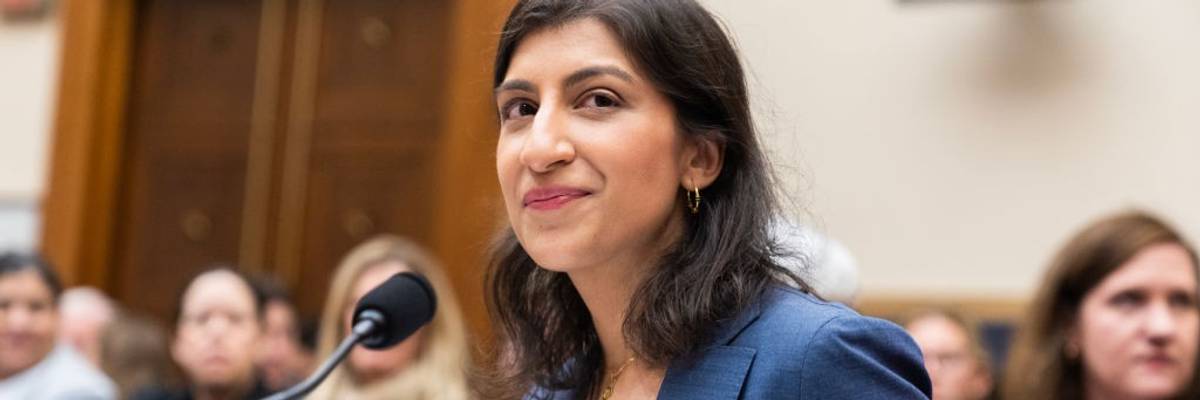
FTC Chair Lina Khan prepares to testify during a congressional hearing in Washington, D.C. on July 13, 2023.
Khan’s FTC has scored historic victories for consumers and workers—even as she’s faced powerful industry opposition and obstruction from right-wing judges.
In June 2021, just months into the Biden era, Zephyr Teachout argued that Lina Khan’s appointment to the Federal Trade Commission “may be the best thing Joe Biden has done” in office. With a firm reputation as a leader in the anti-monopoly movement, her nomination to the FTC was a clear victory for progressives in an administration otherwise primarily staffed by moderates.
Three years on, it’s clear that this optimistic outlook about a Khan-run FTC has been vindicated. In her position, Khan’s FTC has scored historic victories for consumers and workers—even as she’s faced powerful industry opposition and obstruction from right-wing judges.
Understanding the significance of Khan’s tenure means understanding how antitrust enforcement has been sabotaged in recent decades by right-wing ideologues. The federal government adopted antitrust laws beginning in 1890, which would become a crucial tool for reining in corporate abuses for decades to come. But beginning in the 1970s, federal courts would embrace a right-wing reimagining of antitrust law under the guise of promoting “consumer welfare.” Unsurprisingly, this hands-off approach helped create an economy defined by extreme corporate concentration, leading to fewer and worse choices for American consumers.
While the leadership of both agencies are set to change under President-elect Donald Trump, the new merger guidelines mean that Khan’s pro-competition vision will help shape FTC decision-making well past her tenure.
While still in law school, Khan rose to prominence in 2017 for her critique of laissez-faire antitrust enforcement. Given her reputation, observers were quick to speculate on how she’d be able to put her principles to action at the FTC. For one, the commission in recent decades has built a track record of being deferential to the very monopolies it’s tasked to regulate. Additionally, the commission has long suffered from inadequate funding, which has hindered its capacity to police monopolies. But despite these institutional constraints, Khan’s FTC has secured major wins for American consumers, all while facing down hostile corporate actors and their allies in the judiciary.
Monopolistic behavior in the food industry over the past few decades has robbed consumers of choice while increasing grocery costs. Two years ago, grocery giants Kroger and Albertsons announced a massive merger deal that quickly raised alarms among consumer advocates. While such a merger may have gone through unscathed a decade or so prior, the Khan-led FTC filed suit to block the deal. Last month, the FTC won one of its biggest victories in recent years by blocking the merger in court. This victory, along with the FTC’s successful effort to block Tapestry’s acquisition of Capri, shows that Khan’s view of antitrust is increasingly finding support in court.
Sharing jurisdiction on antitrust matters with the Department of Justice (DOJ) Antitrust Division, the two agencies successfully modernized merger guidelines to help identify illegal mergers in their tracks. Observers have credited both the FTC and DOJ Antitrust Division’s aggressive enforcement efforts with a recent decline in merger efforts. And while the leadership of both agencies are set to change under President-elect Donald Trump, the new merger guidelines mean that Khan’s pro-competition vision will help shape FTC decision-making well past her tenure.
These developments, of course, only scrape the surface of the FTC’s accomplishments under Khan. The commission notably blocked an effort by Nvidia to acquire Arm, which was set to be the biggest merger deal in semiconductor industry history. The ultimate failure of Amazon to acquire iRobot, which caused concern among various international antitrust regulators, has been at least partially credited to the FTC’s scrutiny. Among the most meaningful impact of renewed FTC antitrust scrutiny may be felt on private equity firms, a welcome development given said firms’ harms to competition and American society at large.
The Khan-led FTC’s ability to build bipartisan support for efforts such as recent rulemaking on junk fees, as well as on merger guidelines, should be seen as a model for Democratic governance. Moreover, the Khan-led FTC should be applauded for using long-neglected tools at the commission’s disposal, such as its ability to police price discrimination as interlocking directorates.
With Khan set to be succeeded by Andrew Ferguson, Trump’s pick to lead the FTC, it's likely that the FTC will soon shift its approach on antitrust and consumer protection. Nevertheless, it’s clear that Khan will leave behind a legacy that will influence antitrust enforcement for decades to come. And in doing so, Khan will also leave behind a track record that shows what successful progressive governance looks like.
Dear Common Dreams reader, It’s been nearly 30 years since I co-founded Common Dreams with my late wife, Lina Newhouser. We had the radical notion that journalism should serve the public good, not corporate profits. It was clear to us from the outset what it would take to build such a project. No paid advertisements. No corporate sponsors. No millionaire publisher telling us what to think or do. Many people said we wouldn't last a year, but we proved those doubters wrong. Together with a tremendous team of journalists and dedicated staff, we built an independent media outlet free from the constraints of profits and corporate control. Our mission has always been simple: To inform. To inspire. To ignite change for the common good. Building Common Dreams was not easy. Our survival was never guaranteed. When you take on the most powerful forces—Wall Street greed, fossil fuel industry destruction, Big Tech lobbyists, and uber-rich oligarchs who have spent billions upon billions rigging the economy and democracy in their favor—the only bulwark you have is supporters who believe in your work. But here’s the urgent message from me today. It's never been this bad out there. And it's never been this hard to keep us going. At the very moment Common Dreams is most needed, the threats we face are intensifying. We need your support now more than ever. We don't accept corporate advertising and never will. We don't have a paywall because we don't think people should be blocked from critical news based on their ability to pay. Everything we do is funded by the donations of readers like you. When everyone does the little they can afford, we are strong. But if that support retreats or dries up, so do we. Will you donate now to make sure Common Dreams not only survives but thrives? —Craig Brown, Co-founder |
In June 2021, just months into the Biden era, Zephyr Teachout argued that Lina Khan’s appointment to the Federal Trade Commission “may be the best thing Joe Biden has done” in office. With a firm reputation as a leader in the anti-monopoly movement, her nomination to the FTC was a clear victory for progressives in an administration otherwise primarily staffed by moderates.
Three years on, it’s clear that this optimistic outlook about a Khan-run FTC has been vindicated. In her position, Khan’s FTC has scored historic victories for consumers and workers—even as she’s faced powerful industry opposition and obstruction from right-wing judges.
Understanding the significance of Khan’s tenure means understanding how antitrust enforcement has been sabotaged in recent decades by right-wing ideologues. The federal government adopted antitrust laws beginning in 1890, which would become a crucial tool for reining in corporate abuses for decades to come. But beginning in the 1970s, federal courts would embrace a right-wing reimagining of antitrust law under the guise of promoting “consumer welfare.” Unsurprisingly, this hands-off approach helped create an economy defined by extreme corporate concentration, leading to fewer and worse choices for American consumers.
While the leadership of both agencies are set to change under President-elect Donald Trump, the new merger guidelines mean that Khan’s pro-competition vision will help shape FTC decision-making well past her tenure.
While still in law school, Khan rose to prominence in 2017 for her critique of laissez-faire antitrust enforcement. Given her reputation, observers were quick to speculate on how she’d be able to put her principles to action at the FTC. For one, the commission in recent decades has built a track record of being deferential to the very monopolies it’s tasked to regulate. Additionally, the commission has long suffered from inadequate funding, which has hindered its capacity to police monopolies. But despite these institutional constraints, Khan’s FTC has secured major wins for American consumers, all while facing down hostile corporate actors and their allies in the judiciary.
Monopolistic behavior in the food industry over the past few decades has robbed consumers of choice while increasing grocery costs. Two years ago, grocery giants Kroger and Albertsons announced a massive merger deal that quickly raised alarms among consumer advocates. While such a merger may have gone through unscathed a decade or so prior, the Khan-led FTC filed suit to block the deal. Last month, the FTC won one of its biggest victories in recent years by blocking the merger in court. This victory, along with the FTC’s successful effort to block Tapestry’s acquisition of Capri, shows that Khan’s view of antitrust is increasingly finding support in court.
Sharing jurisdiction on antitrust matters with the Department of Justice (DOJ) Antitrust Division, the two agencies successfully modernized merger guidelines to help identify illegal mergers in their tracks. Observers have credited both the FTC and DOJ Antitrust Division’s aggressive enforcement efforts with a recent decline in merger efforts. And while the leadership of both agencies are set to change under President-elect Donald Trump, the new merger guidelines mean that Khan’s pro-competition vision will help shape FTC decision-making well past her tenure.
These developments, of course, only scrape the surface of the FTC’s accomplishments under Khan. The commission notably blocked an effort by Nvidia to acquire Arm, which was set to be the biggest merger deal in semiconductor industry history. The ultimate failure of Amazon to acquire iRobot, which caused concern among various international antitrust regulators, has been at least partially credited to the FTC’s scrutiny. Among the most meaningful impact of renewed FTC antitrust scrutiny may be felt on private equity firms, a welcome development given said firms’ harms to competition and American society at large.
The Khan-led FTC’s ability to build bipartisan support for efforts such as recent rulemaking on junk fees, as well as on merger guidelines, should be seen as a model for Democratic governance. Moreover, the Khan-led FTC should be applauded for using long-neglected tools at the commission’s disposal, such as its ability to police price discrimination as interlocking directorates.
With Khan set to be succeeded by Andrew Ferguson, Trump’s pick to lead the FTC, it's likely that the FTC will soon shift its approach on antitrust and consumer protection. Nevertheless, it’s clear that Khan will leave behind a legacy that will influence antitrust enforcement for decades to come. And in doing so, Khan will also leave behind a track record that shows what successful progressive governance looks like.
In June 2021, just months into the Biden era, Zephyr Teachout argued that Lina Khan’s appointment to the Federal Trade Commission “may be the best thing Joe Biden has done” in office. With a firm reputation as a leader in the anti-monopoly movement, her nomination to the FTC was a clear victory for progressives in an administration otherwise primarily staffed by moderates.
Three years on, it’s clear that this optimistic outlook about a Khan-run FTC has been vindicated. In her position, Khan’s FTC has scored historic victories for consumers and workers—even as she’s faced powerful industry opposition and obstruction from right-wing judges.
Understanding the significance of Khan’s tenure means understanding how antitrust enforcement has been sabotaged in recent decades by right-wing ideologues. The federal government adopted antitrust laws beginning in 1890, which would become a crucial tool for reining in corporate abuses for decades to come. But beginning in the 1970s, federal courts would embrace a right-wing reimagining of antitrust law under the guise of promoting “consumer welfare.” Unsurprisingly, this hands-off approach helped create an economy defined by extreme corporate concentration, leading to fewer and worse choices for American consumers.
While the leadership of both agencies are set to change under President-elect Donald Trump, the new merger guidelines mean that Khan’s pro-competition vision will help shape FTC decision-making well past her tenure.
While still in law school, Khan rose to prominence in 2017 for her critique of laissez-faire antitrust enforcement. Given her reputation, observers were quick to speculate on how she’d be able to put her principles to action at the FTC. For one, the commission in recent decades has built a track record of being deferential to the very monopolies it’s tasked to regulate. Additionally, the commission has long suffered from inadequate funding, which has hindered its capacity to police monopolies. But despite these institutional constraints, Khan’s FTC has secured major wins for American consumers, all while facing down hostile corporate actors and their allies in the judiciary.
Monopolistic behavior in the food industry over the past few decades has robbed consumers of choice while increasing grocery costs. Two years ago, grocery giants Kroger and Albertsons announced a massive merger deal that quickly raised alarms among consumer advocates. While such a merger may have gone through unscathed a decade or so prior, the Khan-led FTC filed suit to block the deal. Last month, the FTC won one of its biggest victories in recent years by blocking the merger in court. This victory, along with the FTC’s successful effort to block Tapestry’s acquisition of Capri, shows that Khan’s view of antitrust is increasingly finding support in court.
Sharing jurisdiction on antitrust matters with the Department of Justice (DOJ) Antitrust Division, the two agencies successfully modernized merger guidelines to help identify illegal mergers in their tracks. Observers have credited both the FTC and DOJ Antitrust Division’s aggressive enforcement efforts with a recent decline in merger efforts. And while the leadership of both agencies are set to change under President-elect Donald Trump, the new merger guidelines mean that Khan’s pro-competition vision will help shape FTC decision-making well past her tenure.
These developments, of course, only scrape the surface of the FTC’s accomplishments under Khan. The commission notably blocked an effort by Nvidia to acquire Arm, which was set to be the biggest merger deal in semiconductor industry history. The ultimate failure of Amazon to acquire iRobot, which caused concern among various international antitrust regulators, has been at least partially credited to the FTC’s scrutiny. Among the most meaningful impact of renewed FTC antitrust scrutiny may be felt on private equity firms, a welcome development given said firms’ harms to competition and American society at large.
The Khan-led FTC’s ability to build bipartisan support for efforts such as recent rulemaking on junk fees, as well as on merger guidelines, should be seen as a model for Democratic governance. Moreover, the Khan-led FTC should be applauded for using long-neglected tools at the commission’s disposal, such as its ability to police price discrimination as interlocking directorates.
With Khan set to be succeeded by Andrew Ferguson, Trump’s pick to lead the FTC, it's likely that the FTC will soon shift its approach on antitrust and consumer protection. Nevertheless, it’s clear that Khan will leave behind a legacy that will influence antitrust enforcement for decades to come. And in doing so, Khan will also leave behind a track record that shows what successful progressive governance looks like.

