SUBSCRIBE TO OUR FREE NEWSLETTER
Daily news & progressive opinion—funded by the people, not the corporations—delivered straight to your inbox.
5
#000000
#FFFFFF
To donate by check, phone, or other method, see our More Ways to Give page.
Daily news & progressive opinion—funded by the people, not the corporations—delivered straight to your inbox.
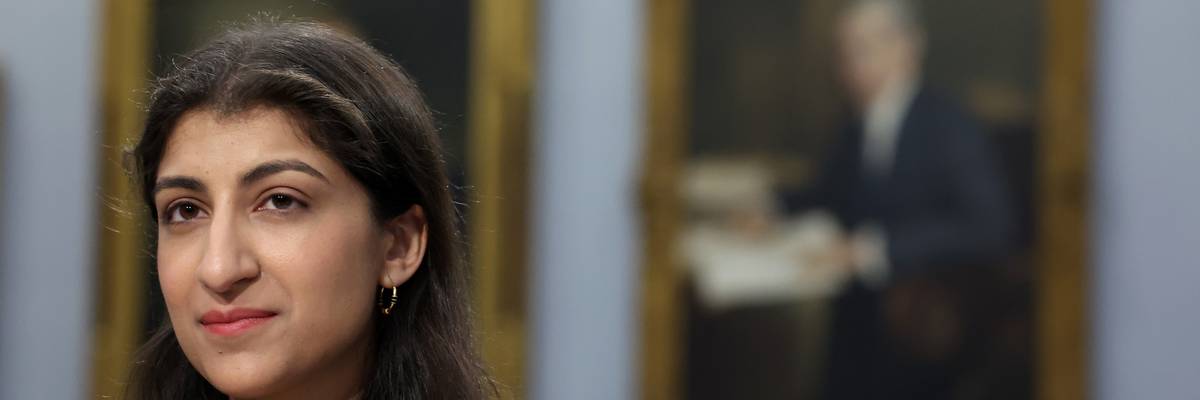
Lina Khan, chair of the Federal Trade Commission (FTC), testifies before the House Appropriations Subcommittee at the Rayburn House Office Building on May 15, 2024 in Washington, D.C.
Harris should reject the smear campaign against Khan’s FTC and commit to reappointing her as chair of the commission, signalling that under her administration, corporate lawbreakers would face the full force of the law.
U.S. Vice President Kamala Harris’ ascension to the top of the Democratic ticket hasn’t just shifted the 2024 electoral calculus—it’s also reignited the battle for the party’s ideological soul. Just as progressives have outlined their hopes for a Harris administration, so too have bad faith actors looking to turn back the clock on the most significant progressive achievement of the Biden era: the reinvigoration of antitrust enforcement.
The revival of anti-monopoly politics has been met with predictable ire from corporate interests that have got off scot-free for decades. This has been largely directed at Lina Khan, the Federal Trade Commission (FTC) chair who has taken on some of America’s most entrenched monopolies. Rather than accede to the demands of Silicon Valley and Wall Street billionaires, Harris should embrace—and entrench—the Biden administration’s antitrust efforts.
It goes without saying that progressives have the right to be disappointed with the legacy of the Biden administration in many respects. Whether one lays the blame on the White House or congressional math, many of the most promising initiatives pushed in 2021 never made it to law. However, the early Biden administration’s focus on reinvigorating antitrust enforcement is one that has paid dividends in the years that followed. The Reagan-era defanging of antitrust helped pave the way for the present-day monopoly crisis, which has left its mark on everything from the tech sector to the rental market to grocery shopping.
The FTC under Khan has taken aim at price gouging in, among others, the energy industry and grocery sector, which compliments Harris’ stated plan to crack down on price gouging if elected.
The Biden administration deserves credit for breaking with his predecessors’ hands-off approach to taking on corporate monopolies. Both Khan at the FTC and Jonathan Kanter, the assistant attorney general for the Antitrust Division at the Department of Justice (DOJ), have taken a tough line against anti-competitive behavior. Khan and Kanter’s efforts to block illegal mergers have been met with rage from corporate America’s worst offenders. This has resulted in frivolous demands for their recusals from key antitrust cases, as well as broader efforts to kneecap antitrust regulation itself. With a “changing of the guard” on the Democratic ticket, these same actors have taken to demanding Harris abandon Biden-era antitrust efforts, complete with a change in personnel.
Harris should reject these demands, and instead look to Khan and Kanter’s successes as a road map for enacting change in Washington. Time and time again, Khan and Kanter have delivered victories for consumers in the face of a hostile press and a right-wing judicial landscape. In August, the DOJ emerged victorious in its historic U.S. v. Google antitrust lawsuit, one that Kanter fittingly says belongs on the “Mount Rushmore of antitrust cases.” In the years following House Democrats’ 2020 report on monopoly power in the tech sector, Biden administration enforcers have filed antitrust suits against Amazon and Apple, along with a separate Google suit set to go to trial this month.
If successful, these lawsuits stand to rein in some of the tech sector’s worst abuses. But make no mistake: The FTC and DOJ’s antitrust efforts target far more than just the abuses of the “Big Tech” giants. This year, the DOJ launched a blockbuster antitrust suit against Ticketmaster, which was largely given a pass for its abuses in previous administrations. The DOJ Antitrust Division has stood with tenants by filing an antitrust lawsuit against RealPage over the company’s role in enabling rental price gouging. The FTC under Khan has taken aim at price gouging in, among others, the energy industry and grocery sector, which compliments Harris’ stated plan to crack down on price gouging if elected.
Antitrust enforcement is both crucial to building a fairer economy and broadly popular with the general public. For this reason, Harris should firmly reject the smear campaign against Khan’s FTC and commit to reappointing her as chair of the commission. Doing so would send a strong signal that under a Harris administration, corporate lawbreakers would face the full force of the law.
Instead of turning back the clock on antitrust, a Harris administration should build upon the progress of the last three years by launching other needed antitrust initiatives. This could include, among others, taking on YouTube-related competition issues, which advocates have sounded the alarm on. More broadly, the DOJ and FTC under a Harris administration should continue to probe would-be monopolists in the artificial intelligence (AI) sector. Given the scope of monopolistic behavior in today’s economy, regulators under a Harris Administration must take a vigilant approach to anti-competitive practices across sectors.Dear Common Dreams reader, It’s been nearly 30 years since I co-founded Common Dreams with my late wife, Lina Newhouser. We had the radical notion that journalism should serve the public good, not corporate profits. It was clear to us from the outset what it would take to build such a project. No paid advertisements. No corporate sponsors. No millionaire publisher telling us what to think or do. Many people said we wouldn't last a year, but we proved those doubters wrong. Together with a tremendous team of journalists and dedicated staff, we built an independent media outlet free from the constraints of profits and corporate control. Our mission has always been simple: To inform. To inspire. To ignite change for the common good. Building Common Dreams was not easy. Our survival was never guaranteed. When you take on the most powerful forces—Wall Street greed, fossil fuel industry destruction, Big Tech lobbyists, and uber-rich oligarchs who have spent billions upon billions rigging the economy and democracy in their favor—the only bulwark you have is supporters who believe in your work. But here’s the urgent message from me today. It's never been this bad out there. And it's never been this hard to keep us going. At the very moment Common Dreams is most needed, the threats we face are intensifying. We need your support now more than ever. We don't accept corporate advertising and never will. We don't have a paywall because we don't think people should be blocked from critical news based on their ability to pay. Everything we do is funded by the donations of readers like you. When everyone does the little they can afford, we are strong. But if that support retreats or dries up, so do we. Will you donate now to make sure Common Dreams not only survives but thrives? —Craig Brown, Co-founder |
U.S. Vice President Kamala Harris’ ascension to the top of the Democratic ticket hasn’t just shifted the 2024 electoral calculus—it’s also reignited the battle for the party’s ideological soul. Just as progressives have outlined their hopes for a Harris administration, so too have bad faith actors looking to turn back the clock on the most significant progressive achievement of the Biden era: the reinvigoration of antitrust enforcement.
The revival of anti-monopoly politics has been met with predictable ire from corporate interests that have got off scot-free for decades. This has been largely directed at Lina Khan, the Federal Trade Commission (FTC) chair who has taken on some of America’s most entrenched monopolies. Rather than accede to the demands of Silicon Valley and Wall Street billionaires, Harris should embrace—and entrench—the Biden administration’s antitrust efforts.
It goes without saying that progressives have the right to be disappointed with the legacy of the Biden administration in many respects. Whether one lays the blame on the White House or congressional math, many of the most promising initiatives pushed in 2021 never made it to law. However, the early Biden administration’s focus on reinvigorating antitrust enforcement is one that has paid dividends in the years that followed. The Reagan-era defanging of antitrust helped pave the way for the present-day monopoly crisis, which has left its mark on everything from the tech sector to the rental market to grocery shopping.
The FTC under Khan has taken aim at price gouging in, among others, the energy industry and grocery sector, which compliments Harris’ stated plan to crack down on price gouging if elected.
The Biden administration deserves credit for breaking with his predecessors’ hands-off approach to taking on corporate monopolies. Both Khan at the FTC and Jonathan Kanter, the assistant attorney general for the Antitrust Division at the Department of Justice (DOJ), have taken a tough line against anti-competitive behavior. Khan and Kanter’s efforts to block illegal mergers have been met with rage from corporate America’s worst offenders. This has resulted in frivolous demands for their recusals from key antitrust cases, as well as broader efforts to kneecap antitrust regulation itself. With a “changing of the guard” on the Democratic ticket, these same actors have taken to demanding Harris abandon Biden-era antitrust efforts, complete with a change in personnel.
Harris should reject these demands, and instead look to Khan and Kanter’s successes as a road map for enacting change in Washington. Time and time again, Khan and Kanter have delivered victories for consumers in the face of a hostile press and a right-wing judicial landscape. In August, the DOJ emerged victorious in its historic U.S. v. Google antitrust lawsuit, one that Kanter fittingly says belongs on the “Mount Rushmore of antitrust cases.” In the years following House Democrats’ 2020 report on monopoly power in the tech sector, Biden administration enforcers have filed antitrust suits against Amazon and Apple, along with a separate Google suit set to go to trial this month.
If successful, these lawsuits stand to rein in some of the tech sector’s worst abuses. But make no mistake: The FTC and DOJ’s antitrust efforts target far more than just the abuses of the “Big Tech” giants. This year, the DOJ launched a blockbuster antitrust suit against Ticketmaster, which was largely given a pass for its abuses in previous administrations. The DOJ Antitrust Division has stood with tenants by filing an antitrust lawsuit against RealPage over the company’s role in enabling rental price gouging. The FTC under Khan has taken aim at price gouging in, among others, the energy industry and grocery sector, which compliments Harris’ stated plan to crack down on price gouging if elected.
Antitrust enforcement is both crucial to building a fairer economy and broadly popular with the general public. For this reason, Harris should firmly reject the smear campaign against Khan’s FTC and commit to reappointing her as chair of the commission. Doing so would send a strong signal that under a Harris administration, corporate lawbreakers would face the full force of the law.
Instead of turning back the clock on antitrust, a Harris administration should build upon the progress of the last three years by launching other needed antitrust initiatives. This could include, among others, taking on YouTube-related competition issues, which advocates have sounded the alarm on. More broadly, the DOJ and FTC under a Harris administration should continue to probe would-be monopolists in the artificial intelligence (AI) sector. Given the scope of monopolistic behavior in today’s economy, regulators under a Harris Administration must take a vigilant approach to anti-competitive practices across sectors.U.S. Vice President Kamala Harris’ ascension to the top of the Democratic ticket hasn’t just shifted the 2024 electoral calculus—it’s also reignited the battle for the party’s ideological soul. Just as progressives have outlined their hopes for a Harris administration, so too have bad faith actors looking to turn back the clock on the most significant progressive achievement of the Biden era: the reinvigoration of antitrust enforcement.
The revival of anti-monopoly politics has been met with predictable ire from corporate interests that have got off scot-free for decades. This has been largely directed at Lina Khan, the Federal Trade Commission (FTC) chair who has taken on some of America’s most entrenched monopolies. Rather than accede to the demands of Silicon Valley and Wall Street billionaires, Harris should embrace—and entrench—the Biden administration’s antitrust efforts.
It goes without saying that progressives have the right to be disappointed with the legacy of the Biden administration in many respects. Whether one lays the blame on the White House or congressional math, many of the most promising initiatives pushed in 2021 never made it to law. However, the early Biden administration’s focus on reinvigorating antitrust enforcement is one that has paid dividends in the years that followed. The Reagan-era defanging of antitrust helped pave the way for the present-day monopoly crisis, which has left its mark on everything from the tech sector to the rental market to grocery shopping.
The FTC under Khan has taken aim at price gouging in, among others, the energy industry and grocery sector, which compliments Harris’ stated plan to crack down on price gouging if elected.
The Biden administration deserves credit for breaking with his predecessors’ hands-off approach to taking on corporate monopolies. Both Khan at the FTC and Jonathan Kanter, the assistant attorney general for the Antitrust Division at the Department of Justice (DOJ), have taken a tough line against anti-competitive behavior. Khan and Kanter’s efforts to block illegal mergers have been met with rage from corporate America’s worst offenders. This has resulted in frivolous demands for their recusals from key antitrust cases, as well as broader efforts to kneecap antitrust regulation itself. With a “changing of the guard” on the Democratic ticket, these same actors have taken to demanding Harris abandon Biden-era antitrust efforts, complete with a change in personnel.
Harris should reject these demands, and instead look to Khan and Kanter’s successes as a road map for enacting change in Washington. Time and time again, Khan and Kanter have delivered victories for consumers in the face of a hostile press and a right-wing judicial landscape. In August, the DOJ emerged victorious in its historic U.S. v. Google antitrust lawsuit, one that Kanter fittingly says belongs on the “Mount Rushmore of antitrust cases.” In the years following House Democrats’ 2020 report on monopoly power in the tech sector, Biden administration enforcers have filed antitrust suits against Amazon and Apple, along with a separate Google suit set to go to trial this month.
If successful, these lawsuits stand to rein in some of the tech sector’s worst abuses. But make no mistake: The FTC and DOJ’s antitrust efforts target far more than just the abuses of the “Big Tech” giants. This year, the DOJ launched a blockbuster antitrust suit against Ticketmaster, which was largely given a pass for its abuses in previous administrations. The DOJ Antitrust Division has stood with tenants by filing an antitrust lawsuit against RealPage over the company’s role in enabling rental price gouging. The FTC under Khan has taken aim at price gouging in, among others, the energy industry and grocery sector, which compliments Harris’ stated plan to crack down on price gouging if elected.
Antitrust enforcement is both crucial to building a fairer economy and broadly popular with the general public. For this reason, Harris should firmly reject the smear campaign against Khan’s FTC and commit to reappointing her as chair of the commission. Doing so would send a strong signal that under a Harris administration, corporate lawbreakers would face the full force of the law.
Instead of turning back the clock on antitrust, a Harris administration should build upon the progress of the last three years by launching other needed antitrust initiatives. This could include, among others, taking on YouTube-related competition issues, which advocates have sounded the alarm on. More broadly, the DOJ and FTC under a Harris administration should continue to probe would-be monopolists in the artificial intelligence (AI) sector. Given the scope of monopolistic behavior in today’s economy, regulators under a Harris Administration must take a vigilant approach to anti-competitive practices across sectors.