SUBSCRIBE TO OUR FREE NEWSLETTER
Daily news & progressive opinion—funded by the people, not the corporations—delivered straight to your inbox.
5
#000000
#FFFFFF
To donate by check, phone, or other method, see our More Ways to Give page.
Daily news & progressive opinion—funded by the people, not the corporations—delivered straight to your inbox.
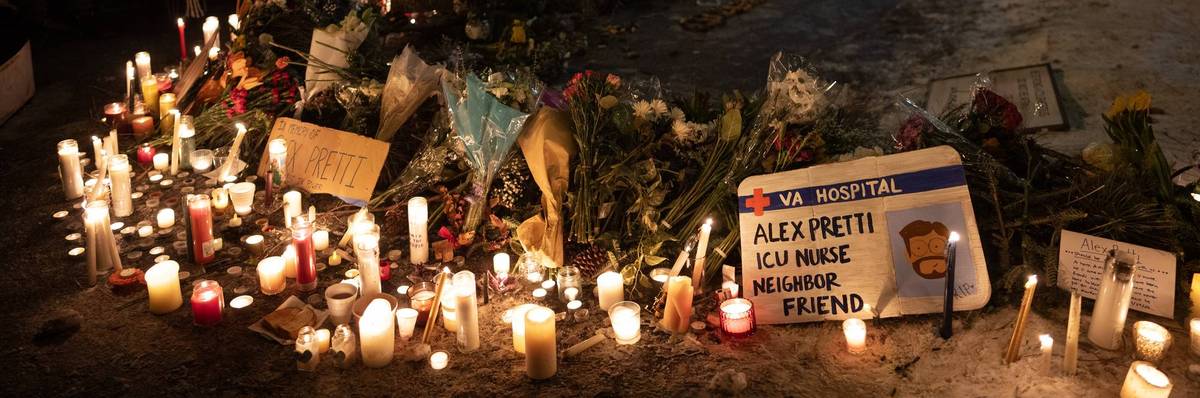
Mourners placed candles at a memorial to Alex Pretti on Nicollet Ave. after attending a vigil and rally at Whittier Park in Minneapolis in the wake of another fatal shooting by federal agents on Saturday, January 24, 2026.
A society cannot remain mentally healthy when its members are repeatedly told not to trust what they see, feel, or know.
Following the murders of Renee Good and Alex Pretti in Minneapolis, people are glued to their phones, televisions, and computer screens with both curiosity and dread. There is a pervasive feeling of unrelenting anxiety and fear. It creeps into otherwise ordinary moments, leaving people unmoored and unable to rest.
As therapists, we traditionally spend our time helping clients unpack what they are experiencing internally. But now, we are facing a moment when we don’t have to invest much in discovering what is causing that pervasive feeling of unease. It’s a collective experience causing individual pain.
There is a longstanding belief that therapy and politics should be kept separate, and that the treatment room ought to be sealed off from the chaos of the outside world. In quieter times, that is a reasonable expectation. But when fear, instability, and disinformation saturate the social atmosphere, pretending those forces stop at the therapy door becomes unrealistic and, at a certain point, irresponsible.
We are living through a period of sustained psychological assault. Constant chaos, relentless distortion, and the normalization of cruelty erode people’s internal sense of reality. When power is exercised without restraint or accountability, confusion and anxiety do not remain abstract. They show up as panic attacks, depressive collapse, insomnia, somatic symptoms, relational breakdowns, and despair.
It would be a mistake to minimize the pain people are experiencing right now or to underestimate how deeply it is shaping mental health.
This is not a partisan claim; it is a psychological one. When psychologically underdeveloped men become intoxicated by power, the effects are predictable and terrifying. Fear increases. Trust erodes. Nervous systems remain on high alert. People begin to doubt their own perceptions. Over time, this destabilization becomes chronic, not only for individuals but for the collective psyche.
Therapists are seeing this every day. Clients who once came to therapy for familiar struggles now arrive carrying an added layer of dread. People of color describe the fear of living in communities that feel increasingly targeted and unsafe. Protesters speak about the psychic toll of being criminalized for dissent. Immigrants and their families live with the constant anxiety of disappearance or deportation to foreign jails known as torture camps. Others describe something harder to name but no less corrosive—the sense that reality itself is no longer reliable.
Those outside the United States are not insulated from this either. When imperial powers posture and threaten, entire populations live in constant fear of destabilization or invasion.
History tells us that these cycles recur, and that eventually, they are resisted and reversed. However, that knowledge offers limited comfort to people living inside the rupture itself. It would be a mistake to minimize the pain people are experiencing right now or to underestimate how deeply it is shaping mental health.
What we call democracy in this country is valuable, but also deeply flawed. Systemic racism and a war on the poorest among us always have been standard fare.
But today, we seem to be entering a new phase where democratic norms are undermined openly and where cruelty is reframed as strength. When the truth is being treated as optional, the psychological cost is profound. A society cannot remain mentally healthy when its members are repeatedly told not to trust what they see, feel, or know.
This is where the fantasy that therapy exists in a political vacuum collapses. Policy decisions shape bodies, relationships, and futures. When people’s lives are destabilized by political forces, the reverberations show up in the quiet despair of the patient on the couch: What is happening? Why do I feel this way? What should I do?
Therapy is an act of reality restoration. It helps people reclaim their perceptions, reconnect with their values, and rebuild trust in themselves and others. Care, in this moment, is not passive. It requires naming harm, recognizing where terror is being manufactured and distributed, and understanding that the psychological health of a society depends on more than individual coping strategies. It depends on truth, accountability, and the protection of human dignity.
Therapists will continue to do what we have always done: Show up, listen carefully, and hold space for transformation. But we should not be asked to pretend that the storm outside has nothing to do with the distress inside. America’s crisis is not only political; it is psychological too.
Dear Common Dreams reader, It’s been nearly 30 years since I co-founded Common Dreams with my late wife, Lina Newhouser. We had the radical notion that journalism should serve the public good, not corporate profits. It was clear to us from the outset what it would take to build such a project. No paid advertisements. No corporate sponsors. No millionaire publisher telling us what to think or do. Many people said we wouldn't last a year, but we proved those doubters wrong. Together with a tremendous team of journalists and dedicated staff, we built an independent media outlet free from the constraints of profits and corporate control. Our mission has always been simple: To inform. To inspire. To ignite change for the common good. Building Common Dreams was not easy. Our survival was never guaranteed. When you take on the most powerful forces—Wall Street greed, fossil fuel industry destruction, Big Tech lobbyists, and uber-rich oligarchs who have spent billions upon billions rigging the economy and democracy in their favor—the only bulwark you have is supporters who believe in your work. But here’s the urgent message from me today. It's never been this bad out there. And it's never been this hard to keep us going. At the very moment Common Dreams is most needed, the threats we face are intensifying. We need your support now more than ever. We don't accept corporate advertising and never will. We don't have a paywall because we don't think people should be blocked from critical news based on their ability to pay. Everything we do is funded by the donations of readers like you. When everyone does the little they can afford, we are strong. But if that support retreats or dries up, so do we. Will you donate now to make sure Common Dreams not only survives but thrives? —Craig Brown, Co-founder |
Following the murders of Renee Good and Alex Pretti in Minneapolis, people are glued to their phones, televisions, and computer screens with both curiosity and dread. There is a pervasive feeling of unrelenting anxiety and fear. It creeps into otherwise ordinary moments, leaving people unmoored and unable to rest.
As therapists, we traditionally spend our time helping clients unpack what they are experiencing internally. But now, we are facing a moment when we don’t have to invest much in discovering what is causing that pervasive feeling of unease. It’s a collective experience causing individual pain.
There is a longstanding belief that therapy and politics should be kept separate, and that the treatment room ought to be sealed off from the chaos of the outside world. In quieter times, that is a reasonable expectation. But when fear, instability, and disinformation saturate the social atmosphere, pretending those forces stop at the therapy door becomes unrealistic and, at a certain point, irresponsible.
We are living through a period of sustained psychological assault. Constant chaos, relentless distortion, and the normalization of cruelty erode people’s internal sense of reality. When power is exercised without restraint or accountability, confusion and anxiety do not remain abstract. They show up as panic attacks, depressive collapse, insomnia, somatic symptoms, relational breakdowns, and despair.
It would be a mistake to minimize the pain people are experiencing right now or to underestimate how deeply it is shaping mental health.
This is not a partisan claim; it is a psychological one. When psychologically underdeveloped men become intoxicated by power, the effects are predictable and terrifying. Fear increases. Trust erodes. Nervous systems remain on high alert. People begin to doubt their own perceptions. Over time, this destabilization becomes chronic, not only for individuals but for the collective psyche.
Therapists are seeing this every day. Clients who once came to therapy for familiar struggles now arrive carrying an added layer of dread. People of color describe the fear of living in communities that feel increasingly targeted and unsafe. Protesters speak about the psychic toll of being criminalized for dissent. Immigrants and their families live with the constant anxiety of disappearance or deportation to foreign jails known as torture camps. Others describe something harder to name but no less corrosive—the sense that reality itself is no longer reliable.
Those outside the United States are not insulated from this either. When imperial powers posture and threaten, entire populations live in constant fear of destabilization or invasion.
History tells us that these cycles recur, and that eventually, they are resisted and reversed. However, that knowledge offers limited comfort to people living inside the rupture itself. It would be a mistake to minimize the pain people are experiencing right now or to underestimate how deeply it is shaping mental health.
What we call democracy in this country is valuable, but also deeply flawed. Systemic racism and a war on the poorest among us always have been standard fare.
But today, we seem to be entering a new phase where democratic norms are undermined openly and where cruelty is reframed as strength. When the truth is being treated as optional, the psychological cost is profound. A society cannot remain mentally healthy when its members are repeatedly told not to trust what they see, feel, or know.
This is where the fantasy that therapy exists in a political vacuum collapses. Policy decisions shape bodies, relationships, and futures. When people’s lives are destabilized by political forces, the reverberations show up in the quiet despair of the patient on the couch: What is happening? Why do I feel this way? What should I do?
Therapy is an act of reality restoration. It helps people reclaim their perceptions, reconnect with their values, and rebuild trust in themselves and others. Care, in this moment, is not passive. It requires naming harm, recognizing where terror is being manufactured and distributed, and understanding that the psychological health of a society depends on more than individual coping strategies. It depends on truth, accountability, and the protection of human dignity.
Therapists will continue to do what we have always done: Show up, listen carefully, and hold space for transformation. But we should not be asked to pretend that the storm outside has nothing to do with the distress inside. America’s crisis is not only political; it is psychological too.
Following the murders of Renee Good and Alex Pretti in Minneapolis, people are glued to their phones, televisions, and computer screens with both curiosity and dread. There is a pervasive feeling of unrelenting anxiety and fear. It creeps into otherwise ordinary moments, leaving people unmoored and unable to rest.
As therapists, we traditionally spend our time helping clients unpack what they are experiencing internally. But now, we are facing a moment when we don’t have to invest much in discovering what is causing that pervasive feeling of unease. It’s a collective experience causing individual pain.
There is a longstanding belief that therapy and politics should be kept separate, and that the treatment room ought to be sealed off from the chaos of the outside world. In quieter times, that is a reasonable expectation. But when fear, instability, and disinformation saturate the social atmosphere, pretending those forces stop at the therapy door becomes unrealistic and, at a certain point, irresponsible.
We are living through a period of sustained psychological assault. Constant chaos, relentless distortion, and the normalization of cruelty erode people’s internal sense of reality. When power is exercised without restraint or accountability, confusion and anxiety do not remain abstract. They show up as panic attacks, depressive collapse, insomnia, somatic symptoms, relational breakdowns, and despair.
It would be a mistake to minimize the pain people are experiencing right now or to underestimate how deeply it is shaping mental health.
This is not a partisan claim; it is a psychological one. When psychologically underdeveloped men become intoxicated by power, the effects are predictable and terrifying. Fear increases. Trust erodes. Nervous systems remain on high alert. People begin to doubt their own perceptions. Over time, this destabilization becomes chronic, not only for individuals but for the collective psyche.
Therapists are seeing this every day. Clients who once came to therapy for familiar struggles now arrive carrying an added layer of dread. People of color describe the fear of living in communities that feel increasingly targeted and unsafe. Protesters speak about the psychic toll of being criminalized for dissent. Immigrants and their families live with the constant anxiety of disappearance or deportation to foreign jails known as torture camps. Others describe something harder to name but no less corrosive—the sense that reality itself is no longer reliable.
Those outside the United States are not insulated from this either. When imperial powers posture and threaten, entire populations live in constant fear of destabilization or invasion.
History tells us that these cycles recur, and that eventually, they are resisted and reversed. However, that knowledge offers limited comfort to people living inside the rupture itself. It would be a mistake to minimize the pain people are experiencing right now or to underestimate how deeply it is shaping mental health.
What we call democracy in this country is valuable, but also deeply flawed. Systemic racism and a war on the poorest among us always have been standard fare.
But today, we seem to be entering a new phase where democratic norms are undermined openly and where cruelty is reframed as strength. When the truth is being treated as optional, the psychological cost is profound. A society cannot remain mentally healthy when its members are repeatedly told not to trust what they see, feel, or know.
This is where the fantasy that therapy exists in a political vacuum collapses. Policy decisions shape bodies, relationships, and futures. When people’s lives are destabilized by political forces, the reverberations show up in the quiet despair of the patient on the couch: What is happening? Why do I feel this way? What should I do?
Therapy is an act of reality restoration. It helps people reclaim their perceptions, reconnect with their values, and rebuild trust in themselves and others. Care, in this moment, is not passive. It requires naming harm, recognizing where terror is being manufactured and distributed, and understanding that the psychological health of a society depends on more than individual coping strategies. It depends on truth, accountability, and the protection of human dignity.
Therapists will continue to do what we have always done: Show up, listen carefully, and hold space for transformation. But we should not be asked to pretend that the storm outside has nothing to do with the distress inside. America’s crisis is not only political; it is psychological too.