

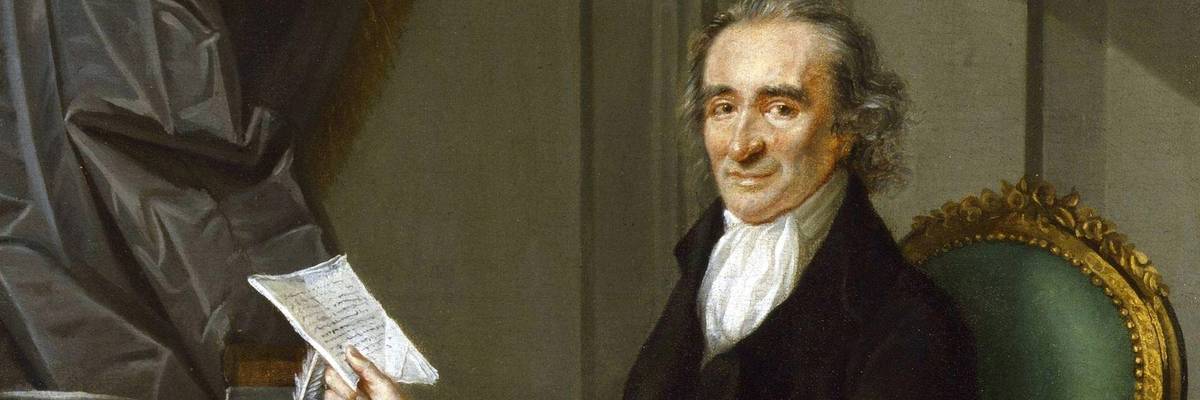
A painting of the great writer and American revolutionary Thomas Paine, by artist George Romney, 1792.
Published 250 Years Ago Today, Thomas Paine's Common Sense Must Inspire Us Again
With a document that speaks powerfully to our current crisis, Paine emboldened his fellow citizens-to-be to turn their colonial rebellion into a world-historic revolutionary war for independence and inspired them to establish a democratic republic.
Common Sense by Thomas Paine is the most influential work of political literature in American history.
Self-published on January 10, 1776, Common Sense instantly became a sensation, spreading like wildfire across the colonies. Within a few weeks, it had sold more copies than any book in the history of the colonies.
Paine’s arguments persuaded thousands-upon-thousands of people throughout the 13 colonies to demand more than reform, to support complete independence from England and join the revolutionary cause.
Less than six months after Common Sense was first published in Philadelphia, the Declaration of Independence was signed in the same city, establishing a new country defined, in contrast to its European predecessors, by its commitment to equality, liberty and the consent of the governed—just as Paine advocated in Common Sense (and, unlike the founding fathers, Paine did not hesitate to advocate for democracy).
Paine showed Americans... that they could govern themselves without kings and overlords, and that they could set an example to the world of what a nation of citizens, not subjects, could accomplish. The relevance of these passages for our troubled times cannot be overstated.
Thomas Paine arrived in Philadelphia from England in late 1774. Paine quickly fell in love with America and its people. Struck by the country’s startling contradictions, magnificent possibilities, and wonderful energies, and moved by the spirit and determination of its people to resist British authority, he committed himself to the American cause. In the Spring of 1775, he called for the abolition of slavery, a position he saw as consistent with—and central to—the rebellion.
Paine published Common Sense on January 10, 1776, a pamphlet of fewer than 50 pages, that changed the course of world history. In its pages, he harnessed Americans’ shared but as-of-yet unstated thoughts, expressing them in words such as “The sun never shined on a cause of greater worth” and “We have it in our power to begin the world over again.” Paine emboldened his fellow citizens-to-be to turn their colonial rebellion into a world-historic revolutionary war for independence, and inspired them to establish a democratic republic. Paine defined the new nation in a democratically expansive and progressive fashion and articulated an American identity charged with exceptional purpose and promise.
In Common Sense, Paine showed Americans that they were in fact Americans, not British colonists, that they could govern themselves without kings and overlords, and that they could set an example to the world of what a nation of citizens, not subjects, could accomplish. The relevance of these passages for our troubled times cannot be overstated.
Paine appreciated the ethnic and religious diversity that already prevailed and projected the nation-to-be as a refuge for those seeking freedom. (Indeed, many passages in Common Sense speak directly to the crises enveloping America today.)
Crucially, Paine portrayed America not as thirteen separate entities, but as a singular nation-state: “Now is the seed time of continental union, faith and honour… Our strength is continental not provincial.” And he proposed a charter—a constitution encompassing a Bill of Rights—both to bind the prospective states into a union and to guarantee that liberty, equality, and democracy would prevail. Most emphatically, he argued for “freedom of conscience” and, to assure it, the separation of Church and State: “As to religion, I hold it to be the indispensable duty of all government, to protect all conscientious professors thereof, and I know of no other business which government hath to do therewith….”
In the spring of that year, 120,000 copies of Common Sense were sold. 500,000 by the end of the Revolutionary War. (Throughout Paine took no royalties, using the funds to buy mittens for General Washington’s troops). Plus, newspapers throughout the colonies excerpted it and working people read it aloud in taverns, cafes, and farm fields. Soon, town councils north and south were petitioning the Second Continental Congress to declare INDEPENDENCE! America turned Paine into a radical, and he turned Americans into democratic revolutionaries.
Today, we honor Common Sense on the 250th Anniversary of its publication, and we honor its author, Tom Paine, one of the authors of our country
We are at a crossroads
This country and this world are at a monumental crossroads. In a few short weeks, US voters will have an opportunity to beat back the forces of fascism and confront the billionaires who are rigging the economy, our media system, and our democracy, making it increasingly impossible for ordinary people to get by. We’re not just talking about the election. We’re talking about what must be done once these fascist elements are vanquished from power. We need a bolder set of solutions than what either major party has so far been willing to offer and a working-class movement ready to fight like hell for it. Trump didn't emerge from nowhere. The conditions that fueled MAGA authoritarianism were created by decades of radical neoliberal economic policies and a corrupt political system dominated by corporate interests. They slashed taxes on the super-rich, promising that the benefits would trickle down. They said giveaways to the corporate titans would make life more affordable for the rest of us. It was all bullshit. And when a bitter, betrayed populace searches for someone to blame, right-wing demagogues have little trouble finding scapegoats. People know when they're being lied to, but you won't hear any of this from the corporate media. Only independent journalism—powered and funded by people who believe in building a better world—can deliver truly trustworthy daily news. Our Fall Campaign is underway, and we need your help. To power our newsroom through the rest of the year, we need to raise $125,000 by midnight on October 31. So if you share our vision, please contribute whatever you can to sustain our work. |
Common Sense by Thomas Paine is the most influential work of political literature in American history.
Self-published on January 10, 1776, Common Sense instantly became a sensation, spreading like wildfire across the colonies. Within a few weeks, it had sold more copies than any book in the history of the colonies.
Paine’s arguments persuaded thousands-upon-thousands of people throughout the 13 colonies to demand more than reform, to support complete independence from England and join the revolutionary cause.
Less than six months after Common Sense was first published in Philadelphia, the Declaration of Independence was signed in the same city, establishing a new country defined, in contrast to its European predecessors, by its commitment to equality, liberty and the consent of the governed—just as Paine advocated in Common Sense (and, unlike the founding fathers, Paine did not hesitate to advocate for democracy).
Paine showed Americans... that they could govern themselves without kings and overlords, and that they could set an example to the world of what a nation of citizens, not subjects, could accomplish. The relevance of these passages for our troubled times cannot be overstated.
Thomas Paine arrived in Philadelphia from England in late 1774. Paine quickly fell in love with America and its people. Struck by the country’s startling contradictions, magnificent possibilities, and wonderful energies, and moved by the spirit and determination of its people to resist British authority, he committed himself to the American cause. In the Spring of 1775, he called for the abolition of slavery, a position he saw as consistent with—and central to—the rebellion.
Paine published Common Sense on January 10, 1776, a pamphlet of fewer than 50 pages, that changed the course of world history. In its pages, he harnessed Americans’ shared but as-of-yet unstated thoughts, expressing them in words such as “The sun never shined on a cause of greater worth” and “We have it in our power to begin the world over again.” Paine emboldened his fellow citizens-to-be to turn their colonial rebellion into a world-historic revolutionary war for independence, and inspired them to establish a democratic republic. Paine defined the new nation in a democratically expansive and progressive fashion and articulated an American identity charged with exceptional purpose and promise.
In Common Sense, Paine showed Americans that they were in fact Americans, not British colonists, that they could govern themselves without kings and overlords, and that they could set an example to the world of what a nation of citizens, not subjects, could accomplish. The relevance of these passages for our troubled times cannot be overstated.
Paine appreciated the ethnic and religious diversity that already prevailed and projected the nation-to-be as a refuge for those seeking freedom. (Indeed, many passages in Common Sense speak directly to the crises enveloping America today.)
Crucially, Paine portrayed America not as thirteen separate entities, but as a singular nation-state: “Now is the seed time of continental union, faith and honour… Our strength is continental not provincial.” And he proposed a charter—a constitution encompassing a Bill of Rights—both to bind the prospective states into a union and to guarantee that liberty, equality, and democracy would prevail. Most emphatically, he argued for “freedom of conscience” and, to assure it, the separation of Church and State: “As to religion, I hold it to be the indispensable duty of all government, to protect all conscientious professors thereof, and I know of no other business which government hath to do therewith….”
In the spring of that year, 120,000 copies of Common Sense were sold. 500,000 by the end of the Revolutionary War. (Throughout Paine took no royalties, using the funds to buy mittens for General Washington’s troops). Plus, newspapers throughout the colonies excerpted it and working people read it aloud in taverns, cafes, and farm fields. Soon, town councils north and south were petitioning the Second Continental Congress to declare INDEPENDENCE! America turned Paine into a radical, and he turned Americans into democratic revolutionaries.
Today, we honor Common Sense on the 250th Anniversary of its publication, and we honor its author, Tom Paine, one of the authors of our country
Common Sense by Thomas Paine is the most influential work of political literature in American history.
Self-published on January 10, 1776, Common Sense instantly became a sensation, spreading like wildfire across the colonies. Within a few weeks, it had sold more copies than any book in the history of the colonies.
Paine’s arguments persuaded thousands-upon-thousands of people throughout the 13 colonies to demand more than reform, to support complete independence from England and join the revolutionary cause.
Less than six months after Common Sense was first published in Philadelphia, the Declaration of Independence was signed in the same city, establishing a new country defined, in contrast to its European predecessors, by its commitment to equality, liberty and the consent of the governed—just as Paine advocated in Common Sense (and, unlike the founding fathers, Paine did not hesitate to advocate for democracy).
Paine showed Americans... that they could govern themselves without kings and overlords, and that they could set an example to the world of what a nation of citizens, not subjects, could accomplish. The relevance of these passages for our troubled times cannot be overstated.
Thomas Paine arrived in Philadelphia from England in late 1774. Paine quickly fell in love with America and its people. Struck by the country’s startling contradictions, magnificent possibilities, and wonderful energies, and moved by the spirit and determination of its people to resist British authority, he committed himself to the American cause. In the Spring of 1775, he called for the abolition of slavery, a position he saw as consistent with—and central to—the rebellion.
Paine published Common Sense on January 10, 1776, a pamphlet of fewer than 50 pages, that changed the course of world history. In its pages, he harnessed Americans’ shared but as-of-yet unstated thoughts, expressing them in words such as “The sun never shined on a cause of greater worth” and “We have it in our power to begin the world over again.” Paine emboldened his fellow citizens-to-be to turn their colonial rebellion into a world-historic revolutionary war for independence, and inspired them to establish a democratic republic. Paine defined the new nation in a democratically expansive and progressive fashion and articulated an American identity charged with exceptional purpose and promise.
In Common Sense, Paine showed Americans that they were in fact Americans, not British colonists, that they could govern themselves without kings and overlords, and that they could set an example to the world of what a nation of citizens, not subjects, could accomplish. The relevance of these passages for our troubled times cannot be overstated.
Paine appreciated the ethnic and religious diversity that already prevailed and projected the nation-to-be as a refuge for those seeking freedom. (Indeed, many passages in Common Sense speak directly to the crises enveloping America today.)
Crucially, Paine portrayed America not as thirteen separate entities, but as a singular nation-state: “Now is the seed time of continental union, faith and honour… Our strength is continental not provincial.” And he proposed a charter—a constitution encompassing a Bill of Rights—both to bind the prospective states into a union and to guarantee that liberty, equality, and democracy would prevail. Most emphatically, he argued for “freedom of conscience” and, to assure it, the separation of Church and State: “As to religion, I hold it to be the indispensable duty of all government, to protect all conscientious professors thereof, and I know of no other business which government hath to do therewith….”
In the spring of that year, 120,000 copies of Common Sense were sold. 500,000 by the end of the Revolutionary War. (Throughout Paine took no royalties, using the funds to buy mittens for General Washington’s troops). Plus, newspapers throughout the colonies excerpted it and working people read it aloud in taverns, cafes, and farm fields. Soon, town councils north and south were petitioning the Second Continental Congress to declare INDEPENDENCE! America turned Paine into a radical, and he turned Americans into democratic revolutionaries.
Today, we honor Common Sense on the 250th Anniversary of its publication, and we honor its author, Tom Paine, one of the authors of our country