SUBSCRIBE TO OUR FREE NEWSLETTER
Daily news & progressive opinion—funded by the people, not the corporations—delivered straight to your inbox.
5
#000000
#FFFFFF
To donate by check, phone, or other method, see our More Ways to Give page.
Daily news & progressive opinion—funded by the people, not the corporations—delivered straight to your inbox.
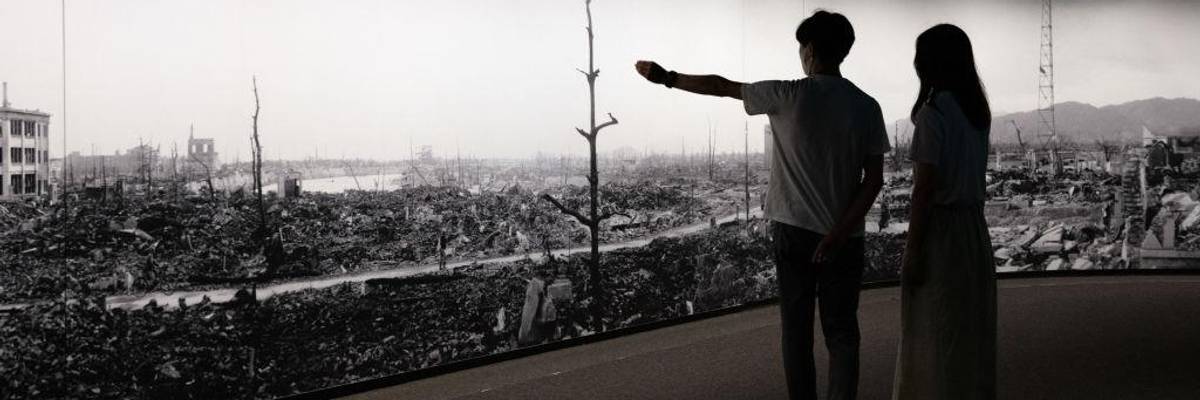
Visitors to Hiroshima Peace Memorial Museum view a large scale panoramic photograph of the aftermath of the atomic bomb attack on Hiroshima, on August 5, 2020 in Hiroshima, Japan. (Photo by Carl Court/Getty Images)
Since the bombings, presidents have routinely offered rhetorical camouflage for reckless nuclear policies, rolling the dice for global catastrophe.
In 1980, when I asked the press office at the U.S. Department of Energy to send me a listing of nuclear bomb test explosions, the agency mailed me an official booklet with the title “Announced United States Nuclear Tests, July 1945 Through December 1979.” As you’d expect, the Trinity test in New Mexico was at the top of the list. Second on the list was Hiroshima. Third was Nagasaki.
So, 35 years after the atomic bombings of those Japanese cities in August 1945, the Energy Department—the agency in charge of nuclear weaponry—was categorizing them as “tests.”
Later on, the classification changed, apparently in an effort to avert a potential PR problem. By 1994, a new edition of the same document explained that the bombings of Hiroshima and Nagasaki “were not ‘tests’ in the sense that they were conducted to prove that the weapon would work as designed... or to advance weapon design, to determine weapons effects, or to verify weapon safety.”
But the atomic bombings of Hiroshima and Nagasaki actually were tests, in more ways than one.
A physicist with the Manhattan Project, David H. Frisch, remembered that U.S. military strategists were eager “to use the bomb first where its effects would not only be politically effective but also technically measurable.”
Take it from the Manhattan Project’s director, Gen. Leslie Groves, who recalled: “To enable us to assess accurately the effects of the bomb, the targets should not have been previously damaged by air raids. It was also desirable that the first target be of such size that the damage would be confined within it, so that we could more definitely determine the power of the bomb.”
A physicist with the Manhattan Project, David H. Frisch, remembered that U.S. military strategists were eager “to use the bomb first where its effects would not only be politically effective but also technically measurable.”
For good measure, after the Trinity bomb test in the New Mexico desert used plutonium as its fission source on July 16, 1945, in early August the military was able to test both a uranium-fueled bomb on Hiroshima and a second plutonium bomb on Nagasaki to gauge their effects on big cities.
Public discussion of the nuclear era began when President Harry Truman issued a statement that announced the atomic bombing of Hiroshima—which he described only as “an important Japanese Army base.” It was a flagrant lie. A leading researcher of the atomic bombings of Japan, journalist Greg Mitchell, has pointed out: “Hiroshima was not an ‘army base’ but a city of 350,000. It did contain one important military headquarters, but the bomb had been aimed at the very center of a city—and far from its industrial area.”
Mitchell added: “Perhaps 10,000 military personnel lost their lives in the bomb but the vast majority of the 125,000 dead in Hiroshima would be women and children.” Three days later, when an atomic bomb fell on Nagasaki, “it was officially described as a ‘naval base’ yet less than 200 of the 90,000 dead were military personnel.”
Since then, presidents have routinely offered rhetorical camouflage for reckless nuclear policies, rolling the dice for global catastrophe. In recent years, the most insidious lies from leaders in Washington have come with silence—refusing to acknowledge, let alone address with genuine diplomacy, the worsening dangers of nuclear war. Those dangers have pushed the hands of the Doomsday Clock from the Bulletin of the Atomic Scientists to an unprecedented mere 90 seconds to cataclysmic Midnight.
Today, in some elite circles of Russia and the United States, normalized talk of using “tactical” nuclear weapons has upped the madness ante.
The ruthless Russian invasion of Ukraine in February 2022 quickly escalated the chances of nuclear war. President Joe Biden’s response was to pretend otherwise, beginning with his State of the Union address that came just days after the invasion; the long speech did not include a single word about nuclear weapons, the risks of nuclear war, or any other such concern.
Today, in some elite circles of Russia and the United States, normalized talk of using “tactical” nuclear weapons has upped the madness ante. It can be shocking to read wildly irresponsible comments coming from top Russian officials about perhaps using nuclear weaponry in the Ukraine war. We might forget that they are giving voice to Russia’s strategic doctrine that is basically the same as ongoing U.S. strategic doctrine—avowedly retaining the option of first use of nuclear weapons if losing too much ground in a military conflict.
Daniel Ellsberg wrote near the close of his vital book The Doomsday Machine: “What is missing—what is foregone—in the typical discussion and analysis of historical or current nuclear policies is the recognition that what is being discussed is dizzyingly insane and immoral: in its almost-incalculable and inconceivable destructiveness and deliberate murderousness, its disproportionality of risked and planned destructiveness to either declared or unacknowledged objectives, the infeasibility of its secretly pursued aims (damage limitation to the United States and allies, ‘victory’ in two-sided nuclear war), its criminality (to a degree that explodes ordinary visions of law, justice, crime), its lack of wisdom or compassion, its sinfulness and evil.”
Dan dedicated the book “to those who struggle for a human future.”
A similar message came from Albert Einstein in 1947 when he wrote about “the release of atomic energy,” warning against “the outmoded concept of narrow nationalisms” and declaring: “For there is no secret and there is no defense; there is no possibility of control except through the aroused understanding and insistence of the peoples of the world.”
Dear Common Dreams reader, It’s been nearly 30 years since I co-founded Common Dreams with my late wife, Lina Newhouser. We had the radical notion that journalism should serve the public good, not corporate profits. It was clear to us from the outset what it would take to build such a project. No paid advertisements. No corporate sponsors. No millionaire publisher telling us what to think or do. Many people said we wouldn't last a year, but we proved those doubters wrong. Together with a tremendous team of journalists and dedicated staff, we built an independent media outlet free from the constraints of profits and corporate control. Our mission has always been simple: To inform. To inspire. To ignite change for the common good. Building Common Dreams was not easy. Our survival was never guaranteed. When you take on the most powerful forces—Wall Street greed, fossil fuel industry destruction, Big Tech lobbyists, and uber-rich oligarchs who have spent billions upon billions rigging the economy and democracy in their favor—the only bulwark you have is supporters who believe in your work. But here’s the urgent message from me today. It's never been this bad out there. And it's never been this hard to keep us going. At the very moment Common Dreams is most needed, the threats we face are intensifying. We need your support now more than ever. We don't accept corporate advertising and never will. We don't have a paywall because we don't think people should be blocked from critical news based on their ability to pay. Everything we do is funded by the donations of readers like you. When everyone does the little they can afford, we are strong. But if that support retreats or dries up, so do we. Will you donate now to make sure Common Dreams not only survives but thrives? —Craig Brown, Co-founder |
Norman Solomon is the national director of RootsAction.org and executive director of the Institute for Public Accuracy. The paperback edition of his latest book, War Made Invisible: How America Hides the Human Toll of Its Military Machine, includes an afterword about the Gaza war.
In 1980, when I asked the press office at the U.S. Department of Energy to send me a listing of nuclear bomb test explosions, the agency mailed me an official booklet with the title “Announced United States Nuclear Tests, July 1945 Through December 1979.” As you’d expect, the Trinity test in New Mexico was at the top of the list. Second on the list was Hiroshima. Third was Nagasaki.
So, 35 years after the atomic bombings of those Japanese cities in August 1945, the Energy Department—the agency in charge of nuclear weaponry—was categorizing them as “tests.”
Later on, the classification changed, apparently in an effort to avert a potential PR problem. By 1994, a new edition of the same document explained that the bombings of Hiroshima and Nagasaki “were not ‘tests’ in the sense that they were conducted to prove that the weapon would work as designed... or to advance weapon design, to determine weapons effects, or to verify weapon safety.”
But the atomic bombings of Hiroshima and Nagasaki actually were tests, in more ways than one.
A physicist with the Manhattan Project, David H. Frisch, remembered that U.S. military strategists were eager “to use the bomb first where its effects would not only be politically effective but also technically measurable.”
Take it from the Manhattan Project’s director, Gen. Leslie Groves, who recalled: “To enable us to assess accurately the effects of the bomb, the targets should not have been previously damaged by air raids. It was also desirable that the first target be of such size that the damage would be confined within it, so that we could more definitely determine the power of the bomb.”
A physicist with the Manhattan Project, David H. Frisch, remembered that U.S. military strategists were eager “to use the bomb first where its effects would not only be politically effective but also technically measurable.”
For good measure, after the Trinity bomb test in the New Mexico desert used plutonium as its fission source on July 16, 1945, in early August the military was able to test both a uranium-fueled bomb on Hiroshima and a second plutonium bomb on Nagasaki to gauge their effects on big cities.
Public discussion of the nuclear era began when President Harry Truman issued a statement that announced the atomic bombing of Hiroshima—which he described only as “an important Japanese Army base.” It was a flagrant lie. A leading researcher of the atomic bombings of Japan, journalist Greg Mitchell, has pointed out: “Hiroshima was not an ‘army base’ but a city of 350,000. It did contain one important military headquarters, but the bomb had been aimed at the very center of a city—and far from its industrial area.”
Mitchell added: “Perhaps 10,000 military personnel lost their lives in the bomb but the vast majority of the 125,000 dead in Hiroshima would be women and children.” Three days later, when an atomic bomb fell on Nagasaki, “it was officially described as a ‘naval base’ yet less than 200 of the 90,000 dead were military personnel.”
Since then, presidents have routinely offered rhetorical camouflage for reckless nuclear policies, rolling the dice for global catastrophe. In recent years, the most insidious lies from leaders in Washington have come with silence—refusing to acknowledge, let alone address with genuine diplomacy, the worsening dangers of nuclear war. Those dangers have pushed the hands of the Doomsday Clock from the Bulletin of the Atomic Scientists to an unprecedented mere 90 seconds to cataclysmic Midnight.
Today, in some elite circles of Russia and the United States, normalized talk of using “tactical” nuclear weapons has upped the madness ante.
The ruthless Russian invasion of Ukraine in February 2022 quickly escalated the chances of nuclear war. President Joe Biden’s response was to pretend otherwise, beginning with his State of the Union address that came just days after the invasion; the long speech did not include a single word about nuclear weapons, the risks of nuclear war, or any other such concern.
Today, in some elite circles of Russia and the United States, normalized talk of using “tactical” nuclear weapons has upped the madness ante. It can be shocking to read wildly irresponsible comments coming from top Russian officials about perhaps using nuclear weaponry in the Ukraine war. We might forget that they are giving voice to Russia’s strategic doctrine that is basically the same as ongoing U.S. strategic doctrine—avowedly retaining the option of first use of nuclear weapons if losing too much ground in a military conflict.
Daniel Ellsberg wrote near the close of his vital book The Doomsday Machine: “What is missing—what is foregone—in the typical discussion and analysis of historical or current nuclear policies is the recognition that what is being discussed is dizzyingly insane and immoral: in its almost-incalculable and inconceivable destructiveness and deliberate murderousness, its disproportionality of risked and planned destructiveness to either declared or unacknowledged objectives, the infeasibility of its secretly pursued aims (damage limitation to the United States and allies, ‘victory’ in two-sided nuclear war), its criminality (to a degree that explodes ordinary visions of law, justice, crime), its lack of wisdom or compassion, its sinfulness and evil.”
Dan dedicated the book “to those who struggle for a human future.”
A similar message came from Albert Einstein in 1947 when he wrote about “the release of atomic energy,” warning against “the outmoded concept of narrow nationalisms” and declaring: “For there is no secret and there is no defense; there is no possibility of control except through the aroused understanding and insistence of the peoples of the world.”
Norman Solomon is the national director of RootsAction.org and executive director of the Institute for Public Accuracy. The paperback edition of his latest book, War Made Invisible: How America Hides the Human Toll of Its Military Machine, includes an afterword about the Gaza war.
In 1980, when I asked the press office at the U.S. Department of Energy to send me a listing of nuclear bomb test explosions, the agency mailed me an official booklet with the title “Announced United States Nuclear Tests, July 1945 Through December 1979.” As you’d expect, the Trinity test in New Mexico was at the top of the list. Second on the list was Hiroshima. Third was Nagasaki.
So, 35 years after the atomic bombings of those Japanese cities in August 1945, the Energy Department—the agency in charge of nuclear weaponry—was categorizing them as “tests.”
Later on, the classification changed, apparently in an effort to avert a potential PR problem. By 1994, a new edition of the same document explained that the bombings of Hiroshima and Nagasaki “were not ‘tests’ in the sense that they were conducted to prove that the weapon would work as designed... or to advance weapon design, to determine weapons effects, or to verify weapon safety.”
But the atomic bombings of Hiroshima and Nagasaki actually were tests, in more ways than one.
A physicist with the Manhattan Project, David H. Frisch, remembered that U.S. military strategists were eager “to use the bomb first where its effects would not only be politically effective but also technically measurable.”
Take it from the Manhattan Project’s director, Gen. Leslie Groves, who recalled: “To enable us to assess accurately the effects of the bomb, the targets should not have been previously damaged by air raids. It was also desirable that the first target be of such size that the damage would be confined within it, so that we could more definitely determine the power of the bomb.”
A physicist with the Manhattan Project, David H. Frisch, remembered that U.S. military strategists were eager “to use the bomb first where its effects would not only be politically effective but also technically measurable.”
For good measure, after the Trinity bomb test in the New Mexico desert used plutonium as its fission source on July 16, 1945, in early August the military was able to test both a uranium-fueled bomb on Hiroshima and a second plutonium bomb on Nagasaki to gauge their effects on big cities.
Public discussion of the nuclear era began when President Harry Truman issued a statement that announced the atomic bombing of Hiroshima—which he described only as “an important Japanese Army base.” It was a flagrant lie. A leading researcher of the atomic bombings of Japan, journalist Greg Mitchell, has pointed out: “Hiroshima was not an ‘army base’ but a city of 350,000. It did contain one important military headquarters, but the bomb had been aimed at the very center of a city—and far from its industrial area.”
Mitchell added: “Perhaps 10,000 military personnel lost their lives in the bomb but the vast majority of the 125,000 dead in Hiroshima would be women and children.” Three days later, when an atomic bomb fell on Nagasaki, “it was officially described as a ‘naval base’ yet less than 200 of the 90,000 dead were military personnel.”
Since then, presidents have routinely offered rhetorical camouflage for reckless nuclear policies, rolling the dice for global catastrophe. In recent years, the most insidious lies from leaders in Washington have come with silence—refusing to acknowledge, let alone address with genuine diplomacy, the worsening dangers of nuclear war. Those dangers have pushed the hands of the Doomsday Clock from the Bulletin of the Atomic Scientists to an unprecedented mere 90 seconds to cataclysmic Midnight.
Today, in some elite circles of Russia and the United States, normalized talk of using “tactical” nuclear weapons has upped the madness ante.
The ruthless Russian invasion of Ukraine in February 2022 quickly escalated the chances of nuclear war. President Joe Biden’s response was to pretend otherwise, beginning with his State of the Union address that came just days after the invasion; the long speech did not include a single word about nuclear weapons, the risks of nuclear war, or any other such concern.
Today, in some elite circles of Russia and the United States, normalized talk of using “tactical” nuclear weapons has upped the madness ante. It can be shocking to read wildly irresponsible comments coming from top Russian officials about perhaps using nuclear weaponry in the Ukraine war. We might forget that they are giving voice to Russia’s strategic doctrine that is basically the same as ongoing U.S. strategic doctrine—avowedly retaining the option of first use of nuclear weapons if losing too much ground in a military conflict.
Daniel Ellsberg wrote near the close of his vital book The Doomsday Machine: “What is missing—what is foregone—in the typical discussion and analysis of historical or current nuclear policies is the recognition that what is being discussed is dizzyingly insane and immoral: in its almost-incalculable and inconceivable destructiveness and deliberate murderousness, its disproportionality of risked and planned destructiveness to either declared or unacknowledged objectives, the infeasibility of its secretly pursued aims (damage limitation to the United States and allies, ‘victory’ in two-sided nuclear war), its criminality (to a degree that explodes ordinary visions of law, justice, crime), its lack of wisdom or compassion, its sinfulness and evil.”
Dan dedicated the book “to those who struggle for a human future.”
A similar message came from Albert Einstein in 1947 when he wrote about “the release of atomic energy,” warning against “the outmoded concept of narrow nationalisms” and declaring: “For there is no secret and there is no defense; there is no possibility of control except through the aroused understanding and insistence of the peoples of the world.”