SUBSCRIBE TO OUR FREE NEWSLETTER
Daily news & progressive opinion—funded by the people, not the corporations—delivered straight to your inbox.
5
#000000
#FFFFFF
To donate by check, phone, or other method, see our More Ways to Give page.
Daily news & progressive opinion—funded by the people, not the corporations—delivered straight to your inbox.
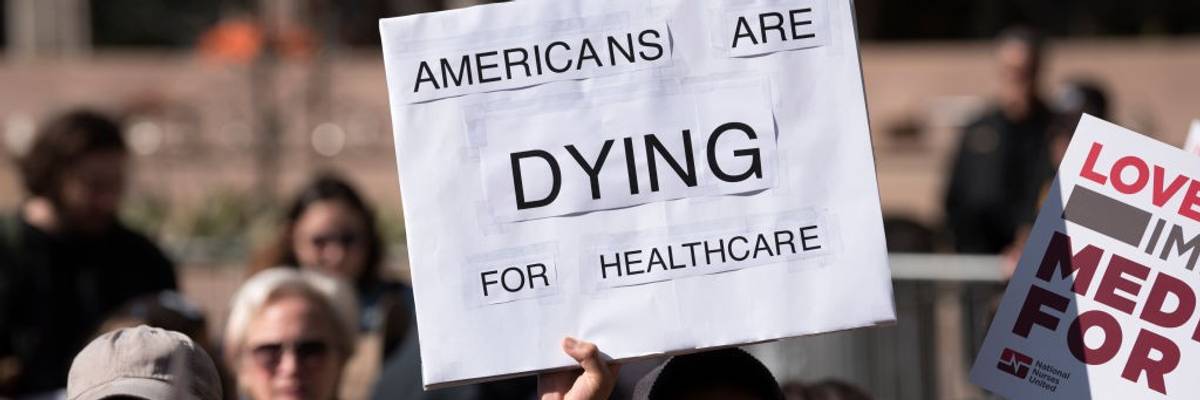
Participants hold signs in the Medicare for All Rally in Los Angeles California on February 4, 2017.
Every other developed country guarantees healthcare to all citizens as a basic human right. We’re essentially the only ones that decided to turn our health into a commodity.
The Financial Times recently reported that Americans are facing the biggest increase in health insurance premiums in 15 years. This comes after the announcement that the Trump administration’s budget bill will cut Medicaid funding, kicking millions of Americans off their insurance and forcing the closure of many rural hospitals.
American healthcare is already, by far, the most expensive in the world. According to the Organization for Economic Cooperation and Development (OECD), we have roughly twice the per-capita healthcare costs of other developed countries, yet we have relatively poor outcomes. By numerous metrics, including preventable deaths, life expectancy, and infant mortality, we lag behind peer countries, despite spending far more than they do. Even well-off Americans with insurance tend to get sicker and die sooner than their counterparts in places like the UK and Canada.
The reason is simple—every other developed country guarantees healthcare to all citizens as a basic human right. We’re essentially the only ones that decided to turn our health into a commodity.
Between 45,000 and 68,000 Americans die each year from preventable diseases, simply because they don’t have access to health insurance. Meaning, if they lived in any other country in the developed world, they’d survive. This shouldn’t be happening in the richest country on Earth.
Single-payer is the future of healthcare.
Historically, the costs of healthcare rise faster than wages and overall inflation. Employers often shift these costs onto workers in the form of higher premiums, co-pays, and deductibles or by dropping benefits for spouses, retirees, and part-time workers. The result is that people are being squeezed more and more. Nearly half of all Americans report struggling to afford healthcare.
It’s been demonstrated numerous times that universal healthcare would save money. Taxes would go up, but private health insurance premiums would be eliminated, so the average American would pay substantially less. It would just be in the form of a tax, not a premium. One report from 2020 compared 22 different cost analyses of potential single-payer initiatives at both the state and federal level and found that 19 of them projected savings (in the first year and long-term).
It’s essential that we transition to a system that prioritizes patient care over profit. Single-payer is the future of healthcare. Until the US joins the rest of the world in guaranteeing healthcare as a basic human right to all citizens, the costs will continue to balloon, as more and more Americans are needlessly bankrupted or killed.
Dear Common Dreams reader, It’s been nearly 30 years since I co-founded Common Dreams with my late wife, Lina Newhouser. We had the radical notion that journalism should serve the public good, not corporate profits. It was clear to us from the outset what it would take to build such a project. No paid advertisements. No corporate sponsors. No millionaire publisher telling us what to think or do. Many people said we wouldn't last a year, but we proved those doubters wrong. Together with a tremendous team of journalists and dedicated staff, we built an independent media outlet free from the constraints of profits and corporate control. Our mission has always been simple: To inform. To inspire. To ignite change for the common good. Building Common Dreams was not easy. Our survival was never guaranteed. When you take on the most powerful forces—Wall Street greed, fossil fuel industry destruction, Big Tech lobbyists, and uber-rich oligarchs who have spent billions upon billions rigging the economy and democracy in their favor—the only bulwark you have is supporters who believe in your work. But here’s the urgent message from me today. It's never been this bad out there. And it's never been this hard to keep us going. At the very moment Common Dreams is most needed, the threats we face are intensifying. We need your support now more than ever. We don't accept corporate advertising and never will. We don't have a paywall because we don't think people should be blocked from critical news based on their ability to pay. Everything we do is funded by the donations of readers like you. When everyone does the little they can afford, we are strong. But if that support retreats or dries up, so do we. Will you donate now to make sure Common Dreams not only survives but thrives? —Craig Brown, Co-founder |
The Financial Times recently reported that Americans are facing the biggest increase in health insurance premiums in 15 years. This comes after the announcement that the Trump administration’s budget bill will cut Medicaid funding, kicking millions of Americans off their insurance and forcing the closure of many rural hospitals.
American healthcare is already, by far, the most expensive in the world. According to the Organization for Economic Cooperation and Development (OECD), we have roughly twice the per-capita healthcare costs of other developed countries, yet we have relatively poor outcomes. By numerous metrics, including preventable deaths, life expectancy, and infant mortality, we lag behind peer countries, despite spending far more than they do. Even well-off Americans with insurance tend to get sicker and die sooner than their counterparts in places like the UK and Canada.
The reason is simple—every other developed country guarantees healthcare to all citizens as a basic human right. We’re essentially the only ones that decided to turn our health into a commodity.
Between 45,000 and 68,000 Americans die each year from preventable diseases, simply because they don’t have access to health insurance. Meaning, if they lived in any other country in the developed world, they’d survive. This shouldn’t be happening in the richest country on Earth.
Single-payer is the future of healthcare.
Historically, the costs of healthcare rise faster than wages and overall inflation. Employers often shift these costs onto workers in the form of higher premiums, co-pays, and deductibles or by dropping benefits for spouses, retirees, and part-time workers. The result is that people are being squeezed more and more. Nearly half of all Americans report struggling to afford healthcare.
It’s been demonstrated numerous times that universal healthcare would save money. Taxes would go up, but private health insurance premiums would be eliminated, so the average American would pay substantially less. It would just be in the form of a tax, not a premium. One report from 2020 compared 22 different cost analyses of potential single-payer initiatives at both the state and federal level and found that 19 of them projected savings (in the first year and long-term).
It’s essential that we transition to a system that prioritizes patient care over profit. Single-payer is the future of healthcare. Until the US joins the rest of the world in guaranteeing healthcare as a basic human right to all citizens, the costs will continue to balloon, as more and more Americans are needlessly bankrupted or killed.
The Financial Times recently reported that Americans are facing the biggest increase in health insurance premiums in 15 years. This comes after the announcement that the Trump administration’s budget bill will cut Medicaid funding, kicking millions of Americans off their insurance and forcing the closure of many rural hospitals.
American healthcare is already, by far, the most expensive in the world. According to the Organization for Economic Cooperation and Development (OECD), we have roughly twice the per-capita healthcare costs of other developed countries, yet we have relatively poor outcomes. By numerous metrics, including preventable deaths, life expectancy, and infant mortality, we lag behind peer countries, despite spending far more than they do. Even well-off Americans with insurance tend to get sicker and die sooner than their counterparts in places like the UK and Canada.
The reason is simple—every other developed country guarantees healthcare to all citizens as a basic human right. We’re essentially the only ones that decided to turn our health into a commodity.
Between 45,000 and 68,000 Americans die each year from preventable diseases, simply because they don’t have access to health insurance. Meaning, if they lived in any other country in the developed world, they’d survive. This shouldn’t be happening in the richest country on Earth.
Single-payer is the future of healthcare.
Historically, the costs of healthcare rise faster than wages and overall inflation. Employers often shift these costs onto workers in the form of higher premiums, co-pays, and deductibles or by dropping benefits for spouses, retirees, and part-time workers. The result is that people are being squeezed more and more. Nearly half of all Americans report struggling to afford healthcare.
It’s been demonstrated numerous times that universal healthcare would save money. Taxes would go up, but private health insurance premiums would be eliminated, so the average American would pay substantially less. It would just be in the form of a tax, not a premium. One report from 2020 compared 22 different cost analyses of potential single-payer initiatives at both the state and federal level and found that 19 of them projected savings (in the first year and long-term).
It’s essential that we transition to a system that prioritizes patient care over profit. Single-payer is the future of healthcare. Until the US joins the rest of the world in guaranteeing healthcare as a basic human right to all citizens, the costs will continue to balloon, as more and more Americans are needlessly bankrupted or killed.