
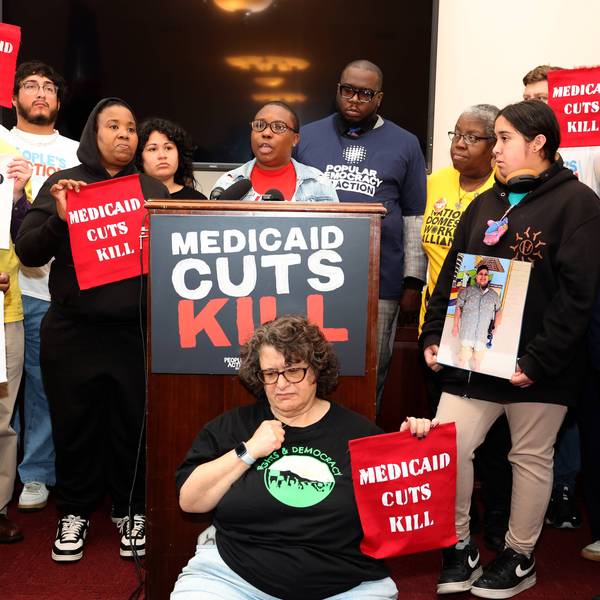
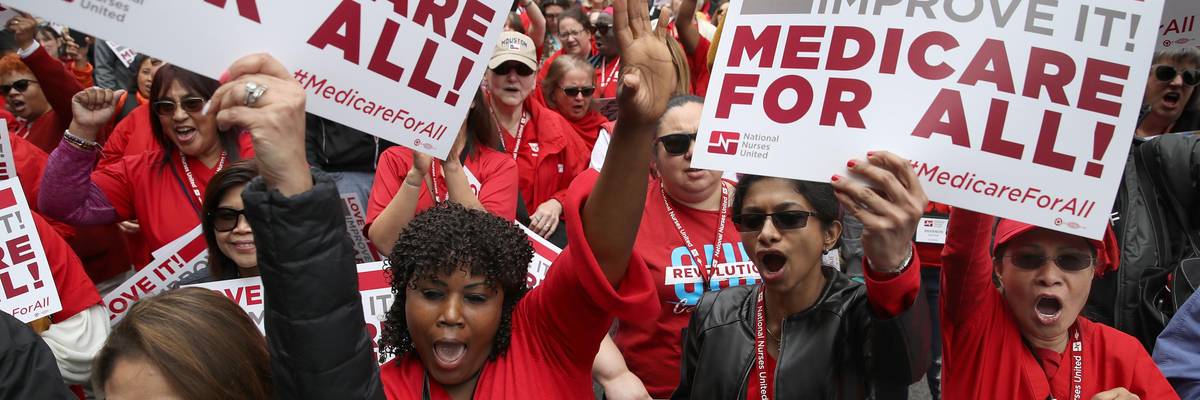
Protesters supporting Medicare for All hold a rally outside PhRMA headquarters April 29, 2019 in Washington, D.C.
New CDC Data Reveals 'National Embarrassment' of For-Profit Healthcare
"Our leaders must act to kick insurance companies to the curb and enact Medicare for All now," said one advocate.
Single-payer advocates on Thursday pointed to new federal life expectancy data—which shows Americans live shorter lives than people in any other major most-developed nation—as the latest proof of the need to enact a Medicare for All-type universal healthcare program.
According to the Centers for Disease Control and Prevention (CDC), U.S. life expectancy was 77.5 years in 2022, an increase of 1.1 years from the previous year. The leading U.S. causes of death in 2022 were heart disease, cancer, unintentional injuries, and Covid-19.
The 2022 figures reversed two consecutive years of declining U.S. life expectancy, largely due to Covid-19, which has killed nearly 1.2 million people in the country. However, U.S. life expectancy in 2022 was still below its pre-pandemic high of 78.8 years in 2019.
"Despite spending the most per capita on healthcare, we have a consistently lower life expectancy than our peers in comparably wealthy countries."
"While it is good news that U.S. life expectancy is finally rising again, it is important to remember that despite spending the most per capita on healthcare, we have a consistently lower life expectancy than our peers in comparably wealthy countries with universal healthcare," said Eagan Kemp, the healthcare policy advocate at Public Citizen.
The United States is the only developed nation in the world without guaranteed universal healthcare.
"We must keep making the point that profit-driven healthcare is not only worse for patients—it's a national embarrassment," Kemp added. "Our leaders must act to kick insurance companies to the curb and enact Medicare for All now."
One 2022 study found that more than 338,000 U.S. Covid-19 deaths could have been prevented if the country had a single-payer universal healthcare system like Medicare for All.
While opponents—including U.S. lawmakers who take substantial donations from the for-profit healthcare and insurance industry—often argue that Medicare for All would be too expensive, a 2020 Congressional Budget Office analysis found that such a program would save between $300 billion and $650 billion annually.
The same study found that approximately 68,000 people die each year in the United States because they lack access to healthcare.
Meanwhile, millions of American families face bankruptcy and financial ruin due to healthcare expenses, as the CEOs of 300 major U.S. healthcare companies made $4.5 billion in collective compensation in 2022.
The United States has the lowest life expectancy of any large rich country while spending far more on healthcare than comparable nations. Figures vary by source and year, but according to the 2023 edition of the CIA Factbook, the U.S. ranked 48th in worldwide life expectancy, while 2021 World Bank figures place the U.S. in 59th place globally, between Algeria and Panama.
U.S. Sen. Bernie Sanders (I-Vt.) and Congressional Progressive Caucus Chair Pramila Jayapal (D-Wash.) last year led more than 120 lawmakers in reintroducing bicameral Medicare for All legislation.
"There is a solution to this health crisis—a popular one that guarantees healthcare to every person as a human right and finally puts people over profits and care over corporations," Jayapal said at the time. "That solution is Medicare for All—everyone in, nobody out."
We are at a crossroads
This country and this world are at a monumental crossroads. In a few short weeks, US voters will have an opportunity to beat back the forces of fascism and confront the billionaires who are rigging the economy, our media system, and our democracy, making it increasingly impossible for ordinary people to get by. We’re not just talking about the election. We’re talking about what must be done once these fascist elements are vanquished from power. We need a bolder set of solutions than what either major party has so far been willing to offer and a working-class movement ready to fight like hell for it. Trump didn't emerge from nowhere. The conditions that fueled MAGA authoritarianism were created by decades of radical neoliberal economic policies and a corrupt political system dominated by corporate interests. They slashed taxes on the super-rich, promising that the benefits would trickle down. They said giveaways to the corporate titans would make life more affordable for the rest of us. It was all bullshit. And when a bitter, betrayed populace searches for someone to blame, right-wing demagogues have little trouble finding scapegoats. People know when they're being lied to, but you won't hear any of this from the corporate media. Only independent journalism—powered and funded by people who believe in building a better world—can deliver truly trustworthy daily news. Our Fall Campaign is underway, and we need your help. To power our newsroom through the rest of the year, we need to raise $125,000 by midnight on October 31. So if you share our vision, please contribute whatever you can to sustain our work. |
Single-payer advocates on Thursday pointed to new federal life expectancy data—which shows Americans live shorter lives than people in any other major most-developed nation—as the latest proof of the need to enact a Medicare for All-type universal healthcare program.
According to the Centers for Disease Control and Prevention (CDC), U.S. life expectancy was 77.5 years in 2022, an increase of 1.1 years from the previous year. The leading U.S. causes of death in 2022 were heart disease, cancer, unintentional injuries, and Covid-19.
The 2022 figures reversed two consecutive years of declining U.S. life expectancy, largely due to Covid-19, which has killed nearly 1.2 million people in the country. However, U.S. life expectancy in 2022 was still below its pre-pandemic high of 78.8 years in 2019.
"Despite spending the most per capita on healthcare, we have a consistently lower life expectancy than our peers in comparably wealthy countries."
"While it is good news that U.S. life expectancy is finally rising again, it is important to remember that despite spending the most per capita on healthcare, we have a consistently lower life expectancy than our peers in comparably wealthy countries with universal healthcare," said Eagan Kemp, the healthcare policy advocate at Public Citizen.
The United States is the only developed nation in the world without guaranteed universal healthcare.
"We must keep making the point that profit-driven healthcare is not only worse for patients—it's a national embarrassment," Kemp added. "Our leaders must act to kick insurance companies to the curb and enact Medicare for All now."
One 2022 study found that more than 338,000 U.S. Covid-19 deaths could have been prevented if the country had a single-payer universal healthcare system like Medicare for All.
While opponents—including U.S. lawmakers who take substantial donations from the for-profit healthcare and insurance industry—often argue that Medicare for All would be too expensive, a 2020 Congressional Budget Office analysis found that such a program would save between $300 billion and $650 billion annually.
The same study found that approximately 68,000 people die each year in the United States because they lack access to healthcare.
Meanwhile, millions of American families face bankruptcy and financial ruin due to healthcare expenses, as the CEOs of 300 major U.S. healthcare companies made $4.5 billion in collective compensation in 2022.
The United States has the lowest life expectancy of any large rich country while spending far more on healthcare than comparable nations. Figures vary by source and year, but according to the 2023 edition of the CIA Factbook, the U.S. ranked 48th in worldwide life expectancy, while 2021 World Bank figures place the U.S. in 59th place globally, between Algeria and Panama.
U.S. Sen. Bernie Sanders (I-Vt.) and Congressional Progressive Caucus Chair Pramila Jayapal (D-Wash.) last year led more than 120 lawmakers in reintroducing bicameral Medicare for All legislation.
"There is a solution to this health crisis—a popular one that guarantees healthcare to every person as a human right and finally puts people over profits and care over corporations," Jayapal said at the time. "That solution is Medicare for All—everyone in, nobody out."
- America's Biggest Lie: We Can't Afford Medicare for All ›
- We Deserve Medicare for All, But What We Get Is Medicare for Wall Street ›
- "Medicare-for-all" Means Something. Don't Let Moderates Water It Down. ›
- As Centrist House Democrats Attack Medicare for All, Fox News Poll Shows 72% of Voters Want 'Government-Run Healthcare Plan' ›
- Opinion | Imagine If the Fight Was Over How to Improve and Expand Medicare and Social Security—Not Destroy Them | Common Dreams ›
- US Healthcare Failures Prove 'We Need' Medicare for All, Says Jayapal | Common Dreams ›
- Opinion | Why Didn't the Covid-19 Pandemic Result in Medicare for All? | Common Dreams ›
- Opinion | The Costs of Our For-Profit Healthcare System Continue to Rise | Common Dreams ›
- Opinion | For-Profit Healthcare Makes Us Sick! | Common Dreams ›
Single-payer advocates on Thursday pointed to new federal life expectancy data—which shows Americans live shorter lives than people in any other major most-developed nation—as the latest proof of the need to enact a Medicare for All-type universal healthcare program.
According to the Centers for Disease Control and Prevention (CDC), U.S. life expectancy was 77.5 years in 2022, an increase of 1.1 years from the previous year. The leading U.S. causes of death in 2022 were heart disease, cancer, unintentional injuries, and Covid-19.
The 2022 figures reversed two consecutive years of declining U.S. life expectancy, largely due to Covid-19, which has killed nearly 1.2 million people in the country. However, U.S. life expectancy in 2022 was still below its pre-pandemic high of 78.8 years in 2019.
"Despite spending the most per capita on healthcare, we have a consistently lower life expectancy than our peers in comparably wealthy countries."
"While it is good news that U.S. life expectancy is finally rising again, it is important to remember that despite spending the most per capita on healthcare, we have a consistently lower life expectancy than our peers in comparably wealthy countries with universal healthcare," said Eagan Kemp, the healthcare policy advocate at Public Citizen.
The United States is the only developed nation in the world without guaranteed universal healthcare.
"We must keep making the point that profit-driven healthcare is not only worse for patients—it's a national embarrassment," Kemp added. "Our leaders must act to kick insurance companies to the curb and enact Medicare for All now."
One 2022 study found that more than 338,000 U.S. Covid-19 deaths could have been prevented if the country had a single-payer universal healthcare system like Medicare for All.
While opponents—including U.S. lawmakers who take substantial donations from the for-profit healthcare and insurance industry—often argue that Medicare for All would be too expensive, a 2020 Congressional Budget Office analysis found that such a program would save between $300 billion and $650 billion annually.
The same study found that approximately 68,000 people die each year in the United States because they lack access to healthcare.
Meanwhile, millions of American families face bankruptcy and financial ruin due to healthcare expenses, as the CEOs of 300 major U.S. healthcare companies made $4.5 billion in collective compensation in 2022.
The United States has the lowest life expectancy of any large rich country while spending far more on healthcare than comparable nations. Figures vary by source and year, but according to the 2023 edition of the CIA Factbook, the U.S. ranked 48th in worldwide life expectancy, while 2021 World Bank figures place the U.S. in 59th place globally, between Algeria and Panama.
U.S. Sen. Bernie Sanders (I-Vt.) and Congressional Progressive Caucus Chair Pramila Jayapal (D-Wash.) last year led more than 120 lawmakers in reintroducing bicameral Medicare for All legislation.
"There is a solution to this health crisis—a popular one that guarantees healthcare to every person as a human right and finally puts people over profits and care over corporations," Jayapal said at the time. "That solution is Medicare for All—everyone in, nobody out."
- America's Biggest Lie: We Can't Afford Medicare for All ›
- We Deserve Medicare for All, But What We Get Is Medicare for Wall Street ›
- "Medicare-for-all" Means Something. Don't Let Moderates Water It Down. ›
- As Centrist House Democrats Attack Medicare for All, Fox News Poll Shows 72% of Voters Want 'Government-Run Healthcare Plan' ›
- Opinion | Imagine If the Fight Was Over How to Improve and Expand Medicare and Social Security—Not Destroy Them | Common Dreams ›
- US Healthcare Failures Prove 'We Need' Medicare for All, Says Jayapal | Common Dreams ›
- Opinion | Why Didn't the Covid-19 Pandemic Result in Medicare for All? | Common Dreams ›
- Opinion | The Costs of Our For-Profit Healthcare System Continue to Rise | Common Dreams ›
- Opinion | For-Profit Healthcare Makes Us Sick! | Common Dreams ›