SUBSCRIBE TO OUR FREE NEWSLETTER
Daily news & progressive opinion—funded by the people, not the corporations—delivered straight to your inbox.
5
#000000
#FFFFFF
To donate by check, phone, or other method, see our More Ways to Give page.
Daily news & progressive opinion—funded by the people, not the corporations—delivered straight to your inbox.
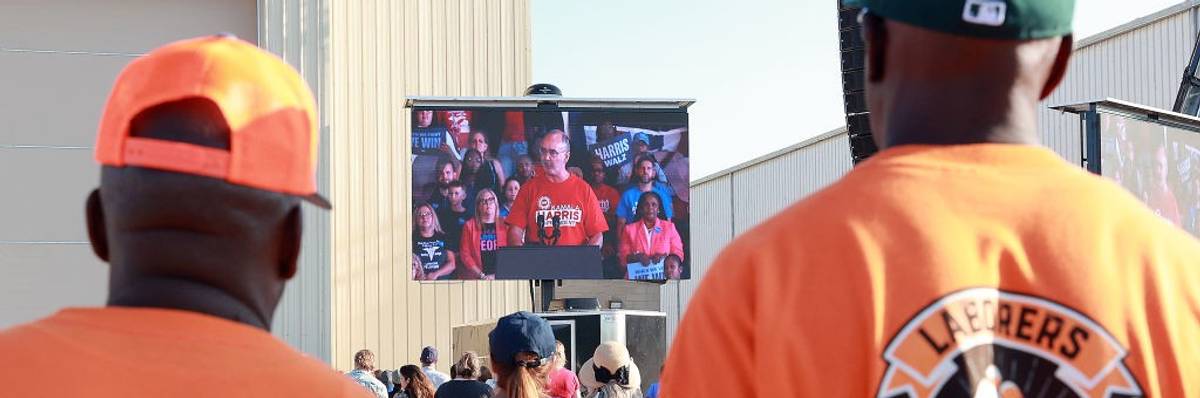
Supporters wearing union attire watch UAW President Shawn Fain speak on a screen as they attend a campaign rally with U.S. Vice President and Democratic presidential candidate Kamala Harris and US Democratic vice presidential candidate and Minnesota Governor Tim Walz at the Detroit Metropolitan Airport in Romulus, Michigan, August 7, 2024.
Buried in the 2020 Democratic Party platform is a little discussed line that could hold the key to reducing wanton job destruction. Will Kamala Harris seize this opportunity?
The number one issue in the election this year, polls tell us, is “the economy.” But what does that mean?
That depends on who you are and where you sit in the vast structure of inequality that engulfs us. If you’re sitting pretty, “the economy” means an expanding gross national product, the growth of your investments, higher stock prices, and lower personal and corporate income taxes. “The economy” for the well-to-do is all about increasing income and wealth with no interference from government meddlers.
For the rest of us, those sitting lower down, “the economy” is deeply connected to finding and holding onto a job that provides a decent income and benefits. Without a stable job it doesn’t much matter if housing or food is expensive, because if you don’t have work you can’t afford much of anything. You’re in trouble, big trouble. Proposals for systemic economic growth seem far removed from your day-to-day struggles.
A low unemployment rate, to be sure, is critically important to working people. Tight labor markets help drive up wages and create job more openings, but that’s not the same as having a stable job. Unemployment can be low and you still can be bounced from job to job, continually undermining your standard of living.
How do these corporations get the money for nearly three-quarters of a trillion dollars in stock buybacks each year? They lay off workers, freeing up cash by reducing payroll expenses. The more the better.
The research from my book, Wall Street’s War on Workers, shows that more than 30 million workers have lost their jobs due to mass layoffs since 1996. The usual explanation for these layoffs puts the blame on new technologies and the inevitable decline of manufacturing jobs because of stiff global competition from workers in other countries who earn much less.
But that’s not the whole story. If it was, then why are high-tech workers also seeing their jobs disappear? (Spoiler alert, it’s not AI.) In 2023, approximately 264,220 jobs were lost in tech companies, the crown jewels of our post-industrial economy. So far this year, another 135,811 have evaporated.
The Challenger Report, which tracks overall corporate layoffs, finds that 75,891 jobs were cut in August 2024. It also shows that on average this year, 891 jobs per month were cut due to AI. (For a fuller description on why new technologies like AI are not the primary job killers, please see Chapter 11 in Wall Street’s War on Workers.)
Why is there so much job instability? For the most prosperous corporations, it’s not due to a lack of profits, technology, or foreign competition. Meta, Alphabet, and Microsoft laid off more than 40,000 workers in 2022-23 despite booking hundreds of billions of dollars in profits.
These high-tech behemoths kill jobs because of what “the economy” means to their CEOs and to their major Wall Street investors. Their economy values higher stock prices, which translates into enormous incomes for investors and the company executives who are mostly paid through stock incentives.
How do they raise the stock price? Better products? Sure, that works but it takes too much time. The best and surest way to quickly raise the stock price is through a stock buyback, which before SEC deregulation in 1982 was an illegal form of financial manipulation. In a stock buyback, a company uses its own cash or borrowed money to repurchase its own shares in the stock market. These stocks are retired, reducing the number available and increasing the company’s earnings per share. The buyback doesn’t improve the company’s performance, it simply raises the price of the shares and shovels money to the wealthiest investors and company officials. This is plain and simple stock manipulation, something that Econ 101 tells us is a no-no in free-market capitalism where prices are supposed to be set by market supply and demand, not by one company’s self-dealing.
How do these corporations get the money for nearly three-quarters of a trillion dollars in stock buybacks each year? They lay off workers, freeing up cash by reducing payroll expenses. The more the better. Which is how the very same economy can look so very different to those siphoning off corporate wealth and those losing their jobs.
How are the two presidential candidates addressing this problem?
Trump wants to make it worse. He’s in love with Elon Musk, who he called in a recent interview “the greatest cutter.” He praises the way Musk laid off half of the workers at Twitter to help cover the costs of his purchase of the company. Trump now says he wants Musk to head a government efficiency commission, so he can cut, cut, cut government employees. And, if you think Trump will halt or even limit stock buybacks, please share your meds!
What about Harris? The Democratic Party platform in 2024 calls for an increase in the stock buyback excise tax from 1 to 4 percent. That’s better than nothing, but that’s nowhere near high enough to discourage stock buybacks and the job slashing that goes with them.
Voluntary buyouts are common for higher-level white-collar employees, why not make them the rule of the land for companies doing business with the government?
But buried in the 2020 Democratic Party platform is a little discussed line that could hold the key to reducing wanton job destruction. It reads, “Taxpayer money should not be used to pay out dividends, fund stock buybacks, or give raises to executives.” Unfortunately, this refers only to pandemic assistance funds to corporations, but it offers a way forward.
Harris could expand on that line to say,
“In my administration, no taxpayer money will go to corporations who lay off taxpayers and conduct stock buybacks. That means the $700 billion of taxpayer money per year in federal grants and contracts will not go to any corporation that lays off taxpayers or conducts stock buybacks.”
Corporations receiving tax-payer money would be free to restructure if they needed to, but would only be permitted to conduct voluntary layoffs, which means they would have to dip into their massive stock buyback funds to create wage and benefit severance packages sufficient to encourage workers to move on. Voluntary buyouts are common for higher-level white-collar employees, why not make them the rule of the land for companies doing business with the government?
In 1992, during Bill Clinton’s first campaign for president, James Carville famously said of the race’s most important issue, “it’s the economy, stupid.” Today, “the economy” means different things for the wealthy than it does for the rest of us. Maybe Carville’s mantra needs revision: “It’s job loss, stupid!”
Losing your job is one of the most stressful life events, but the troubles of those laid off are often papered over with promises of bright new jobs in the future that go to someone else. The candidate who turns this stress into action and calls for an end to the needless slaughter of jobs via stock buybacks could, in my humble opinion, run away with this election.Dear Common Dreams reader, It’s been nearly 30 years since I co-founded Common Dreams with my late wife, Lina Newhouser. We had the radical notion that journalism should serve the public good, not corporate profits. It was clear to us from the outset what it would take to build such a project. No paid advertisements. No corporate sponsors. No millionaire publisher telling us what to think or do. Many people said we wouldn't last a year, but we proved those doubters wrong. Together with a tremendous team of journalists and dedicated staff, we built an independent media outlet free from the constraints of profits and corporate control. Our mission has always been simple: To inform. To inspire. To ignite change for the common good. Building Common Dreams was not easy. Our survival was never guaranteed. When you take on the most powerful forces—Wall Street greed, fossil fuel industry destruction, Big Tech lobbyists, and uber-rich oligarchs who have spent billions upon billions rigging the economy and democracy in their favor—the only bulwark you have is supporters who believe in your work. But here’s the urgent message from me today. It's never been this bad out there. And it's never been this hard to keep us going. At the very moment Common Dreams is most needed, the threats we face are intensifying. We need your support now more than ever. We don't accept corporate advertising and never will. We don't have a paywall because we don't think people should be blocked from critical news based on their ability to pay. Everything we do is funded by the donations of readers like you. When everyone does the little they can afford, we are strong. But if that support retreats or dries up, so do we. Will you donate now to make sure Common Dreams not only survives but thrives? —Craig Brown, Co-founder |
Les Leopold is the executive director of the Labor Institute and author of the new book, “The Billionaires Have Two Parties, We Need a Party of Our Own” (2026). His previous books include: “Wall Street’s War on Workers: How Mass Layoffs and Greed Are Destroying the Working Class and What to Do About It" (2024); "Runaway Inequality: An Activist's Guide to Economic Justice" (2015); and “The Man Who Hated Work and Loved Labor: The Life and Times of Tony Mazzocchi” (2007). Read more of his work on his substack here.
The number one issue in the election this year, polls tell us, is “the economy.” But what does that mean?
That depends on who you are and where you sit in the vast structure of inequality that engulfs us. If you’re sitting pretty, “the economy” means an expanding gross national product, the growth of your investments, higher stock prices, and lower personal and corporate income taxes. “The economy” for the well-to-do is all about increasing income and wealth with no interference from government meddlers.
For the rest of us, those sitting lower down, “the economy” is deeply connected to finding and holding onto a job that provides a decent income and benefits. Without a stable job it doesn’t much matter if housing or food is expensive, because if you don’t have work you can’t afford much of anything. You’re in trouble, big trouble. Proposals for systemic economic growth seem far removed from your day-to-day struggles.
A low unemployment rate, to be sure, is critically important to working people. Tight labor markets help drive up wages and create job more openings, but that’s not the same as having a stable job. Unemployment can be low and you still can be bounced from job to job, continually undermining your standard of living.
How do these corporations get the money for nearly three-quarters of a trillion dollars in stock buybacks each year? They lay off workers, freeing up cash by reducing payroll expenses. The more the better.
The research from my book, Wall Street’s War on Workers, shows that more than 30 million workers have lost their jobs due to mass layoffs since 1996. The usual explanation for these layoffs puts the blame on new technologies and the inevitable decline of manufacturing jobs because of stiff global competition from workers in other countries who earn much less.
But that’s not the whole story. If it was, then why are high-tech workers also seeing their jobs disappear? (Spoiler alert, it’s not AI.) In 2023, approximately 264,220 jobs were lost in tech companies, the crown jewels of our post-industrial economy. So far this year, another 135,811 have evaporated.
The Challenger Report, which tracks overall corporate layoffs, finds that 75,891 jobs were cut in August 2024. It also shows that on average this year, 891 jobs per month were cut due to AI. (For a fuller description on why new technologies like AI are not the primary job killers, please see Chapter 11 in Wall Street’s War on Workers.)
Why is there so much job instability? For the most prosperous corporations, it’s not due to a lack of profits, technology, or foreign competition. Meta, Alphabet, and Microsoft laid off more than 40,000 workers in 2022-23 despite booking hundreds of billions of dollars in profits.
These high-tech behemoths kill jobs because of what “the economy” means to their CEOs and to their major Wall Street investors. Their economy values higher stock prices, which translates into enormous incomes for investors and the company executives who are mostly paid through stock incentives.
How do they raise the stock price? Better products? Sure, that works but it takes too much time. The best and surest way to quickly raise the stock price is through a stock buyback, which before SEC deregulation in 1982 was an illegal form of financial manipulation. In a stock buyback, a company uses its own cash or borrowed money to repurchase its own shares in the stock market. These stocks are retired, reducing the number available and increasing the company’s earnings per share. The buyback doesn’t improve the company’s performance, it simply raises the price of the shares and shovels money to the wealthiest investors and company officials. This is plain and simple stock manipulation, something that Econ 101 tells us is a no-no in free-market capitalism where prices are supposed to be set by market supply and demand, not by one company’s self-dealing.
How do these corporations get the money for nearly three-quarters of a trillion dollars in stock buybacks each year? They lay off workers, freeing up cash by reducing payroll expenses. The more the better. Which is how the very same economy can look so very different to those siphoning off corporate wealth and those losing their jobs.
How are the two presidential candidates addressing this problem?
Trump wants to make it worse. He’s in love with Elon Musk, who he called in a recent interview “the greatest cutter.” He praises the way Musk laid off half of the workers at Twitter to help cover the costs of his purchase of the company. Trump now says he wants Musk to head a government efficiency commission, so he can cut, cut, cut government employees. And, if you think Trump will halt or even limit stock buybacks, please share your meds!
What about Harris? The Democratic Party platform in 2024 calls for an increase in the stock buyback excise tax from 1 to 4 percent. That’s better than nothing, but that’s nowhere near high enough to discourage stock buybacks and the job slashing that goes with them.
Voluntary buyouts are common for higher-level white-collar employees, why not make them the rule of the land for companies doing business with the government?
But buried in the 2020 Democratic Party platform is a little discussed line that could hold the key to reducing wanton job destruction. It reads, “Taxpayer money should not be used to pay out dividends, fund stock buybacks, or give raises to executives.” Unfortunately, this refers only to pandemic assistance funds to corporations, but it offers a way forward.
Harris could expand on that line to say,
“In my administration, no taxpayer money will go to corporations who lay off taxpayers and conduct stock buybacks. That means the $700 billion of taxpayer money per year in federal grants and contracts will not go to any corporation that lays off taxpayers or conducts stock buybacks.”
Corporations receiving tax-payer money would be free to restructure if they needed to, but would only be permitted to conduct voluntary layoffs, which means they would have to dip into their massive stock buyback funds to create wage and benefit severance packages sufficient to encourage workers to move on. Voluntary buyouts are common for higher-level white-collar employees, why not make them the rule of the land for companies doing business with the government?
In 1992, during Bill Clinton’s first campaign for president, James Carville famously said of the race’s most important issue, “it’s the economy, stupid.” Today, “the economy” means different things for the wealthy than it does for the rest of us. Maybe Carville’s mantra needs revision: “It’s job loss, stupid!”
Losing your job is one of the most stressful life events, but the troubles of those laid off are often papered over with promises of bright new jobs in the future that go to someone else. The candidate who turns this stress into action and calls for an end to the needless slaughter of jobs via stock buybacks could, in my humble opinion, run away with this election.Les Leopold is the executive director of the Labor Institute and author of the new book, “The Billionaires Have Two Parties, We Need a Party of Our Own” (2026). His previous books include: “Wall Street’s War on Workers: How Mass Layoffs and Greed Are Destroying the Working Class and What to Do About It" (2024); "Runaway Inequality: An Activist's Guide to Economic Justice" (2015); and “The Man Who Hated Work and Loved Labor: The Life and Times of Tony Mazzocchi” (2007). Read more of his work on his substack here.
The number one issue in the election this year, polls tell us, is “the economy.” But what does that mean?
That depends on who you are and where you sit in the vast structure of inequality that engulfs us. If you’re sitting pretty, “the economy” means an expanding gross national product, the growth of your investments, higher stock prices, and lower personal and corporate income taxes. “The economy” for the well-to-do is all about increasing income and wealth with no interference from government meddlers.
For the rest of us, those sitting lower down, “the economy” is deeply connected to finding and holding onto a job that provides a decent income and benefits. Without a stable job it doesn’t much matter if housing or food is expensive, because if you don’t have work you can’t afford much of anything. You’re in trouble, big trouble. Proposals for systemic economic growth seem far removed from your day-to-day struggles.
A low unemployment rate, to be sure, is critically important to working people. Tight labor markets help drive up wages and create job more openings, but that’s not the same as having a stable job. Unemployment can be low and you still can be bounced from job to job, continually undermining your standard of living.
How do these corporations get the money for nearly three-quarters of a trillion dollars in stock buybacks each year? They lay off workers, freeing up cash by reducing payroll expenses. The more the better.
The research from my book, Wall Street’s War on Workers, shows that more than 30 million workers have lost their jobs due to mass layoffs since 1996. The usual explanation for these layoffs puts the blame on new technologies and the inevitable decline of manufacturing jobs because of stiff global competition from workers in other countries who earn much less.
But that’s not the whole story. If it was, then why are high-tech workers also seeing their jobs disappear? (Spoiler alert, it’s not AI.) In 2023, approximately 264,220 jobs were lost in tech companies, the crown jewels of our post-industrial economy. So far this year, another 135,811 have evaporated.
The Challenger Report, which tracks overall corporate layoffs, finds that 75,891 jobs were cut in August 2024. It also shows that on average this year, 891 jobs per month were cut due to AI. (For a fuller description on why new technologies like AI are not the primary job killers, please see Chapter 11 in Wall Street’s War on Workers.)
Why is there so much job instability? For the most prosperous corporations, it’s not due to a lack of profits, technology, or foreign competition. Meta, Alphabet, and Microsoft laid off more than 40,000 workers in 2022-23 despite booking hundreds of billions of dollars in profits.
These high-tech behemoths kill jobs because of what “the economy” means to their CEOs and to their major Wall Street investors. Their economy values higher stock prices, which translates into enormous incomes for investors and the company executives who are mostly paid through stock incentives.
How do they raise the stock price? Better products? Sure, that works but it takes too much time. The best and surest way to quickly raise the stock price is through a stock buyback, which before SEC deregulation in 1982 was an illegal form of financial manipulation. In a stock buyback, a company uses its own cash or borrowed money to repurchase its own shares in the stock market. These stocks are retired, reducing the number available and increasing the company’s earnings per share. The buyback doesn’t improve the company’s performance, it simply raises the price of the shares and shovels money to the wealthiest investors and company officials. This is plain and simple stock manipulation, something that Econ 101 tells us is a no-no in free-market capitalism where prices are supposed to be set by market supply and demand, not by one company’s self-dealing.
How do these corporations get the money for nearly three-quarters of a trillion dollars in stock buybacks each year? They lay off workers, freeing up cash by reducing payroll expenses. The more the better. Which is how the very same economy can look so very different to those siphoning off corporate wealth and those losing their jobs.
How are the two presidential candidates addressing this problem?
Trump wants to make it worse. He’s in love with Elon Musk, who he called in a recent interview “the greatest cutter.” He praises the way Musk laid off half of the workers at Twitter to help cover the costs of his purchase of the company. Trump now says he wants Musk to head a government efficiency commission, so he can cut, cut, cut government employees. And, if you think Trump will halt or even limit stock buybacks, please share your meds!
What about Harris? The Democratic Party platform in 2024 calls for an increase in the stock buyback excise tax from 1 to 4 percent. That’s better than nothing, but that’s nowhere near high enough to discourage stock buybacks and the job slashing that goes with them.
Voluntary buyouts are common for higher-level white-collar employees, why not make them the rule of the land for companies doing business with the government?
But buried in the 2020 Democratic Party platform is a little discussed line that could hold the key to reducing wanton job destruction. It reads, “Taxpayer money should not be used to pay out dividends, fund stock buybacks, or give raises to executives.” Unfortunately, this refers only to pandemic assistance funds to corporations, but it offers a way forward.
Harris could expand on that line to say,
“In my administration, no taxpayer money will go to corporations who lay off taxpayers and conduct stock buybacks. That means the $700 billion of taxpayer money per year in federal grants and contracts will not go to any corporation that lays off taxpayers or conducts stock buybacks.”
Corporations receiving tax-payer money would be free to restructure if they needed to, but would only be permitted to conduct voluntary layoffs, which means they would have to dip into their massive stock buyback funds to create wage and benefit severance packages sufficient to encourage workers to move on. Voluntary buyouts are common for higher-level white-collar employees, why not make them the rule of the land for companies doing business with the government?
In 1992, during Bill Clinton’s first campaign for president, James Carville famously said of the race’s most important issue, “it’s the economy, stupid.” Today, “the economy” means different things for the wealthy than it does for the rest of us. Maybe Carville’s mantra needs revision: “It’s job loss, stupid!”
Losing your job is one of the most stressful life events, but the troubles of those laid off are often papered over with promises of bright new jobs in the future that go to someone else. The candidate who turns this stress into action and calls for an end to the needless slaughter of jobs via stock buybacks could, in my humble opinion, run away with this election.