
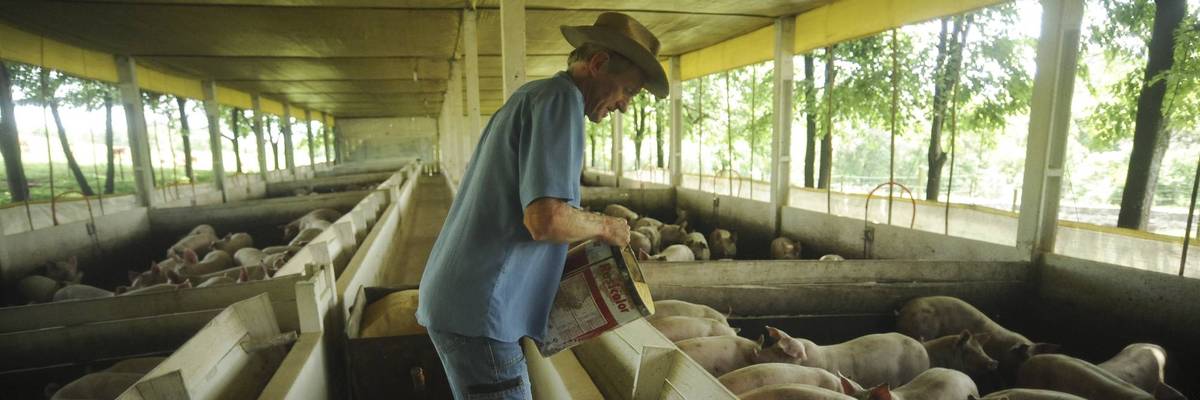
A farmer feeds animals in the city of Tangua, city of agricultural planting, poultry, flowers, vegetables, and cattle raising, in the interior of Rio de Janeiro, on the World Farmer's Day, on May 13, 2022.
Don't Let the EU-Mercosur Agreement Be a Loss for Animal Welfare
The EU talks a good game, but rhetoric alone is not enough. The ratification delay is a golden opportunity for reflection and to strengthen standards.
Gestation crates are metal cages, typically no bigger than 7 feet by 2 feet, used to contain female pigs—known as sows—for most of their breeding lives. The crates are so small that their inhabitants cannot walk or even turn around. Natural behaviors such as rummaging, fetching food, nesting, and grazing are all denied to them.
Without question they are among the cruelest fixtures in the meat industry. Many countries in the Western world, including the European Union, have either banned or significantly restricted their use. The European Commission plans to phase them out entirely by 2027. A recent landmark piece of legislation, however, threatens to undo this critical progress.
The EU-Mercosur (Argentina, Brazil, Paraguay, and Uruguay) Agreement, signed to great fanfare on January 17, 2026, has been heralded as both historic and ambitious. Less discussed, however, is what the agreement could mean for animal welfare protections in both hemispheres.
The EU may be home to some of the highest animal welfare standards of any government in the world, but the same cannot be said for Mercosur, where millions of sows are still confined to gestation crates for long periods of time.
Unless safeguards are put in place, this trade agreement risks reversing the EU's progress on deforestation altogether.
Sinergia Animal, the international animal protection organisation whose Brazilian operations I lead, publishes a yearly report called Pigs in Focus, which ranks major Brazilian producers on their animal welfare standards. Despite being the country’s fourth-largest pork processor and a major dairy company, Frimesa has still not committed to ban crates for sows. Farrowing cages and battery cages for chickens remain widespread too. We have been negotiating with them for years, and despite their competitors making meaningful progress, they are still dragging their heels on making even basic improvements.
The problem does not stop with Frimesa. Minerva Foods, one of the leading meat producers in South America and a major supplier of pork products globally, continues to cause immense suffering. Ear notching, teeth clipping, and tail docking, as well as the routine misuse of antimicrobials, are all common. Again, while commitments to phase out these techniques have been made, our research exposes the use of excessively long deadlines that serve to prolong animal suffering.
These are not exceptional, isolated cases. They represent a wider system across Mercosur countries—one that may end up supplying significantly more of the meat consumed in the EU.
This raises serious questions about the EU’s commitment to animal welfare standards, which is why the European Parliament’s decision in late January to request a legal opinion from the Court of Justice of the European Union (CJEU) on the agreement’s conformity with the EU treaties, thereby halting the ratification process, is a welcome one.
The review could take up to two years, which gives EU policymakers more than enough time to revisit the issue of animal welfare and mitigate against the new incentive structures now in place for Mercosur producers.
It would, however, be a mistake to assume that greater attention should be paid to animal welfare protections alone. After all, lower standards mean higher yields. In Argentina and Uruguay, 89% and 88% of eggs come from hens kept in battery or enriched cages. In Brazil the figure is 95%. In the EU, by comparison, 38% of hens are still kept in cages—something seen as too high but will nonetheless put European producers at a significant competitive disadvantage.
An increase in demand for meat will also magnify pressure on vital ecosystems. As demand for land and animal feed goes up, so too will the rate of deforestation. The resultant loss of habitat will accelerate biodiversity decline, threatening ecosystems that are a key natural defense against climate change.
These developments cannot be divorced from the geopolitics of the climate crisis. With the US having reneged on its international climate commitments, the pressure is on the EU to at least partially fill the leadership void. So far they are failing, with initiatives such as the Deforestation Regulation and electric vehicle mandate either abandoned or reduced in ambition. Unless safeguards are put in place, this trade agreement risks reversing the EU's progress on deforestation altogether.
So what can the EU do? At a minimum, Brussels must demand that meat produced under unacceptably low standards is not imported to the EU. However, equally important is that Mercosur countries are still able to benefit economically from the agreement by retaining access to the EU market. This means pushing for Mercosur countries to eliminate battery cages and sow stalls, ban mutilations without pain relief, enrich spaces, and meaningfully improve handling standards.
The EU talks a good game, but rhetoric alone is not enough. The ratification delay is a golden opportunity for reflection and to strengthen standards. Political leaders have been right to label the agreement as historic, but unless robust protections are put in place, it may well be remembered for all the wrong reasons.
We are at a crossroads
This country and this world are at a monumental crossroads. In a few short weeks, US voters will have an opportunity to beat back the forces of fascism and confront the billionaires who are rigging the economy, our media system, and our democracy, making it increasingly impossible for ordinary people to get by. We’re not just talking about the election. We’re talking about what must be done once these fascist elements are vanquished from power. We need a bolder set of solutions than what either major party has so far been willing to offer and a working-class movement ready to fight like hell for it. Trump didn't emerge from nowhere. The conditions that fueled MAGA authoritarianism were created by decades of radical neoliberal economic policies and a corrupt political system dominated by corporate interests. They slashed taxes on the super-rich, promising that the benefits would trickle down. They said giveaways to the corporate titans would make life more affordable for the rest of us. It was all bullshit. And when a bitter, betrayed populace searches for someone to blame, right-wing demagogues have little trouble finding scapegoats. People know when they're being lied to, but you won't hear any of this from the corporate media. Only independent journalism—powered and funded by people who believe in building a better world—can deliver truly trustworthy daily news. Our Fall Campaign is underway, and we need your help. To power our newsroom through the rest of the year, we need to raise $125,000 by midnight on October 31. So if you share our vision, please contribute whatever you can to sustain our work. |
Gestation crates are metal cages, typically no bigger than 7 feet by 2 feet, used to contain female pigs—known as sows—for most of their breeding lives. The crates are so small that their inhabitants cannot walk or even turn around. Natural behaviors such as rummaging, fetching food, nesting, and grazing are all denied to them.
Without question they are among the cruelest fixtures in the meat industry. Many countries in the Western world, including the European Union, have either banned or significantly restricted their use. The European Commission plans to phase them out entirely by 2027. A recent landmark piece of legislation, however, threatens to undo this critical progress.
The EU-Mercosur (Argentina, Brazil, Paraguay, and Uruguay) Agreement, signed to great fanfare on January 17, 2026, has been heralded as both historic and ambitious. Less discussed, however, is what the agreement could mean for animal welfare protections in both hemispheres.
The EU may be home to some of the highest animal welfare standards of any government in the world, but the same cannot be said for Mercosur, where millions of sows are still confined to gestation crates for long periods of time.
Unless safeguards are put in place, this trade agreement risks reversing the EU's progress on deforestation altogether.
Sinergia Animal, the international animal protection organisation whose Brazilian operations I lead, publishes a yearly report called Pigs in Focus, which ranks major Brazilian producers on their animal welfare standards. Despite being the country’s fourth-largest pork processor and a major dairy company, Frimesa has still not committed to ban crates for sows. Farrowing cages and battery cages for chickens remain widespread too. We have been negotiating with them for years, and despite their competitors making meaningful progress, they are still dragging their heels on making even basic improvements.
The problem does not stop with Frimesa. Minerva Foods, one of the leading meat producers in South America and a major supplier of pork products globally, continues to cause immense suffering. Ear notching, teeth clipping, and tail docking, as well as the routine misuse of antimicrobials, are all common. Again, while commitments to phase out these techniques have been made, our research exposes the use of excessively long deadlines that serve to prolong animal suffering.
These are not exceptional, isolated cases. They represent a wider system across Mercosur countries—one that may end up supplying significantly more of the meat consumed in the EU.
This raises serious questions about the EU’s commitment to animal welfare standards, which is why the European Parliament’s decision in late January to request a legal opinion from the Court of Justice of the European Union (CJEU) on the agreement’s conformity with the EU treaties, thereby halting the ratification process, is a welcome one.
The review could take up to two years, which gives EU policymakers more than enough time to revisit the issue of animal welfare and mitigate against the new incentive structures now in place for Mercosur producers.
It would, however, be a mistake to assume that greater attention should be paid to animal welfare protections alone. After all, lower standards mean higher yields. In Argentina and Uruguay, 89% and 88% of eggs come from hens kept in battery or enriched cages. In Brazil the figure is 95%. In the EU, by comparison, 38% of hens are still kept in cages—something seen as too high but will nonetheless put European producers at a significant competitive disadvantage.
An increase in demand for meat will also magnify pressure on vital ecosystems. As demand for land and animal feed goes up, so too will the rate of deforestation. The resultant loss of habitat will accelerate biodiversity decline, threatening ecosystems that are a key natural defense against climate change.
These developments cannot be divorced from the geopolitics of the climate crisis. With the US having reneged on its international climate commitments, the pressure is on the EU to at least partially fill the leadership void. So far they are failing, with initiatives such as the Deforestation Regulation and electric vehicle mandate either abandoned or reduced in ambition. Unless safeguards are put in place, this trade agreement risks reversing the EU's progress on deforestation altogether.
So what can the EU do? At a minimum, Brussels must demand that meat produced under unacceptably low standards is not imported to the EU. However, equally important is that Mercosur countries are still able to benefit economically from the agreement by retaining access to the EU market. This means pushing for Mercosur countries to eliminate battery cages and sow stalls, ban mutilations without pain relief, enrich spaces, and meaningfully improve handling standards.
The EU talks a good game, but rhetoric alone is not enough. The ratification delay is a golden opportunity for reflection and to strengthen standards. Political leaders have been right to label the agreement as historic, but unless robust protections are put in place, it may well be remembered for all the wrong reasons.
Gestation crates are metal cages, typically no bigger than 7 feet by 2 feet, used to contain female pigs—known as sows—for most of their breeding lives. The crates are so small that their inhabitants cannot walk or even turn around. Natural behaviors such as rummaging, fetching food, nesting, and grazing are all denied to them.
Without question they are among the cruelest fixtures in the meat industry. Many countries in the Western world, including the European Union, have either banned or significantly restricted their use. The European Commission plans to phase them out entirely by 2027. A recent landmark piece of legislation, however, threatens to undo this critical progress.
The EU-Mercosur (Argentina, Brazil, Paraguay, and Uruguay) Agreement, signed to great fanfare on January 17, 2026, has been heralded as both historic and ambitious. Less discussed, however, is what the agreement could mean for animal welfare protections in both hemispheres.
The EU may be home to some of the highest animal welfare standards of any government in the world, but the same cannot be said for Mercosur, where millions of sows are still confined to gestation crates for long periods of time.
Unless safeguards are put in place, this trade agreement risks reversing the EU's progress on deforestation altogether.
Sinergia Animal, the international animal protection organisation whose Brazilian operations I lead, publishes a yearly report called Pigs in Focus, which ranks major Brazilian producers on their animal welfare standards. Despite being the country’s fourth-largest pork processor and a major dairy company, Frimesa has still not committed to ban crates for sows. Farrowing cages and battery cages for chickens remain widespread too. We have been negotiating with them for years, and despite their competitors making meaningful progress, they are still dragging their heels on making even basic improvements.
The problem does not stop with Frimesa. Minerva Foods, one of the leading meat producers in South America and a major supplier of pork products globally, continues to cause immense suffering. Ear notching, teeth clipping, and tail docking, as well as the routine misuse of antimicrobials, are all common. Again, while commitments to phase out these techniques have been made, our research exposes the use of excessively long deadlines that serve to prolong animal suffering.
These are not exceptional, isolated cases. They represent a wider system across Mercosur countries—one that may end up supplying significantly more of the meat consumed in the EU.
This raises serious questions about the EU’s commitment to animal welfare standards, which is why the European Parliament’s decision in late January to request a legal opinion from the Court of Justice of the European Union (CJEU) on the agreement’s conformity with the EU treaties, thereby halting the ratification process, is a welcome one.
The review could take up to two years, which gives EU policymakers more than enough time to revisit the issue of animal welfare and mitigate against the new incentive structures now in place for Mercosur producers.
It would, however, be a mistake to assume that greater attention should be paid to animal welfare protections alone. After all, lower standards mean higher yields. In Argentina and Uruguay, 89% and 88% of eggs come from hens kept in battery or enriched cages. In Brazil the figure is 95%. In the EU, by comparison, 38% of hens are still kept in cages—something seen as too high but will nonetheless put European producers at a significant competitive disadvantage.
An increase in demand for meat will also magnify pressure on vital ecosystems. As demand for land and animal feed goes up, so too will the rate of deforestation. The resultant loss of habitat will accelerate biodiversity decline, threatening ecosystems that are a key natural defense against climate change.
These developments cannot be divorced from the geopolitics of the climate crisis. With the US having reneged on its international climate commitments, the pressure is on the EU to at least partially fill the leadership void. So far they are failing, with initiatives such as the Deforestation Regulation and electric vehicle mandate either abandoned or reduced in ambition. Unless safeguards are put in place, this trade agreement risks reversing the EU's progress on deforestation altogether.
So what can the EU do? At a minimum, Brussels must demand that meat produced under unacceptably low standards is not imported to the EU. However, equally important is that Mercosur countries are still able to benefit economically from the agreement by retaining access to the EU market. This means pushing for Mercosur countries to eliminate battery cages and sow stalls, ban mutilations without pain relief, enrich spaces, and meaningfully improve handling standards.
The EU talks a good game, but rhetoric alone is not enough. The ratification delay is a golden opportunity for reflection and to strengthen standards. Political leaders have been right to label the agreement as historic, but unless robust protections are put in place, it may well be remembered for all the wrong reasons.