

SUBSCRIBE TO OUR FREE NEWSLETTER
Daily news & progressive opinion—funded by the people, not the corporations—delivered straight to your inbox.
5
#000000
#FFFFFF
To donate by check, phone, or other method, see our More Ways to Give page.
Daily news & progressive opinion—funded by the people, not the corporations—delivered straight to your inbox.
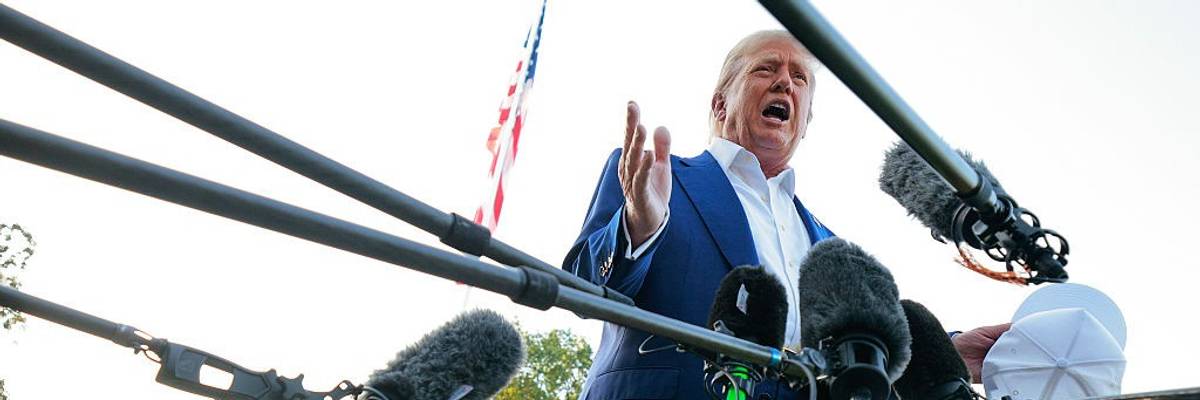
US President Donald Trump speaks to reporters before boarding the Marine One presidential helicopter and departing the White House on June 24, 2025 in Washington, DC.
The real question is not whether Trump is allowed to use degrading language, but whether a president who does so honors the dignity of the office—or hollows it out from within.
When a president uses language that dehumanizes, it is not a matter of legality, it is a matter of dignity, and it signals who our society values. Every utterance from the Oval Office carries weight; it sets norms, authorizes behaviors, and communicates whose humanity is recognized and whose is diminished.
When President Donald Trump referred to Minnesota Gov. Tim Walz using the R-word, defenders rushed in with a familiar refrain: freedom of speech. He can say what he wants. He is protected. End of discussion.
But this is not a freedom-of-speech question. It is a freedom-of-dignity question.
Donald Trump is not a private citizen muttering into the void. He is the most powerful person in the world, speaking through a global amplifier backed by the authority of the presidency. The real question is not whether he is allowed to use degrading language, but whether a president who does so honors the dignity of the office—or hollows it out from within.
A president’s words do more than reveal character; they instruct the nation in who it is permitted to become.
Some defenders argue that only the N-word merits being reduced to an initial, that if Trump wants to use “retarded,” he can—and so can anyone else. They dismiss criticism as cancel culture, another example of Democrats weaponizing political correctness.
This defense is morally hollow. Saying, “Only the N-word counts” is an impoverished standard. Harmful language does not become acceptable simply because it targets a different group. The R-word is not neutral—it has been used for decades to demean, exclude, and dehumanize people with intellectual and developmental disabilities, reducing human beings to a punchline or a flaw.
This is not about partisan loyalty or performative outrage. It is about whether we believe people deserve basic dignity regardless of disability. If you had a child, a sibling, or a close friend with an intellectual or developmental disability, would you really argue that the most powerful person in the country should be excused for using a word that has long diminished their worth? Would that feel like free speech, or like indifference?
Leadership is not only about what one is legally permitted to say. It is about what one chooses to say. Leaders set norms. When they adopt language that punches down, they grant permission for others to follow. Calling that out is not political correctness; it is a minimal ethical expectation of public leadership.
BJ Stasio, a Peer Specialist 2 with the New York State Office for People With Developmental Disabilities, explains:
When national leaders use the R-word casually, it reactivates real harm for people who were once labeled, limited, and underestimated. As someone who has lived with that label—and now leads within the disability rights movement—I know firsthand what the stigma can do.
Nicole LeBlanc, a disability employment consultant and self-advocacy adviser, underscores the emotional and systemic toll:
Seeing the R-word insult return to everyday language is enraging. Many people with autism—especially those diagnosed in adulthood—carry complex trauma histories from bullying and verbal abuse. Research shows they are more likely to be bullied than the general population, leading to high rates of PTSD, anxiety, and other challenges. People with disabilities want respect, love, acceptance, and access to services that allow us to thrive, not just survive. Using hateful language fuels negative attitudes, health disparities, and higher abuse rates. Respect is not optional.
Emauni Crawley, a behavioral health coach and disability advocate, is blunt:
The manner in which Trump articulates the R-word is not a result of ignorance. It is an act of perverseness.
Dr. Gary Schaffer, professor of school psychology, mental health counselor, author, and a person with disabilities, adds historical context:
The R-word is not neutral. It is hate speech, reducing learning and behavioral differences to something laughable and diminishing a person’s value to society. When the president of the United States uses it openly, he gives a green light to discriminate, segregate, and withhold empathy—not only from people with intellectual disabilities, but from anyone with learning or behavioral differences.
This danger is not theoretical. Prior to 1975, many students with disabilities were denied access to education entirely because they were deemed incapable of learning. Language paved the way for policy. It always does.
Max Donatelli, a US Air Force Vietnam veteran, disability advocate, and parent, put it plainly:
The public disrespect shown by this president to people with intellectual and developmental disabilities is unprecedented. Our country deserves better. As a parent and advocate, we have found it challenging to rid our language of the R-word at the local, state, and national levels. We helped New York State end its use of it in the office that administers services to people with intellectual and developmental disabilities. What was once the Office for Mental Retardation and Developmental Disabilities is now the Office for People with Developmental Disabilities, thanks to significant advocacy. Our wonderful son Craig, who has Down syndrome, deserves the respect and opportunities afforded all citizens. The use of this slur is a stain on this presidency that won’t be forgotten by us.
The R-word entered medical and educational usage in the late 19th and early 20th centuries as a supposedly humane replacement for earlier slurs. By the 1960s and 1970s, it had become an everyday insult. Its harm was so widespread that it was removed from professional, legal, and clinical use, replaced by terms such as intellectual disability and developmental disability. Organizations like the Special Olympics have spent decades urging the public to abandon the word entirely.
Trump’s use of it is therefore not accidental, nostalgic, or brave. It is regressive. It communicates that labeling human beings this way is acceptable—even legitimate. Taboos are ethical boundaries. When a president violates them intentionally, the violation instructs.
Words alone are dangerous. When paired with policy, the harm compounds. Rhetoric that degrades, combined with policies that strip protections, sends a clear message about whose lives are valued and whose are negotiable. Programs like SOAR, which helped people with severe mental health challenges access Social Security benefits and provided housing, healthcare, and stability. Cutting them leaves people exposed. The erosion of special education, weakening of Americans with Disabilities Act guidance, and refusal to provide real-time American Sign Language interpretation at White House events send the same message: Accessibility is optional; inclusion is an inconvenience.
Harm becomes systemic not all at once, but sentence by sentence, joke by joke, policy memo by policy memo. The erosion of dignity rarely announces itself as violence. It begins as permission—to mock, dismiss, reduce. When that permission comes from the highest office in the land, it spreads.
This is not about fragility. It is about responsibility. A president’s words do more than reveal character; they instruct the nation in who it is permitted to become. When language degrades and protections are hollowed out, dignity ceases to be shared and becomes a privilege rationed by power.
The question is no longer whether such language is legal. It is whether we will accept a politics that treats some people’s humanity as expendable, and whether we will recognize, before it spreads further, that a nation willing to bargain away dignity at the margins will eventually find it gone at the center.
Dear Common Dreams reader, It’s been nearly 30 years since I co-founded Common Dreams with my late wife, Lina Newhouser. We had the radical notion that journalism should serve the public good, not corporate profits. It was clear to us from the outset what it would take to build such a project. No paid advertisements. No corporate sponsors. No millionaire publisher telling us what to think or do. Many people said we wouldn't last a year, but we proved those doubters wrong. Together with a tremendous team of journalists and dedicated staff, we built an independent media outlet free from the constraints of profits and corporate control. Our mission has always been simple: To inform. To inspire. To ignite change for the common good. Building Common Dreams was not easy. Our survival was never guaranteed. When you take on the most powerful forces—Wall Street greed, fossil fuel industry destruction, Big Tech lobbyists, and uber-rich oligarchs who have spent billions upon billions rigging the economy and democracy in their favor—the only bulwark you have is supporters who believe in your work. But here’s the urgent message from me today. It's never been this bad out there. And it's never been this hard to keep us going. At the very moment Common Dreams is most needed, the threats we face are intensifying. We need your support now more than ever. We don't accept corporate advertising and never will. We don't have a paywall because we don't think people should be blocked from critical news based on their ability to pay. Everything we do is funded by the donations of readers like you. When everyone does the little they can afford, we are strong. But if that support retreats or dries up, so do we. Will you donate now to make sure Common Dreams not only survives but thrives? —Craig Brown, Co-founder |
When a president uses language that dehumanizes, it is not a matter of legality, it is a matter of dignity, and it signals who our society values. Every utterance from the Oval Office carries weight; it sets norms, authorizes behaviors, and communicates whose humanity is recognized and whose is diminished.
When President Donald Trump referred to Minnesota Gov. Tim Walz using the R-word, defenders rushed in with a familiar refrain: freedom of speech. He can say what he wants. He is protected. End of discussion.
But this is not a freedom-of-speech question. It is a freedom-of-dignity question.
Donald Trump is not a private citizen muttering into the void. He is the most powerful person in the world, speaking through a global amplifier backed by the authority of the presidency. The real question is not whether he is allowed to use degrading language, but whether a president who does so honors the dignity of the office—or hollows it out from within.
A president’s words do more than reveal character; they instruct the nation in who it is permitted to become.
Some defenders argue that only the N-word merits being reduced to an initial, that if Trump wants to use “retarded,” he can—and so can anyone else. They dismiss criticism as cancel culture, another example of Democrats weaponizing political correctness.
This defense is morally hollow. Saying, “Only the N-word counts” is an impoverished standard. Harmful language does not become acceptable simply because it targets a different group. The R-word is not neutral—it has been used for decades to demean, exclude, and dehumanize people with intellectual and developmental disabilities, reducing human beings to a punchline or a flaw.
This is not about partisan loyalty or performative outrage. It is about whether we believe people deserve basic dignity regardless of disability. If you had a child, a sibling, or a close friend with an intellectual or developmental disability, would you really argue that the most powerful person in the country should be excused for using a word that has long diminished their worth? Would that feel like free speech, or like indifference?
Leadership is not only about what one is legally permitted to say. It is about what one chooses to say. Leaders set norms. When they adopt language that punches down, they grant permission for others to follow. Calling that out is not political correctness; it is a minimal ethical expectation of public leadership.
BJ Stasio, a Peer Specialist 2 with the New York State Office for People With Developmental Disabilities, explains:
When national leaders use the R-word casually, it reactivates real harm for people who were once labeled, limited, and underestimated. As someone who has lived with that label—and now leads within the disability rights movement—I know firsthand what the stigma can do.
Nicole LeBlanc, a disability employment consultant and self-advocacy adviser, underscores the emotional and systemic toll:
Seeing the R-word insult return to everyday language is enraging. Many people with autism—especially those diagnosed in adulthood—carry complex trauma histories from bullying and verbal abuse. Research shows they are more likely to be bullied than the general population, leading to high rates of PTSD, anxiety, and other challenges. People with disabilities want respect, love, acceptance, and access to services that allow us to thrive, not just survive. Using hateful language fuels negative attitudes, health disparities, and higher abuse rates. Respect is not optional.
Emauni Crawley, a behavioral health coach and disability advocate, is blunt:
The manner in which Trump articulates the R-word is not a result of ignorance. It is an act of perverseness.
Dr. Gary Schaffer, professor of school psychology, mental health counselor, author, and a person with disabilities, adds historical context:
The R-word is not neutral. It is hate speech, reducing learning and behavioral differences to something laughable and diminishing a person’s value to society. When the president of the United States uses it openly, he gives a green light to discriminate, segregate, and withhold empathy—not only from people with intellectual disabilities, but from anyone with learning or behavioral differences.
This danger is not theoretical. Prior to 1975, many students with disabilities were denied access to education entirely because they were deemed incapable of learning. Language paved the way for policy. It always does.
Max Donatelli, a US Air Force Vietnam veteran, disability advocate, and parent, put it plainly:
The public disrespect shown by this president to people with intellectual and developmental disabilities is unprecedented. Our country deserves better. As a parent and advocate, we have found it challenging to rid our language of the R-word at the local, state, and national levels. We helped New York State end its use of it in the office that administers services to people with intellectual and developmental disabilities. What was once the Office for Mental Retardation and Developmental Disabilities is now the Office for People with Developmental Disabilities, thanks to significant advocacy. Our wonderful son Craig, who has Down syndrome, deserves the respect and opportunities afforded all citizens. The use of this slur is a stain on this presidency that won’t be forgotten by us.
The R-word entered medical and educational usage in the late 19th and early 20th centuries as a supposedly humane replacement for earlier slurs. By the 1960s and 1970s, it had become an everyday insult. Its harm was so widespread that it was removed from professional, legal, and clinical use, replaced by terms such as intellectual disability and developmental disability. Organizations like the Special Olympics have spent decades urging the public to abandon the word entirely.
Trump’s use of it is therefore not accidental, nostalgic, or brave. It is regressive. It communicates that labeling human beings this way is acceptable—even legitimate. Taboos are ethical boundaries. When a president violates them intentionally, the violation instructs.
Words alone are dangerous. When paired with policy, the harm compounds. Rhetoric that degrades, combined with policies that strip protections, sends a clear message about whose lives are valued and whose are negotiable. Programs like SOAR, which helped people with severe mental health challenges access Social Security benefits and provided housing, healthcare, and stability. Cutting them leaves people exposed. The erosion of special education, weakening of Americans with Disabilities Act guidance, and refusal to provide real-time American Sign Language interpretation at White House events send the same message: Accessibility is optional; inclusion is an inconvenience.
Harm becomes systemic not all at once, but sentence by sentence, joke by joke, policy memo by policy memo. The erosion of dignity rarely announces itself as violence. It begins as permission—to mock, dismiss, reduce. When that permission comes from the highest office in the land, it spreads.
This is not about fragility. It is about responsibility. A president’s words do more than reveal character; they instruct the nation in who it is permitted to become. When language degrades and protections are hollowed out, dignity ceases to be shared and becomes a privilege rationed by power.
The question is no longer whether such language is legal. It is whether we will accept a politics that treats some people’s humanity as expendable, and whether we will recognize, before it spreads further, that a nation willing to bargain away dignity at the margins will eventually find it gone at the center.
When a president uses language that dehumanizes, it is not a matter of legality, it is a matter of dignity, and it signals who our society values. Every utterance from the Oval Office carries weight; it sets norms, authorizes behaviors, and communicates whose humanity is recognized and whose is diminished.
When President Donald Trump referred to Minnesota Gov. Tim Walz using the R-word, defenders rushed in with a familiar refrain: freedom of speech. He can say what he wants. He is protected. End of discussion.
But this is not a freedom-of-speech question. It is a freedom-of-dignity question.
Donald Trump is not a private citizen muttering into the void. He is the most powerful person in the world, speaking through a global amplifier backed by the authority of the presidency. The real question is not whether he is allowed to use degrading language, but whether a president who does so honors the dignity of the office—or hollows it out from within.
A president’s words do more than reveal character; they instruct the nation in who it is permitted to become.
Some defenders argue that only the N-word merits being reduced to an initial, that if Trump wants to use “retarded,” he can—and so can anyone else. They dismiss criticism as cancel culture, another example of Democrats weaponizing political correctness.
This defense is morally hollow. Saying, “Only the N-word counts” is an impoverished standard. Harmful language does not become acceptable simply because it targets a different group. The R-word is not neutral—it has been used for decades to demean, exclude, and dehumanize people with intellectual and developmental disabilities, reducing human beings to a punchline or a flaw.
This is not about partisan loyalty or performative outrage. It is about whether we believe people deserve basic dignity regardless of disability. If you had a child, a sibling, or a close friend with an intellectual or developmental disability, would you really argue that the most powerful person in the country should be excused for using a word that has long diminished their worth? Would that feel like free speech, or like indifference?
Leadership is not only about what one is legally permitted to say. It is about what one chooses to say. Leaders set norms. When they adopt language that punches down, they grant permission for others to follow. Calling that out is not political correctness; it is a minimal ethical expectation of public leadership.
BJ Stasio, a Peer Specialist 2 with the New York State Office for People With Developmental Disabilities, explains:
When national leaders use the R-word casually, it reactivates real harm for people who were once labeled, limited, and underestimated. As someone who has lived with that label—and now leads within the disability rights movement—I know firsthand what the stigma can do.
Nicole LeBlanc, a disability employment consultant and self-advocacy adviser, underscores the emotional and systemic toll:
Seeing the R-word insult return to everyday language is enraging. Many people with autism—especially those diagnosed in adulthood—carry complex trauma histories from bullying and verbal abuse. Research shows they are more likely to be bullied than the general population, leading to high rates of PTSD, anxiety, and other challenges. People with disabilities want respect, love, acceptance, and access to services that allow us to thrive, not just survive. Using hateful language fuels negative attitudes, health disparities, and higher abuse rates. Respect is not optional.
Emauni Crawley, a behavioral health coach and disability advocate, is blunt:
The manner in which Trump articulates the R-word is not a result of ignorance. It is an act of perverseness.
Dr. Gary Schaffer, professor of school psychology, mental health counselor, author, and a person with disabilities, adds historical context:
The R-word is not neutral. It is hate speech, reducing learning and behavioral differences to something laughable and diminishing a person’s value to society. When the president of the United States uses it openly, he gives a green light to discriminate, segregate, and withhold empathy—not only from people with intellectual disabilities, but from anyone with learning or behavioral differences.
This danger is not theoretical. Prior to 1975, many students with disabilities were denied access to education entirely because they were deemed incapable of learning. Language paved the way for policy. It always does.
Max Donatelli, a US Air Force Vietnam veteran, disability advocate, and parent, put it plainly:
The public disrespect shown by this president to people with intellectual and developmental disabilities is unprecedented. Our country deserves better. As a parent and advocate, we have found it challenging to rid our language of the R-word at the local, state, and national levels. We helped New York State end its use of it in the office that administers services to people with intellectual and developmental disabilities. What was once the Office for Mental Retardation and Developmental Disabilities is now the Office for People with Developmental Disabilities, thanks to significant advocacy. Our wonderful son Craig, who has Down syndrome, deserves the respect and opportunities afforded all citizens. The use of this slur is a stain on this presidency that won’t be forgotten by us.
The R-word entered medical and educational usage in the late 19th and early 20th centuries as a supposedly humane replacement for earlier slurs. By the 1960s and 1970s, it had become an everyday insult. Its harm was so widespread that it was removed from professional, legal, and clinical use, replaced by terms such as intellectual disability and developmental disability. Organizations like the Special Olympics have spent decades urging the public to abandon the word entirely.
Trump’s use of it is therefore not accidental, nostalgic, or brave. It is regressive. It communicates that labeling human beings this way is acceptable—even legitimate. Taboos are ethical boundaries. When a president violates them intentionally, the violation instructs.
Words alone are dangerous. When paired with policy, the harm compounds. Rhetoric that degrades, combined with policies that strip protections, sends a clear message about whose lives are valued and whose are negotiable. Programs like SOAR, which helped people with severe mental health challenges access Social Security benefits and provided housing, healthcare, and stability. Cutting them leaves people exposed. The erosion of special education, weakening of Americans with Disabilities Act guidance, and refusal to provide real-time American Sign Language interpretation at White House events send the same message: Accessibility is optional; inclusion is an inconvenience.
Harm becomes systemic not all at once, but sentence by sentence, joke by joke, policy memo by policy memo. The erosion of dignity rarely announces itself as violence. It begins as permission—to mock, dismiss, reduce. When that permission comes from the highest office in the land, it spreads.
This is not about fragility. It is about responsibility. A president’s words do more than reveal character; they instruct the nation in who it is permitted to become. When language degrades and protections are hollowed out, dignity ceases to be shared and becomes a privilege rationed by power.
The question is no longer whether such language is legal. It is whether we will accept a politics that treats some people’s humanity as expendable, and whether we will recognize, before it spreads further, that a nation willing to bargain away dignity at the margins will eventually find it gone at the center.

