SUBSCRIBE TO OUR FREE NEWSLETTER
Daily news & progressive opinion—funded by the people, not the corporations—delivered straight to your inbox.
5
#000000
#FFFFFF
To donate by check, phone, or other method, see our More Ways to Give page.
Daily news & progressive opinion—funded by the people, not the corporations—delivered straight to your inbox.
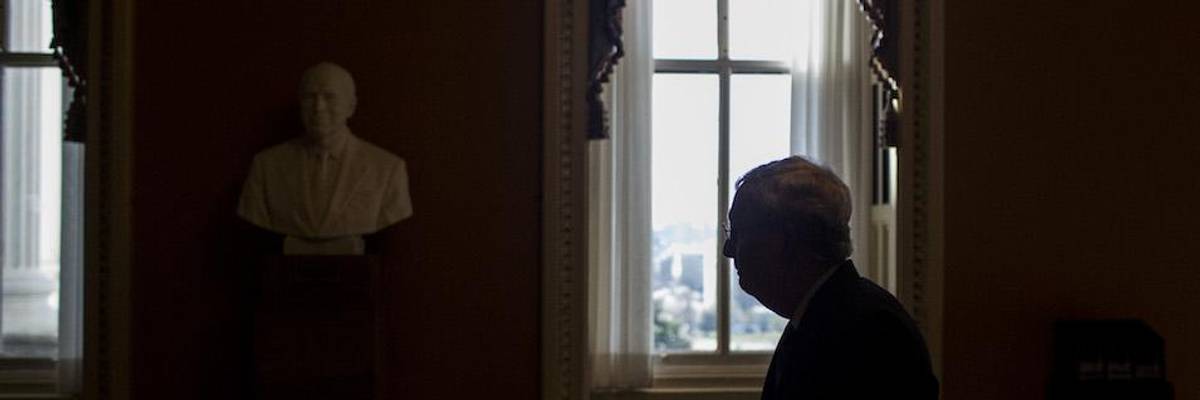
Senate Majority Leader Mitch McConnell (R-Ky.) leaves the Senate Floor following a vote on April 3, 2019 in Washington, DC. (Photo: Zach Gibson/Getty Images)
No one should be surprised that Mitch McConnell has promised that any potential 2020 Trump Supreme Court nominee will not get the Merrick Garland treatment -- i.e., be held up until after the presidential race is decided. While McConnell and his Republican colleagues have tried to frame their 2016 obstructionism on Garland's nomination and prospective 2020 decision in various forms of Senate tradition, he has, in this instance, been more-than-normally forthright: Supreme Court nominations are all about partisan politics, nothing more, nothing less.
In that, McConnell is the living, breathing, calculating face of everything that is wrong with our current politics. To the extent to which our system has become dysfunctional, McConnell is the single chief architect of that sclerosis. President Donald Trump is a dangerous, blundering wrecking ball, but McConnell was undermining the system well before (and is likely to outlast) him.
Nothing exemplifies McConnell's role as norm-wrecking partisan warrior than the Garland affair: Almost as soon as word of Justice Antonin Scalia's death emerged, McConnell had promised to block anyone President Barack Obama might nominate. "The American people should have a voice in the selection of their next Supreme Court justice," the pious, pompous McConnell said then, noting that Obama was at the time a lame duck president.
But the American people had had a voice in that selection when they elected Obama less than four years earlier to serve as president. The Senate hadn't confirmed an election-year high court nominee "for the better part of a century," McConnell and Judiciary Committee Chairman Chuck Grassley pointed out, ignoring the fact that the last time such a circumstance had arisen, more than a century earlier, the Senate did both vote, and voted to confirm.
McConnell, it seems, is no longer so concerned with the wishes of "the American people" in advance of an election.
In any case, asked Tuesday about a hypothetical 2020 Supreme Court nomination, McConnell was direct: "Oh, we'd fill it." What's changed?
Per CNN: "David Popp, a spokesman for McConnell, said the difference between now and three years ago ... is that at that time the White House was controlled by a Democrat and the Senate by Republicans. This time, both are controlled by the GOP."
Popp also pointed reporters to comments McConnell made in October: "The tradition going back to the 1880s has been if a vacancy occurs in a presidential election year, and there is a different party in control of the Senate than the presidency, it is not filled."
Here is the complete list of split-government, election year Supreme Court nominees in the last 130 years: Merrick Garland. That's it. If you want to get expansive, here's the entire list of election year, split-government, pre-election Supreme Court nominees: Merrick Garland in 2016 and Melville Fuller in 1888.
Of course, if you listened to McConnell you might think that the Senate routinely refused to consider any election year nomination to the high court because of tradition. But between 1888 and 2016, it never came up. And, when it did come up in 1888, and Democratic President Grover Cleveland nominated Fuller to be chief justice, the Republican-controlled Senate ... confirmed him overwhelmingly.
(Fuller, a Democrat who had managed Stephen Douglas' losing presidential campaign in 1860 but avoided military service during the Civil War, went on to preside over a court that upheld the South's Jim Crow laws in Plessy v. Ferguson, threw out federal income tax law -- a ruling rebuked by no less than the 16th Amendment -- and made antitrust cases harder to prosecute. Garland would've done considerably better.)
So if there's any "tradition" to be drawn from history, it's that, before McConnell came along, the Senate had no problem confirming a Supreme Court nominee from another party. That's how the system is supposed to work: Partisanship is supposed to have its limits.
McConnell claims to be a Senate traditionalist and presumably self-identifies as a patriot. But given the opportunity to preserve Senate traditions or maximize partisan gain, there's little evidence that McConnell even understands the question. The Garland power play was without precedent in history and whacked away at the kind of inter-party cooperation necessary for our system to work.
And he wasn't done: Later on in 2016, he famously refused to cooperate in a joint government statement decrying Russian interference in our election. A foreign adversary was assaulting our system, and McConnell couldn't see past his party affiliation because they were helping his side. Perhaps in Russian President Vladimir Putin's attempts to wreck our system, McConnell saw a kindred spirit.
McConnell, notably, was also in favor of filibuster abuse (when he was in the minority) before he was against it (in the majority); has praised gridlock; has gone along with the legislative terrorism of debt-ceiling showdowns and government shutdowns; and infamously said in 2010 that the "single most important" achievement the GOP could aim for was denying Obama re-election. (One supposes Garland was a back-door way of getting some of that.)
The Washington Post's Dana Milbank once wrote that McConnell's tombstone should include the inscription: "He broke America." He has been called the "gravedigger of American democracy," "destroyer of norms" and "the true villain of some of the ugliest moments in this period of U.S. history." And those are understatements.
McConnell, at least, has been around long enough and is smart enough to know precisely what it is he's doing. Trump seemingly doesn't understand our system or a president's place in history beyond his desire to get his way. It's hard to see that as worse than McConnell's deliberate effort to destroy that which he cannot control.
Dear Common Dreams reader, It’s been nearly 30 years since I co-founded Common Dreams with my late wife, Lina Newhouser. We had the radical notion that journalism should serve the public good, not corporate profits. It was clear to us from the outset what it would take to build such a project. No paid advertisements. No corporate sponsors. No millionaire publisher telling us what to think or do. Many people said we wouldn't last a year, but we proved those doubters wrong. Together with a tremendous team of journalists and dedicated staff, we built an independent media outlet free from the constraints of profits and corporate control. Our mission has always been simple: To inform. To inspire. To ignite change for the common good. Building Common Dreams was not easy. Our survival was never guaranteed. When you take on the most powerful forces—Wall Street greed, fossil fuel industry destruction, Big Tech lobbyists, and uber-rich oligarchs who have spent billions upon billions rigging the economy and democracy in their favor—the only bulwark you have is supporters who believe in your work. But here’s the urgent message from me today. It's never been this bad out there. And it's never been this hard to keep us going. At the very moment Common Dreams is most needed, the threats we face are intensifying. We need your support now more than ever. We don't accept corporate advertising and never will. We don't have a paywall because we don't think people should be blocked from critical news based on their ability to pay. Everything we do is funded by the donations of readers like you. When everyone does the little they can afford, we are strong. But if that support retreats or dries up, so do we. Will you donate now to make sure Common Dreams not only survives but thrives? —Craig Brown, Co-founder |
No one should be surprised that Mitch McConnell has promised that any potential 2020 Trump Supreme Court nominee will not get the Merrick Garland treatment -- i.e., be held up until after the presidential race is decided. While McConnell and his Republican colleagues have tried to frame their 2016 obstructionism on Garland's nomination and prospective 2020 decision in various forms of Senate tradition, he has, in this instance, been more-than-normally forthright: Supreme Court nominations are all about partisan politics, nothing more, nothing less.
In that, McConnell is the living, breathing, calculating face of everything that is wrong with our current politics. To the extent to which our system has become dysfunctional, McConnell is the single chief architect of that sclerosis. President Donald Trump is a dangerous, blundering wrecking ball, but McConnell was undermining the system well before (and is likely to outlast) him.
Nothing exemplifies McConnell's role as norm-wrecking partisan warrior than the Garland affair: Almost as soon as word of Justice Antonin Scalia's death emerged, McConnell had promised to block anyone President Barack Obama might nominate. "The American people should have a voice in the selection of their next Supreme Court justice," the pious, pompous McConnell said then, noting that Obama was at the time a lame duck president.
But the American people had had a voice in that selection when they elected Obama less than four years earlier to serve as president. The Senate hadn't confirmed an election-year high court nominee "for the better part of a century," McConnell and Judiciary Committee Chairman Chuck Grassley pointed out, ignoring the fact that the last time such a circumstance had arisen, more than a century earlier, the Senate did both vote, and voted to confirm.
McConnell, it seems, is no longer so concerned with the wishes of "the American people" in advance of an election.
In any case, asked Tuesday about a hypothetical 2020 Supreme Court nomination, McConnell was direct: "Oh, we'd fill it." What's changed?
Per CNN: "David Popp, a spokesman for McConnell, said the difference between now and three years ago ... is that at that time the White House was controlled by a Democrat and the Senate by Republicans. This time, both are controlled by the GOP."
Popp also pointed reporters to comments McConnell made in October: "The tradition going back to the 1880s has been if a vacancy occurs in a presidential election year, and there is a different party in control of the Senate than the presidency, it is not filled."
Here is the complete list of split-government, election year Supreme Court nominees in the last 130 years: Merrick Garland. That's it. If you want to get expansive, here's the entire list of election year, split-government, pre-election Supreme Court nominees: Merrick Garland in 2016 and Melville Fuller in 1888.
Of course, if you listened to McConnell you might think that the Senate routinely refused to consider any election year nomination to the high court because of tradition. But between 1888 and 2016, it never came up. And, when it did come up in 1888, and Democratic President Grover Cleveland nominated Fuller to be chief justice, the Republican-controlled Senate ... confirmed him overwhelmingly.
(Fuller, a Democrat who had managed Stephen Douglas' losing presidential campaign in 1860 but avoided military service during the Civil War, went on to preside over a court that upheld the South's Jim Crow laws in Plessy v. Ferguson, threw out federal income tax law -- a ruling rebuked by no less than the 16th Amendment -- and made antitrust cases harder to prosecute. Garland would've done considerably better.)
So if there's any "tradition" to be drawn from history, it's that, before McConnell came along, the Senate had no problem confirming a Supreme Court nominee from another party. That's how the system is supposed to work: Partisanship is supposed to have its limits.
McConnell claims to be a Senate traditionalist and presumably self-identifies as a patriot. But given the opportunity to preserve Senate traditions or maximize partisan gain, there's little evidence that McConnell even understands the question. The Garland power play was without precedent in history and whacked away at the kind of inter-party cooperation necessary for our system to work.
And he wasn't done: Later on in 2016, he famously refused to cooperate in a joint government statement decrying Russian interference in our election. A foreign adversary was assaulting our system, and McConnell couldn't see past his party affiliation because they were helping his side. Perhaps in Russian President Vladimir Putin's attempts to wreck our system, McConnell saw a kindred spirit.
McConnell, notably, was also in favor of filibuster abuse (when he was in the minority) before he was against it (in the majority); has praised gridlock; has gone along with the legislative terrorism of debt-ceiling showdowns and government shutdowns; and infamously said in 2010 that the "single most important" achievement the GOP could aim for was denying Obama re-election. (One supposes Garland was a back-door way of getting some of that.)
The Washington Post's Dana Milbank once wrote that McConnell's tombstone should include the inscription: "He broke America." He has been called the "gravedigger of American democracy," "destroyer of norms" and "the true villain of some of the ugliest moments in this period of U.S. history." And those are understatements.
McConnell, at least, has been around long enough and is smart enough to know precisely what it is he's doing. Trump seemingly doesn't understand our system or a president's place in history beyond his desire to get his way. It's hard to see that as worse than McConnell's deliberate effort to destroy that which he cannot control.
No one should be surprised that Mitch McConnell has promised that any potential 2020 Trump Supreme Court nominee will not get the Merrick Garland treatment -- i.e., be held up until after the presidential race is decided. While McConnell and his Republican colleagues have tried to frame their 2016 obstructionism on Garland's nomination and prospective 2020 decision in various forms of Senate tradition, he has, in this instance, been more-than-normally forthright: Supreme Court nominations are all about partisan politics, nothing more, nothing less.
In that, McConnell is the living, breathing, calculating face of everything that is wrong with our current politics. To the extent to which our system has become dysfunctional, McConnell is the single chief architect of that sclerosis. President Donald Trump is a dangerous, blundering wrecking ball, but McConnell was undermining the system well before (and is likely to outlast) him.
Nothing exemplifies McConnell's role as norm-wrecking partisan warrior than the Garland affair: Almost as soon as word of Justice Antonin Scalia's death emerged, McConnell had promised to block anyone President Barack Obama might nominate. "The American people should have a voice in the selection of their next Supreme Court justice," the pious, pompous McConnell said then, noting that Obama was at the time a lame duck president.
But the American people had had a voice in that selection when they elected Obama less than four years earlier to serve as president. The Senate hadn't confirmed an election-year high court nominee "for the better part of a century," McConnell and Judiciary Committee Chairman Chuck Grassley pointed out, ignoring the fact that the last time such a circumstance had arisen, more than a century earlier, the Senate did both vote, and voted to confirm.
McConnell, it seems, is no longer so concerned with the wishes of "the American people" in advance of an election.
In any case, asked Tuesday about a hypothetical 2020 Supreme Court nomination, McConnell was direct: "Oh, we'd fill it." What's changed?
Per CNN: "David Popp, a spokesman for McConnell, said the difference between now and three years ago ... is that at that time the White House was controlled by a Democrat and the Senate by Republicans. This time, both are controlled by the GOP."
Popp also pointed reporters to comments McConnell made in October: "The tradition going back to the 1880s has been if a vacancy occurs in a presidential election year, and there is a different party in control of the Senate than the presidency, it is not filled."
Here is the complete list of split-government, election year Supreme Court nominees in the last 130 years: Merrick Garland. That's it. If you want to get expansive, here's the entire list of election year, split-government, pre-election Supreme Court nominees: Merrick Garland in 2016 and Melville Fuller in 1888.
Of course, if you listened to McConnell you might think that the Senate routinely refused to consider any election year nomination to the high court because of tradition. But between 1888 and 2016, it never came up. And, when it did come up in 1888, and Democratic President Grover Cleveland nominated Fuller to be chief justice, the Republican-controlled Senate ... confirmed him overwhelmingly.
(Fuller, a Democrat who had managed Stephen Douglas' losing presidential campaign in 1860 but avoided military service during the Civil War, went on to preside over a court that upheld the South's Jim Crow laws in Plessy v. Ferguson, threw out federal income tax law -- a ruling rebuked by no less than the 16th Amendment -- and made antitrust cases harder to prosecute. Garland would've done considerably better.)
So if there's any "tradition" to be drawn from history, it's that, before McConnell came along, the Senate had no problem confirming a Supreme Court nominee from another party. That's how the system is supposed to work: Partisanship is supposed to have its limits.
McConnell claims to be a Senate traditionalist and presumably self-identifies as a patriot. But given the opportunity to preserve Senate traditions or maximize partisan gain, there's little evidence that McConnell even understands the question. The Garland power play was without precedent in history and whacked away at the kind of inter-party cooperation necessary for our system to work.
And he wasn't done: Later on in 2016, he famously refused to cooperate in a joint government statement decrying Russian interference in our election. A foreign adversary was assaulting our system, and McConnell couldn't see past his party affiliation because they were helping his side. Perhaps in Russian President Vladimir Putin's attempts to wreck our system, McConnell saw a kindred spirit.
McConnell, notably, was also in favor of filibuster abuse (when he was in the minority) before he was against it (in the majority); has praised gridlock; has gone along with the legislative terrorism of debt-ceiling showdowns and government shutdowns; and infamously said in 2010 that the "single most important" achievement the GOP could aim for was denying Obama re-election. (One supposes Garland was a back-door way of getting some of that.)
The Washington Post's Dana Milbank once wrote that McConnell's tombstone should include the inscription: "He broke America." He has been called the "gravedigger of American democracy," "destroyer of norms" and "the true villain of some of the ugliest moments in this period of U.S. history." And those are understatements.
McConnell, at least, has been around long enough and is smart enough to know precisely what it is he's doing. Trump seemingly doesn't understand our system or a president's place in history beyond his desire to get his way. It's hard to see that as worse than McConnell's deliberate effort to destroy that which he cannot control.