SUBSCRIBE TO OUR FREE NEWSLETTER
Daily news & progressive opinion—funded by the people, not the corporations—delivered straight to your inbox.
5
#000000
#FFFFFF
To donate by check, phone, or other method, see our More Ways to Give page.
Daily news & progressive opinion—funded by the people, not the corporations—delivered straight to your inbox.
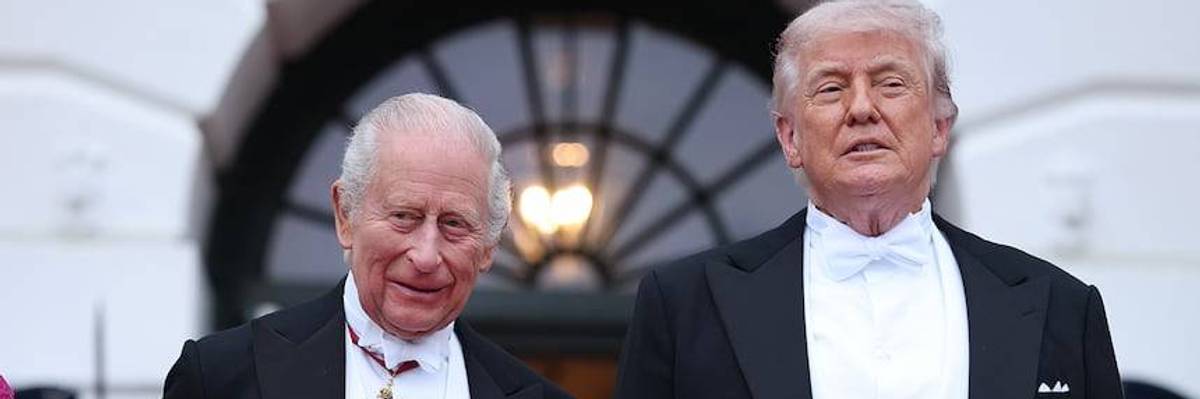
US President Donald Trump welcomes King Charles to the White House for a state dinner Tuesday in Washington, D.C.
If we’re serious about addressing protections for misconduct and abuses of power, ending these special rights—originally justified as a divine right—should be our top priority.
On three major occasions in President Trump’s second term, his opponents, including many elected officials, have taken to the streets under the banner of “No Kings.” And yet just this week, King Charles III spoke before our joint houses of Congress, where his comments about governmental checks and balances drew a standing ovation from everyone there.
A contradiction lies here, between our history and our perception of it. The truth is, the law that made kings untouchable—that “the king can do no wrong”—has never gone away in the United States. Instead, it multiplied. Today we call it “sovereign immunity.”
The Declaration of Independence blamed the King for its grievances, claiming his actions showed an “absolute Despotism” and “absolute Tyranny over these States.” But the taxes it complained about came from Parliament, which in 1688 had subordinated the King’s political role to itself and its Prime Minister. True, the monarch retained a total legislative veto (among other powers), but it last invoked that power in 1708. Colonial complaints about the King not recognizing colonial legislatures suggest the opposite of the grievance—a monarchical commitment against tyranny, by declining to override and usurp Parliament’s powers via royal whim.
Describing the 1789 Constitution, Alexander Hamilton wrote that, except for a few important “particulars, the power of the President will resemble equally that of the king of Great Britain.” Some changes shed the aristocracy; others infused more checks and balances, like making the veto power conditional. As for the right of kings, Hamilton argued that the impeachment power of Congress addressed it, because an impeached president would be subject to prosecution “in the ordinary course of law.” Unfortunately for us, history did not walk that line.
The 1789 Constitution also split sovereign power between federal and state governments. These twin powers then pulled a trick: they successfully argued that the special right of kings had transferred to them. Courts applied this special right to political subdivisions, like counties and municipalities, and to those who act on their behalf, like legislators, judges, clerks, bureaucrats, and police. Tocqueville thought these subdivisions “mitigat[ed] tyranny,” viewing “townships, municipal bodies, and counties” as “concealed break-waters, which check or part the tide of popular excitement.” But by permitting them sovereign immunity, the opposite happened: our myriad government bodies (sometimes four or five to a person) now each hold the right of kings. Instead of ridding ourselves of kingly power, we multiplied it.
Courts continue to expand these special powers. In 2024, the right-wing majority of the US Supreme Court confirmed that presidential immunity insulates the officeholder from criminal responsibility, so long as the alleged acts happened while carrying out official duties. Last March, the Court expanded the immunity available to law enforcement. Now, police officers have immunity from suit for any constitutional violation not explicitly addressed by an appellate or high court. And a federal appeals court recently held that governments have no general duty to compensate a bystander when law enforcement destroys their property in the course of their duties. If police break down your door, in error or not, you must pay for the fix.
We don't need courts to tell us these things. We see government officials acting above the law every day, even in incidents as small as police ignoring parking rules or blaring through stoplights into oncoming traffic, just to then turn their lights off. Rules for thee, but not for me. While we still have the right of kings, we don't have to keep it.
If we’re serious about addressing protections for misconduct and abuses of power, ending these special rights—originally justified as a divine right—should be our top priority. We have the tools to do it. Governments may waive and disclaim their special rights through legislation, and many have done that in limited doses. We should move forward to end the special right altogether, which we can accomplish through legislation at local, state, and federal levels. For a sound first step, Congress could reintroduce and pass the Ending Qualified Immunity Act, which would strip these special rights from law enforcement in civil-rights cases.
And most fundamentally, we should recognize that we have not ended the rule of kings just yet. Abuses of power and protection against accountability under the rule of law aren’t of a bygone era, and the monarchy didn't take its special rights with it when it left. Sadly, the powers of kings and queens were left behind, written into our laws under a different name.
Dear Common Dreams reader, It’s been nearly 30 years since I co-founded Common Dreams with my late wife, Lina Newhouser. We had the radical notion that journalism should serve the public good, not corporate profits. It was clear to us from the outset what it would take to build such a project. No paid advertisements. No corporate sponsors. No millionaire publisher telling us what to think or do. Many people said we wouldn't last a year, but we proved those doubters wrong. Together with a tremendous team of journalists and dedicated staff, we built an independent media outlet free from the constraints of profits and corporate control. Our mission has always been simple: To inform. To inspire. To ignite change for the common good. Building Common Dreams was not easy. Our survival was never guaranteed. When you take on the most powerful forces—Wall Street greed, fossil fuel industry destruction, Big Tech lobbyists, and uber-rich oligarchs who have spent billions upon billions rigging the economy and democracy in their favor—the only bulwark you have is supporters who believe in your work. But here’s the urgent message from me today. It's never been this bad out there. And it's never been this hard to keep us going. At the very moment Common Dreams is most needed, the threats we face are intensifying. We need your support now more than ever. We don't accept corporate advertising and never will. We don't have a paywall because we don't think people should be blocked from critical news based on their ability to pay. Everything we do is funded by the donations of readers like you. When everyone does the little they can afford, we are strong. But if that support retreats or dries up, so do we. Will you donate now to make sure Common Dreams not only survives but thrives? —Craig Brown, Co-founder |
On three major occasions in President Trump’s second term, his opponents, including many elected officials, have taken to the streets under the banner of “No Kings.” And yet just this week, King Charles III spoke before our joint houses of Congress, where his comments about governmental checks and balances drew a standing ovation from everyone there.
A contradiction lies here, between our history and our perception of it. The truth is, the law that made kings untouchable—that “the king can do no wrong”—has never gone away in the United States. Instead, it multiplied. Today we call it “sovereign immunity.”
The Declaration of Independence blamed the King for its grievances, claiming his actions showed an “absolute Despotism” and “absolute Tyranny over these States.” But the taxes it complained about came from Parliament, which in 1688 had subordinated the King’s political role to itself and its Prime Minister. True, the monarch retained a total legislative veto (among other powers), but it last invoked that power in 1708. Colonial complaints about the King not recognizing colonial legislatures suggest the opposite of the grievance—a monarchical commitment against tyranny, by declining to override and usurp Parliament’s powers via royal whim.
Describing the 1789 Constitution, Alexander Hamilton wrote that, except for a few important “particulars, the power of the President will resemble equally that of the king of Great Britain.” Some changes shed the aristocracy; others infused more checks and balances, like making the veto power conditional. As for the right of kings, Hamilton argued that the impeachment power of Congress addressed it, because an impeached president would be subject to prosecution “in the ordinary course of law.” Unfortunately for us, history did not walk that line.
The 1789 Constitution also split sovereign power between federal and state governments. These twin powers then pulled a trick: they successfully argued that the special right of kings had transferred to them. Courts applied this special right to political subdivisions, like counties and municipalities, and to those who act on their behalf, like legislators, judges, clerks, bureaucrats, and police. Tocqueville thought these subdivisions “mitigat[ed] tyranny,” viewing “townships, municipal bodies, and counties” as “concealed break-waters, which check or part the tide of popular excitement.” But by permitting them sovereign immunity, the opposite happened: our myriad government bodies (sometimes four or five to a person) now each hold the right of kings. Instead of ridding ourselves of kingly power, we multiplied it.
Courts continue to expand these special powers. In 2024, the right-wing majority of the US Supreme Court confirmed that presidential immunity insulates the officeholder from criminal responsibility, so long as the alleged acts happened while carrying out official duties. Last March, the Court expanded the immunity available to law enforcement. Now, police officers have immunity from suit for any constitutional violation not explicitly addressed by an appellate or high court. And a federal appeals court recently held that governments have no general duty to compensate a bystander when law enforcement destroys their property in the course of their duties. If police break down your door, in error or not, you must pay for the fix.
We don't need courts to tell us these things. We see government officials acting above the law every day, even in incidents as small as police ignoring parking rules or blaring through stoplights into oncoming traffic, just to then turn their lights off. Rules for thee, but not for me. While we still have the right of kings, we don't have to keep it.
If we’re serious about addressing protections for misconduct and abuses of power, ending these special rights—originally justified as a divine right—should be our top priority. We have the tools to do it. Governments may waive and disclaim their special rights through legislation, and many have done that in limited doses. We should move forward to end the special right altogether, which we can accomplish through legislation at local, state, and federal levels. For a sound first step, Congress could reintroduce and pass the Ending Qualified Immunity Act, which would strip these special rights from law enforcement in civil-rights cases.
And most fundamentally, we should recognize that we have not ended the rule of kings just yet. Abuses of power and protection against accountability under the rule of law aren’t of a bygone era, and the monarchy didn't take its special rights with it when it left. Sadly, the powers of kings and queens were left behind, written into our laws under a different name.
On three major occasions in President Trump’s second term, his opponents, including many elected officials, have taken to the streets under the banner of “No Kings.” And yet just this week, King Charles III spoke before our joint houses of Congress, where his comments about governmental checks and balances drew a standing ovation from everyone there.
A contradiction lies here, between our history and our perception of it. The truth is, the law that made kings untouchable—that “the king can do no wrong”—has never gone away in the United States. Instead, it multiplied. Today we call it “sovereign immunity.”
The Declaration of Independence blamed the King for its grievances, claiming his actions showed an “absolute Despotism” and “absolute Tyranny over these States.” But the taxes it complained about came from Parliament, which in 1688 had subordinated the King’s political role to itself and its Prime Minister. True, the monarch retained a total legislative veto (among other powers), but it last invoked that power in 1708. Colonial complaints about the King not recognizing colonial legislatures suggest the opposite of the grievance—a monarchical commitment against tyranny, by declining to override and usurp Parliament’s powers via royal whim.
Describing the 1789 Constitution, Alexander Hamilton wrote that, except for a few important “particulars, the power of the President will resemble equally that of the king of Great Britain.” Some changes shed the aristocracy; others infused more checks and balances, like making the veto power conditional. As for the right of kings, Hamilton argued that the impeachment power of Congress addressed it, because an impeached president would be subject to prosecution “in the ordinary course of law.” Unfortunately for us, history did not walk that line.
The 1789 Constitution also split sovereign power between federal and state governments. These twin powers then pulled a trick: they successfully argued that the special right of kings had transferred to them. Courts applied this special right to political subdivisions, like counties and municipalities, and to those who act on their behalf, like legislators, judges, clerks, bureaucrats, and police. Tocqueville thought these subdivisions “mitigat[ed] tyranny,” viewing “townships, municipal bodies, and counties” as “concealed break-waters, which check or part the tide of popular excitement.” But by permitting them sovereign immunity, the opposite happened: our myriad government bodies (sometimes four or five to a person) now each hold the right of kings. Instead of ridding ourselves of kingly power, we multiplied it.
Courts continue to expand these special powers. In 2024, the right-wing majority of the US Supreme Court confirmed that presidential immunity insulates the officeholder from criminal responsibility, so long as the alleged acts happened while carrying out official duties. Last March, the Court expanded the immunity available to law enforcement. Now, police officers have immunity from suit for any constitutional violation not explicitly addressed by an appellate or high court. And a federal appeals court recently held that governments have no general duty to compensate a bystander when law enforcement destroys their property in the course of their duties. If police break down your door, in error or not, you must pay for the fix.
We don't need courts to tell us these things. We see government officials acting above the law every day, even in incidents as small as police ignoring parking rules or blaring through stoplights into oncoming traffic, just to then turn their lights off. Rules for thee, but not for me. While we still have the right of kings, we don't have to keep it.
If we’re serious about addressing protections for misconduct and abuses of power, ending these special rights—originally justified as a divine right—should be our top priority. We have the tools to do it. Governments may waive and disclaim their special rights through legislation, and many have done that in limited doses. We should move forward to end the special right altogether, which we can accomplish through legislation at local, state, and federal levels. For a sound first step, Congress could reintroduce and pass the Ending Qualified Immunity Act, which would strip these special rights from law enforcement in civil-rights cases.
And most fundamentally, we should recognize that we have not ended the rule of kings just yet. Abuses of power and protection against accountability under the rule of law aren’t of a bygone era, and the monarchy didn't take its special rights with it when it left. Sadly, the powers of kings and queens were left behind, written into our laws under a different name.